

Business
General Motors is set to report earnings before the bell. Here’s what Wall Street expects


The General Motors global headquarters at Hudson’s Detroit in Detroit, Michigan, US, on Monday, Jan. 12, 2026.
Jeff Kowalsky | Bloomberg | Getty Images
DETROIT – General Motors is set to report its first-quarter earnings before the bell Tuesday.
Here’s what Wall Street is expecting, based on a survey of analysts by LSEG:
- Earnings per share: $2.62 adjusted
- Revenue: $43.68 billion
Those results would mark a roughly 1% decline in revenue compared with a year earlier and a 5.8% decrease in adjusted earnings per share.
GM’s 2025 first-quarter results included $44.02 billion in revenue, net income attributable to stockholders of $2.78 billion, and adjusted earnings before interest and taxes of $3.49 billion.
Aside from earnings and any changes to the automaker’s 2026 guidance, investors will be monitoring effects from the Iran war, tariff impacts and additional charges related to the automaker’s pullback in all-electric vehicles.
After announcing $7.6 billion in EV write-downs last year, the automaker said it expected additional charges but at a lower level than in 2025.
GM’s 2026 earnings guidance is better than its expectations and results from last year. It includes net income attributable to stockholders of between $10.3 billion and $11.7 billion; adjusted earnings before interest and taxes of $13 billion to $15 billion; and EPS of between $11 and $13 for the year.


Shell has agreed a 16.4 billion US dollar (£12.1 billion) deal to buy Canadian energy firm ARC Resources in a bid to boost its gas production and reserves.
The British energy giant said the acquisition will strengthen its resource base “for decades to come”.
It will also strengthen the business’s presence in North America, where it already operates gas plants.
The deal will combine ARC’s more than 1.5 million net acres of land with Shell’s approximately 440,000 in the Montney gas resource in Canada.
It will increase Shell’s production growth rate from 1% to 4% through to 2030, compared with 2025, according to the firm.
Shell’s chief executive Wael Sawan said acquiring the “high quality, low-cost” energy business “strengthens our resource base for decades to come”.
He added: “We are accessing uniquely positioned assets and welcoming colleagues that bring deep expertise which, combined with Shell’s strong basin level performance, provides a compelling proposition for shareholders.
“This establishes Canada as a heartland for Shell while furthering our strategy to deliver more value with less emissions.”
Shell has been carrying out a new growth strategy focused on extracting more oil and gas, moving from a focus on green energy and reducing spending on renewables.
It hopes the shift will support production targets and drive greater returns for investors.
The announcement comes a few weeks after Shell said it had cut its gas production outlook for the first quarter of 2026 after being affected by the conflict in the Middle East.
The energy giant trimmed its guidance for integrated gas production after volumes from Qatar were particularly affected during recent attacks.
The deal will see ARC’s shareholders receive 8.20 Canadian dollars (£4.50) and about 0.4 Shell shares for each ARC share.
Including about 2.8 billion US dollars (£2.1 billion) in debt that Shell will take on, the acquisition is valued at about 16.4 billion US dollars (£12.1 billion).
It is expected to complete in the second half of 2026, subject to shareholder, court and regulatory approvals.
BP has come under fire after revealing profits more than doubled in the first three months of the year, thanks to the soaring cost of crude caused by the Iran war.
Chief executive Meg O’Neill praised the quarter as sending the firm “in the right direction” and “strengthening the balance sheet” – but critics have labelled the energy giant’s revenues as “horrifying” as “millions suffer the fallout” from war.
The FTSE 100 firm revealed its preferred profit measure – underlying replacement cost profit – surged by over 130% to a better-than-expected $3.2bn (£2.4bn) in the first quarter, up from $1.38bn (£1.02bn) a year earlier and $1.54bn (£1.13bn) in the previous three months. Most analysts had expected first-quarter profits of $2.67bn (£1.97bn).
Campaigners accused the group of profiting at the expense of households, who have seen fuel prices rocket at the pumps and are set to see energy bills jump higher once more when the price cap is next updated on July 1.
The price of oil has risen from the mid-$60s range in February to over $100 now, spiking close to $120 several times during the course of the Iran war.
Patrick Galey, head of news investigations at campaigning organisation Global Witness, said: “It is horrifying to see BP’s profits grow as millions suffer the fallout from the US-Israel war on Iran. Unfortunately we’ve been here before – when Russia invaded Ukraine four years ago we saw big oil firms make bumper profits from spiralling fuel costs.
“As oil prices drive up bills once again, it’s clear that fossil fuel companies don’t enhance affordability or energy security, they make life worse. They destroy the climate, push up the cost of living, and rake in billions in profit while innocent civilians die.
“It’s well overdue that we make oil companies pay for the damage their doing. If they broke it, they need to fix it. It’s clear they can afford to. BP profits, we all pay.”
Mike Childs, head of science, policy and research at Friends of the Earth, added: “Just as we saw in 2022 following Russia’s invasion of Ukraine, fossil fuel giants are quids in when global instability drastically inflates fuel prices.
“But again, it’s ordinary people who pay the price when soaring energy prices threaten to plunge the UK into an even deeper cost-of-living crisis.”
The End Fuel Poverty Coalition called for a windfall tax on firms profiting from the Iran-related energy crisis.
The campaign group’s co-ordinator Simon Francis said: “These astronomical profits are a startling reminder that when conflict drives up the price of oil and gas, energy companies profit and households pay.”
BP’s new chief executive Meg O’Neill, who took over at the helm on April 1, said the group was ensuring fuel supplies are met across the UK.
She said: “The teams across BP are playing their part to keep oil, gas and refined products flowing during an incredibly challenging time – focused on maintaining safe, reliable and cost-efficient operations.”
She added: “We are working with customers and governments to get fuel where it’s needed, helping minimise disruption and the impact it can have on people’s lives.”
Ms O’Neill took over from Murray Auchincloss, who himself served only two years in the role after succeeeding Bernard Looney’s three-year tenure. Prior to the recent regular changes, Bob Dudley spent a full decade in the job up to 2020.
BP have struggled with strategy direction and the transition to clean energy, first doubling down on their green plan before an abrupt about-face turn.
In share price terms, the results saw BP rise 2.5 per cent in early trading on Tuesday, adding to a surge of more than 28 per cent in the past three months alone, as investors watched a soaring oil price and predicted the profits to come.
“In February, BP announced it was halting share buybacks as weak oil prices hurt profitability. How times change,” said Freetrade’s investment writer, Duncan Ferris.
“The firm has been among the best-performing supermajors since the escalation of conflict in Iran. Higher oil prices, and the opportunities they offer to the company’s traders, have breathed life into a stock battered by faltering low-carbon projects and investor unrest.”
Oil prices have raced higher since the US-Israel war on Iran started on February 28 and are now more than 60% up so far this year.
Brent crude reached close to 120 dollars a barrel at one stage and, despite falling back, is still above the 100 dollars level as peace talks falter and amid fears over a looming global energy supply crisis.
BP’s update showed its customers and products division – including its oil trading unit – reported profits of 2.5 billion (£1.84 billion), compared with 1.4 billion dollars (£1.03 billion) in the previous quarter and just 103 million dollars (£76.2 million) a year ago as traders were able to capitalise on highly volatile oil prices.
Additional reporting by PA
Business
Strait of Hormuz blockade persists, but India’s imports of Russian oil are down from highs seen in March – here’s why – The Times of India
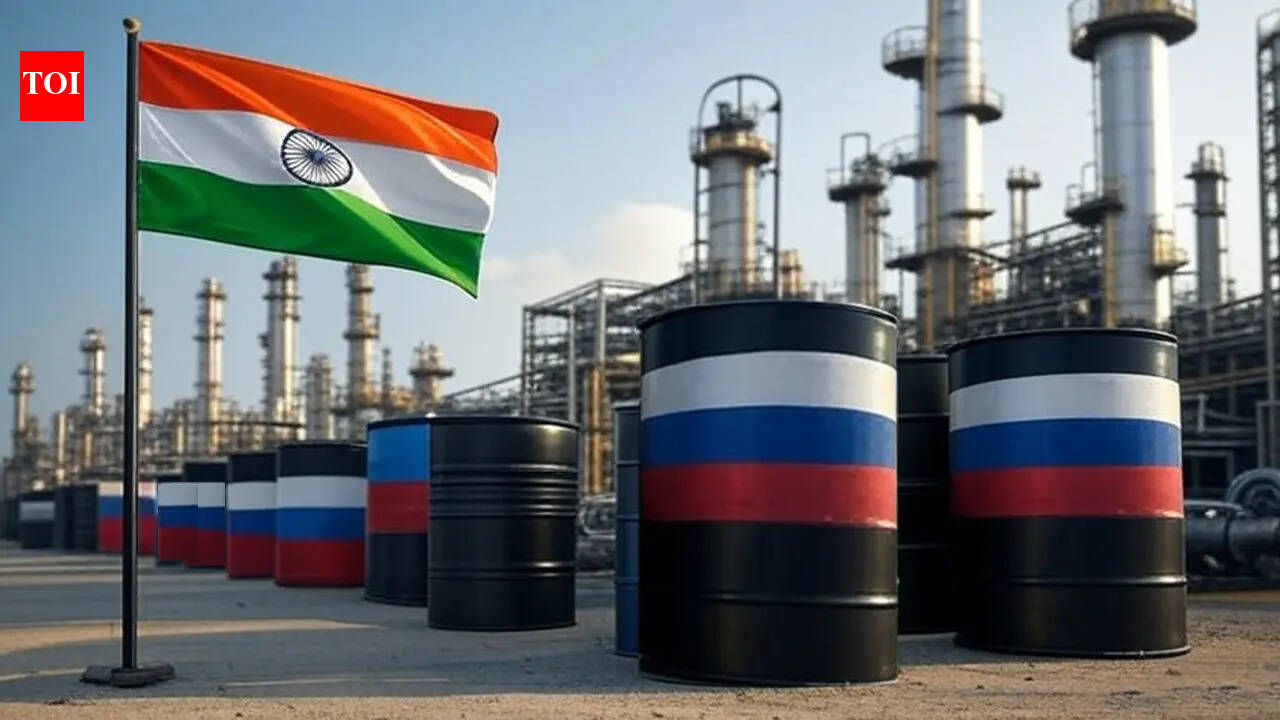
India’s imports of crude oil from Russia have dropped from the highs seen in March when the supply disruptions from the Middle East caused by the US-Iran war and the Strait of Hormuz closure prompted refiners to step up buys from Moscow.India’s imports of Russian crude oil have declined 20 per cent month-on-month in April to 1.57 million barrels per day, easing from the sharp surge recorded in March. The spike in March had been driven by the availability of floating cargoes during the Iran conflict, along with a temporary waiver on US sanctions. This waiver has been extended for now. Nearly all Indian refiners, except Numaligarh Refinery, are now importing Russian crude. This marks a significant shift from January, when only three refiners – namely Indian Oil, Nayara Energy and BPCL, were purchasing Russian oil after US sanctions on key Russian exporters had discouraged many buyers. Reliance resumed its Russian crude imports in February.Also Read | Iran war: Trump sanctions waiver or not – why India continues to buy Russian oil
Why are Russian crude oil imports down in April?
April volumes were affected by loading disruptions at a major Russian export terminal following a Ukrainian attack.Indian Oil Corporation remained the largest importer of Russian crude in both March and April. Between April 1 and April 26, the company imported an average of 670,000 barrels per day, accounting for roughly 42 per cent of India’s total Russian crude purchases. This was about two-and-a-half times the volume imported by Reliance Industries, which averaged 263,000 barrels per day, according to Kpler data quoted in an ET report. In March, Indian Oil had imported 589,000 barrels per day. Other major buyers in April included Bharat Petroleum Corporation Limited at 136,000 barrels per day, Hindustan Petroleum Corporation Limited at 83,000 barrels per day, Mangalore Refinery and Petrochemicals Limited at 68,000 barrels per day, HPCL-Mittal Energy Limited at 66,000 barrels per day, and Nayara Energy at 28,000 barrels per day. The buyers of an additional 262,000 barrels per day could not be immediately identified.Nayara Energy’s imports dropped sharply from 315,000 barrels per day in March, largely because the Rosneft-backed refiner began a 35-day maintenance shutdown on April 9.According to Nikhil Dubey, Senior Research Analyst at Kpler, the temporary closure of the Strait of Hormuz in March prompted Indian refiners to turn to readily available floating Russian cargoes in the Indian Ocean and other regions to offset supply disruptions from the Gulf. This led to a significant jump in imports during that month.India imported nearly 2 million barrels per day of Russian crude in March, substantially higher than the 1.3 million barrels per day of India-bound cargoes loaded from Russian ports in February. The higher March arrivals were supported by floating supplies. Since Russian shipments generally take around a month to reach India, lower February loadings, which were caused by US sanctions that had curtailed Indian purchases, had an impact on subsequent arrivals.Russian crude loadings in March were estimated at around 1.5 million barrels per day, which translated into similar arrival volumes at Indian ports in April, as most of the previously available floating cargoes had already been absorbed.Dubey also noted that Ukrainian attacks on a Russian Baltic Sea terminal in March disrupted loading operations.

Shell strikes £12.1 billion deal to buy Canadian energy firm

Match officials announced for HBL PSL 11 qualifier – SUCH TV
BP profits more than double as oil trading booms amid Iran war

-

 Sports1 week ago
NCAA men’s gymnastics championship: All-time winners list
-

 Sports1 week ago
WWE WrestleMania 42 Night 2: Live match results and analysis
-

 Fashion1 week ago
UK’s Sosandar returns to profitability amid robust FY26 performance
-

 Politics1 week ago
UK’s Starmer seeks to deflect blame over Mandelson appointment
-
 Business1 week ago
No fuel shortage: Govt assures 100% domestic LPG, PNG, CNG supply amid Hormuz energy crunch – The Times of India
-

 Entertainment1 week ago
Lee Anderson, Zarah Sultana kicked out of UK Parliament for calling PM ‘liar’
-
 Business1 week ago
How Trump’s psychedelics executive order could unlock stalled cannabis reform
-
 Business7 days ago
Us-India Trade Talks: US–India trade deal: Where do talks stand & what to expect – explained – The Times of India