

Fashion
Giorgio Armani: What does the future hold for the group?


Translated by
Nazia BIBI KEENOO
Published
September 6, 2025
The legendary Italian couturier, who passed away on 4 September, leaves behind a highly coveted luxury empire. As succession questions multiply, the future of the Giorgio Armani brand now takes center stage.
“Giorgio Armani has always made independence of thought and action his trademark. Today, as in the past, the company reflects this spirit. His family and collaborators will continue the adventure of the group in respect and continuity of these values,” stated the company when announcing the death of the iconic designer. These clear words, however, open the door to many questions about the future of the empire left behind by “King Giorgio.”
Between the company and his personal estate — including properties, artworks, real estate investments, shares, the Olimpia Milano basketball team, and the Armani/Silos museum — Giorgio Armani leaves behind a fortune estimated between €11 billion and €13 billion. With no direct heirs, he was free to designate how his estate would be managed. His last wishes will be revealed once his will is opened.
His immediate family includes his sister, Rosanna (86), and her son, Andrea Camerana (55), as well as his two nieces, Silvana (69) and Roberta (54), the daughters of his late brother, Sergio. All are members of the board of Giorgio Armani SpA, as is his longtime right-hand and managing consultant, Pantaleo “Leo” Dell‘Orco (72), who oversees the menswear collections. The designer has long referred to them as his intended successors.
The board also includes Yoox founder Federico Marchetti and Rothschild banker Irving Bellotti, who is also a board member of the Giorgio Armani Foundation, created in 2016 to ensure continuity of the company’s vision.
In a recent interview with How To Spend It, the Financial Times supplement, Giorgio Armani reiterated this succession plan: “My succession plan consists of gradually transferring the responsibilities I have always assumed to those closest to me, such as Leo Dell’Orco, to family members and to the entire team.” He added, “I would like the succession to be organic and not a moment of rupture.”
The founder controlled 99.9% of Giorgio Armani SpA, with the Giorgio Armani Foundation holding the remaining 0.1%. In 2024, the group employed nearly 8,700 people globally and posted €2.3 billion in revenue — a 6% drop from the previous year. Net profit also fell sharply, from €163 million in 2023 to €51.6 million. Europe accounts for 49% of revenue, with the Americas and Asia-Pacific each contributing 21%.

Armani meticulously prepared for this transition. The company’s revised articles of association were first approved in 2016 and finalized in September 2023. These statutes will take formal effect upon the opening of the succession. According to press reports at the time, the structure includes various share categories and voting rights, with a potential public listing allowed five years after the statutes take effect. Furthermore, 75% of shareholders must approve any mergers, spin-offs, amendments, or capital increases at an extraordinary general meeting.
During the transition, management may be handled by a select leadership committee. Creatively, Armani leaves behind a globally recognized design language and aesthetic. For now, it’s difficult to imagine another designer stepping into his shoes. The in-house design studio, led in part by Leo Dell’Orco, is expected to continue developing upcoming collections.
The responsibility of preserving the brand’s identity and value, estimated to be worth between €6 billion and €12 billion, depending on the analysts, will rest with the family and senior leadership. How this heritage is managed and evolved in the near future will shape Giorgio Armani SpA’s trajectory — and may invite interest from global luxury groups and investment funds.
This article is an automatic translation.
Click here to read the original article.
Copyright © 2025 FashionNetwork.com All rights reserved.
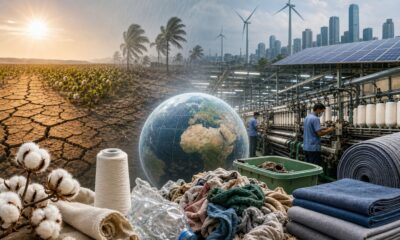





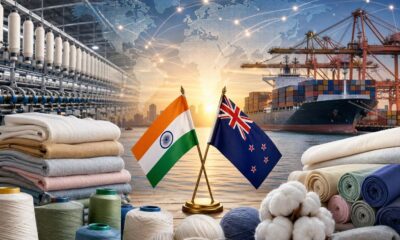


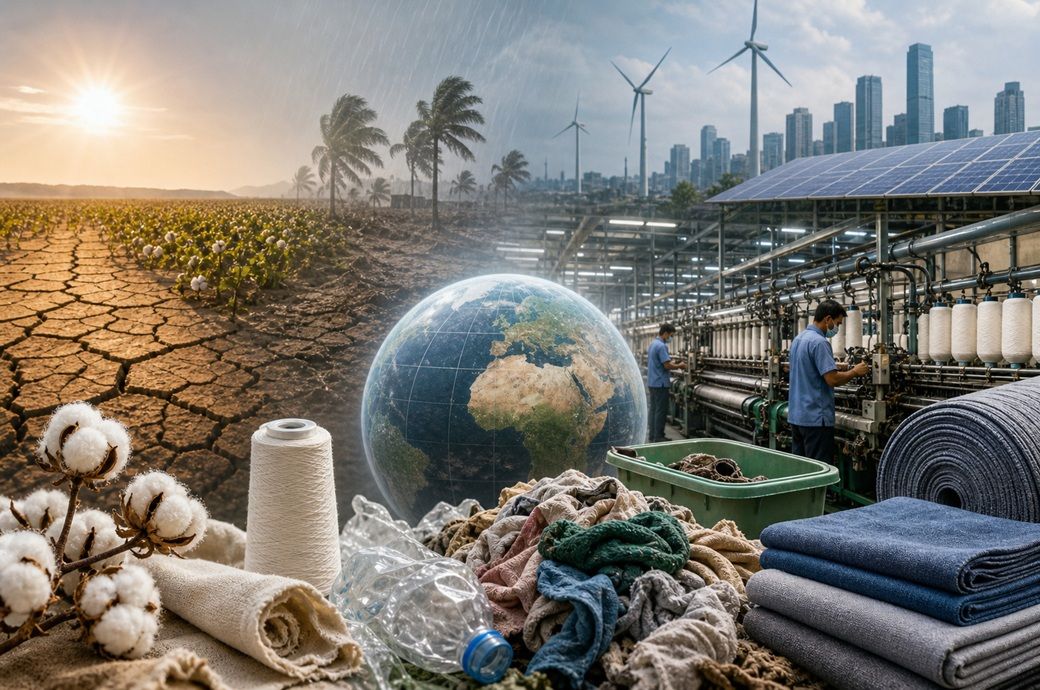
The apparel climate story has moved out of the ESG report and into the cost sheet. In ****–****, climate risk is showing up as cotton quality loss, import dependence, energy volatility, cooling capex, carbon-price exposure and mandatory textile-waste fees. For brands and suppliers, the question is no longer whether climate action is ‘responsible’. It is whether delay will make product margins uncompetitive.
The latest data makes the shift visible. Textile Exchange says global fibre production reached *** million tonnes in **** and could hit *** million tonnes by **** if business continues as usual. Polyester alone now makes up ** per cent of global fibre output, with ** per cent still fossil-based. That scale gives apparel a low-cost material engine, but it also ties the sector to fossil energy, petrochemical volatility and future carbon accounting.
Caprolactam (CPL) prices initially held near $*.**–*.**/kg with minimal movement, while nylon chips saw uptick to ~$*.***/kg (+*.* per cent WoW) driven by short-term restocking. Nylon filament yarn (DTY **D/**F) prices remained stable at ~$*.**–*.**/kg, supported by existing inventory and steady downstream textile operations.
By the second week (April * to April **), benzene stabilised, but caprolactam began to weaken to ~$*.**–*.**/kg (−*.* per cent WoW), signalling the start of broader chain pressure. Nylon chips responded with a mild correction to ~$*.***/kg (−* per cent WoW), while filament yarn prices continued to hold steady due to inventory buffers and ongoing execution of prior textile orders. In the third week (Apr **–**), caprolactam stable to ~$*.*/kg, and chips followed to ~$*.***/kg (Stable WoW).
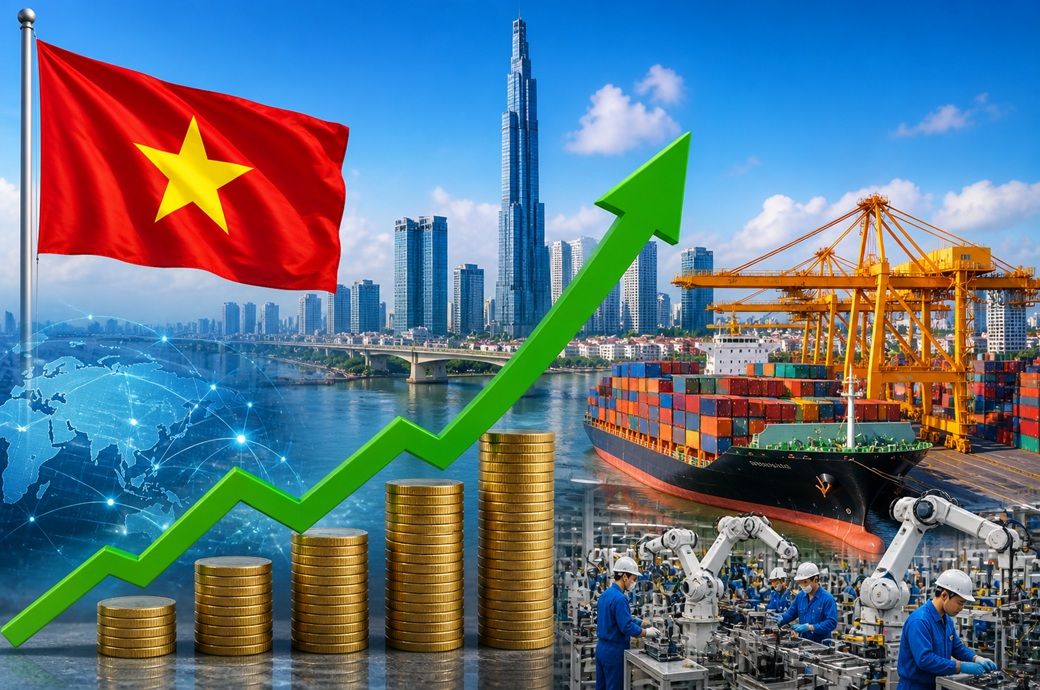
Total registered FDI, including newly registered and adjusted capital, along with foreign investors’ contributions and share purchases, reached $18.24 billion as of April 27, up 32 per cent year on year (YoY), according to the Ministry of Finance’s National Statistics Office (NSO).
Vietnam attracted $18.24 billion in FDI in January–April 2026, up 32 per cent, driven by manufacturing and processing.
Realised FDI hit a five-year high, signalling continued capacity expansion.
Trade surged to $344.17 billion, supported by strong US demand and rising imports from Asia, highlighting deeper global supply chain integration and export momentum.
A total of 1,249 new projects were licensed with combined registered capital of $12.15 billion, reflecting a 3.7 per cent annual increase in project numbers and a 2.2-fold rise in value. Manufacturing and processing dominated, attracting $8.12 billion, or 66.8 per cent of total newly registered capital.
Realised FDI in the January–April period was estimated at $7.40 billion, up 9.8 per cent YoY and marking the highest level for the period in the past five years. Of this, the manufacturing and processing sector disbursed $6.12 billion, accounting for 82.7 per cent. Meanwhile, 316 existing projects registered additional capital of $3.13 billion, representing a sharp 51 per cent decline compared to the same period last year. Combining newly registered and adjusted capital, total FDI into manufacturing and processing reached $10.49 billion, or 68.6 per cent of the total.
Foreign investors carried out 976 capital contribution and share purchase transactions worth $2.96 billion, up 61.9 per cent YoY. Among these, 325 deals increased enterprises’ charter capital by $445.13 million, while 651 share acquisitions without capital increases totalled $2.51 billion. Wholesale and retail trade led these investments, capturing $1.89 billion, or 63.9 per cent.
Among 53 countries and territories with newly licensed projects, Singapore was the largest investor with $6.05 billion, accounting for 49.8 per cent of the total. It was followed by the Republic of Korea with $4.08 billion (33.6 per cent), China with $524.1 million (4.3 per cent), Japan with $462 million (3.8 per cent), Hong Kong (China) with $329.2 million (2.7 per cent), and the Netherlands with $318.5 million (2.6 per cent).
On the trade front, Vietnam’s total trade with the rest of the world was estimated at $344.17 billion in the first four months of 2026, a significant increase from $277.21 billion in the same period last year, the NSO said. In April alone, trade volume reached an estimated $94.32 billion, rising 8 per cent from March and 26.7 per cent YoY.
The United States remained the largest importer of Vietnamese goods, with imports valued at $53.9 billion, while China continued as the top supplier with $69 billion. Imports from traditional markets also surged, with South Korea and ASEAN recording growth rates of 57.8 per cent and 44.3 per cent, respectively.
Fibre2Fashion News Desk (MS)


Jimmy Kimmel roasts Donald, Melanie Trump even after warning

Telehealth Abortion Is Still Possible Without Mifepristone

FDA withdrew studies finding Covid, shingles vaccines were safe

-

 Tech1 week ago
A Brain Implant for Depression Is About to Be Tested in Humans
-

 Sports1 week ago
Pro wrestling star Steph De Lander reveals how colleague’s advice helped lead her to title triumph at ACW
-

 Tech1 week ago
Almost 90% of women leave tech industry within 10 years | Computer Weekly
-
 Business1 week ago
‘I had £20,000 stolen and had to fight a 13-month fraud reporting rule to get it back’
-

 Entertainment1 week ago
Norway joins Type 26 Frigate Programme to boost NATO naval power
-

 Entertainment1 week ago
Melania Trump says ABC should ‘take a stand’ on late-night host Kimmel
-
 Business6 days ago
PSX plunges over 4,800 points | The Express Tribune
-

 Tech1 week ago
This Ambitious Laptop Doesn’t Leave Much Room for Your Hands