

Business
Gold hits Rs410,278/tola amid global rally | The Express Tribune

KARACHI:
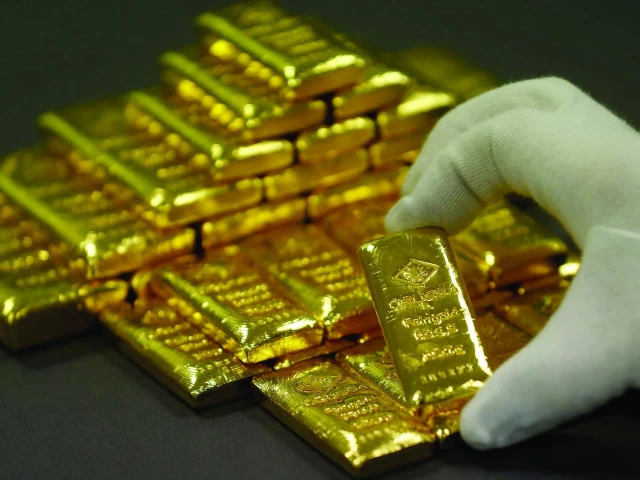
Gold prices in Pakistan surged to fresh record highs on Wednesday, tracking the global rally driven by a weaker dollar, safe-haven demand, expectations of a US rate cut following softer jobs data and a looming government shutdown.
According to the All Pakistan Sarafa Gems and Jewellers Association (APSGJA), the local price of gold rose by Rs3,500 per tola to reach Rs410,278, while the 10-gram rate climbed by Rs3,001 to settle at Rs351,747.
On Tuesday, the yellow metal had already posted a sharp rise, with per-tola price touching Rs406,778 after a gain of Rs3,178.
In the international market, spot gold traded within a volatile range as investors weighed uncertainty over the US government’s budget deadlock. Interactive Commodities Director Adnan Agar said gold touched a high of $3,895, a low of $3,853, and was last hovering around $3,864.
“The market has gone so high that it’s now taking a breather,” Agar said, noting that gold’s rally appears exhausted in the short term. “If the US government shutdown continues and jobs data is delayed, safe-haven demand may sustain prices. But if Washington resolves the impasse soon, gold could see a correction, because it needs an economic reason to adjust downwards.”
Spot gold was up 0.2% at $3,864.16 an ounce at 11:20 am ET (1520 GMT) after touching a record peak of $3,895.09, according to Reuters. US gold futures for December delivery gained 0.5% to $3,891.10.
Meanwhile, the Pakistani rupee inched up against the US dollar in the inter-bank market on Wednesday. By the day’s close, the currency stood at 281.31 against the greenback, marking an improvement of one paisa from Tuesday’s close at 281.32.
The dollar weakened against a basket of other leading currencies, making dollar-priced gold more affordable for overseas buyers.
Moreover, the State Bank of Pakistan (SBP) on Wednesday raised a total of Rs2.13 trillion through the auction of Pakistan Investment Bonds – Floating Rate (PFL) and Market Treasury Bills (MTBs).
According to the central bank’s Domestic Markets & Monetary Management Department, the auction of 10-year floating-rate PIBs (semi-annual) attracted bids worth Rs394 billion. Out of these, the SBP accepted Rs244 billion in competitive bids at a cut-off price of 94.5465, along with Rs2.75 billion in non-competitive bids. The total accepted amount stood at Rs246.75 billion.
Separately, the SBP sold MTBs worth Rs1.88 trillion, including both competitive and non-competitive bids, across different maturities. Data breakdown shows that Rs310.2 billion was raised through one-month bills at a cut-off yield of 11.15%, Rs43.5 billion in three-month bills at 11.05%, Rs66.8 billion in six-month bills at 11.05%, and Rs220.9 billion in 12-month bills at 11.19%.
The latest auction results indicate that yields have remained largely stable around the 11% mark, reflecting steady market expectations on the interest rate outlook. The government continues to rely heavily on short-term borrowing while maintaining demand for longer tenor floating-rate PIBs.





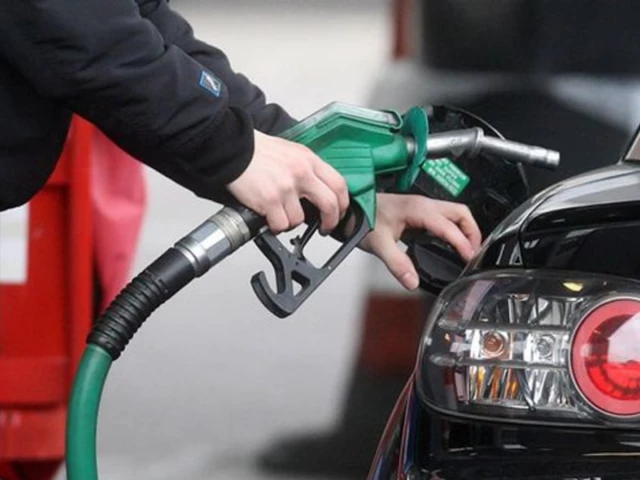

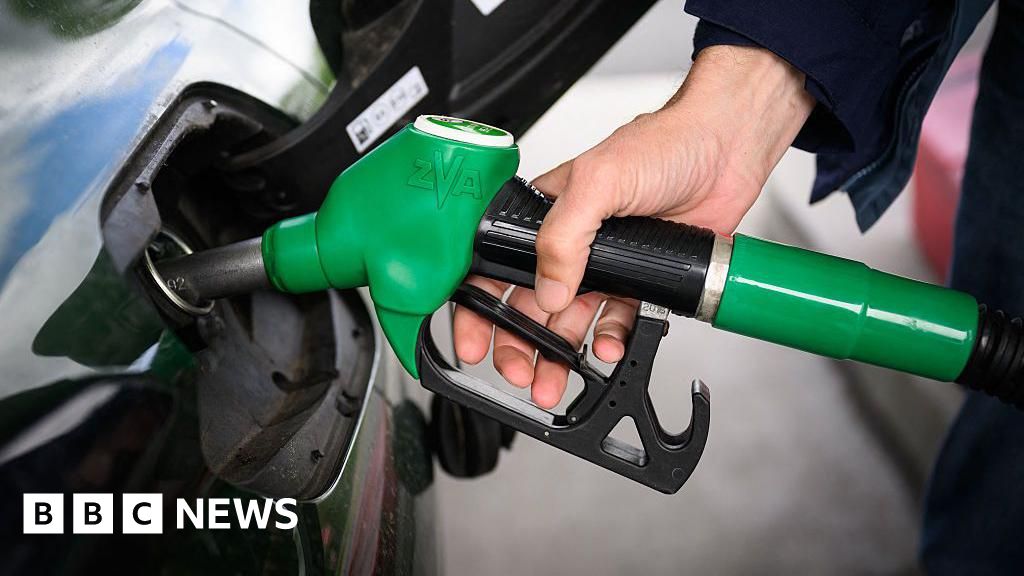
Brent crude sinks by a tenth after Iran says the key waterway is open for commercial ships for the rest of the ceasefire.
Source link

Oil prices tumbled on Friday after Iranian officials said they would allow commercial traffic to resume in the Strait of Hormuz. This lifted equity markets in Europe and New York, where major indices hit new records.
Citing the ceasefire between Israel and Lebanon, Iran’s Foreign Minister Abbas Araghchi said Tehran would lift its blockade on shipping through the key Gulf energy trade route.
“In line with the ceasefire in Lebanon, the passage for all commercial vessels through Strait of Hormuz is declared completely open for the remaining period of ceasefire,” Araghchi said.
Traffic in the strategic waterway, through which one-fifth of the world’s crude oil normally flows, has been disrupted by Iran since the US-Israeli offensive began on Feb. 28. At one point, this sent oil prices to a peak of nearly $120 a barrel and roiled the global economy.
Both Brent, the benchmark international contract, and its US equivalent WTI fell below $90 per barrel following Tehran’s announcement. Brent later cut its losses and finished at $90.38 a barrel, down 9.1%.
‘Immediate impact’
“This news is having an immediate impact on markets,” said Kathleen Brooks, research director at XTB.
The move also sent a jolt through equity markets, extending a rally in New York. There, equities have pushed ever higher since late March in anticipation of a breakthrough in the Middle East crisis.
“We had seen a big move the last two weeks, and now it’s just really pricing completely out the worst-case scenario, said Angelo Kourkafas, from Edward Jones.
Kourkafas also pointed to underlying strength in the US economy that should get more attention in the coming period as geopolitical concerns ebb.
“Geopolitical developments are moving in the right direction, and at the same time, the earning strength is hard to ignore,” Kourkafas said.
The broad-based S&P 500 finished at 7,126.06, up 1.2% for the day and 4.5% for the week.
‘Good news’
Earlier, European stocks closed higher, with both Frankfurt and Paris gaining 2%.
US President Donald Trump cheered the reopening of the Strait of Hormuz in an interview with AFP.
“We’re very close to having a deal,” Trump said in a brief telephone call with AFP from Las Vegas. He added there were “no sticking points at all” left with Tehran.
But Iran quickly pushed back on one key point.
Iran’s foreign ministry said Friday that its stockpile of enriched uranium would not be transferred “anywhere.” It rejected an earlier claim by Trump that the Islamic Republic had agreed to hand it over.
Shipping industry figures, meanwhile, gave a cautious welcome to Iran’s announcement.
A spokesman for German transportation giant Hapag-Lloyd, which has ships stuck in the Gulf, told AFP by phone that the reopening was “in general… good news.”
But he cautioned that shippers still needed details of what route vessels could take and in what order, citing fears of mines.
“One thousand ships cannot just go now to the entrance of the strait, that will be chaos. They (the Iranians) need to give clear orders,” said the spokesman, Nils Haupt.
“We would be ready to go very soon if some of these open questions can be solved within the weekend.”

One man says he cancelled his holiday to Spain due to the rising costs and uncertainty.
Source link


Nathalie Baye, low-key legend of French cinema, dies aged 77

Transfer rumors, news: Liverpool eye Wharton amid Man United, Real Madrid interest

The Best Movies to Stream This Month

-

 Politics1 week ago
Indian airlines hit hardest after Dubai limits foreign flights until May 31
-

 Entertainment5 days ago
Palace left in shock as Prince William cancels grand ceremony
-

 Sports5 days ago
The case for Man United’s Fernandes as Premier League’s best
-

 Politics1 week ago
Chinese, Taiwanese will unite, Xi tells Taiwan opposition leader
-

 Sports1 week ago
Documents: NC State trainer initiated ‘unwelcome,’ ‘sexual’ contact
-

 Entertainment1 week ago
Dua Lipa hits major career high ahead of wedding with Callum Turner
-
 Business5 days ago
UK could adopt EU single market rules under new legislation
-
 Business1 week ago
He paid $248 in illegal tariffs for this coat. Will he ever get it back?