

Business
Gold price soars past $3,500, sets new record – SUCH TV


Gold prices surged to a record high above $3,500 on Tuesday, as investors flocked to safe-haven assets amid global economic uncertainty. The precious metal touched $3,501.59 per ounce during early trading in Asia, surpassing its previous record of $3,500.10 set in April.
The rally in gold comes as investors weigh a weakening US dollar and the potential for interest rate cuts by the Federal Reserve.
Wall Street pulled back from record highs on Friday after a key US inflation report showed accelerated prices, limiting the Fed’s policy flexibility.
Markets were closed on Monday for Labor Day, while the US dollar traded mixed against major currencies.
Last month, former President Trump said he would fire Federal Reserve governor Lisa Cook if she did not resign, following his criticism over alleged mortgage fraud claims.
The record also came after a US appeals court ruled that many of Donald Trump’s tariffs, which have upended global trade, were illegal.
But it allowed the measures to remain in place for now, giving the US president time to take the fight to the Supreme Court.








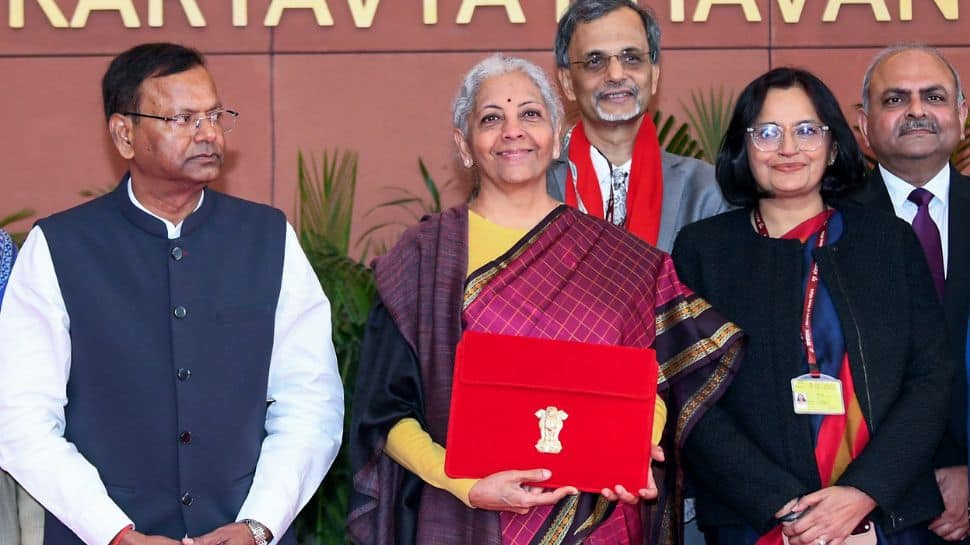
New Delhi: The Cabinet on Sunday approved the Union Budget 2026-27 during a meeting in Parliament chaired by Prime Minister Narendra Modi. A meeting of the Union Cabinet was held at Sansad Bhawan at 10 a.m., and after the Cabinet’s approval, Finance Minister Nirmala Sitharaman proceeded to Parliament to present the Budget.
Earlier, FM Sitharaman met President Droupadi Murmu and offered her a copy of the digital budget. The President also offered ‘dahi-cheeni’ (curd and sugar) to Sitharaman when she arrived at the Rashtrapati Bhavan. The Finance Minister was seen carrying her trademark ‘bahi-khata’, a tablet wrapped in a red-coloured cloth bearing a golden-coloured national emblem on it.
Minister of State for Finance Pankaj Chaudhary, Chief Economic Advisor Dr V. Anantha Nageswaran, Central Board of Direct Taxes (CBDT) Chairman Ravi Agrawal and other officials were seen accompanying the Finance Minister. Sitharaman was set to present her ninth consecutive Union Budget in the Lok Sabha. In 2021, she switched to using a digital tablet to carry the Budget papers, further promoting a modern and eco-friendly approach.
The ‘bahi-khata’ is a red pouch that holds the digital tablet containing the Budget documents. This year, Sitharaman opted for a deep maroon Kanjeevaram saree from Tamil Nadu. The saree featured a deep maroon base with a contrasting border and subtle gold detailing, paired with a yellow blouse.
The Budget is likely to strike a deft balance of sustaining growth momentum and maintaining fiscal consolidation. It also needs to address near-term challenges emanating from unprecedented geopolitical flux, said economists. According to economists, the budget is likely to focus more on capital expenditure, especially in sectors deemed to be strategically important owing to prevailing geopolitical compulsions.
While the FY26 Budget was more tilted towards stimulating middle-class consumption with tax reliefs, the FY27 Budget’s approach to stimulating consumption will be selective, they added.
Business
Education Budget 2026 Live Updates: What Will The Education Sector Get From FM Nirmala Sitharaman?
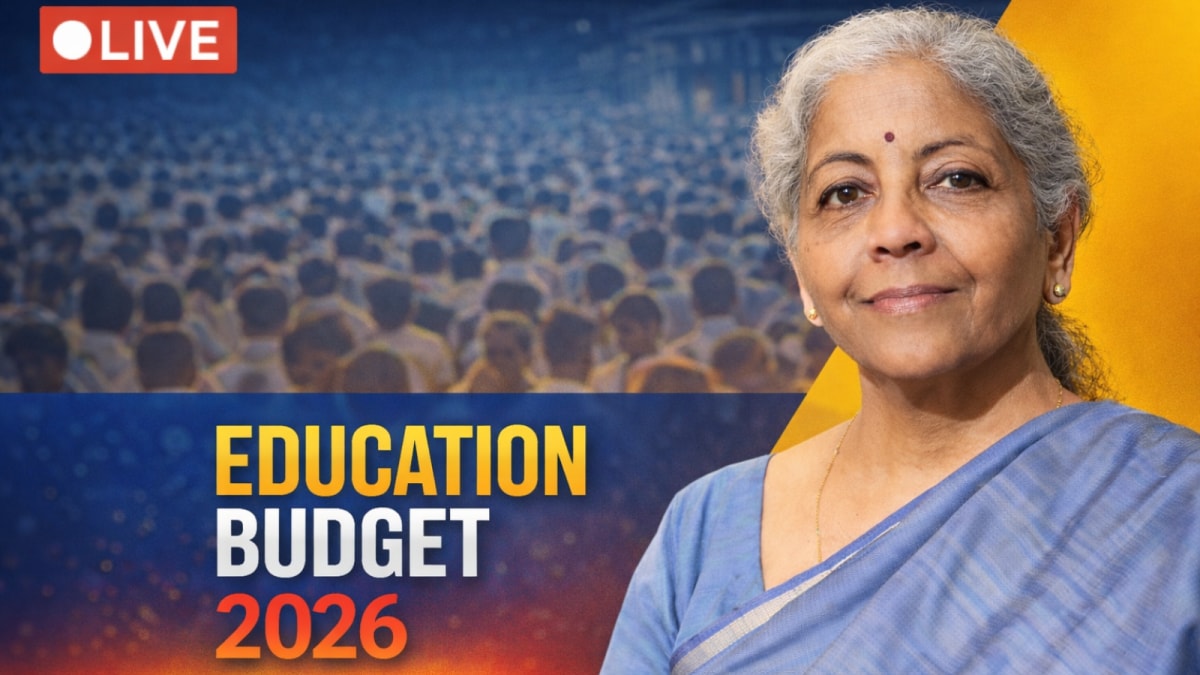
Union Education Budget 2026 Live Updates: Union Finance Minister Nirmala Sitharaman will present the Union Budget 2026–27 on February 1, with a strong focus expected on the Education Budget 2026, a key area of interest for students, teachers, and institutions across the country.
In the previous budget, the Bharatiya Janata Party government announced plans to add 75,000 medical seats over five years and strengthen infrastructure at IITs established after 2014. For 2025, the Centre had earmarked Rs 1,28,650.05 crore for education, a 6.65 percent rise compared to the previous year.
Meanwhile, the Economic Survey 2025–26, tabled in the Parliament of India, points to persistent challenges in school education. While enrolment at the school level is close to universal, this has not translated into consistent learning outcomes, especially beyond elementary classes. The net enrolment rate drops sharply at the secondary level, standing at just over 52 per cent.
The survey also flags concerns over student retention after Class 8, particularly in rural areas. It notes an uneven spread of schools, with a majority offering only foundational and preparatory education, while far fewer institutions provide secondary-level schooling. This gap, the survey suggests, is a key reason behind low enrolment in higher classes.
Stay tuned to this LIVE blog for all the latest updates on the Education Budget 2026 LIVE.

The Oil and Gas Regulatory Authority (Ogra) has increased the price of liquefied petroleum gas (LPG). According to a notification, the price of LPG has risen by Rs6.37 per kilogram. Following the increase, the price of a domestic LPG cylinder has gone up by Rs75.21. The revised prices have come into effect immediately.
The rise in LPG prices has added to the inflationary burden on household consumers.

Budget 2026: Cabinet gives green signal to Union Budget 2026–27

After ads, will ChatGPT responses remain trustworthy? OpenAI says yes

US’ Levi Strauss reports solid FY25, driven by organic growth

-
 Business1 week ago
Success Story: This IITian Failed 17 Times Before Building A ₹40,000 Crore Giant
-

 Fashion1 week ago
South Korea tilts sourcing towards China as apparel imports shift
-

 Sports1 week ago
Transfer rumors, news: Saudi league eyes Salah, Vinícius Jr. plus 50 more
-

 Sports5 days ago
PSL 11: Local players’ category renewals unveiled ahead of auction
-

 Entertainment1 week ago
TikTok seals deal for new US joint venture to avoid American ban
-

 Sports1 week ago
Wanted Olympian-turned-fugitive Ryan Wedding in custody, sources say
-
 Politics1 week ago
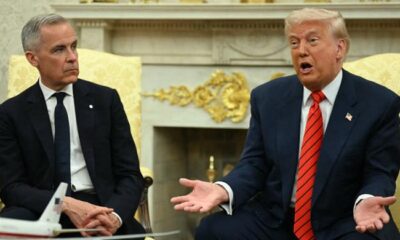
Trump revokes Canada’s invitation to join Board of Peace
-

 Fashion1 week ago
Tamil Nadu wind policy tweaks to boost textile sector competitiveness