

Business
Greenland: What natural resources does the island have?


Archie Mitchelland
Danielle Kaye,Business reporters
 Getty Images
Donald Trump has made clear he covets Greenland.
Now he claims to have secured the “framework” of a future deal, to address defence on the island – a deal that he says includes rights to rare earth minerals.
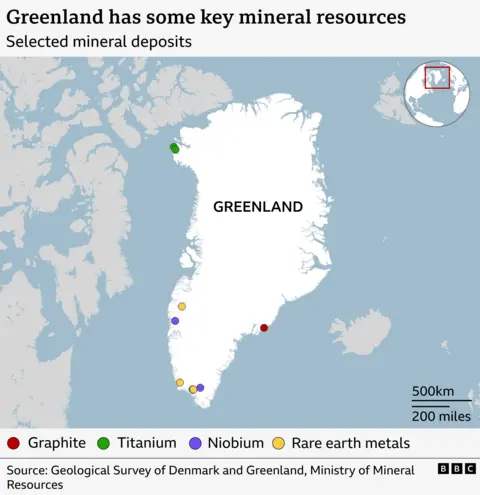
So what natural resources does Greenland have?
Greenland is believed to sit on top of large reserves of oil and natural gas.
It is also said to be home to the vast majority of raw materials considered crucial for electronics, green energy and other strategic and military technologies – to which Trump has been pushing to secure America’s access.
Overall, 25 of 34 minerals deemed “critical raw materials” by the European Commission are found in Greenland, including graphite, niobium and titanium, according to the 2023 Geological Survey of Denmark and Greenland.
Greenland’s strategic importance is “not just about defence”, Senator Ted Cruz, a Republican from Texas, said at a Senate hearing last year about the potential acquisition of Greenland, pointing to the island’s “vast reserves of rare earth elements”.

Trump has sometimes downplayed the importance of those resources, pointing to what he claims is rising Russian and Chinese influence in the region to justify his claims that the US has to “have” the island.
“I want Greenland for security – I don’t want it for anything else,” he told reporters at the World Economic Forum in Davos on Wednesday, pointing in part to the difficulty of exploring in the Arctic region. “You have to go 25ft down through ice to get it. It’s not, it’s not something that a lot of people are going to do or want to do.”
But access to the island’s natural resources have loomed large in the background for the administration, which has put the US economy at the centre of its geopolitical vision and has made combatting China’s dominance of the rare earths industry a priority.
Trump’s interest in controlling Greenland is “primarily about access to those resources, and blocking China’s access”, according to Steven Lamy, professor of international relations at the University of Southern California.
Even before Trump’s second term, the US had been tightening its ties with Greenland, including by reopening its consulate in the island’s capital, Nuuk, in 2020, responding to Russia and China’s expanding military presence in the Arctic.
Since Trump returned to office, his allies have talked up the island’s commercial potential, as rising temperatures expand sea routes and opportunities to explore the region’s fisheries and other natural resources, especially those related to defence, such as energy and critical minerals, that the administration sees as a priority.
“This is about shipping lanes. This is about energy. This is about fisheries. And, of course, it’s about your mission, which is keeping us safe and monitoring space, monitoring our adversaries, and making sure the American people can sleep safely in their homes, day in and day out,” Mike Waltz, the current US ambassador to the United Nations and then Trump’s national security adviser, told US troops stationed in Greenland last year.
And Louisiana Governor Jeff Landry told CNBC this month that Trump was a “business president” who believed the island represented “a more robust trading opportunity”.
Over the summer, the Trump administration signed off on the possibility of backing an American company’s mining project in Greenland, via $120m (£90m) in financing from the Export-Import Bank of the United States.
The plan built on other deals the Trump administration has agreed with Australia and Japan, as well as private firms, to secure US access to supply and production of rare earths, an industry now dominated by China.
Dr Patrick Schröder, a senior research fellow at Chatham House, said the scale of Greenland’s critical minerals holdings had the potential to “shift the dial” for the US, allowing it to reduce its reliance on China – a key priority for the administration.
But critics of Trump’s designs on the island, say it is not clear why US control would be necessary to access the island’s resources.
Analysts also warn that tapping them is easier said than done.
Among other challenges, mining in Greenland currently is expensive and hampered by severe weather conditions, a lack of infrastructure and a small labour force, Lamy said.
While exploration permits have been given for 100 blocs of the island, there are just two productive mines in Greenland.
“Greenland has been trying to attract outside investments into its extractive industries for a long time, and has not had a lot of luck because the business case just hasn’t really been there,” said Mikkel Runge Olesen, a senior researcher at the Danish Institute for International Studies.
“It’s true that there are huge quantities of minerals of various kinds in Greenland. However, it also costs a lot of money to extract those minerals.”
But Prof Andrew Shepherd, director of the Centre for Polar Observation and Modelling, said rapidly melting layers of ice are increasingly easing the process, exposing rock for potential mining and creating river runoff.
“Getting all the fieldwork done traditionally has been very hard to do because you have to get energy to remote regions,” he told the BBC.
“With the melting ice, you get the potential for hydro power in the area where the land is being exposed… so this presents itself as an interesting prospect.”
Jennifer Spence, director of the Arctic Initiative at the Harvard Kennedy School, said when it came to mining in Greenland, “it’s all still about potential”.
Still, she thinks the island’s strategic shipping location and rare earths deposits were key factors drawing Trump’s attention.
“His logic is that there’s a national security imperative,” Spence said. “My belief is that this is much more economically driven.”
Additional reporting by Natalie Sherman

Sir Keir Starmer says it is “deeply concerning” the rapper is set to headline a festival after recent antisemitic comments.
Source link
Business
Stock markets outlook: Dalal Street braces for swings as RBI MPC decision, war risks weigh on sentiment–Check key triggers – The Times of India

Domestic equities are expected to remain volatile this week as investors track the Reserve Bank’s monetary policy decision, global macroeconomic cues and evolving developments in the West Asia conflict, analysts said, according to PTI.Market participants will also keep a close watch on crude oil price movements and foreign fund flows, which continue to influence sentiment.Vinod Nair, Head of Research at Geojit Investments Ltd, said the RBI’s Monetary Policy Committee (MPC) meeting will be the key domestic trigger, with investors focusing on the central bank’s stance on inflation and growth.“A rate pause is near-certain consensus, the central bank walks a tightrope between crude-driven inflation risks and a four-year low Manufacturing PMI signalling a softening growth impulse. The governor’s commentary on the rate cycle trajectory and FY27 projections will be closely monitored.“Globally, the US March CPI reading will carry significant importance, as it buries residual Fed rate-cut hopes, strengthens the dollar and tightens financial conditions for emerging markets, including India,” Nair said.He added that geopolitical developments in West Asia will remain the dominant factor shaping market direction.“Indian markets return after a three-day gap and remain acutely vulnerable to weekend war developments, with crude trajectory and any credible ceasefire signal being the decisive variable that could either trigger a sharp relief rally or extend the current sell-on-rise mode,” he said.In the previous holiday-shortened week, the BSE Sensex declined 263.67 points, or 0.35%, while the NSE Nifty fell 106.5 points, or 0.46%.Siddhartha Khemka, Head of Research (Wealth Management) at Motilal Oswal Financial Services Ltd, said investor sentiment will remain closely linked to developments in the West Asia conflict.Brent crude prices have stayed elevated near $107 per barrel, fuelling concerns around imported inflation. Currency pressures have also intensified, with the rupee weakening sharply before recovering towards Rs 93 against the US dollar following RBI intervention, he noted.Foreign institutional investor (FII) outflows remain a key overhang, with March witnessing heavy selling of Rs 1.2 lakh crore, among the highest monthly outflows in recent years.“Investors will monitor the US Federal Open Market Committee (FOMC) meeting minutes, GDP data, and initial jobless claims for further cues on growth and the policy trajectory.“Overall, markets are expected to remain volatile as geopolitical developments, crude price movements, FII flows and global macro data continue to drive sentiment,” Khemka said.Analysts said any signs of de-escalation in the West Asia conflict could ease crude prices and stabilise the currency, offering relief to markets, while further escalation may prolong risk aversion and keep pressure on foreign flows.

One elderly couple had to find £1,000 for an oil delivery and suppliers are not giving quotes, a councillor says.
Source link


Actress Tori Spelling hospitalized after Southern California crash; authorities investigating cause

With Messi goal, Inter Miami open new stadium with dream moment

Justin Bieber ignites documentary release speculations ahead of Coachella

-

 Sports1 week ago
USMNT handed reality check by Doku, Belgium ahead of World Cup
-

 Sports1 week ago
2026 NCAA men’s hockey tournament: Schedule, results
-

 Fashion1 week ago
EU apparel imports slump 15.48% YoY in Jan; Bangladesh hardest hit
-
Uncategorized6 days ago
[CinePlex360] Please moderate: “Further tariff
-
Uncategorized3 days ago
[CinePlex360] Please moderate: “Trump signals p
-

 Tech2 days ago
Our Favorite iPad Is $50 Off
-
Uncategorized1 week ago
[CinePlex360] Please moderate: “Apple scrapping
-

 Entertainment1 week ago
The Avett Brothers’ bassist explains why he wrote a book about John Quincy Adams