

Tech
Here Are the Housewarming Gifts I Love Having in My Home


Make a house into a home with these gifts, whether your recipient is moving into their first house or a great new apartment.
Source link












Cable ties are ideal for keeping multiple cables bound together and making them easier to manage. You probably have a bunch already, but you can buy a pack of 60 ($7) reusable ones cheaply.

Alex Tech
10-Foot Cable Sleeve
Cable sleeves are even better, since they provide a mesh cover for bundles of cables, making it easy to remove or add cables.
Label Your Cables
If you have more than one cable, make sure that you label them. This can save you a lot of trouble later. Picking a different color for your Ethernet cables (or at least not black, white, or gray) can help you to immediately tell them apart from other cable types, especially handy if you’re installing them behind walls or under floors.
How to Hide Ethernet Cables
There are several ways to hide Ethernet cables, and some are much tougher and more invasive than others.
Running an Ethernet cable along your baseboard or skirting board can be reasonably neat, and it’s easy to do. Depending on your baseboard style, there might be a suitable channel or recess, and you can use cable clips with nails or adhesive. The tricky part is dealing with doors and transitions between rooms. If you’re lucky, there might be enough of a gap under your door, though it can be neater and safer to drill a hole through the wall to get the cable from one room to the next.
Probably the easiest way to hide cables is to stick them under your carpets. It’s best to stay tight to the baseboards to minimize the risk of anyone standing on the cable. If you have carpet grippers around the edges, you may be able to run cables on either side of them to keep them neatly out of the way. Just make sure to avoid high-traffic areas, and if you do have to run a cable across a doorway, get a proper cable protector.

D-Line
6-Foot Floor Cord Cover
If you don’t want visible cables, but can’t go into or under the wall, cable raceways or trunking could be the answer. You can get kits with various lengths of trunking with angled turns to run your cable. The best trunking can also be painted to match your baseboard or walls, which really helps it blend in.


D-Line
Mini Cable Trunking 4-Meter Pack
Maybe your cable run could be an excuse to upgrade your rooms with some crown molding or coving. Crown molding that runs around the top of a room, where the wall meets the ceiling, is easy to fit and can add a decorative flourish and hide paintwork. It can also contain a channel with an Ethernet cable inside, though you’ll still need a neat solution to run the cable in and out.
Behind the Wall or Under the Floor
For the neatest finish, you can’t beat running cable behind your wall or under the floor, but this is also the most difficult way to do it. You need various tools, and it can be a messy job, with potential risks including electrical cables and water pipes. If you’re up for the challenge and your home is suitable, here are a few things that can help you do a good job.
Boeray Fiberglass Flexible Snake Rods ($19): These extendable, flexible rods make it easier to run cables from spot A to spot B with limited access.
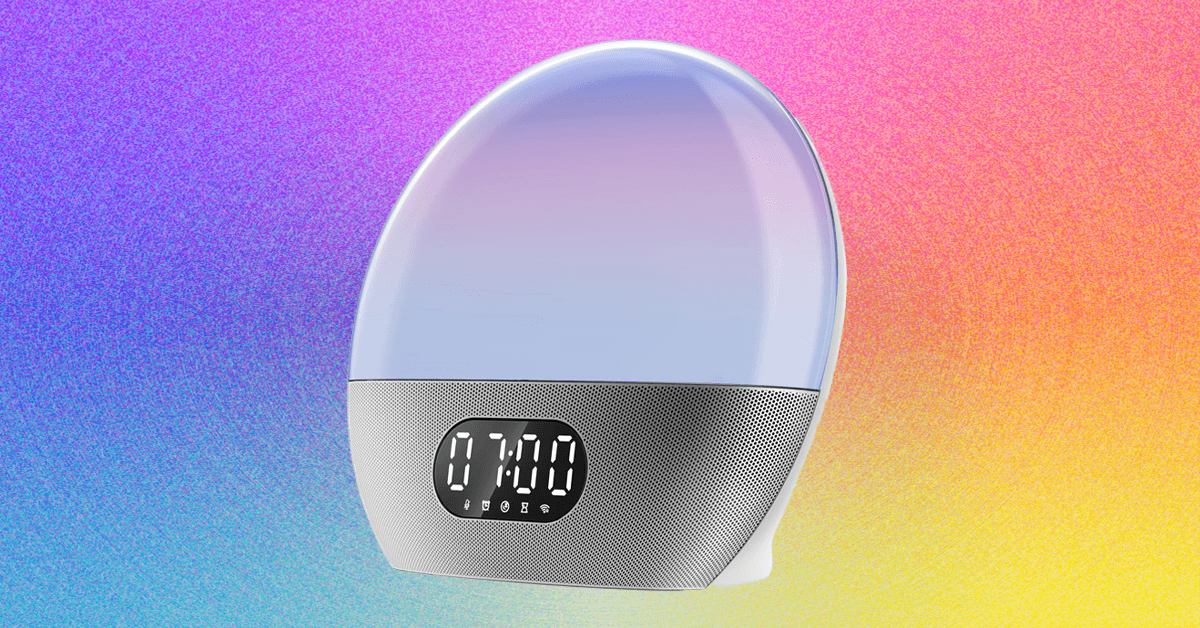
Ultimately, these lights can do a lot. They can double as a sound machine, help you wake up and fall asleep, and even act as a regular bedside lamp if they’re bright enough. Not all sunrise alarms have all of these features, though, so you have to choose how much you want to spend and what features are most important to you.
What Features Should You Look for in a Sunrise Alarm Clock?
You might see a range of features listed for a sunrise alarm, and more expensive ones will include more of these than cheaper models. If you’re not sure what features you want, try this series of questions to figure out what features you need.
Do you struggle to fall asleep? Splurge on a sunrise alarm with a nighttime or wind-down routine. These help build a routine for you to fall asleep to.
Do you need one device that doubles as an alarm and a bedside lamp? Get a brighter sunrise clock that has easy controls to switch it on as a bedside lamp. Not all sunrise clocks have these, so check the details carefully (and reviews like mine!) and note that cheaper, smaller sunrise alarm clocks usually won’t brighten an entire bedroom.
Are you picky about your alarm sounds? Check how many sounds are offered. Just about every sunrise clock has some sound machine features and options, but cheaper ones tend to only have a couple of sounds and might not have the sound you’re looking for.
Do you want app control? Some options in this guide don’t have a partner app or Wi-Fi capabilities, especially some of my favorites. An app doesn’t necessarily make it a better sunrise clock, but it can be convenient to use. If you prefer an app to set up your sunrise lamp, shop the Casper, Hatch, Loftie, and WiiM.
Which Sunrise Alarm Clocks Are Best?

Lumie
Bodyclock Luxe 700FM
This sunrise alarm is my favorite one. It’s big and bright with a stylish exterior, and has a button for lamp mode so you can easily switch it on to use in the evening as a regular lamp, and it was bright enough to fill my bedroom like a normal lamp. It has a nice range of sounds, and not only connects to the radio but allows you to save five stations. There are both sunrise and sunset settings. The biggest downside is it only has a 24-hour clock, and it doesn’t connect to Wi-Fi or an app so you have to set the time manually (and change it manually for daylight saving). If you want to spend less, the Shine 300 ($169) is a little smaller and has fewer sounds, but otherwise is similarly great.

The very existence of left-handedness seems to defy Darwin. According to the theory of evolution by natural selection (in very simplified terms), a species should retain the characteristics necessary for survival and reproduction and discard those that are not very useful. And yet around 10 percent of people continue to develop greater dexterity in their left hand, a rate that has remained stable throughout history. Why do humans continue to retain this peculiar ability?
A study conducted by researchers at the University of Chieti-Pescara in Italy set out to confirm a hypothesis indicating that, while right-handed people have advantages in cooperative behaviors, left-handed people—particularly males, the study notes—have advantages in competitive behaviors, especially in one-on-one situations. This hypothesis is based on evolutionarily stable strategy (ESS), a concept from game theory applied to evolution.
This is how ESS explains why the proportion of left-handed people remains low but constant. If almost everyone in a population is right-handed, being left-handed offers a frequency-dependent advantage: Being in the minority, left-handers are less predictable in competitive interactions (e.g., a boxing match), which may translate into small advantages (left hook!). But if left-handedness became very common, that advantage would disappear because others would adapt to encountering left-handers with the same frequency. In evolutionary terms, a “stable equilibrium” is reached when the majority are right-handed and a minority are left-handed, because neither “strategy” can completely eliminate the other since their advantages change depending on how frequent each is in the population.
How can a study support this hypothesis? The Italian researchers conducted two experiments to see whether a dominant hand is linked to any specific personality type. The results were recently published in the academic journal Scientific Reports.
Righty vs. Lefty
In the first experiment, about 1,100 participants completed questionnaires designed to measure their handedness (their level of dexterity between one hand and the other) and various facets of competitiveness, such as their inclination to achieve personal goals or their aversion to anxiety-driven competition. The results showed that people who identified with greater left-handed laterality tended to show higher levels of personal development-oriented competitiveness and lower levels of anxious avoidance. That is, left-handers tended to be more inclined to engage in competitive situations than right-handers.
In addition, when strongly lateralized groups were compared (just pure southpaws, no ambidextrousness), left-handers scored higher on “hypercompetitiveness,” a trait that implies an intense desire to win, even at the expense of others.
In the second experiment, a subgroup of 48 participants (half right-handed and half left-handed, with equal proportions of men and women) took a pegboard test, a classic laboratory test that measures manual dexterity. Interestingly, no significant differences were observed here either between left-handers and right-handers or between laterality measures and competitiveness scores. This suggests that hand preference and competitiveness are not directly related to motor skills.
Give Them a Hand
According to the authors of the study, left-handedness is not simply a biological accident, but a characteristic that may offer advantages in competitive contexts and is therefore worth preserving. This supports, at least in part, the idea that the unequal distribution between right-handers and left-handers could be maintained by an evolutionary balance. While the right-handed majority favors social cooperation, the left-handed minority benefits in competitive contexts, where surprise plays a role.
But what about other personality types? Are left-handed people more extroverted or more emotionally unstable? The study cited here found no significant differences between left-handed and right-handed people in the Big Five personality traits (openness, conscientiousness, extraversion, agreeableness, and neuroticism). Nor was there any relationship between handedness and levels of depression or anxiety in this sample of people without a psychiatric diagnosis. This suggests that the advantage associated with left-handedness is more linked to competitiveness than to general differences in personality or mental health.
The study also examined differences by sex. Men, in general, scored higher on hyper-competitiveness and development-oriented competitiveness, while women showed a greater tendency to avoid competition due to anxiety. This suggests that the interaction between hand preference, competitive profile, and gender is complex and likely influenced by multiple biological and environmental factors that warrant further investigation.
This story originally appeared on WIRED en Español and has been translated from Spanish.


Rihanna’s Beverly Hills home hit by gunfire; suspect arrested, LAPD says

Iran war: Oil prices jump above $100 for first time in four years

King Charles urges unity, brighter future, wishing Happy Commonwealth Day

-

 Fashion1 week ago
South Korea’s Misto Holdings completes planned leadership transition
-

 Politics1 week ago
Iran launches retaliation against Israel, launches ballistic missiles
-

 Entertainment1 week ago
Al Jazeera broadcast interrupted by emergency missile alert in Qatar
-

 Politics2 days ago
India let Iran warship dock the day US sank another off Sri Lanka, say officials
-

 Sports1 week ago
College basketball star suspended by team for spitting toward opposing fan
-

 Fashion1 week ago
India’s real GDP estimated to grow 7.6% in FY26 under new base FY23
-

 Sports1 week ago
Transfer rumors, news: Man City, Man United in for Anderson
-

 Sports1 week ago
Sources: Trump, college leaders to tackle issues at roundtable