CNN
—
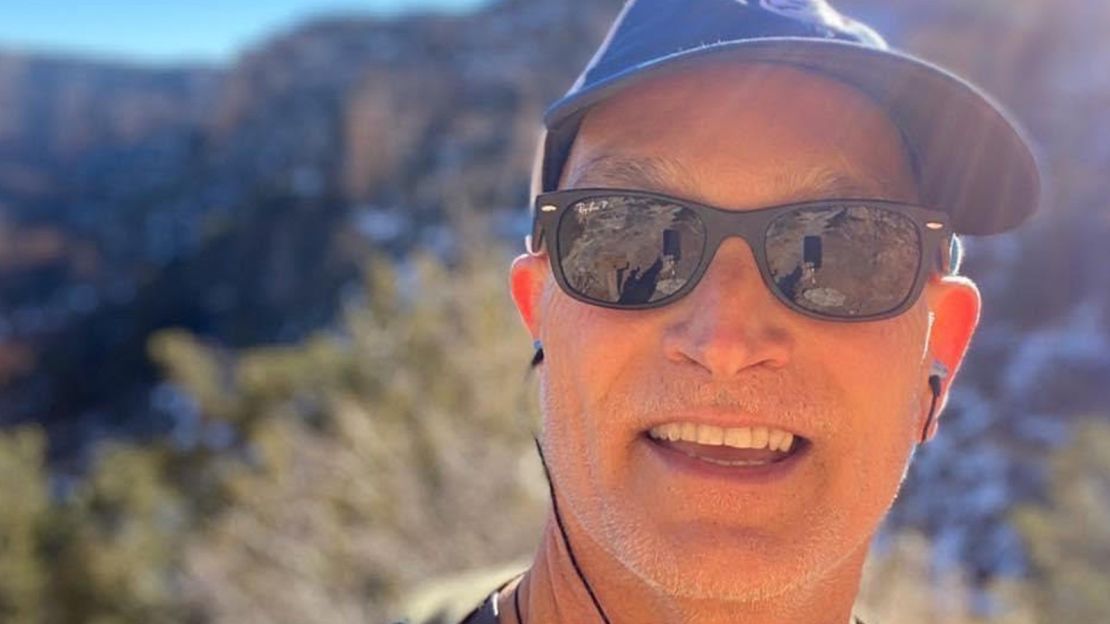
Paul Templer was living his best life.
He was 28 and conducting tours in his native Zimbabwe, with a focus on photographic safaris.
He had been away for a few years, including a stint in the British army. But he had returned to Africa’s bush country “and fell back in love with it. The wildlife, the flora, the fauna, the great outdoors, the space – just everything about it. I was at home.”
Templer said Zimbabwe’s guide certification program was rigorous, and there was a lot of pride among the guides who passed. He reveled in showing tourists the area’s majestic wildlife – including the water-loving, very territorial hippos.
“It was idyllic,” he told CNN Travel. “Life was really, really good – until one day I had a really bad day at the office.”
March 9, 1996. A Saturday. Templer learned a good friend who was to lead a canoe safari down the Zambezi River had malaria. He agreed to take his pal’s place. “I loved that stretch of the river. It was an area I know like the back of my hand.”
The expedition consisted of six safari clients (four Air France crewmembers and a couple from Germany), three apprentice guides plus Templer. They had three canoes – clients in the first two seats and a guide in the back. Then one apprentice guide was in a one-person safety kayak.
And down the famed Zambezi they went. “Things were going the way they were supposed to go. Everyone was having a pretty good time.”
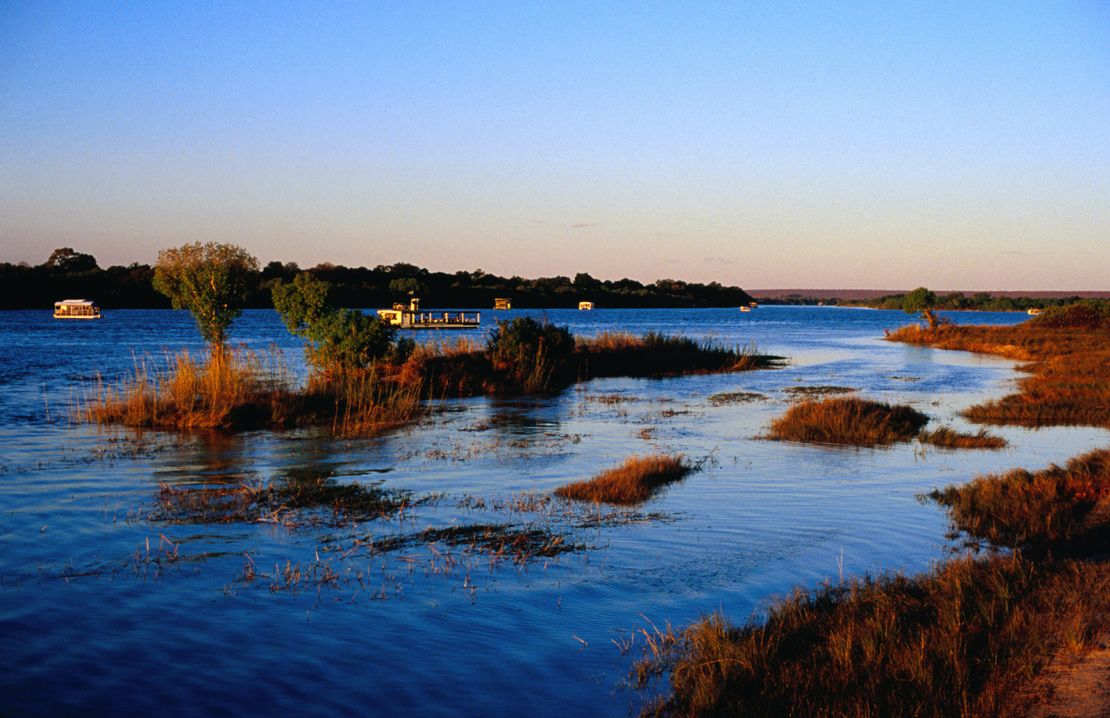
Eventually, they came across a pod of about a dozen hippos. That’s not unexpected on the Zambezi, Africa’s fourth-longest river. They weren’t alarmed at first as they were at a safe distance. But “we were getting closer, and I was trying to take evasive action. … The idea was let’s just paddle safely around the hippos.”
Templer’s canoe led the way, with the other two canoes and kayak to follow. He pulled into a little channel waiting on the others. But the third canoe had fallen back from the group and was off the planned course. Templer’s not sure how that happened.
“Suddenly, there’s this big thud. And I see the canoe, like the back of it, catapulted up into the air. And Evans, the guide in the back of the canoe, catapulted out of the canoe.” The clients managed to remain in the canoe somehow.
“Evans is in the water, and the current is washing Evans toward a mama hippo and her calf 150 meters [490 feet] away. … So I know I’ve got to get him out quickly. I don’t have time to drop my clients off.” He yells to Ben, one of the other guides, to retrieve the clients who were in the canoe that had been attacked.
Ben got the clients to safety on a rock in the middle of the river that hippos couldn’t climb.
Meanwhile, Templer turned his canoe around to get Evans. The plan was to pull alongside of him and pull him into Templer’s canoe.
“I was paddling towards him … getting closer, and I saw this bow wave coming towards me. If you’ve ever seen any of those old movies with a torpedo coming toward a ship, it was kind of like that. I knew it was either a hippo or a really large crocodile coming at me,” he said.
“But I also knew that if I slapped the blade of my paddle on water … that’s really loud. And the percussion underwater seems to turn the animals away,” he said. “So I slapped the water, and as it was supposed to do, the torpedo wave stops.”
He was getting closer to Evans, but they were also getting closer to the female and calf.
“I’m leaning over – it’s kind of a made-for-Hollywood movie – Evans is reaching up. … Our fingers almost touched. And then the water between us just erupted. Happened so fast I didn’t see a thing.”
What happened next was nightmarish and surreal.
“My world went dark and strangely quiet.” Templer said it took a few seconds to figure out what was going on.
“From the waist down, I could feel the water. I could feel I was wet in the river. From my waist up, it was different. I was warm, and it wasn’t wet like the river, but it wasn’t dry either. And it was just incredible pressure on my lower back. I tried to move around; I couldn’t.
“I realized I was up to my waist down a hippo’s throat.”
Hippos: Huge, territorial and dangerous
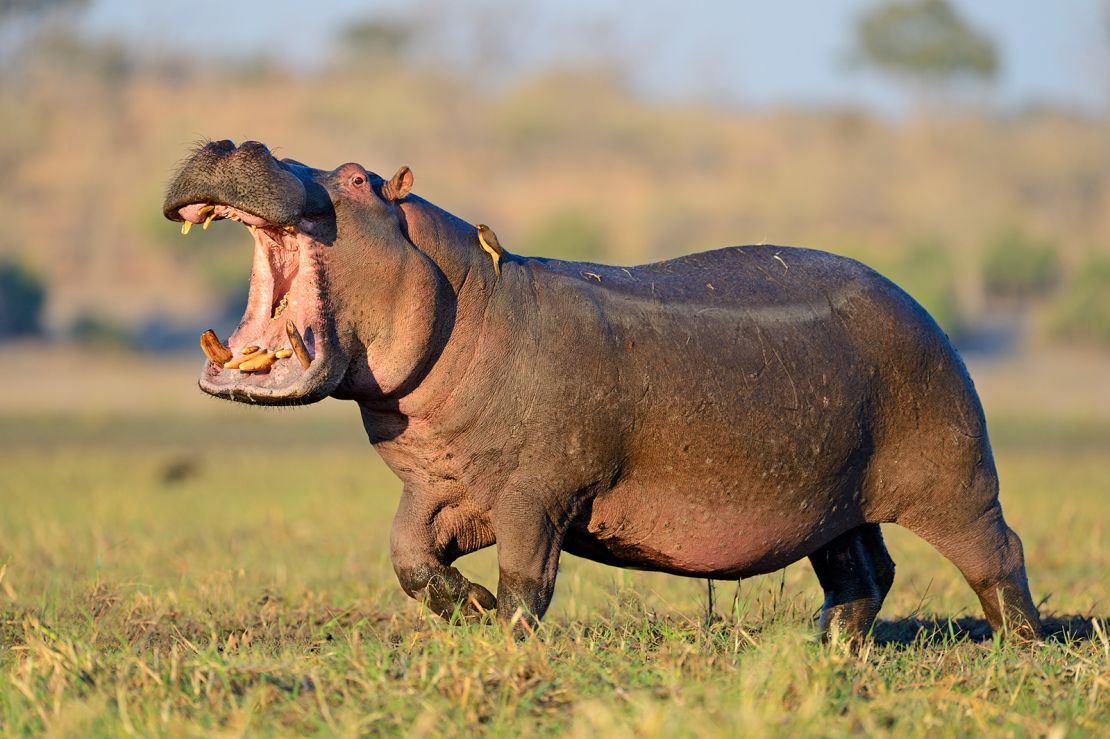
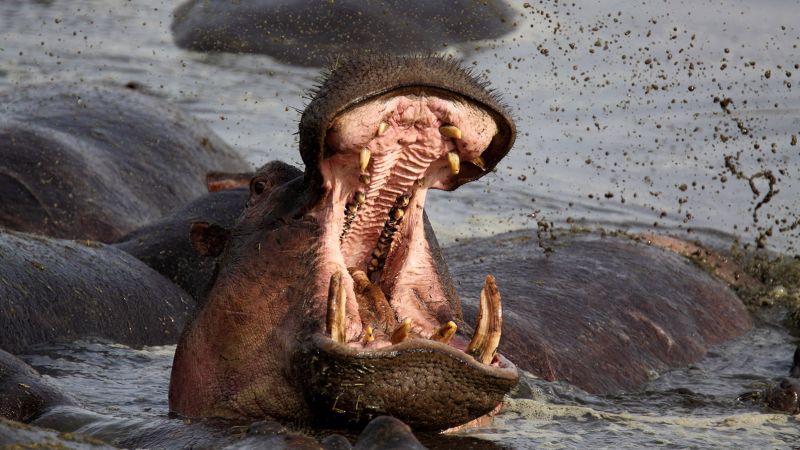
There’s a good reason a fully grown hippopotamus can fit a large portion of a fully grown adult in its mouth. Hippos can grow up to 16.5 feet long (5 meters), 5.2 feet tall (1.6 meters) and weigh up to 4.5 tons (4 metric tonnes), according to National Geographic.
They sport enormous mouths and can open their strong jaws to 150 degrees.
Their teeth might be the most frightening thing of all. Their molars are used for eating plants, but their sharp canines, which might reach 20 inches (51 centimeters), are for defense and fighting. Their bite is almost three times stronger than that of a lion. One bite from a hippo can possibly cut a human body in half.
They’re found naturally in various parts sub-Saharan Africa, particularly in East and Southern Africa, living in or near rivers and other water sources. (And they are an invasive species in Colombia thanks to escapees from drug lord Pablo Escobar’s menagerie).
Hippos are very territorial and might aggressively attack any animal encroaching on their territory, including hyenas, lions and crocodiles.
Hippos and humans
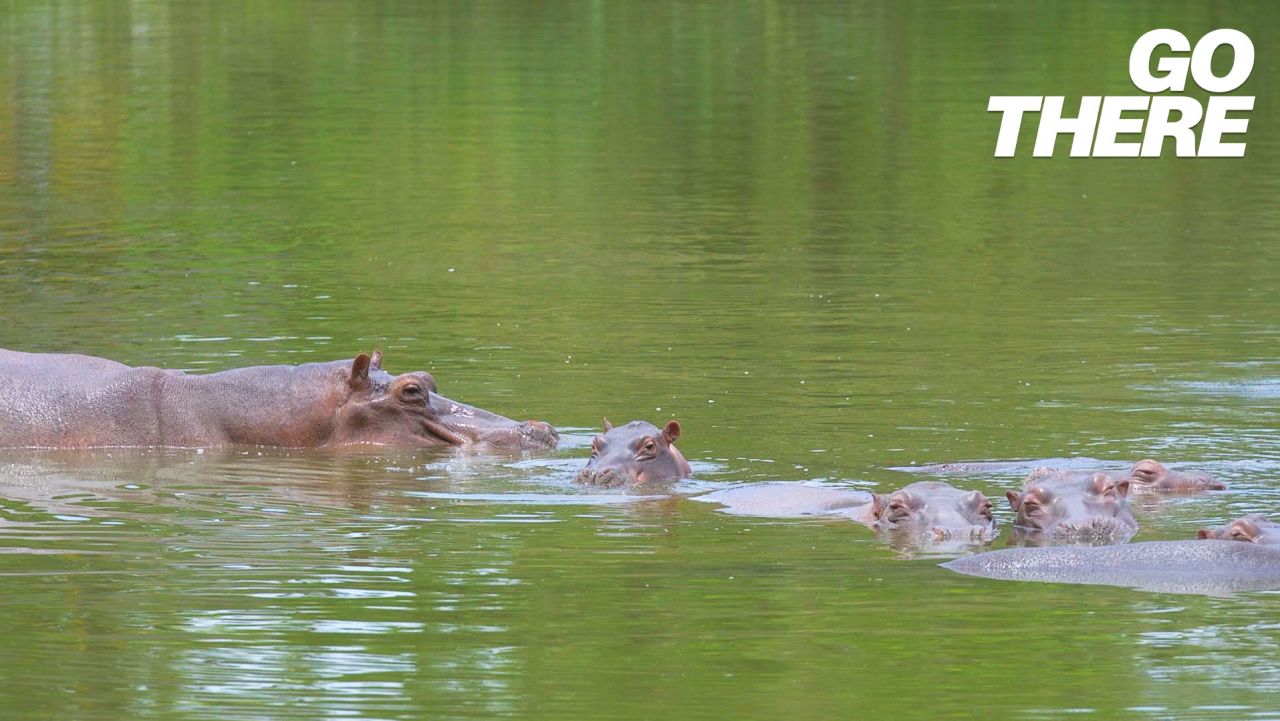
‘If I say run, you run’: CNN goes searching for Pablo Escobar’s hippos
They also kill people. That we know for sure. Many internet sources say around 500 a year, but an exact figure is still uncertain because some attacks and deaths come in very remote regions and don’t get reported.
“The question I get asked the most when people find out I study hippos is: ‘Is it true hippos kill more people than any animal?’ Rebecca Lewison, conservation ecologist and associate professor at San Diego State University, told CNN Travel in an email interview.
“I’m not entirely sure where that started but … there is no authority or reliable data. People are surprised that hippos kill people. They look slow, and they are mostly in water. There are some nonfatal interactions, but people (or hippos) tend to fare badly from interactions.”
Dr. Philip Muruthi, chief scientist and vice president of species conservation and science of the African Wildlife Foundation, said the AWF doesn’t have a credible source on the number of attacks or fatalities either.
While more stats need to be collected, one study found that the probability of being killed by a hippopotamus attack is in the range of 29% to 87% – higher than that of a grizzly bear attack at 4.8%, shark attack at 22.7% and crocodile attack at 25%.
Those were rather bad odds of survival working against Templer.
“I’m guessing I was wedged so far down its throat it must have been uncomfortable because he spat me out. So I burst to the surface, sucked a lungful of fresh air and I came face to face with Evans, the guide who I was trying to rescue. And I said, ‘We got to get out of here!’ ”
But Evans was in serious trouble. Templer started swimming back for him “and I was just moving in for your classic lifesaver’s hold when – WHAM! – I got hit from below. So once again, I’m up to my waist down the hippo’s throat. But this time my legs are trapped but my hands are free.”
He tried to go for his gun, but he was being thrashed around so much he couldn’t grab it. The hippo – which turned out to be an older, aggressive male – spat Templer out a second time.
“This time when I come to the surface I look around, there’s no sign of Evans.” Templer assumed Evans had been rescued, and he tried to escape himself.
“I’m making pretty good progress and I’m swimming along there and I come up for the stroke and swimming freestyle and I look under my arm – and until my dying day I’ll remember this – there’s this hippo charging in towards me with his mouth wide open bearing in before he scores a direct hit.”
This time, Templer was sideways in the hippo’s mouth, legs dangling out one side of the mouth, shoulders and head on the other side of its mouth.
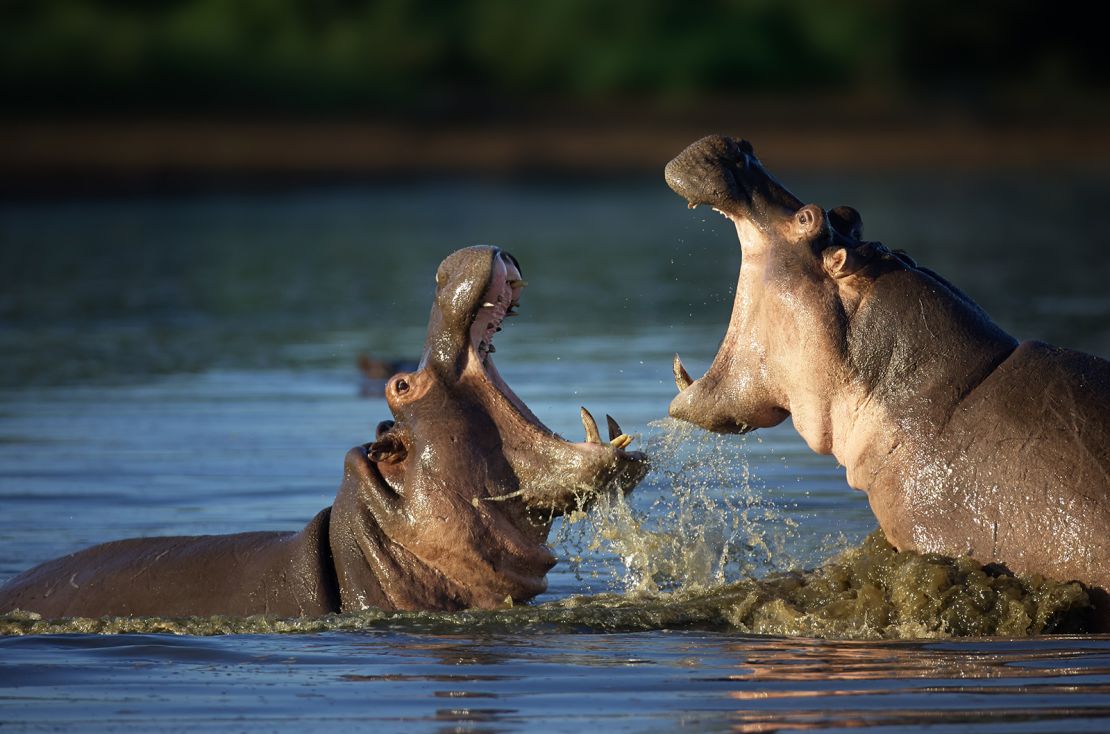
“And then he just goes berserk. … When hippos are fighting, the way they fight is they try to tear apart and just destroy whatever it is they’re attacking,” Templer said.
“For me, fortunately everything was happening in slow motion. So when he’d go under water, I’d hold my breath. When we were on the surface, I would take a deep breath and I would try to hold onto tusks that were boring through me” to stop from being ripped apart.
Templer said one of the clients watching the horror later described it like a “vicious dog trying to rip apart a rag doll.”
He figures the whole attack took about three and a half minutes.
Meanwhile, apprentice guide Mack in the safety kayak – “showing incredible bravery, risking his life to save mine – pulls his boat in inches from my face.” Templer managed to grab a handle on the kayak, and “Mack dragged me to the relative safety of this rock.”
The expedition was still in one hell of a mess, though.
Who gets attacked and why
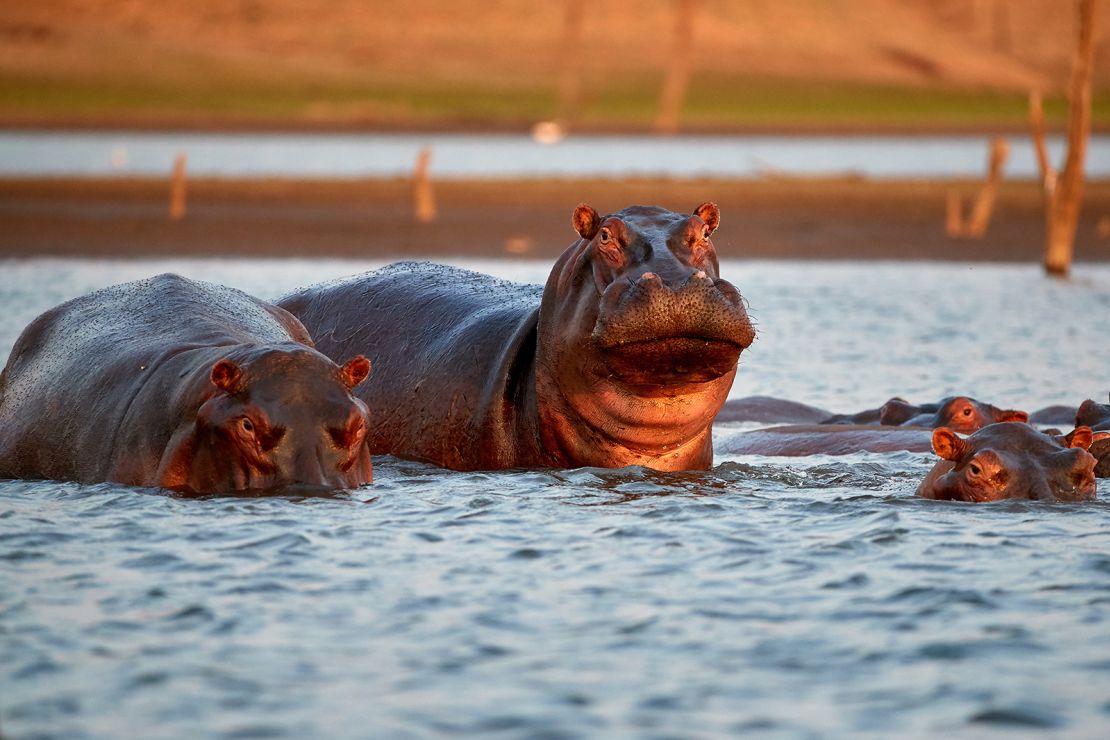
People living near hippo territory are more likely victims of attacks than tourists, said Lewison.
“Most of the attacks happen in the water, but because hippos raid crops on farms, there are also attacks on people trying to protect their crops. There are some tourists, but largely the attacks are happening to local residents,” Lewison said.
Human encroachment from Africa’s booming population makes matters worse, increasing the chances of deadly interactions, she said.
Despite the encounters gone bad, sub-Saharan Africa depends on hippos.
“Hippos are important ecosystem engineers of the ecology of freshwater areas they inhabit. This is through nutrient recycling from dung (they consume large amounts of vegetation),” Muruthi said.
“Hippos attack not to eat people, but to get them the hell away from them,” Lewison said. “I don’t think hippos are particularly aggressive, but I think when under pressure, they attack.”
Stuck on a rock and in a hard place
Back on the rock in the Zambezi, Templer asked Mack where Evans was. Mack said, “He’s gone, man, he’s just gone.”
Templer knew he needed to come up with a plan to get them off the rock and to the riverbank, but “first I needed to settle myself down.”
He assessed the situation: One man missing. The first aid kit, radio and gun all gone. Six scared clients, two canoes and one paddle left. And his own body was shattered.
“My left foot was especially bad; it looked as if someone had tried to beat a hole through it with a hammer.” He couldn’t move his arms. One arm from elbow down was “crushed to a pulp.”
Blood was bubbling out of his mouth. They realized his lung was punctured. Mack rolled Templer over and could see a gaping hole in his back and plugged it with Saran Wrap from a plate of snacks.
Templer made the call: No matter the risk, they had to get off that rock.
He was loaded into a canoe. Ben paddled. The hippo kept bumping the canoe. He went from being terrified to calm on that ride back.
He described “a profound spiritual experience in which I had this incredible sense of peace and realization this was my moment of choice. Like do I go, or do I stay? Do I close my eyes and drift off, or do I fight my way through this and stick around?”
“I chose to stick around, and as soon as I made that choice, it was more pain than I could ever imagine I could endure. It was so intense I thought I was going to die, and when I didn’t, I kind of wished I would.”
Ben and Templer made it out of the river, but without finding Evans. His body was found three days later. They concluded he had drowned because he didn’t have any signs of animal attack on him.
“Evans did nothing wrong. The fact that he died was purely a tragedy.”
Meanwhile, some people on shore had realized something was wrong in the river. A well-trained Zimbabwe rescue team was able to safely ferry everyone else off the rock.
“And that was my bad day at the office.”
Templer was out of the river but not out of the woods.
It took eight hours to drive him to the nearest hospital. In a month’s time, he had several major surgeries. He thought he would lose one leg and both arms. His surgeon didn’t think he’d live.
But not only did the surgeon save Templer’s life, he saved his legs and one arm. The other arm, however, was beyond salvation.
He realized that in the ICU when he woke up and was feeling for his left hand. It was gone. “I just remember feeling devastated. I spent my whole life being active and it was almost more than I could bare.”
But then he was flooded with relief to realize his right arm and legs had been saved. For the next month, he was “emotionally all over the map.”
He got physical and occupational therapy in Zimbabwe and then more in the United Kingdom. He got a prosthesis “and then just started trying to get back to life.”

Templer, Muruthi and Lewison all say safe outings start with education – and avoiding trouble in the first place.
“Hippos have no interest in dealing with people. Stay away from them, and they will leave you alone. They are not hunting humans,” Lewison said.
“Do not get close to them,” Muruthi said. “They don’t want any intrusion. … They’re not predators; it’s by accident if they’re injuring people.”
Want close-up views and photos of the creatures? Instead of venturing too close, invest in good binoculars and telephoto camera lenses.
Do not walk along well-worn hippo paths, stay close to your group and don’t approach them from behind, Muruthi said.
“Follow the rules. If you are a tourist, and it says ‘Stay in your vehicle,’ then stay in your vehicle. And even when you’re in your vehicle, don’t drive it right to the animal.”
Muruthi also advised that your party make some noise in areas known for hippos. “It’s good for them to know you’re around.”
“Hippos usually come out of water late in the evening and at night to forage, so avoid trekking along the river at that time,” Muruthi said. Also stay on high alert during the dry season when food is scarce.
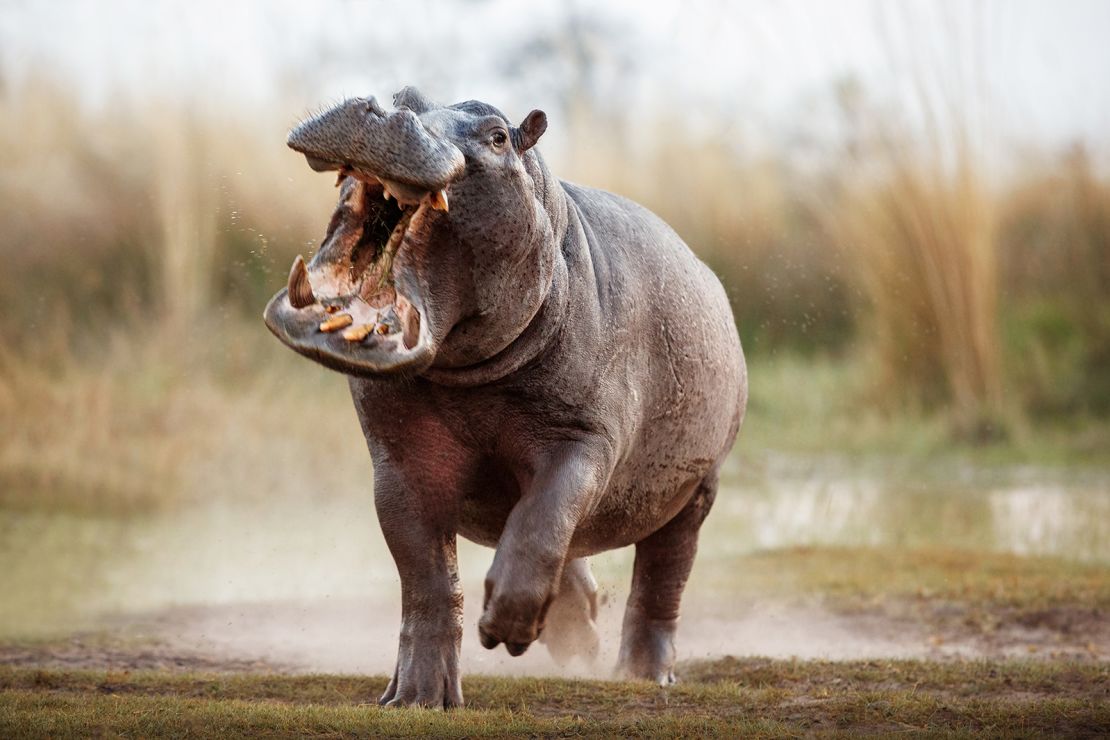
Get to know the signs of disturbed hippos, Muruthi advised, in case you wander too closely. An agitated one will open its mouth wide and yawn as aggressive display. Also watch for a head thrown back, shaking of the head, grunting and snorting.
“These are signs you should have left already!” Muruthi said.
If you’ve attracted unwanted attention, Muruthi said to always remember you cannot outrun a hippo. They may look sluggish, but they can run 30 mph (almost 43 kph). Instead, you should try to climb a tree or find an obstacle to put between you and the hippo such as a rock or anthill.
Muruthi, Lewison and Templer all said never stay between a hippo and the water. If it’s charging you, run parallel to the water source. As with so many other protective female animals, never get between a mama hippo and her young, Templer said.
What if you’re in a small watercraft?
“Typically, if a hippo is going to be attacking, you’ll see it coming way before. There will be that bow wave. … If you slap the water, the percussion 99.9 times out of 100 will turn the hippo,” Templer said. “If you’re in a canoe and a hippo knocks you in the water, get away from the canoe. The hippo is going for this big shape, getting it off its territory.”
It’s also safer to view hippos on the water in a larger vessel, which the animal would have a harder time capsizing, Muruthi said.
Unlike attacks by some other wild animals, humans are almost defenseless once an attack by a large hippo begins.
“Once attacked, there is nothing you can do,” Muruthi said. “Fight for dear life and watch for any chance to escape.” He said you could try to poke at the eyes or any spot that might inflict unexpected pain. But given the size just of a hippo head, even that’s a tall order.
“Hippos typically hole punch you, so there isn’t much you can do if they get hold of you,” Lewison said.
Based on his attack, Templer said try not to panic “when dragged underwater. Remember to suck in air if on the surface.”
Another hippo attack survivor in this National Geographic video also was able to conserve her breath. She also grabbed the hippo’s snout, and one expert in the video theorizes that might have startled the hippo into letting her go.
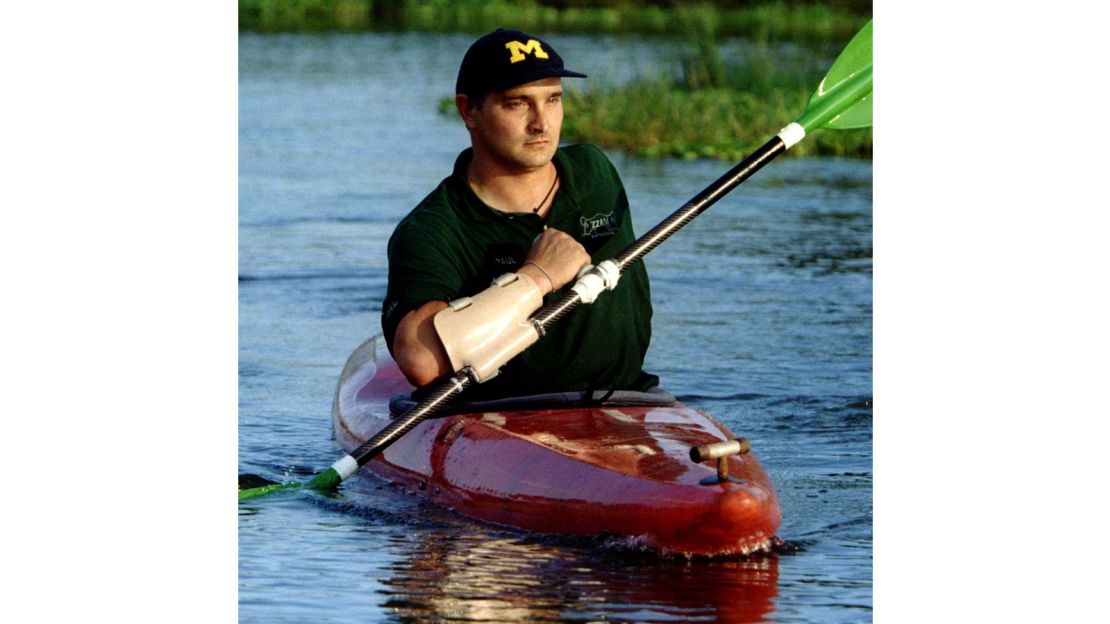
Two years after that attack, Templer said that he and a team made the longest recorded descent of the Zambezi River to date. It took three months and covered 1,600 miles (2,575 kilometers).
How did Templer find the resilience to reclaim his life?
After a particularly rough day trying to maneuver in a wheelchair, he said that his surgeon told him: “You’re the sum of your choices. You’re exactly who, what and where you choose to be in life.”
Templer said he focused on what’s possible vs. what he’s lost. “If you look for what’s possible, it generally is.”
Templer later moved to United States; got married to the sister of a journalist on the record-setting Zambezi trip; wrote the book “What’s Left of Me”; and is a speaker.
Should people be afraid to even go on safari – especially in hippo areas – after learning of a harrowing story like Templer’s?
Muruthi said go, but go smartly. Be sure to get advice from professional tour guides – and then follow their guidance, Muruthi said. “In Kenya, for example, contact the Kenya Professional Safari Guides Association,” he said.
Templer said his attack was an “anomaly,” and he doesn’t want anyone to be dissuaded by what happened on his 1996 river run.
“My biggest counsel would be: Absolutely go and do it. But hook yourself up with someone who knows what they’re doing out there. But by all means, go out … and experience it.”