

Tech
How digital twins are helping people with motor neurone disease speak | Computer Weekly


An initiative by a UK-based charity, supported by technology companies and universities, has developed an artificial intelligence (AI)-powered digital twin that allows people with communications disabilities to speak in a natural way.
The technology, known as VoxAI, represents a step-change from the computer-assisted voice used by late physicist Stephen Hawking, one of the first well-known public figures with motor neurone disease (MND).
The Scott-Morgan Foundation was set up by its founder, roboticist Peter Scott-Morgan, to apply engineering principles to disability after he was diagnosed with MND.
A five-year project led by the trust has developed an AI-powered platform that is helping people with MND, also known as amyotrophic lateral sclerosis (ALS), to communicate in a natural way despite their disabilities.
It was developed by the foundation’s chief technologist, Bernard Muller, who is paralysed with MND and has learned to write code using eye-tracking technology.
The platform brings together AI technologies to create photo-realistic avatars that move in a natural way, with natural facial expressions, and can reproduce the voice of the person using it. It is able to listen to the conversation and offer disabled people a choice of three answers that they could select based on its understanding of the person.
One of the people testing the technology, Leah Stavenhagen, for example, worked as a consultant at McKinsey before she developed MND. The AI she uses has been trained on a book she wrote, along with 30 interviews in English and French.
LaVonne Roberts, CEO of the Scott-Morgan Foundation, told Computer Weekly that while people did not mind waiting to hear what Stephen Hawking had to say, delays in communication usually cause problems for both the speaker and the listener.
“When you have someone that is having to spell something out laboriously, they are fatiguing their eyes, which has been shown to further progression of MND, so we are trying to protect from that,” she said.
“The other thing that happens is people start giving much shorter answers because they don’t have the time to stay in a conversation,” added Roberts. “And, honestly, you end up with awkward pauses.”
The Scott-Morgan Foundation, which demonstrated the technology today at an AI Summit in New York, plans to make the software available free of charge, so that it can be used by as many people as possible. It will also offer a subscription version for more advanced features.
Many off-the-shelf computers and tablets now come with workable eye-tracking, and tracking devices provided by the NHS may also be able to use the technology, said Roberts.
“The idea was to democratise the technology by putting it on the web, giving the license keys, so that people have their voice back again,” she said.
More than 100 million people in the world who live with conditions that severely limit speech – including people recovering from a stroke, or living with cerebral palsy, a traumatic brain injury or non-verbal autism – could benefit from the technology.
The foundation plans to start a two-year trial of the platform, which will track some 20 participants using the technology, led by Mexican university Tecnológico de Monterrey, which will evaluate its impact.
It is also developing a simplified platform that could be used by people who do not have access to Wi-Fi.
Gil Perry, CEO of D-ID, which creates digital avatars for businesses, contributed to the project after the company helped a few people with MND/ALS in ways they found life-changing.
His company joined the project with the Scott-Morgan Foundation about two years ago, after meeting with Roberts. “I saw that LaVonne has the vision and can connect all the dots together, because she has a group of people who just sleep and dream that vision day and night,” said Perry.
The company has improved its technology so that it can create an avatar that shows facial expressions, even for someone whose condition means they are at an advanced stage of immobility.
Roberts said that one of the breakthrough moments came after a mother told the foundation that, although the technology was good, “You just didn’t capture my daughter’s smile”. That sparked work to make the avatars more lifelike. “I remember Erin’s mother crying when she saw Erin on a video, and she was like, ‘That’s her smile’,” she said. “And I knew we were onto something.”
Muller, who architected the platform, said that his avatar not only makes him visible, but also “present”. “When someone sees my avatar smile or shows concern, they are seeing me, not a disability,” he added. “That changes everything about how I connect with the world.”

The WIRED Reviews Team has been covering Amazon’s Big Spring Sale since it began at on Wednesday, and the overall deals have been … not great, honestly. So far, we’ve found decent markdowns on vacuums, smart bird feeders, and even an air fryer we love, but I just saw that Cadence Capsules, those colorful magnetic containers you may have seen on your social media pages, are 20 percent off. (For reference, the last time I saw them on sale, they were a measly 9 percent off.)
If you’re not familiar, they allow you to decant your full-sized personal care products you use at home—from shampoo and sunscreen to serums and pills—into a labeled, modular system of hexagonal containers that are leak-proof, dishwasher safe, and stick together magnetically in your bag or on a countertop. No more jumbled, travel-sized toiletries and leaky, mismatched bottles and tubes.

Cadence Capsules have garnered some grumbling online for being overly heavy or leaking, but I’ve been using them regularly for about a year—I discuss decanting your daily-use products in my guide to How to Pack Your Beauty Routine for Travel—and haven’t experienced any leaks. They do add weight if you’re trying to travel super-light, and because they’re magnetic, they will also stick to other metal items in your toiletry bag, like bobby pins or other hair accessories. This can be annoying, especially if you’re already feeling chaotic or in a hurry.
Otherwise, Capsules are modular, convenient, and make you feel supremely organized—magnetic, interchangeable inserts for the lids come with permanent labels like “shampoo,” “conditioner,” “cleanser,” and “moisturizer.” Maybe you love this; maybe you don’t. But at least if you buy on Amazon, you can choose which label genre you get (Haircare, Bodycare, Skincare, Daily Routine). If this just isn’t your jam, the Cadence website offers a set of seven that allows you to customize the color and lid label of each Capsule, but that set is not currently on sale.

This is the older Kindle Scribe, but the price and features are the best you’ll get, especially when it’s on sale like this. I still reach for this model even though I have the newer third generation, and keep in mind the second generation will also get some of the newer software and experiences over time. With the sale, it’s half the price of the newer model.
If you’re already a Kindle reader and looking to upgrade, it’s likely because you want a new feature like a color screen. While the Kobo above is the better buy, if you want to stay in the Kindle ecosystem but add some color to your books, both the Colorsoft and Colorsoft Signature are on sale.

Amazon
Kindle (2024, 11th Gen)
If you’re looking to spend as little as possible, the basic Kindle (11th generation) is still a great e-reader and is currently under $100. It can do almost everything the other Kindles can (except the Scribe) on a snappy black-and-white screen. It doesn’t have a warm front light either, but it’s still a great purchase for the price.
Power up with unlimited access to WIRED. Get best-in-class reporting and exclusive subscriber content that’s too important to ignore. Subscribe Today.
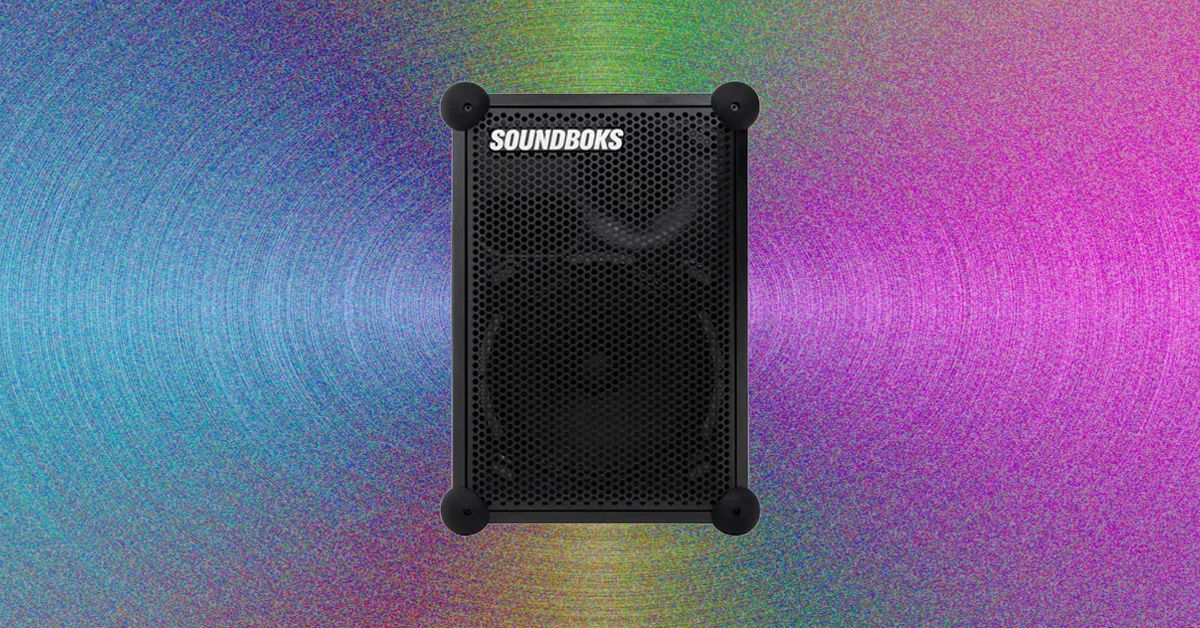
In addition to the rubber balls, there’s a nice physical interface on the side for adjusting volume and pairing multiple Mix speakers together if you have multiple on hand (I was only sent the single mono speaker). Setup involves installing the Soundboks app, pairing to the speaker via Bluetooth on your phone, and picking whatever you want to play. It’s all quick and painless, especially for my first-time pairing with a Samsung Galaxy S24 Ultra.
Otherwise, it’s all very pro audio. Everything reminds me very much of the Peavey PA system I have in my music rehearsal space. The top of the speaker features a built-in carrying handle and a place for a strap (an accessory you have to buy aftermarket, or you can fasten it with any strap you have that fits through the hole). There are also top-hat mounts for the speakers to slide onto traditional PA pole stands, if you wanted to use them in that way at a party or event.
The grill is replaceable, as is the massive internal battery, which means that these things are pretty much indestructible as long as the amp and speakers themselves still work—the battery is the weak point of most portable speakers in 2026.
I bounced it around my yard, dropped it off my patio, and generally beat the crap out of it during my two-week testing period, and the thing just needed a little wipe down and a charge when it ran out of juice. The claimed 40 hours of battery at reasonable volume is accurate, but you’ll get about eight hours at max volume (which is very good for the category). If you need to bring some walk-out music to your kid’s all-day Little League tournament, this a great way to go.
Big Sound
Photograph: Parker Hall
Soundboks calls this speaker midsize, but at 21.4 pounds and the size of a medium-size cooler, I’d still call it a large speaker. That said, the size doesn’t make it any less portable than competitors from JBL and others; you still need a car or cargo ebike to take one of these with you, so what’s a couple inches here or there? The fact that this is a rectangle actually makes it easier to strap down than many others, especially with the holes for the strap and the built-in handle to tie down through.


Amazon’s Spring Sale Is So-So, but Cadence Capsules Are a Bright Spot

The unexpected path that led Morgan and Frankie Price to Arkansas gymnastics

US-Iran mediation: Politicians castigate India’s Jaishankar for spiteful remarks on Pakistan

-

 Fashion1 week ago
Sales at US apparel, clothing accessories stores up 4% YoY in Jan 2026
-

 Tech1 week ago
Justice Department Says Anthropic Can’t Be Trusted With Warfighting Systems
-

 Fashion1 week ago
Spain’s Inditex FY25 sales rise 3.2% to $46.28 bn amid strong demand
-

 Politics1 week ago
Iran strikes Tel Aviv with cluster-warhead missiles in retaliation of Larijani’s martyrdom
-

 Sports1 week ago
March Madness 2026 – How to watch in SA, start time, schedule, TV channel for NCAA championship basketball tournament
-

 Entertainment1 week ago
Val Kilmer revived 1 year after death through AI
-
 Entertainment1 week ago
With few new leads 45 days after Nancy Guthrie’s disappearance, investigation “becomes much harder,” expert says
-
 Business1 week ago
Brits cashing in jewellery as gold price hits record high