

Sports
How Rams’ Puka Nacua uses team’s ‘Breakfast Club,’ veteran leadership to continue chasing greatness

NEWYou can now listen to Fox News articles!
The usual NFL player heads into his third season hoping for that “leap year,” one where that next step of production is taken to prove his worth for his squad, which ultimately results in a hopeful contract extension.
But there’s also the rare group of third-year players – those who are clearly NFL stars from the start – that franchises would love to keep aboard and continue to build around.
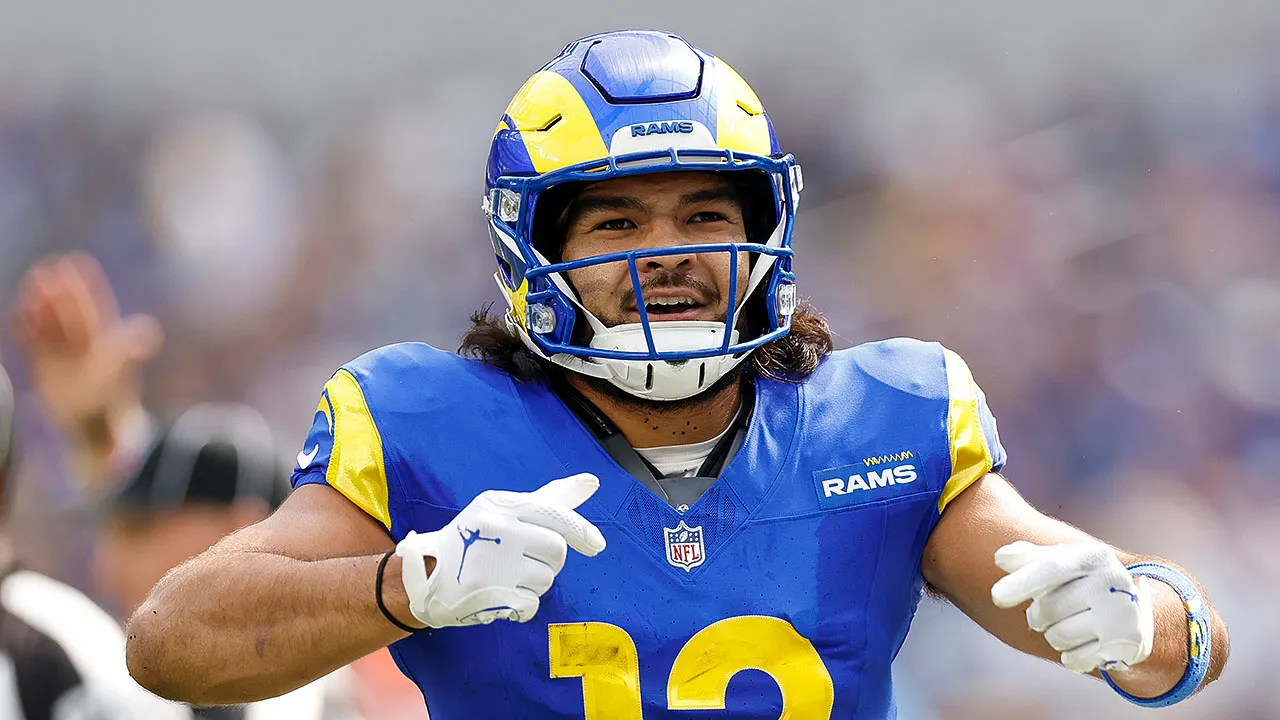
For the Los Angeles Rams, it’s wide receiver Puka Nacua, the NFL’s current leader in receptions (52) and receiving yards (588) through Week 5 of the 2025 campaign.
CLICK HERE FOR MORE SPORTS COVERAGE ON FOXNEWS.COM
Puka Nacua of the Los Angeles Rams runs downfield during the second half of an NFL football game against the San Francisco 49ers at SoFi Stadium on Oct. 02, 2025 in Inglewood, California. (Brooke Sutton/Getty Images)
Nacua burst onto the scene in 2023, when he broke the all-time rookie receiving yards record with 1,486 after catching 105 passes from quarterback Matthew Stafford. He was just shy of 1,000 yards in 2024 after injuries kept him out for six games, but the third-year star out of BYU is once again in the elite category of receivers gracing the gridiron each week.
Nacua was a diamond in the rough when the Rams drafted him in the fifth round in 2023, but that diamond is shining bright in Los Angeles. And though he isn’t the typical third-year player hoping to take that leap, Nacua told Fox News Digital that he does have a similar mindset.
This is essentially the floor of what he wishes to do in the NFL.
SEAHAWKS RECEIVER JAXON SMITH-NJIGBA DRAWS GLARE FROM NFL REF AFTER WILD HOT MIC MOMENT
“One-hundred percent,” Nacua, who also discussed his new journey with Invisalign, said when asked if he feels like he’s just getting started. “I just think the opportunity I have, I’m blessed to be around great people. I’m blessed to start my career with Matthew Stafford and Cooper Kupp and Sean McVay. That’s NFL royalty right there, so the opportunity to get better every single day because of the people around me, it’s been such a confidence boost and such motivation in the offseason.
“There’s a statement to be made for myself in the improvement I can make each year, and it’s fun to be able to go out there and perform at the level we’re at right now, and to be on the same page as Matthew because I think our success – we’re on the same page right now and we have the ability to continue to get better.”
Nacua knows that without his rapport with Stafford, the stat lines and league records wouldn’t be jaw-dropping. He also mentioned Kupp, the new Seattle Seahawks receiver, who was traded this offseason mainly due to the emergence of Nacua as the team’s top receiver.
But part of Kupp’s legacy with the Rams still lives on in a fun meeting before practices during the week they like to call “The Breakfast Club.” Stafford and Kupp would meet in the early hours of each morning before game day to prepare for their next opponent. While there’s no formal invite, Nacua started to get involved in that during his rookie year, and now he’s the alpha receiver in the room alongside teammates and coaches.
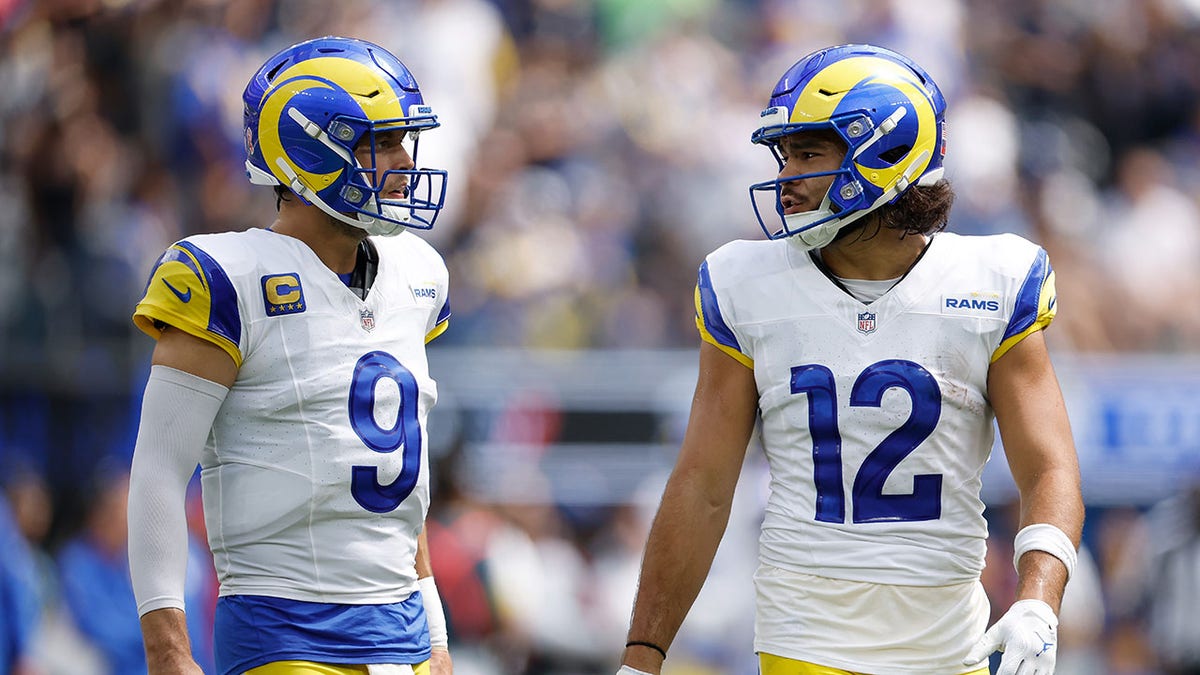
Matthew Stafford and Puka Nacua of the Los Angeles Rams talk in the first quarter of a game against the Houston Texans at SoFi Stadium on Sept. 7, 2025 in Inglewood, California. (Harry How/Getty Images)
“To be able to be there when Cooper’s there in the morning, to hear the understanding and the communication that went on between those two. Now, the standard that was set before me, I’m in the meetings now and I’m having that conversation with Matthew. It’s been so fun because as much as it is football, I think it is the conversations we have that aren’t about football. He’s a girl dad, he’s got four daughters, and I don’t know what that’s like. But the experience we have and conversations we have, I think it allows for trust and just being human beings. I know he sees the work and everybody on our team sees how he works. So, that gives you such a confidence to be like, ‘All right, I don’t want to let him down because I know the effort that he puts in.’”
And you can’t look at what Nacua’s doing this season without giving credit to his new receiver counterpart, Davante Adams. Like Stafford, he’s another girl dad who has put in blood, sweat and tears into this game and knows what it takes to stand out from the rest of the pack.
Nacua learned quickly what type of impact Adams would have on his game.
49ERS’ DEFENSE DIGS DEEP TO THWART RAMS’ OVERTIME CHARGE FOR WIN
“He’s got such a different mindset and mentality and the power that he moves with on the football field, you can feel it,” he said of Adams.
Nacua was used to being the first one to go during drills, but that quickly changed when Adams joined the fray.
“I asked him to be the number one guy who’s taking the first reps in all the drills because I could feel when he was going behind me,” Nacua said, laughing. “I’m running my routes and I’m like, ‘You, the ground is shaking behind me.’ I’m trying to watch his reps so I can learn. You watch him move and I was like, ‘I can feel the power, the urgency that he moves with on the football field.’ It’s something I’ve tried to incorporate in my game because, as a wide receiver, efficiency and power is something that I enjoy in the game of football. To be able to watch that, I knew I needed to add that into my game as well.”
Between breaking down film with Stafford and McVay and soaking in all that Kupp and Adams have been able to teach him simply by practicing and playing together, Nacua has developed into one of the game’s best at his position.
For Nacua, this is only just the start.
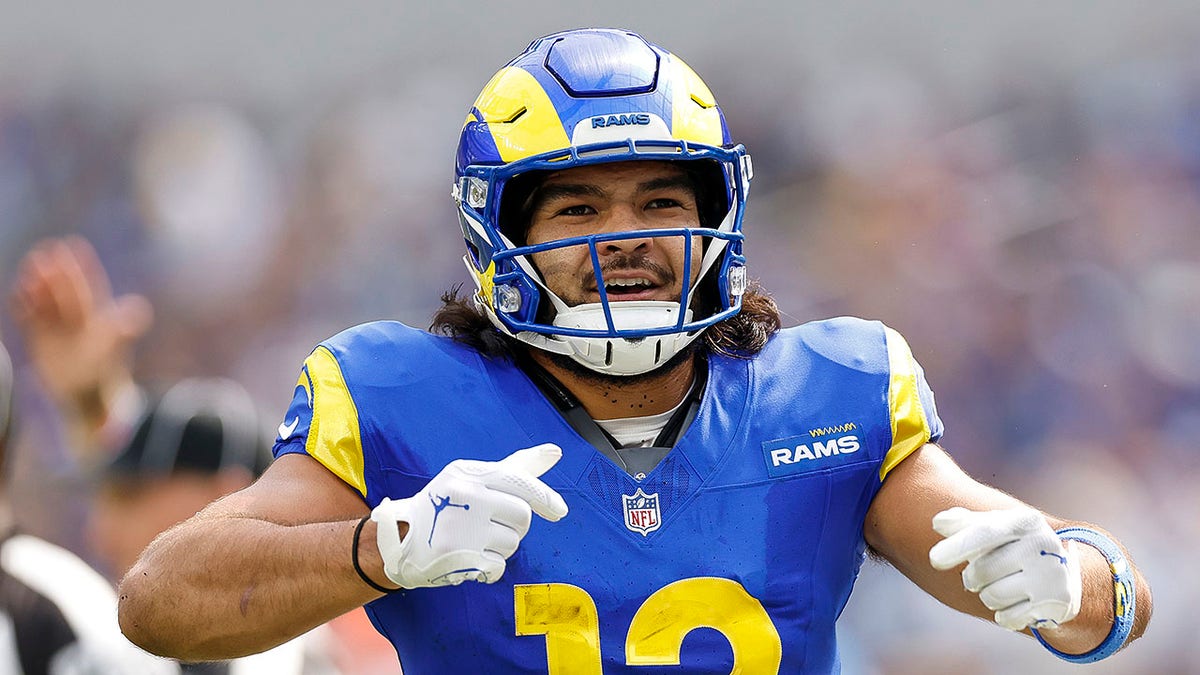
Puka Nacua of the Los Angeles Rams reacts during the second quarter against the Indianapolis Colts at SoFi Stadium on Sept. 28, 2025 in Inglewood, California. (Ronald Martinez/Getty Images)
CLICK HERE TO GET THE FOX NEWS APP
LOOK GOOD, FEEL GOOD, PLAY GOOD
The line above is one that Nacua tries to live by on the field, even if he does enter his infamous “dark place” on game day.
But the Rams receiver refers to himself as a “big energy guy and a smiley guy off the field,” especially now that he has begun his Invisalign aligners at the start of the season. As he’s crushing it in the box score through five weeks, he revealed it’s been five weeks since he began wearing his aligners.
“I’m on schedule right now, we’re staying in tune, and they help me sleep good. They also give me so much confidence when I go out there on the field. I’m smiling. I like to be a big energy guy and a smiley guy off the field. But on the football field, I think it looks pretty good when I’m mean-mugging out there.”
Follow Fox News Digital’s sports coverage on X, and subscribe to the Fox News Sports Huddle newsletter.










- Coach Hesson, Aqib Javed interfered in selection matters: sources.
- Dar complains 20 players selected, but captain, coach chose wrong 15.
- Salman Agha showed no resistance on selection matter, says Dar
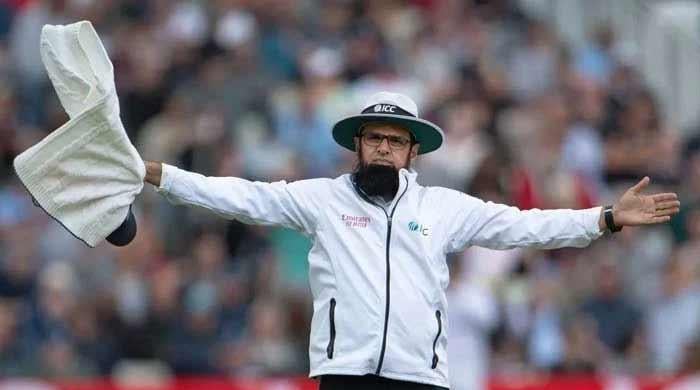
KARACHI: Following Pakistan’s poor performance in the Super Four stage of the ICC Men’s T20 World Cup and the team’s exit from the event, a member of the national selection committee, Aleem Dar, has decided to resign.
According to highly reliable sources, the ICC Elite Panel umpire stepped down due to extraordinary interference in selection matters by head coach Mike Hesson and the silence of the influential selection committee member Aaqib Javed.
Aleem Dar complains that selectors had announced Pakistan’s best 20 players, but then the captain and coach chose the wrong 15, followed by incorrect selections in the playing XI. As a result, selectors are left only to face criticism.
During the ICC Men’s T20 World Cup, Aleem Dar had expressed reservations over the inclusion of former captain Babar Azam and all-rounder Shadab Khan in the squad despite their lack of performance. However, Captain Salman Ali Agha, who, according to Aleem Dar, did not even merit a place in the squad as captain along with Aaqib Javed, showed no resistance. Coach Mike Hesson openly had the final say in selection matters.
Aleem Dar had also proposed that experienced wicketkeeper Mohammad Rizwan should be played at number six instead of wicketkeeper Usman Khan. His stance was that if Shadab and Babar could be part of the team despite their underperformance, then Mohammad Rizwan also deserved another opportunity.
In the current circumstances, Aleem Dar’s resignation is being viewed as a principled decision. He believes that Allah has granted him great respect through cricket, and he does not wish to work as a puppet; therefore, it is better for him to step down.
Premier League soccer is stuck.
The last time the league felt stuck like this was about a decade ago. Despite TV revenues that were lapping the rest of Europe, the best Premier League teams — how can I put this? — stunk.
The league offered nothing unique from a tactical or talent perspective. The best soccer was being played in Germany, Spain, and even Italy. The likes of Bayern Munich, Real Madrid, Barcelona, and Juventus were, inarguably, better than anyone in England. As if to prove the point, Leicester City went out and won the Premier League in 2016.
The following season was the first with Jürgen Klopp and Pep Guardiola in England, and all the problems were almost immediately solved. Liverpool and Manchester City quickly became two of the best teams in the world, and they both did it through compelling risk-forward soccer: Man City by attempting to dominate possession to a degree we’d never seen outside of continental Europe, Liverpool through their vertical, high-pressing “heavy metal football.”
Everyone else was forced to adapt or die, and the next 10 years may have been the peak of English soccer: an era that married technical and physical skill with on-field results. The teams were great — and they were great to watch.
The solution to the Premier League’s rut isn’t as clear this time around, though. Back then, Premier League teams were rich, and all they had to do was hire the guys who built the better soccer that was being played elsewhere in Europe. Now, though, the Premier League teams are rich — and, as we’ve seen in the Champions League, they’re better than everyone else in Europe. And the game has been overwhelmed with set plays in a way I didn’t envision happening — even when I warned about it back in October.
Through 28 weeks, Premier League teams have combined for 505 open-play goals — the fewest since the 2020-21 pandemic season. And if we remove that one season in the history of England’s top flight when there were no fans in the stands, then this is the lowest-scoring season from open play since 2009-10.
Teams have only put 1,659 open-play shots on target so far this season — by far the lowest in Opta’s 17-season dataset, and 300-plus shots fewer than in either of the past two seasons.
Prefer pretty passing to goalmouth action? Well, you’ve been bored to death this year, too: teams have completed 48,248 open-play passes in the attacking third. That’s the lowest since 2011-12 and nearly 10,000 fewer than we saw either last year or the year before.
The best soccer teams in the world have landed on a style of soccer that eschews most of the things most people love about the sport: risky, intricate passing patterns and shots on goal.
Fixing this — and it needs to be fixed, unless you think soccer is the most popular sport in the world because “watching a lot of corner kicks” is our universal language — will require rule changes and new modes of on-field enforcement. But it will also require a coach or a club willing to do something that might break the sport free of its current stalemate.
To any prospective trailblazer out there, I have a suggestion: Do something no one else is doing right now and fully embrace the back three.
– Top 50 USMNT players of 2026, ranked by club form
– Do Premier League summer transfers need more patience?
– Premier League Power Rankings: Chelsea up, Liverpool down
Why nobody plays a back three
Wait, wait — where are you going?
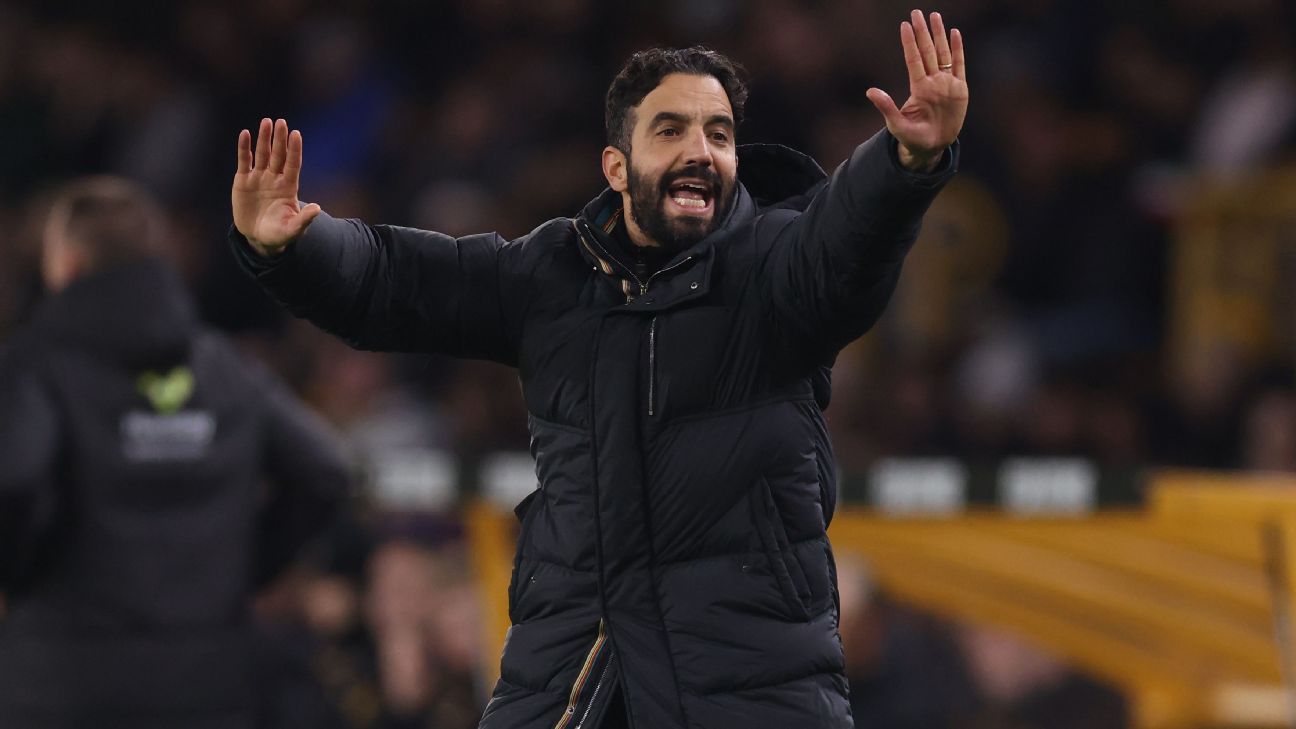
“Um, your big idea is that more coaches and clubs should do what, uh, Ruben Amorim was doing before he got fired? Have you seen Manchester United’s record since they stopped playing with a back three?”
First off, Amorim had the team in sixth place when he got fired. Plus, I’d argue that Manchester United were the one team in the league that was actually playing risk-taking, wide-open soccer. Their matches featured a ton of shots — at both ends of the field. It’s not like he got fired because the team wasn’t doing well. He got fired because he was a pain to work with, as his pre-firing news conference made clear.
“Well, he was a pain to work with because he refused to play anything other than his stupid back three!”
That brings us to the main problem with quantifying the effect of playing with a back three: so many people have given it a bad reputation.
Back in 2022, soccer data analysts Pascal Bauer, Gabriel Anzer, and Laurie Shaw wrote a fantastic paper titled “Putting team formations in association football into context” for the Journal of Sports Analytics. Bauer works for the German FA, Anzer with RB Leipzig, and Shaw recently joined Liverpool after leaving City. These are three of the more accomplished and refined analysts in the sport, and it’s obvious in the paper.
Formation notations, of course, are largely meaningless. Games are dynamic, player movement is fluid and unpredictable. “No 4-4-2s are created equal” and all that. So, to define a team’s formation, the trio looked at how a team positioned their players in the buildup phase — once they’ve settled possession, the opposition has settled into its defensive shape, and the challenge becomes: “How do we move the ball up the field?”
By using tracking data from seven Bundesliga seasons, they identified that most teams tend to build up with either two or three defenders as the deepest line of players — the former indicating a back four, the latter indicating a back three. Most teams also defended the buildup phase with either a back four or a back three. They compared the success of the various formations against each other by looking at the average expected goals created in each matchup.
“The conclusion is that the three-defender build-up formation appears to be more easily countered than the two-defender formation while showing less of an upside benefit against other formations,” they wrote. “Building up with two defenders is significantly more popular amongst Bundesliga teams than building with three defenders; our results indicate that the latter does indeed appear to be a weaker option.”
The one caveat to their findings, the authors note, is that if there were a preference among stronger or weaker teams to favor a certain buildup structure. The paper was published in March 2023, and the back four was the formation of choice at Bayern Munich, who would win their 11th-straight title just a few months later.
And a year after that, the Bundesliga winner could go undefeated for the first time ever — except, this time, it wasn’t Bayern Munich. It was Xabi Alonso’s Bayer Leverkusen, and they played with a back three.
Want to overachieve? Play a back three
Over the past 10 or 15 years, if a team has overachieved, they were probably playing back three.
Who has been the biggest overachiever in the Champions League over the past five years? Inter Milan’s annual revenues usually make them the 13th or 14th richest team in the world, and they’ve made it to two of the past three finals in the European cup — something no other team in the world can say.
The most surprising Champions League winner of the past 10 years? Frankly, the only surprising Champions League winner of the past 10 years? That would be Chelsea in 2021 — the same season they fired Frank Lampard and finished in fourth place in the Premier League. When Thomas Tuchel was brought in to replace Lampard midseason, what did he do? He switched to a back three. Oh, and the last time Chelsea won the Premier League, in 2017? They played a back three.
When RB Leipzig made a run to the Champions League semifinals in 2020, they were playing a back three. Remember how Atalanta used to flirt with Serie A titles every season? For most of that time, they played a back three.
How about when Sheffield United finished in ninth place a season after being promoted? A back three. Heck, remember when Tottenham Hotspur used to challenge for Champions League places instead of fending off a place in the Championship? The last time they finished top four, they were playing a back three.
But it’s not only upstarts catching everyone else off guard. Juventus used to win Serie A every year and make deep runs in the Champions League. And while their recent decline has much more to do with blatant corruption and club mismanagement than the formation they play, they’ve also moved away from the back three that brought them so much success.
And what about maybe the best team we’ve ever seen, the 2022-23 Manchester City side that won the treble? They caught Arsenal and everyone else once Guardiola shifted into something like a back three, where they’d play four defenders — Rúben Dias, Nathan Aké, one of Manuel Akanji and Kyle Walker, and John Stones — and then Stones would step into the midfield in possession. The outside backs would then pinch in, rather than running forward.
Here’s what their pass map looked like in the first half of the Champions League final against Inter Milan:
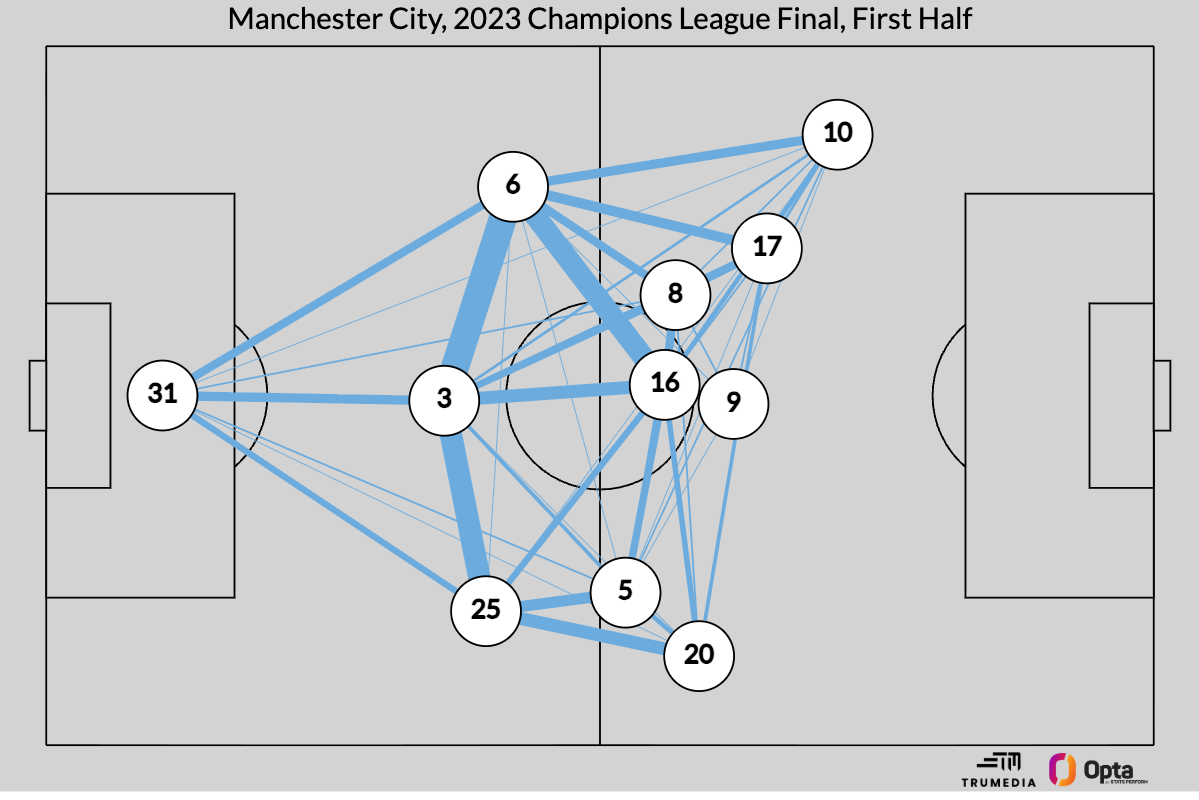
It’s been good enough to win the treble, make multiple Champions League finals, and go undefeated in the Bundesliga, but it’s still not good enough for anyone in the Premier League … yet.
Why it’s time for the Premier League to embrace the back three
Per Opta’s designations, here’s the frequency with which every formation has been used in the league since 2009:
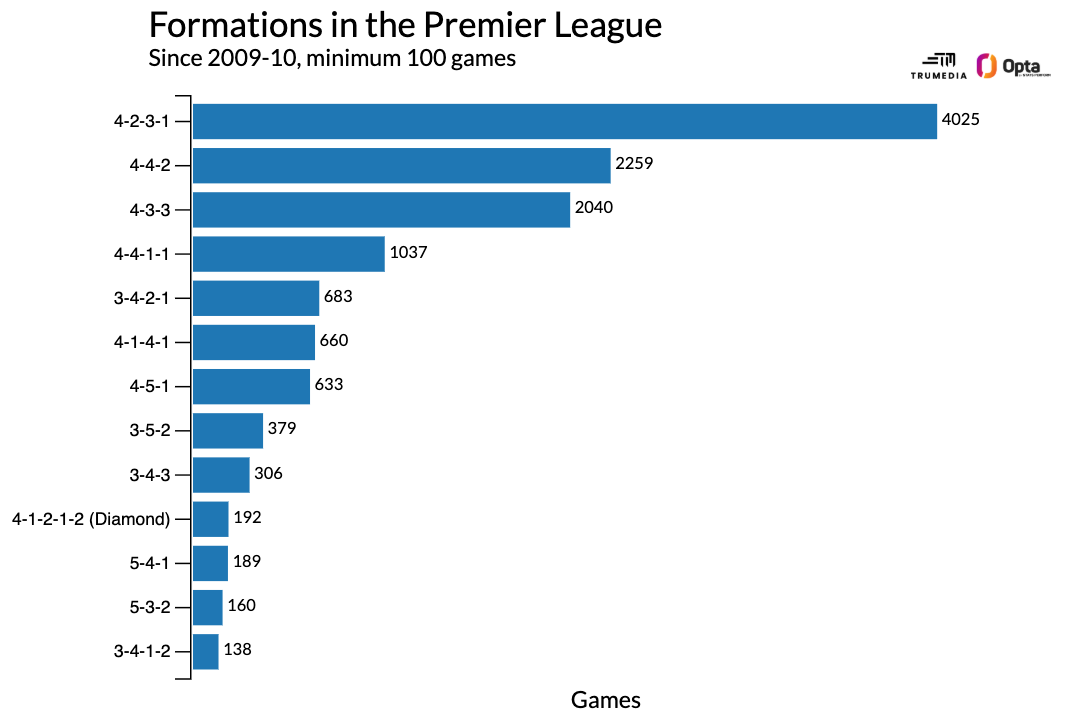
Formations are fluid and not all built the same, so plenty of caveats apply, but it’s clear that the back four, in its three different guises — first the 4-4-2, then the 4-2-3-1, followed by the 4-3-3, and now back to the 4-2-3-1 — is king.
And, well, the results would seem to support these choices. Here’s the collective goal differentials of all of those formations:
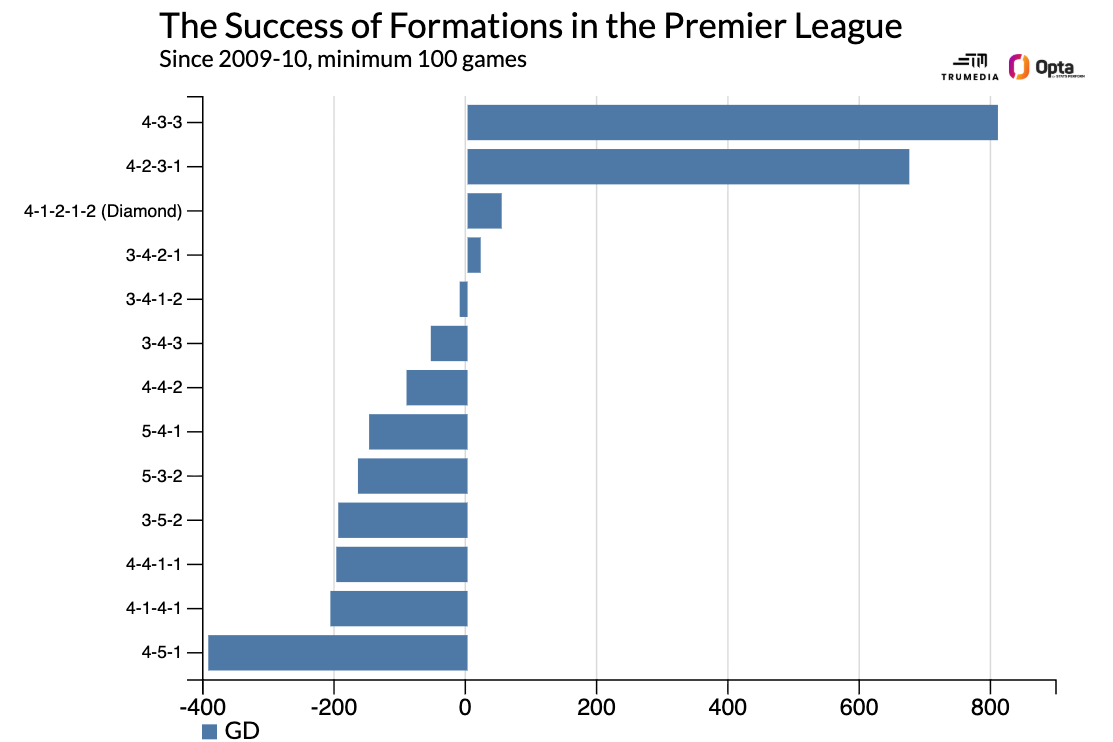
But as the authors of the Bundesliga study asked, how much of that is because of the true efficacy of the back four and how much of that is simply because the best teams in the Premier League happen to play with a back four?
Now, I think we should give the likes of Guardiola and Klopp some credit — that they, and other top managers, favored back fours because it was a more effective base arrangement to build from. And I think it probably was. If you were able to pin the ball high up the field, circulate possession up, back, around, and through your opponent, and only have to occasionally snuff out counter-attacks, then it made sense for you to only have two nominal centerbacks on the field.
To be an utterly dominant team like Manchester City and Liverpool were — or Bayern Munich are — then the back four is probably the optimal arrangement. Why? Simply because it puts more attack-first players on the field and asks fewer players to cover the areas you’ll occasionally need to defend.
But the Premier League has changed. Guardiola complains about it every week: everyone is more athletic and everyone can man-to-man mark your players now. The best clubs don’t necessarily have more elite talent than they had five or seven years ago, but the rest of the Premier League is gobbling up the types of players who would’ve played for Borussia Dortmund and AC Milan back then.
As such, these teams can’t be pressed off the field as easily as they were in the past. (Plus, the top teams are playing so many games that Klopp-style gegenpressing might be a physical impossibility anyway.) And when they do get pinned back, the quality of the players who are “parking the bus” is way higher than it used to be, as is the quality of the players who will launch the occasional counter-attack out of the deep block.
That all leads to where we are now: the ball rarely ends up near the goal, and the only way you can consistently score goals is from set pieces. Liverpool’s season was on the brink of falling apart, then they fired their set piece coach, scored seven set piece goals in a row, and now they’re three points back of third. This is just how it works right now — and it’s not fun.
The game is screaming out for someone to try something different — and to me, that’s where the value of a top team switching to a back three lies: it’s different. It may not have been the optimal approach when you needed 90 points to win the league, but it seems clear that the league has figured out how to negate the front-foot 4-3-3 or 4-2-3-1 style that the best teams in the Premier League have favored over the past decade. At the very least, the back-three base would create new angles that the rest of the league isn’t used to seeing.
Doing something different, too, would create all kinds of advantages in team-building.
These are the four hardest roles to fill in the sport: (1) a ball-playing centerback who is athletic enough to play in a high line but also big enough to dominate in the air, (2) a technically skilled fullback with the physical capacity to cover an entire sideline, (3) a defensive midfielder who can cover all the space behind the attackers and help progress the ball up the field, (4) and a goal-scoring, ball-dominant winger. They’re cheat codes for a back-four system. And at a given moment, there might be five of each of these players in the world.
To acquire one of these guys, you have to get really lucky and, say, happen to have a stadium in the same town that Trent Alexander-Arnold was born in, or you have to spend hundreds of millions of dollars in transfer fees just for the chance of acquiring one of them.
But what if you could play in a way where you didn’t have to chase any of those player types? Wouldn’t that be a massive advantage on the transfer market?
In, say, a base 3-5-2 system, none of those roles are really necessary. With three center backs, you’re not asking one or two guys to cover an entire half of the field by themselves. The wingbacks don’t have quite the same defensive responsibilities as top-level fullbacks. The midfielders need not be as rangy since there’s more defensive support behind them. And the attacking onus shifts more toward strikers and attacking midfielders, rather than wide forwards.
(In case you’re wondering: yes, Liverpool’s current and future personnel feel particularly suited for this approach.)
While Amorim’s devotion to the back three made it seem like the least flexible formation in the world, it should be way more flexible than the way we’re used to seeing top teams play. When you have those skeleton-key type roles, then you need to have those players on the field, playing those roles. But the 3-5-2 should be infinitely customizable, and it seems like it would better fit the new mold of front-office-driven team building, where some clubs try to identify undervalued players and then task the manager with figuring out how to piece it all together.
If you’re playing a top team, then maybe one of the front two is an attacking midfielder, and that allows you to clog the middle of the field and control the ball. Against lesser opposition, you can drop the midfielder into the midfield three and play with two actual strikers. The same goes for wingbacks. If you’re chasing the game or are expected to have lots of possession, you can just play an actual winger in that role.
Need more solidity? Then throw in a more traditional fullback. It’s true with the center backs, too. Three bigger center backs can solidify the defense, but you can play around by dropping a midfielder or a fullback into one of the outside centre-back slots. Different players will interpret the roles differently and change the overall dynamic.
Formations are just telephone numbers, as Guardiola has said. Picking your starting formation isn’t coaching or tactics — developing a style of approach, a relationship between your players, and an overall appetite for risk is what matters. Regardless of the formation you play, soccer will always be about creating space, controlling space, and exploiting space.
At least for now, though, there just isn’t much space in the Premier League, save for the moments when a guy can launch a long throw-in with his hands from the sideline or whip in a cross from the corner flag. It won’t last forever, but if it’s going to change, somebody is going to have to start doing something different.
Somebody, please, try winning some games by playing a back three.

The Pakistan Super League (PSL) franchise formerly known as Sialkot Stallionz has been renamed Multan Sultans following a majority acquisition by CD Ventures, PSL Chief Executive Salman Naseer said on Tuesday.
He made the announcement at a joint news conference alongside franchise owner Hamza Majeed and CD Ventures chief Gohar Shah.
Naseer said CD Ventures has taken a majority stake in the team, which was initially bought by OZ Developers for Rs1.85 billion at the PSL auction held in January.
Naseer revealed that, following the latest developments, the franchise’s valuation has risen to Rs2 billion annually.
“Gohar Shah requested to change the franchise’s name after becoming CEO, and that request has been accepted,” Naseer said.
“Sialkot Stallionz will now compete as Multan Sultans.”
Majeed described the arrangement as a strategic partnership approved by both the Pakistan Cricket Board (PCB) and the PSL.
“With PCB and PSL approval, this strategic partnership has been finalised,” Majeed said. “CD Ventures’ Gohar Shah is now our strategic partner and will serve as the franchise’s CEO going forward.”
He praised Shah’s enthusiasm, adding: “Gohar Shah’s passion and drive are even greater than mine. Seeing his energy makes me happy, and I welcome him to our league.”
Speculation had surrounded the Sialkot franchise in recent weeks amid reports that OZ Developers had offloaded a significant portion of their shares after one of their partners withdrew shortly after the PSL auction.
There were also unverified claims of financial difficulties within the parent company, which Majeed publicly denied last week, confirming only that discussions with CD Ventures were ongoing.
Speaking at the press conference, Gohar Shah confirmed he has officially joined the franchise as CEO and expressed his desire to restore South Punjab’s representation in the league.
“A stallion alone cannot win the PSL. To move forward, a stallion needs a sultan, and we have come as Sultans,” he remarked.
He added that retaining the Multan identity was important to him.
“It was my wish that the name Multan Sultans remain, and for me it was essential,” he said.
Shah also outlined his broader cricketing vision, which he has termed “Total Cricket”.
“Cricket should be played in a way that serves Pakistan cricket’s needs. In my opinion, the squad selected is correct. Final decisions on the playing XI and other matters will be taken once the camp begins,” he added.
Despite the name change, Majeed assured Sialkot supporters that their backing would not be overlooked.
“We are grateful to Sialkot Stallionz fans for their encouragement,” he said. “There will still be an element of the Stallionz identity visible in our campaign.”
He also confirmed that transport arrangements would be made for Sialkot supporters to attend Multan Sultans matches during the season.
The rebranding marks a significant shift ahead of PSL season 11, which is scheduled to commence on 26 March across five venues in the country.


ICE cotton drops 1% on Middle East war, stronger US dollar

US stock market: Wall street crashes amid Iran tension; Dow jones slips over 900 points, Nasdaq dips by 2% – The Times of India

PM invites lawmakers, party chiefs for in-camera briefing on regional conflict

-

 Politics5 days ago
What are Iran’s ballistic missile capabilities?
-
 Business7 days ago
Households set for lower energy bills amid price cap shake-up
-

 Sports5 days ago
Sri Lanka’s Shanaka says constant criticism has affected players’ mental health
-

 Sports1 week ago
Top 50 USMNT players of 2026, ranked by club form: USMNT Player Performance Index returns
-

 Politics5 days ago
US arrests ex-Air Force pilot for ‘training’ Chinese military
-
 Business7 days ago
Lucid widely misses earnings expectations, forecasts continued EV growth in 2026
-

 Fashion1 week ago
OECD GDP growth slows to 0.3% in Q4 amid mixed trends
-

 Fashion5 days ago
Policy easing drives Argentina’s garment import surge in 2025