

Politics
How the Bondi Beach mass shooting unfolded

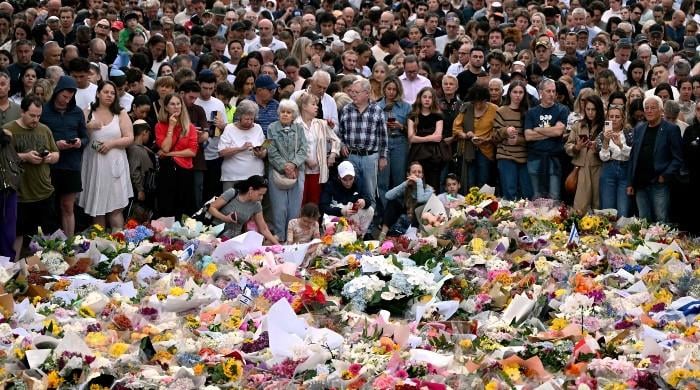
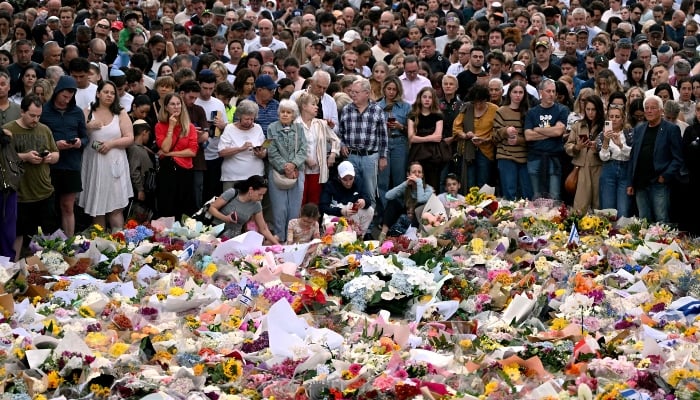
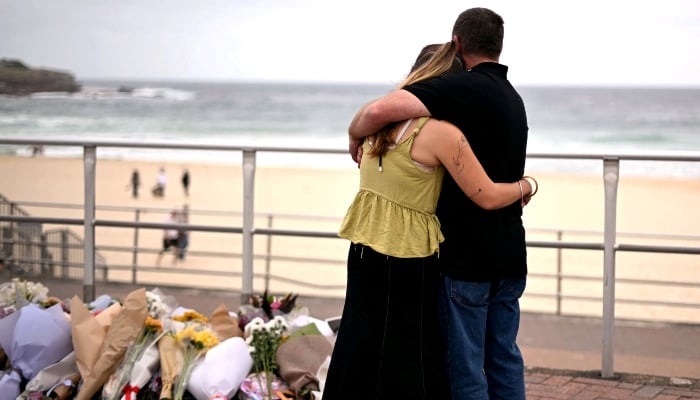
SYDNEY: Australia is reckoning with one of its deadliest mass shootings after a father and son opened fire on crowds gathered for a Jewish festival at Bondi Beach.
Using witness testimony, amateur footage and official statements, AFP pieced together a timeline of Sunday’s attack that killed 15 people and wounded dozens.
Teenage Daesh supporter
Naveed Akram, 24, first caught the eye of Australia’s intelligence agency in 2019, when he was a teenager rubbing shoulders with supporters of the Daesh group in Sydney.
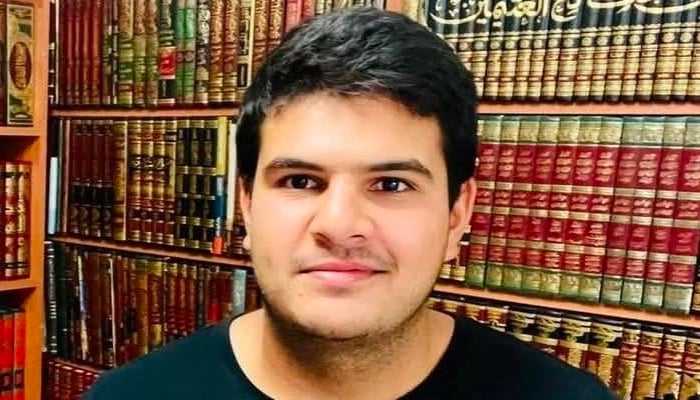
Prime Minister Anthony Albanese said on Tuesday two of Naveed’s associates were later jailed but he was not considered a serious threat and largely fell off the radar.
That was until he joined his 50-year-old father Sajid Akram in a shooting spree aimed at Jewish crowds gathered to celebrate Hanukkah.
Philippines trip
Sajid and Naveed booked a trip to the southern Philippines in the weeks before the attack but the purpose of their visit remains unclear.
Australian broadcaster ABC said they went to run military drills with extremist organisations.
They had already been radicalised by an “Daesh ideology” by that point, authorities said.
Going fishing
Naveed told family before the shooting that he was taking his father on a fishing trip to Jervis Bay, about two hours’ drive south of Sydney.
He later told his mother stories about scuba diving, what he had been eating, and how he was wilting in the oppressive heat.
“Anyone would wish to have a son like my son… he’s a good boy,” his mother Verena told local media.
However, the pair were in reality staying at a humble Airbnb in Sydney’s outer suburbs, where authorities believe they plotted the attack.
Police later seized two guns from the property.
5.15pm
The pair left their hideout on Sunday afternoon bound for Bondi, according to CCTV footage obtained by the Sydney Morning Herald.
They drove through light Sunday traffic, and then parked their car and watched the busy beach below.
Donuts, ice cream
It was a typical sweltering summer Sunday afternoon at one of Australia’s most famous tourist hotspots.
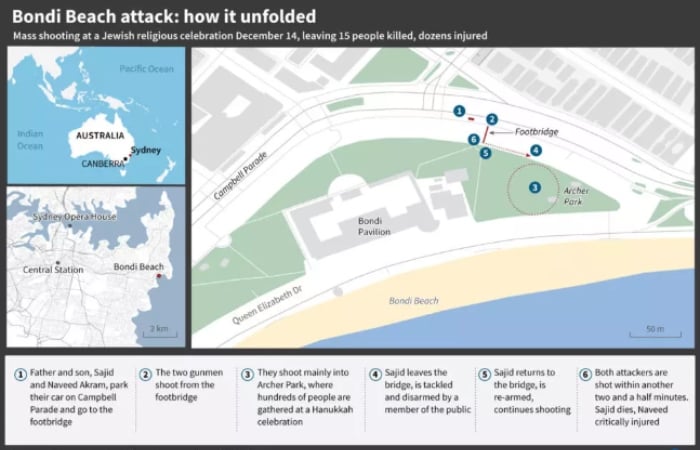
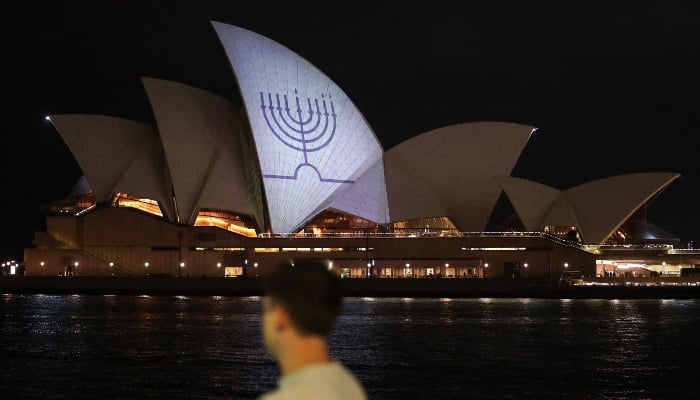
Hundreds of worshippers joined the typically bustling crowds for an event to mark the start of Hanukkah, the Jewish festival of light.
“Let’s fill Bondi with joy and light,” read flyers promising free donuts, ice cream and hot chips.
There was also a petting zoo and face painting for children.
6.47pm
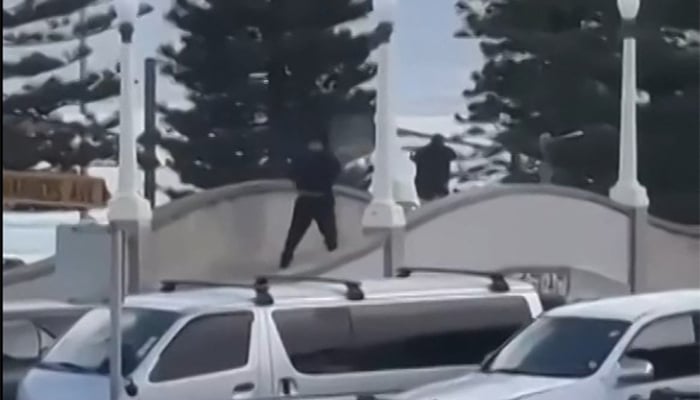
Hanukkah celebrations were in full swing when Sajid and Naveed, armed with long-barrelled guns, stepped out of their car and began shooting.
“For a split second I felt sorry for him because I thought he was tripping over and picking up crutches… but it’s a gun,” witness Bridget Sarks told the ABC.
It is unclear when exactly the first bullets flew but police said they received the first reports at around 6.47pm.
The festive atmosphere delayed the realisation that something terrible was unfolding.
Many witnesses thought the first cracks of gunfire were nothing more than celebratory fireworks.
Panic
Panic quickly set in.
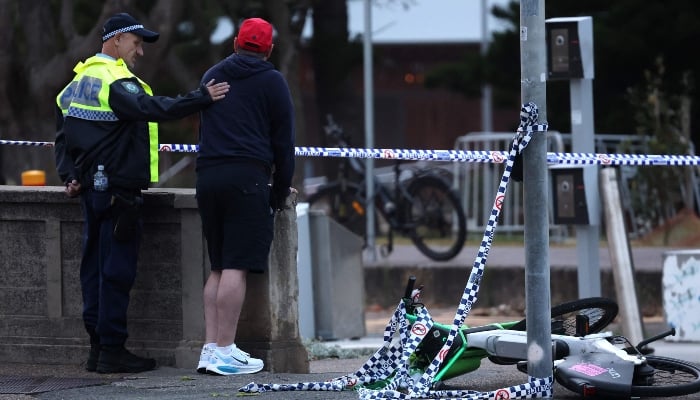
Thousands of beachgoers dropped everything and fled for their lives as the gunshots rang out.
Police gave one of the earliest indications that something truly awful had happened just after 7pm.
“We are still asking people in the area to take shelter until we can determine what is happening,” they said on social media.
A team of off-duty lifeguards sprinted across the sand to drag children to safety.
Others much closer to the gunmen sought whatever cover they could find.
Heather Nolan said she and her family sheltered behind a wooden bench and that she put “my young kids behind the bench and put myself over them”.
Holocaust survivor Alex Kleytman was killed shielding his wife from the bullets.
Reuven Morrison, 62, died as he tried to throw a brick at one of the gunmen.
Ten-year-old Matilda, described by her family as a “happy” child, was shot in front of her younger sister and died in hospital.
Taking shelter
Churches, bars and restaurants threw their doors open to shelter the panicked crowds.
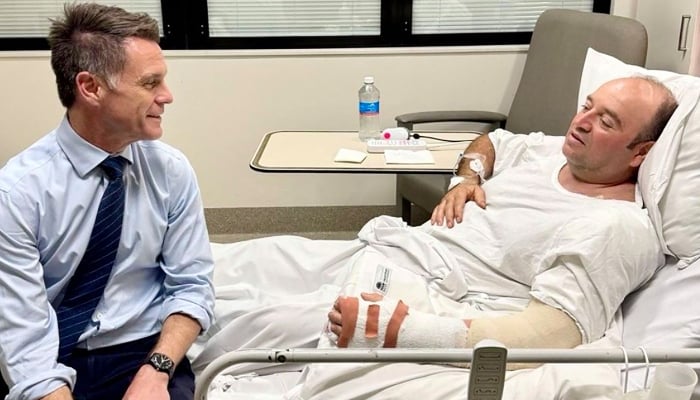
Frenchman Alban Baton, 23, hid for several hours with other customers in a grocery store cool room.
At around that time, Sajid Akram left a footbridge that offered a commanding view of the area and advanced towards the festival.
As Sajid fired into the crowd, fruit seller Ahmed Al Ahmed — who had been getting coffee with friends — approached him from behind and tackled him in a heroic act broadcast around the world.
Ahmed wrestled the gun away before pointing it at the assailant, who then backed away.
Ahmed was shot twice but it isn’t clear when or by whom.
Naveed remained on the bridge, firing round after round with cold determination.
Police arrive
Onlookers can be heard on video angrily demanding: “Where are the cops? Where are the cops, man?”
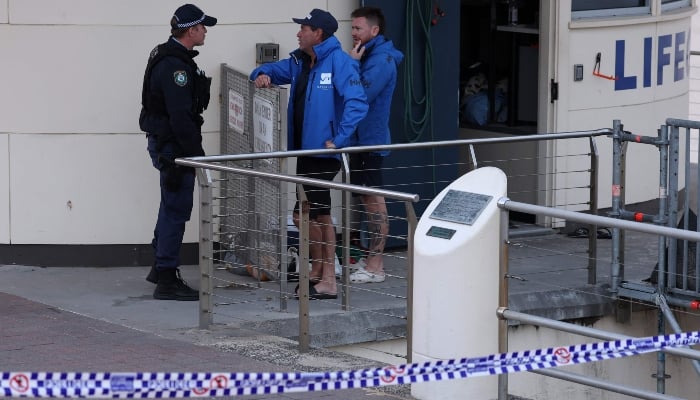
Armed police arrived about 10 minutes into the carnage, as Sajid rejoined his son on the footbridge.
Sajid was killed in an exchange of fire with police. Naveed kept shooting until he, too, was apparently shot and restrained.
Witnesses cheered as he fell to the ground.
Aftermath
Scuffles broke out as one member of the public kicked one of the gunmen, prostrate and surrounded by empty shotgun shells.
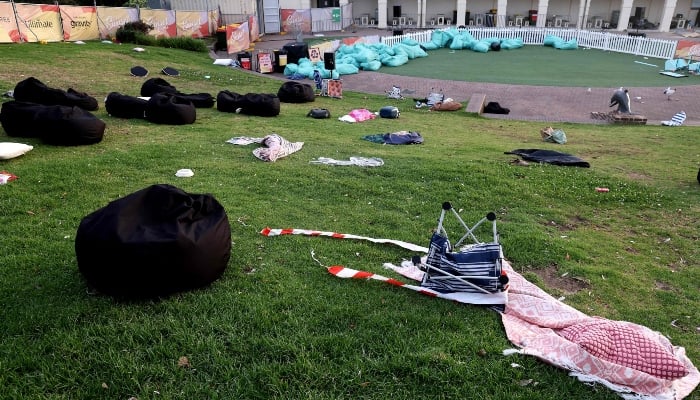
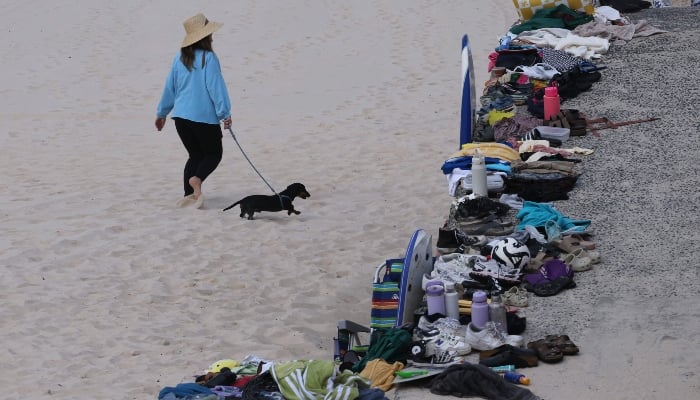
Sirens blared as CPR was frantically administered to the bodies strewn across the beachfront.
One witness described it as a “war zone”.
Bleeding victims were carried across the beach on surfboards used as makeshift stretchers.
Dozens of wounded were rushed to hospital.
At around 9.36pm, New South Wales Premier Chris Minns declared the mass shooting a terrorist attack.
Authorities confirmed next morning that 15 people were killed.
Sajid was also killed, and his son remains in a coma.

- White House sees war powers clock as halted.
- No US-Iran fire reported since early April ceasefire.
- Democrats dispute truce effect on legal deadline.
WASHINGTON: A US-Iran ceasefire that began in early April has “terminated” hostilities between the two sides for the purposes of an approaching congressional war powers deadline, a senior official of President Donald Trump’s administration said on Thursday.
Trump faced a deadline on Friday to end the Iran war or make the case to Congress for extending it, but the date was most likely to pass without altering the course of the war.
“For War Powers Resolution purposes, the hostilities that began on Saturday, February 28, have terminated,” said the official, describing the administration’s thinking.
There has been no exchange of fire between the US armed forces and Iran since a fragile ceasefire began more than three weeks ago, the official added.
Earlier, analysts and congressional aides had said they expected Trump to notify Congress that he planned a 30-day extension or to disregard the deadline, with the administration arguing the ceasefire marked an end to the conflict.
The 1973 law allows the president 60 days to wage military action before ending it, seeking authorisation from Congress or asking for a 30-day extension on grounds of “unavoidable military necessity” for the safety of the armed forces.
The Iran war began with airstrikes launched by Israel and the United States on February 28. Trump formally notified Congress of the conflict 48 hours later, triggering a 60-day deadline of May 1.
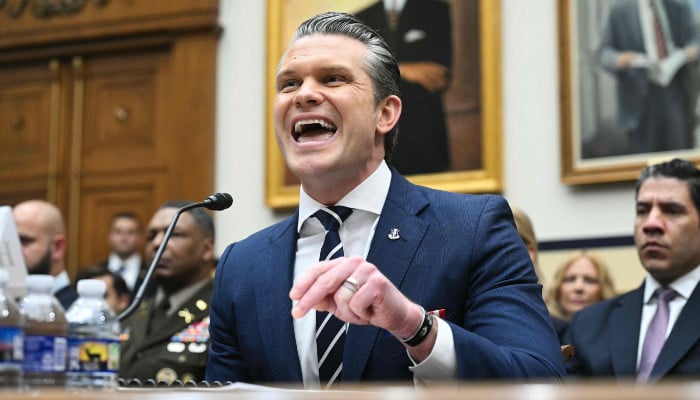
Defence Secretary Pete Hegseth told a Senate hearing on Thursday he understood that the 60-day clock stopped during the truce. Opposition Democrats disputed that, saying there was no such legal provision.
The US Constitution says only Congress, not the president, can declare war, but the curb does not apply for operations the administration casts as short-term or countering an immediate threat.
Trump’s Republican Party holds a narrow majority in both chambers of Congress. Democrats have tried since the war began to pass resolutions to force Trump to withdraw US forces or obtain congressional authorisation.
Republicans have voted them down.
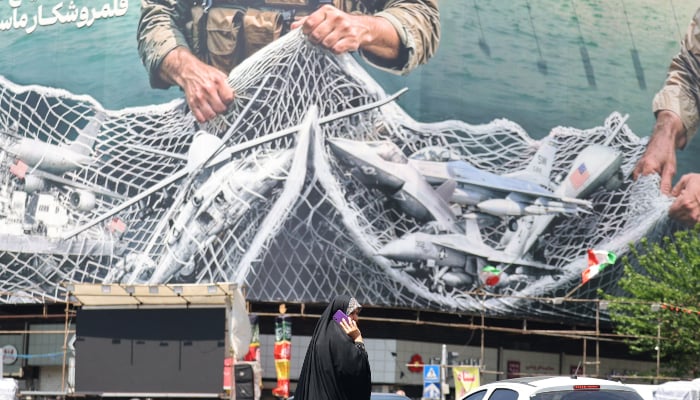
Iran responded to the February 28 attacks by the US and Israel with its own strikes on Israel and Gulf states that host American bases. US-Israeli strikes on Iran and Israeli attacks in Lebanon have killed thousands and displaced millions.
SYDNEY: An angry crowd clashed with Australian police outside a hospital treating the suspected killer of a five-year-old Indigenous girl in the outback town of Alice Springs.
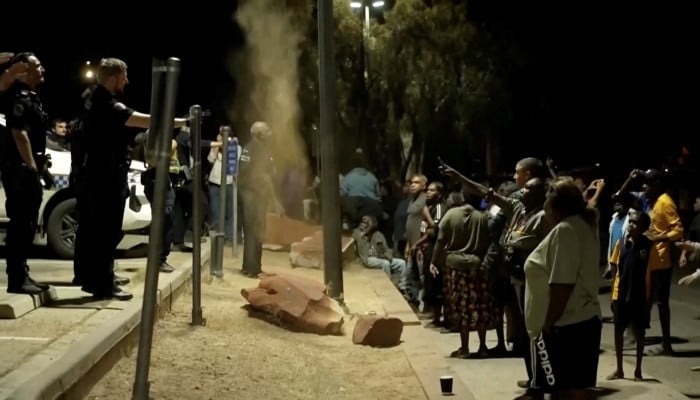
Images on local media Friday showed teargas in the air, a police van in flames, and crowds yelling at armed officers keeping people at bay during the overnight confrontation.
The violence followed the discovery Thursday of a body south of Alice Springs believed to be that of the little girl, referred to at her family’s request as Kumanjayi Little Baby.
She had disappeared from an Indigenous community camp called Old Timers late on Saturday night, sparking a vast, days-long search on foot, horseback, and by helicopter that gripped much of the country.
Police said a formal autopsy would be held on the child’s body, which was found about five kilometres (three miles) from the camp.
Hours after her body was found, police announced they had arrested the suspect, Jefferson Lewis.
‘He was unconscious’
Lewis was beaten until he was unconscious after turning himself in to Indigenous community members on Thursday evening at a camp by Alice Springs, in central Australia.
When police and emergency services intervened, they too came under attack, said Northern Territory Police Force Commissioner Martin Dole.
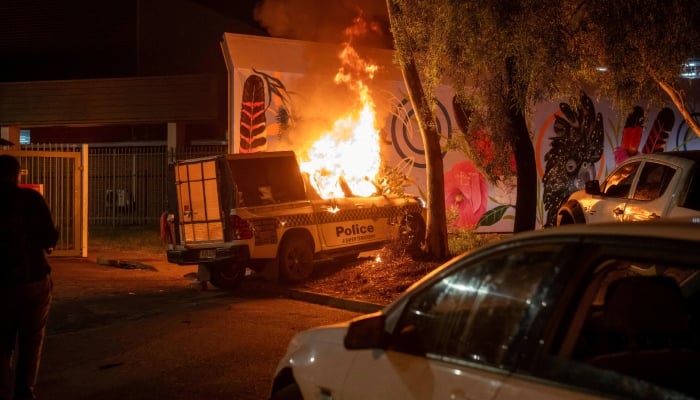
“At the time of his apprehension by us, he was unconscious and he was in the process of being treated by St John’s Ambulance when they were set upon, as were the police,” he told a news conference.
Lewis was then taken to hospital.
“A large crowd gathered and tried to gain access to that hospital,” the police commissioner said.
“We called out all the resources we had available to quell that violent disturbance. And just let me say that the behaviour that we saw last night cannot be explained away, excused or accepted.”
Dole said “a number” of police were injured at the hospital, and one officer was treated for a head wound inflicted during the suspect´s arrest.
Ambulance and fire crew members were also attacked, he said, with one fire and rescue officer receiving a “significant facial injury”.
‘Sorry business’
One woman was being investigated for allegedly trying to set a police car alight.
Many people outside the hospital shouted that Lewis must face “payback”, public broadcaster ABC reported, referring to a traditional punishment in central Australian Indigenous communities.
“I just call for calm across the community,” Dole said.
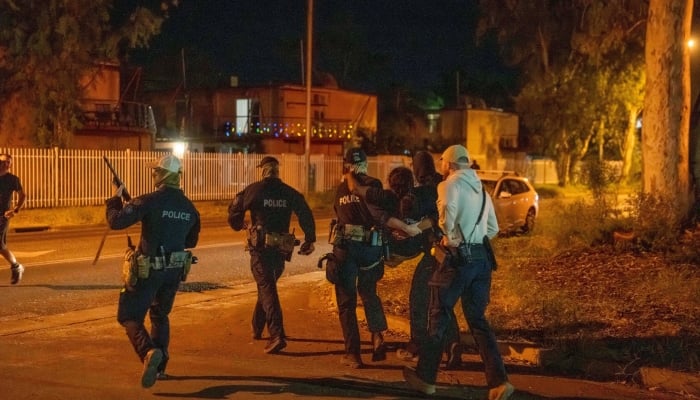
Police said they removed Lewis for his safety from the hospital to the Northern Territory capital of Darwin, where he was being held in custody.
He is expected to face charges in the coming days.
Northern Territory Chief Minister Lia Finocchiaro said the girl’s death was the realisation of “our worst nightmares”.
But it was no excuse for violence, she said, recalling how the community had united to search for the missing child.
“This week, we’ve seen this town come together like never before — hundreds of people walking shoulder to shoulder through the long buffel grass, through the bush, to make sure we left no stone unturned,” Finocchiaro said.
“I don’t want last night to take away from that extraordinary effort.”
Robin Granites, a spokesman for the family and an elder of the Warlpiri Indigenous group, called for calm in the community.
“It is time now for sorry business, to show respect for our family and have space for grieving and remembering,” he said in a statement.
“We need to be strong for each other, we must respect family and cultural practice.”
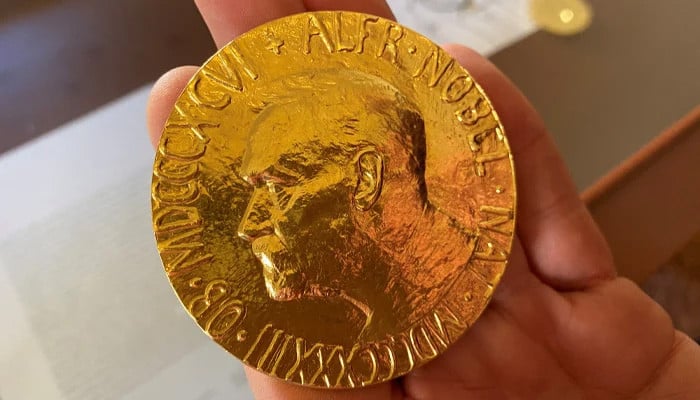
Some 287 candidates will be considered for the 2026 Nobel Peace Prize, the secretary of the Norwegian Nobel Committee said on Thursday, with US President Donald Trump likely to be among the nominees.
Of this year’s nominations, 208 are individuals and 79 are organisations, said Kristian Berg Harpviken, adding that there were many new nominees compared to last year.
“Since I am new in the job, one of the things that has to some extent surprised me is how much renewal there is from year to year on the list,” Harpviken said in an interview. He has held the position since January 2025.
Despite the number of conflicts rising worldwide and international cooperation under pressure, the award remains relevant, he added.
“The Peace Prize is even more important in a period like the one we’re living in,” he said. “There is as much good work, if not more, than ever.”
Trump likely nominated, but not confirmed
The leaders of Cambodia, Israel and Pakistan have said they nominated Trump for this year’s prize. Their nominations, if made, would have been done in spring and summer 2025, and they are therefore valid given the deadline was January 31.
There is no way of verifying they have done as they have said as nominations remain secret for 50 years and Harpviken declined to say on Thursday whether Trump had been nominated.
A nomination is not an endorsement by the award body.
In addition to committee members, thousands of people worldwide can propose names: members of governments and parliaments; current heads of state; university professors of history, social sciences, law and philosophy; and former Nobel Peace Prize laureates, among others.
Many names appear on betting sites giving odds on this year’s possible laureates, from Russia’s Yulia Navalnaya, the wife of the late Russian opposition leader Alexei Navalny, to Pope Leo and Sudan’s Emergency Response Rooms, a volunteer aid group, among others.
Concern for health of jailed Iranian laureate
Harpviken said the committee was deeply concerned about the health of the 2023 Peace Prize laureate, Iranian human rights activist Narges Mohammadi, which is worsening after she suffered a heart attack in prison.
Her supporters said on Wednesday her life was in imminent danger.
“Her sister was able to visit her in prison yesterday and the reports coming out after that are actually quite alarming as to her health condition,” said Harpviken.
“We see there is a lot of international pressure now. So we hope that the Iranian authorities do pay attention to that and release her so that she can have proper medical treatment.”
Who else could be nominated?
Among possible nominees for this year’s prize are Lisa Murkowski, the US senator for Alaska, and Aaja Chemnitz, a member of the Danish parliament elected from Greenland, according to the Norwegian lawmaker who nominated them both.
“Together they have worked relentlessly to build trust and to secure a peaceful development of the Arctic region over many years,” said the lawmaker, Lars Haltbrekken.
Greenland has been in particular focus this year due to Trump’s relentless push to acquire the island from Nato ally Denmark.
This year’s Nobel Peace Prize will be announced on October 9, while the ceremony will take place on December 10.


Germany’s Adidas posts strong Q1 on DTC momentum, broad demand

Gross GST collections hit record high of Rs 2.43 lakh crore in April 2026 despite US-Iran war concerns – The Times of India

De-risking from China just got easier with India-New Zealand FTA

-

 Sports1 week ago
PSL 11: Hyderabad Kingsmen opt to field after winning toss against Multan Sultans
-
 Business1 week ago
Trump administration in advanced talks for a rescue package for Spirit Airlines, source says
-

 Entertainment1 week ago
Anne Hathaway shares major news about ‘Princess Diaries 3’
-

 Tech1 week ago
Microsoft faces court battle in £2bn Windows Server class action | Computer Weekly
-
 Business1 week ago
Gold prices in Pakistan Today – April 23, 2026 | The Express Tribune
-

 Entertainment1 week ago
Mike Vrabel to miss Patriots’ final NFL draft day —here’s why
-
 Business1 week ago
High-Skilled Immigration: US tightens screws on high-skilled immigration: Denial rates surge across key visa categories – The Times of India
-

 Fashion1 week ago
Canada forms new advisory committee to strengthen US trade relations