

Fashion
In Milan, Ferragamo, Stella Jean and MSGM bank on a vibrant summer


Published
September 28, 2025
Fever gripped Milan on Saturday, as Meryl Streep, in the midst of filming “The Devil Wears Prada 2”, was spotted in the front row at Dolce & Gabbana. In this effervescent atmosphere, the Milanese couturiers were particularly optimistic, banking on a rebound. For next summer, they are betting on a return to lightness and a sense of fun, with creations brimming with vitality. Their women’s ready-to-wear collections for spring/summer 2026 give pride of place to fluid, colourful garments, rich in detail, texture and print—particularly at Ferragamo, Stella Jean and MSGM.
Class, sensuality, movement. With Maximilian Davis steering the aesthetic since 2022, Ferragamo continues its repositioning, cultivating a distinctive idea of luxury and elegance. Sophisticated silhouettes and exquisite materials remain, once again, the cornerstones of its wardrobe.
This season, the British designer played as never before with colour and texture, developing two strands: one feminine, the other more masculine.
The tailoring chapter embraced dark tones and an austere, almost wintry spirit, with sweeping coats, trench coats and a series of suits. Loose, pooling trousers came with swathing tuxedo jackets, cinched at the waist by a long, fringed satin scarf. At times, these suits assumed the ease of pyjamas and dressing gowns. Leather appeared, for instance, in a tank top paired with a straight suede skirt, while a short-sleeved little black dress came cut in vinyl.
The other side of the collection leaned into refined sensuality with diaphanous, often sheer fabrics, such as organza tops split vertically at the front, or lace slips inlaid with satin. Silk dresses stopped above the knee, sometimes extending into long, floor-skimming ribbons or fine fringing. This fringed detail also traced the flanks and cuffs, evoking the fluid, swinging looks of the 1920s.

Back on the Milan catwalks after a three-year absence, Stella Jean delivered a collection rich in colour and craftsmanship. Known for her cross-cultural fashion, the Italian-Haitian designer took guests this time to Bhutan, where she had various pieces produced by local craftswomen using ancestral techniques.
These included traditional Tego jackets and the kira dress (a rectangular piece of fabric wrapped around the body), made on handlooms. Another example: sleeveless coats woven from nettle fibres, onto which the designer had the various stages of production— from harvesting to weaving—embroidered in brightly coloured wool yarns.
With its vibrant palette and clever mix of prints and painted motifs, the collection skilfully fuses classic pieces with unique creations touched by the ethnic, such as intricately woven aprons, tapestries worn as bustiers or rugs wrapped around the waist as skirts. In tall fishermen’s waders worn musketeer-style, the models appear in multicoloured embroidered dresses, topped with straw hats—each one different—and adorned with bold shell necklaces.

Stella Jean’s high-end women’s ready-to-wear line has always spotlighted endangered artisanal skills, which she strives to preserve around the world.
“I said I’d be back on the catwalks when I had something to say. I’m back with two concrete proposals to safeguard the production chain. I’m appealing for VAT to be lowered for all craft-fashion products, and for our artisans to be able to benefit from self-certification,” the designer said backstage.
At the end of her show, Stella Jean came out brandishing the white T-shirt with the slogan “Grazie, Mr Armani”, which she wore in 2013, when the couturier showed his support by allowing her to stage her first show in Milan. “I wanted to pay him one last tribute. He did a lot for fashion. It’s thanks to him that Made in Italy has become a real passport around the world,” she said.

At MSGM, Massimo Giorgetti transformed his boutique in the centre of Milan, at the height of Saturday shopping, into a vast, glass-walled backstage and photo studio, where passers-by can observe through the broad shop windows—like an enormous aquarium—the different phases of putting a fashion show together, from fittings and make-up through to the shoot.
“I wanted to open the boutique to everyone’s view to celebrate the house and the teams. It’s a symbol, too. The place where we work and where we sell fashion,” explained the designer, who founded the label some fifteen years ago.
The streetwise, carefree girls of his early days have evolved into young women. They still display a fresh, joyful style, but with a slightly more refined touch. Their wardrobes took in elegant couture-flared dresses in cotton poplin and polka-dot chiffon numbers, little marled coats and floral-printed duchesse satin ones. Not forgetting the essential cardigan, reimagined in pop pink or orange and studded with metal.
Giorgetti proposes a fashion firmly anchored in the present, as evidenced by the models who leave the boutique and cut through the adjoining street before a delighted audience, bag tucked under the arm—just like in real life. They slip into pretty little dresses, tartan mini-skirts and hybrid T-shirts splicing motifs. They play with Breton stripes, mixing them with metallic silver pieces. A striped cropped jumper tossed over a white maxi shirt and wide-leg trousers is enough to give them instant flair.
This article is an automatic translation.
Click here to read the original article.
Copyright © 2025 FashionNetwork.com All rights reserved.










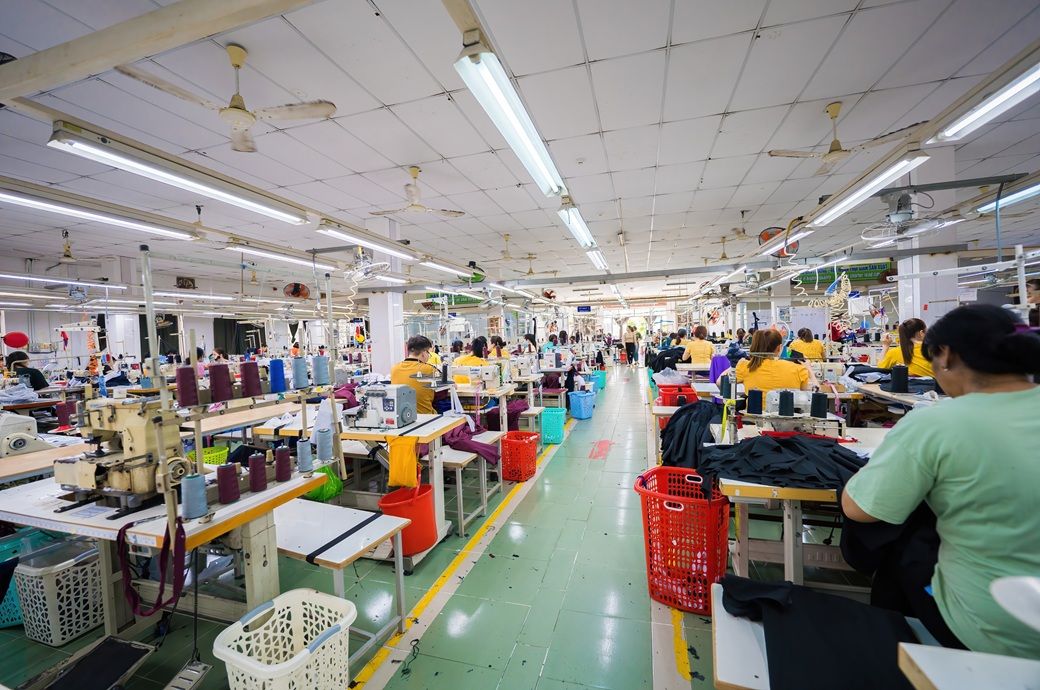
With sustainability benchmarks rising, companies are rethinking how they produce and deliver, pivoting toward greener, more circular models that reduce waste, emissions, and resource use.
The stakes are high. In 2025, Vietnam’s exports to the EU reportedly reached $56.2 billion, up 10.1 per cent year on year, underscoring how pivotal Europe is for the country’s manufacturing base.
Vietnam’s textile and footwear exporters are accelerating sustainability efforts as stricter EU regulations reshape market access requirements.
Rising compliance pressure from measures such as CBAM and ESPR is pushing manufacturers toward circular production, cleaner technologies and greater supply-chain transparency, though limited green finance remains a major challenge for smaller firms.
The EU market, nevertheless, comes with its own challenges as access to this market increasingly depends on meeting strict environmental and product-design requirements.
The EU is rolling out an ambitious sustainability agenda, including the Carbon Border Adjustment Mechanism (CBAM) and the Ecodesign for Sustainable Products Regulation (ESPR). Together, these measures are changing what global suppliers must document, design, and decarbonise.
ESPR shifts expectations toward durability, repairability, and recyclability, while pushing manufacturers to reduce products’ overall environmental footprint. Supply chains are also expected to become more transparent through Digital Product Passports, and practices such as destroying unsold goods being phased out gradually.
For Vietnam’s exporters, compliance is becoming a baseline requirement to keep EU orders and remain competitive.
Recognising this, both the Government and industry players are stepping up. Vietnam’s long-term development strategy for textiles and footwear, which stretches to 2030 with a vision toward 2035, places sustainability at its core. The plan charts a path toward efficient, environmentally responsible growth anchored in a circular economy, where materials are reused, waste is minimised, and production cycles are closed rather than linear.
Crucially, it also provides a legal backbone to help businesses align with global sustainability trends.
On the ground, change is already underway. Textile and apparel manufacturers are investing in renewable energy, upgrading machinery, and fine-tuning production processes to cut emissions and resource use. These shifts are not just about compliance; they are about future-proofing operations in a market where green credentials increasingly determine who wins contracts.
However, the transition has not been entirely seamless. A key barrier seems to be access to green finance, especially for small and medium-sized enterprises. Large firms can more readily fund clean technologies and certification, while smaller suppliers often struggle to fund the shift, risking exclusion from high-value export markets if they cannot keep pace.
There is also a growing recognition that policy support needs to go further. As Vietnam leans into a circular economy, industry voices are calling for a more cohesive and comprehensive framework, one that not only sets clear standards for circular products but also actively incentivises recycling, cleaner production, and sustainable innovation.
Without this, progress risks being uneven, with smaller firms left behind.
Momentum is, nevertheless, building as manufacturers and policymakers push for better-aligned standards and support mechanisms. The goal is to narrow the gap between sustainability ambition and day-to-day implementation across the sector.
The aim is clear: create an ecosystem where businesses of all sizes can invest in circular solutions, strengthen their export capabilities, and meet the EU’s exacting standards head-on.
Fibre2Fashion News Desk (DR)

The increase was driven primarily by higher reinvested earnings and intra-company loans, indicating continued engagement by existing investors with Bangladesh.
Reinvested earnings rose by 318.25 per cent, from $103.79 million in 2024 to $434.10 million in 2025, while intra-company loans increased by 25.68 per cent, from $621.96 million to $781.68 million.
Bangladesh’s net FDI inflows increased by 39.36 per cent last year to $1,770.42 million compared with $1,270.39 million in 2024, the Bangladesh Bank said.
The increase was driven primarily by higher reinvested earnings and intra-company loans.
Reinvested earnings rose by 318.25 per cent, from $103.79 million in 2024 to $434.10 million in 2025, while intra-company loans rose by 25.68 per cent.
Equity capital remained broadly stable, rising by 1.84 per cent, from $544.64 million to $554.64 million in 2025, a release from Bangladesh Investment Development Authority said.
Greenfield project announcements declined by 16 per cent in 2025.
Fibre2Fashion News Desk (DS)


UK growth forecast upgraded by IMF but ‘risks’ remain

Cardi B nearly passes out during parenting moment: ‘I can’t handle it’

The Backward Logic of Chickenpox Parties

-

 Entertainment5 days ago
Conan O’Brien hat tricks as Oscar host
-

 Tech1 week ago
Could Contact-Tracing Apps Help With the Hantavirus? Not Really
-

 Fashion5 days ago
Italy’s Zegna Group’s Q1 growth boosted by strong organic performance
-

 Sports1 week ago
Bobby Cox, legendary Atlanta Braves manager who led 1995 World Series champions, dead at 84
-

 Entertainment1 week ago
Martin Short: Facing tragedy with joy
-

 Entertainment1 week ago
Tom Brady gets back at Kevin Hart during Netflix roast
-

 Entertainment1 week ago
Martha Stewart: How to make an omelet
-

 Tech1 week ago
Papa Johns Is Getting Into Drone Delivery—but Not for Pizza