

Business
India Begins Critical Minerals Journey To Strengthen Supply Chain Resilience

New Delhi: The Union Cabinet has approved a Rs 1,500 crore incentive scheme under the National Critical Mineral Mission (NCMM) to boost India’s recycling capacity for critical minerals from secondary sources such as e-waste, lithium-ion battery scrap, and end-of-life vehicle parts.
By fostering both new and existing recyclers, the initiative aims to build 270 kilo tonnes annual recycling capacity, produce 40 kilo tonnes of critical minerals, attract around Rs 8,000 crore in investments, and generate nearly 70,000 jobs — a strategic step to strengthen supply chain resilience and reduce import dependency, according to the government.
Critical minerals are fast becoming the oil of the 21st century, scarce, strategic, and fiercely contested. They are the building blocks of a modern economy.
India has set major climate milestones like cutting the emissions intensity of its GDP by 45 per cent by 2030 (from 2005 levels), sourcing half of its power capacity from non-fossil fuels by the same year, and achieving net-zero emissions by 2070.
Central to meeting these targets is the National Critical Mineral Mission (NCMM) to secure long-term supplies of lithium, cobalt, nickel, and rare earths. Beyond ensuring clean energy and electric mobility, the mission is designed to attract investments, foster innovation, and place India at the centre of global supply chains for the industries of tomorrow, according to the government.
As the world pivots to clean energy and advanced technologies, control over critical minerals has become the new frontier of geopolitics.
In January 2025, India responded with the National Critical Mineral Mission (NCMM), launched for a period of seven years from 2024-25 to 2030-31, with a proposed expenditure of Rs 16,300 crore and an expected investment of Rs 18,000 crore by Public Sector Undertakings (PSUs) and other stakeholders.
It is not merely a mining programme, but a strategic blueprint to secure energy security, drive industrial growth, and cement technological independence. From the lithium that powers electric vehicles to the rare earths vital for defence systems, the National Critical Minerals Mission casts its net wide.
A central target of the National Critical Minerals Mission (NCMM) is to catalyse innovation by supporting and monitoring the filing of 1,000 patents across the critical minerals value chain by FY 2030–31.
The aim is clear: accelerate the development and commercialisation of homegrown technologies vital for India’s energy transition and strategic industries. That momentum is already visible. In a parallel move, the guidelines for setting up a dedicated Centre of Excellence (CoE) under the Mission were cleared on April 6, 2025, marking a key step in advancing India’s critical minerals strategy.



Business
Noida International Airport inauguration: Delhi-NCR gets new airport – all you need to know – The Times of India
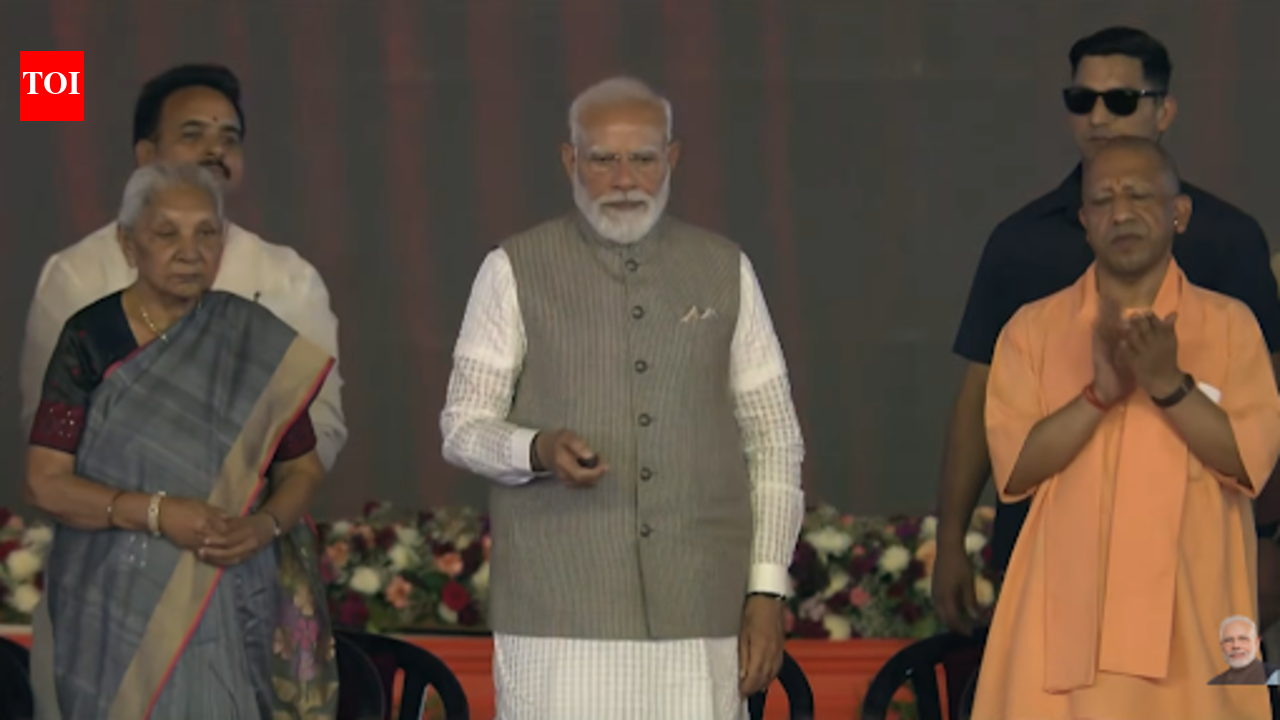
NEW DELHI: Prime Minister Narendra Modi on Saturday inaugurated Phase I of the Noida International Airport at Jewar in Uttar Pradesh, marking a significant milestone in India’s expanding aviation infrastructure.PM Modi was accompanied by Uttar Pradesh chief minister Yogi Adityanath and Governor Anandiben Patel.
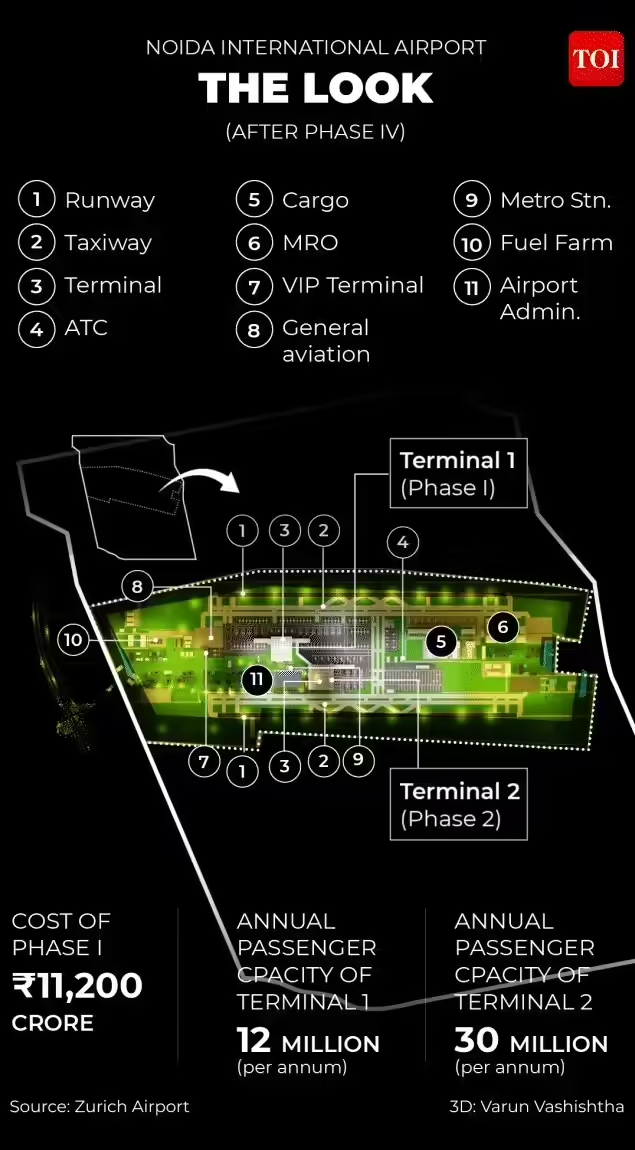
Developed at an investment of around Rs 11,200 crore under a Public–Private Partnership (PPP) model, the project is expected to enhance both regional and international connectivity for the National Capital Region (NCR).The airport is being positioned as a key addition to India’s aviation network, aimed at easing pressure on existing infrastructure while supporting the country’s ambition of becoming a global aviation hub.
Second international gateway for Delhi NCR
Noida International Airport has been developed as the second international gateway for Delhi NCR, complementing the existing Indira Gandhi International Airport, which currently handles the majority of the region’s air traffic.
.
With rising passenger demand and capacity constraints at IGI Airport, the new facility is expected to play a crucial role in distributing traffic more efficiently.Together, the two airports will function as an integrated aviation system, helping reduce congestion, improve connectivity, and enhance the region’s standing among leading global aviation hubs.
Phase I capacity and future expansion plans
Phase I of the airport is designed to handle 12 million passengers per annum (MPPA), providing immediate relief to the region’s growing air travel demand.The project has been planned with scalability in mind, with provisions to expand capacity to 70 million passengers annually in subsequent phases. This long-term vision reflects the government’s strategy to future-proof infrastructure and accommodate sustained growth in air travel.
Modern infrastructure and all-weather operations
The airport features a 3,900-metre runway capable of handling wide-body aircraft, making it suitable for both domestic and international long-haul operations.
.
Equipped with advanced navigation systems such as the Instrument Landing System (ILS) and modern airfield lighting, the facility is designed to support efficient, all-weather, round-the-clock operations. These features ensure operational reliability even under challenging weather conditions.
Cargo hub and logistics ecosystem
In addition to passenger services, the airport includes a comprehensive cargo ecosystem aimed at strengthening logistics and trade.The Multi-Modal Cargo Hub comprises an Integrated Cargo Terminal and dedicated logistics zones, with an initial handling capacity of over 2.5 lakh metric tonnes annually. This capacity is expected to expand significantly to around 18 lakh metric tonnes in the future, positioning the airport as a major cargo and logistics centre in North India.
Dedicated MRO facility to enhance efficiency
A key component of the airport’s infrastructure is a 40-acre Maintenance, Repair and Overhaul (MRO) facility.This dedicated facility is expected to improve operational efficiency by enabling airlines to service and maintain aircraft locally, reducing turnaround times and operational costs. It also strengthens India’s capabilities in aviation maintenance services.
Sustainability and future-ready design
Noida International Airport has been designed as a sustainable and future-ready infrastructure project, with a focus on achieving net-zero emissions.The project incorporates energy-efficient systems and environmentally responsible practices, aligning with India’s broader climate goals. The airport’s development reflects a growing emphasis on green infrastructure in large-scale projects.
Architecture inspired by Indian heritage
Blending modern infrastructure with cultural aesthetics, the airport’s architectural design draws inspiration from traditional Indian elements such as ghats and havelis.This approach aims to create a distinctive identity for the airport while offering passengers a sense of place rooted in Indian heritage.
Strategic location and multi-modal connectivity
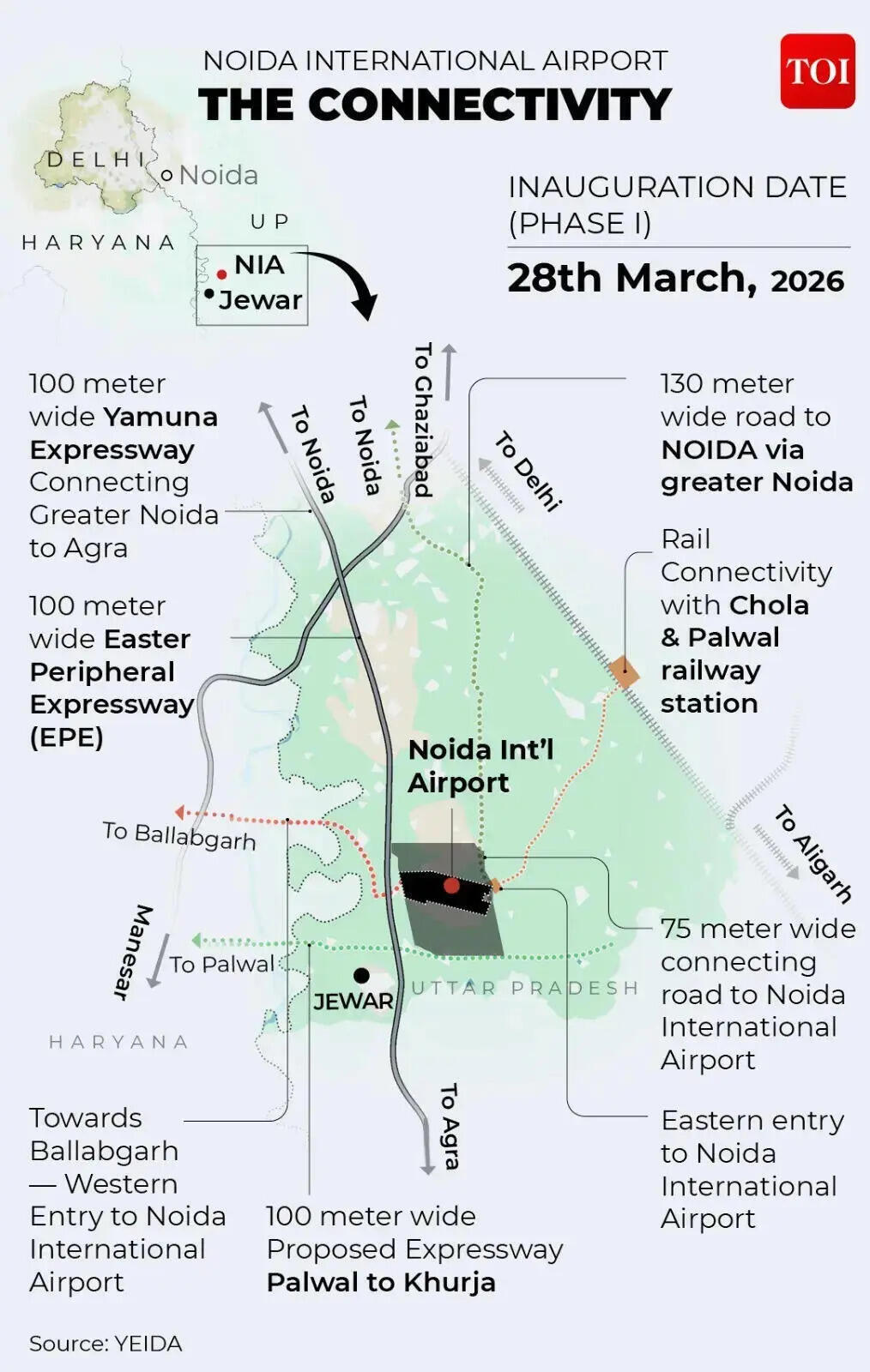
Strategically located along the Yamuna Expressway in Gautam Buddha Nagar district, the airport is planned as a multi-modal transport hub.It will feature seamless integration with road, rail, metro and regional transit systems, ensuring smooth connectivity for passengers and cargo. This connectivity is expected to significantly improve accessibility for travellers across Delhi NCR and neighbouring regions.
Boost to India’s aviation ambitions
The inauguration of Phase I of Noida International Airport is being seen as a major step in strengthening India’s aviation ecosystem.By expanding capacity, improving connectivity, and integrating modern infrastructure with sustainability, the project is expected to play a key role in positioning Delhi NCR as a major global aviation hub while supporting economic growth and regional development

Butter, chocolate, coffee and milk have all seen prices rocket. Tracing back through the story of one particular supermarket staple begins to explain why
Source link
Business
Petrol, diesel prices: How US-Iran war, excise cuts and global oil prices affect you & economy – top things to know – The Times of India
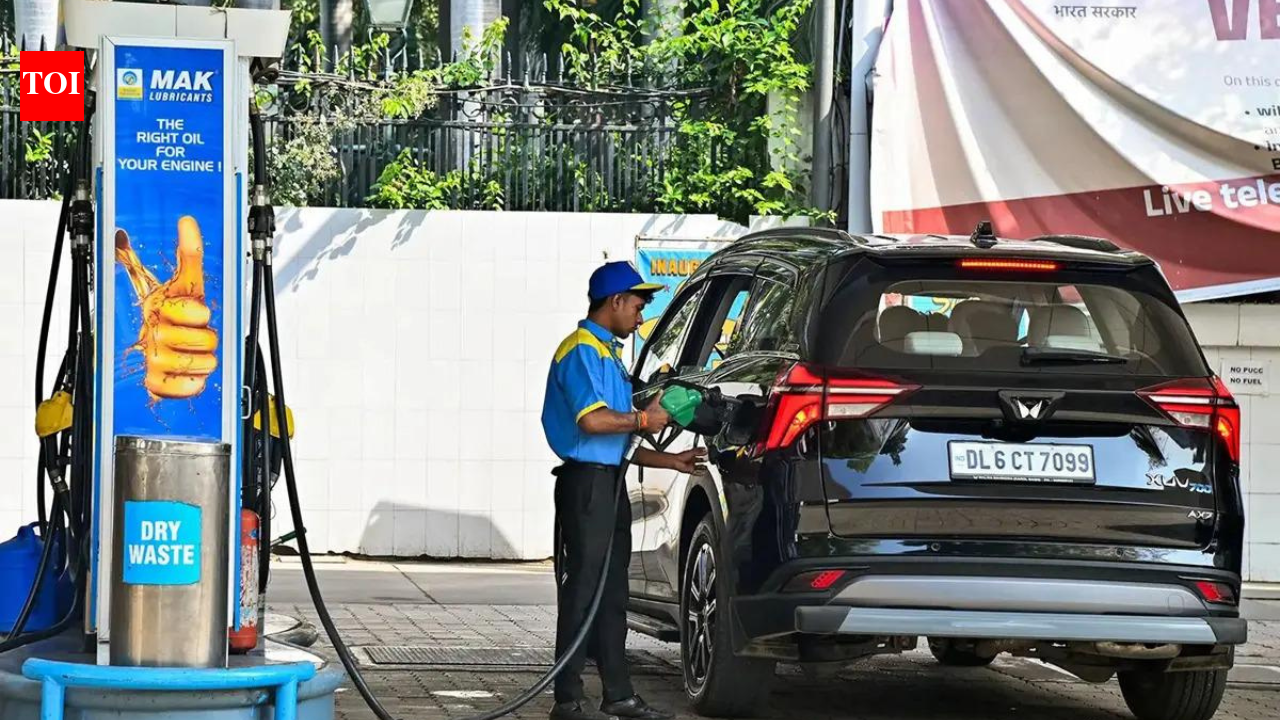
Petrol prices today: Petrol prices in New Delhi on Saturday remained unchanged at Rs 94.77 per litre, while diesel is steady at Rs 87.67 per litre. Similarly, Mumbai sees petrol at Rs 103.54 per litre and diesel at Rs 90.03, with no change from yesterday. The government has cut excise duty on petrol and diesel The conflict in West Asia has triggered sharp increases in international crude oil prices. Since February 28, when US and Israeli strikes targeted Iranian facilities, Brent crude briefly surged to $119 per barrel before easing to around $100. West Texas Intermediate (WTI) similarly rose from $70 pre-conflict to over $92, creating supply shocks globally.The ongoing US-Iran conflict has disrupted oil supply chains and sent crude prices soaring worldwide. India’s oil dependenceIndia imports around 88% of its crude oil requirements, with nearly half transported through the Strait of Hormuz, a critical maritime strait located between Persian Gulf and Gulf of Oman.Any disruption here poses an immediate risk to domestic fuel availability. Tehran’s warnings to vessels and insurer withdrawals have complicated tanker movement, impacting supply.Excise duty cut by governmentTo shield consumers from rising global crude prices, the Centre slashed excise duty on petrol from Rs 13 to Rs 3 per litre and removed it entirely on diesel (from Rs 10). The reduction aims to maintain stable retail prices and prevent a direct burden on citizens.No price hike or cutThe excise duty cut will not result in petrol and diesel prices at the pump going down, since the intent of the cut is to prevent the need for a hike in prices in line with international rates. Oil marketing companies (OMCs) are absorbing the higher input costs, ensuring that retail prices do not spike amid global volatility.Financial implications of duty cutsCBIC Chairman Vivek Chaturvedi said this reduction is expected to result in a revenue loss of about Rs 7,000 crore over the next 15 days. This measure offsets potential increases of Rs 24 per litre for petrol and Rs 30 per litre for diesel that would have been necessary due to rising international crude prices.Cargo and export measuresThe government imposed export duties of Rs 21.5 per litre on diesel and Rs 29.5 per litre on ATF to ensure domestic availability and prevent windfall gains in international markets.Chaturvedi said on Friday that the government will reassess the special additional excise duty, also known as windfall tax, on diesel and aviation turbine fuel every two weeks. Addressing the media, he explained that the levy has been introduced to ensure sufficient domestic supply of these fuels.He noted that the government expects to collect around Rs 1,500 crore from this duty in the first fortnight. To discourage overseas sales and prioritise local availability, export duties of Rs 21.5 per litre on diesel and Rs 29.5 per litre on aviation turbine fuel have been imposed, with the revised rates coming into force from Friday.The windfall tax was initially introduced in July 2022 to limit extraordinary gains made by refiners after the Russia-Ukraine conflict and was later withdrawn in December 2024. Private retailer pricing variationsNayara Energy, India’s largest private fuel retailer, increased petrol by Rs 5 per litre and diesel by Rs 3 per litre at its 6,967 outlets to offset input costs. In contrast, Jio-BP, operating 2,185 outlets, has maintained retail prices despite significant losses.Strategic domestic measuresPrime Minister Narendra Modi speaking at the Rajya Sabha said that India maintains strategic reserves of 53 lakh metric tonnes of crude oil, with plans to expand to over 65 lakh MT.Ethanol blending has reduced crude oil imports by 4.5 crore barrels annually. Increased refining capacity, metro expansion and railway electrification have also reduced dependency on diesel, helping stabilize domestic fuel consumption.Diplomatic efforts and global sourcingPM Modi has been actively engaging with Iran, the US, and other countries to secure safe transit of oil and LPG tankers. India has diversified import sources from 27 to 41 countries and procured Russian crude to fill supply gaps.The government has also constituted seven empowered groups to manage fuel, supply chains, and logistics.


NHL playoff watch: Guide to all 15 games on Showdown Saturday

King Charles health update leaves Prince William worried: ‘upsetting’

Zayn Malik shares personal video message on ‘Mind of Mine’ 10th anniversary

-
 Business1 week ago
Flipkart group CFO to leave co amid IPO plans – The Times of India
-
 Business1 week ago
Video: The Effects of High Oil Prices
-

 Fashion1 week ago
China’s textile & apparel exports surge 17% to $50 bn in Jan-Feb 2026
-

 Sports1 week ago
Rating Adidas’ 2026 World Cup away shirts: Argentina, Spain, Mexico and more
-

 Sports1 week ago
American Conference Commissioner Tim Pernetti thanks Trump for Army-Navy game executive order
-
Tech1 week ago
The Corsair 4000D RS PC Case Keeps Your System Cool
-

 Tech1 week ago
‘Uncanny Valley’: Nvidia’s ‘Super Bowl of AI,’ Tesla Disappoints, and Meta’s VR Metaverse ‘Shutdown’
-

 Tech1 week ago
Gamers Hate Nvidia’s DLSS 5. Developers Aren’t Crazy About It, Either