

Business
Union Cabinet Okays Rs 7,280 Crore Scheme For Manufacturing Rare Earth Permanent Magnets

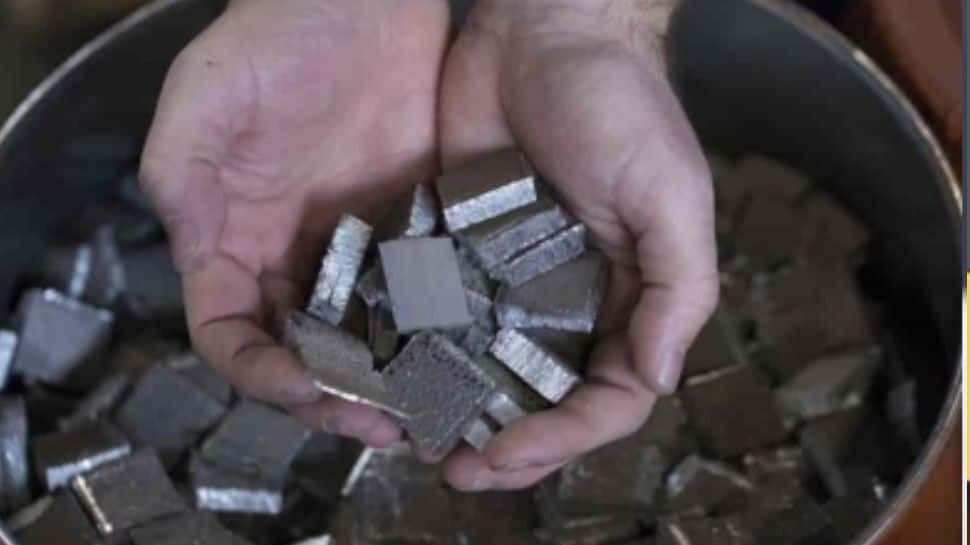
New Delhi: The Union Cabinet, chaired by Prime Minister Narendra Modi, on Wednesday approved the scheme to promote the manufacturing of Sintered Rare Earth Permanent Magnets in the country with an investment of Rs 7,280 crore.
This first-of-its-kind initiative aims to establish 6,000 metric tons per annum of integrated rare earth permanent magnet (REPM) manufacturing capacity in India, thereby enhancing self-reliance and positioning India as a key player in the global market, according to a Cabinet communique.
REPMs are one of the strongest types of permanent magnets and are vital for electric vehicles, renewable energy, electronics, aerospace, and defence applications. The scheme will support the creation of integrated permanent magnet manufacturing facilities, involving conversion of rare earth oxides to metals, metals to alloys, and alloys to finished REPMs.
Driven by the rapidly growing demand from electric vehicles, renewable energy, industrial applications, and consumer electronics, India’s consumption of REPMs is expected to double by 2030 from 2025. At present, India’s demand for these magnets is met primarily through imports. With this initiative, India will establish its first-ever integrated REPM manufacturing facilities, generating employment, strengthening self-reliance and advancing the nation’s commitment to achieve Net Zero by 2070, the statement said.
The total financial outlay of the scheme is Rs 7,280 crore, comprising sales-linked incentives of Rs 6,450 crore on REPM sales for five years and capital subsidy of Rs 750 crore for setting up an aggregate of 6,000 million tonnes per annum REPM manufacturing facilities.
The scheme envisions allocating the total capacity to five beneficiaries through a global competitive bidding process. Each beneficiary will be allotted up to 1,200 million tonnes per annum capacity, the statement added.
The total duration of the scheme will be 7 years from the date of award, including a 2-year gestation period for setting up an integrated REPM manufacturing facility, and 5 years for incentive disbursement on the sale of REPM.
“This initiative by the Government of India is a landmark step towards strengthening the domestic REPM manufacturing ecosystem and enhancing competitiveness in the global markets. By fostering indigenous capabilities in REPM production, the scheme will not only secure the magnet supply chain for domestic industries but also support the nation’s Net Zero 2070 commitment. It embodies the Government’s unwavering commitment to build a technologically self-reliant, globally competitive, and sustainable industrial base, in line with the vision of Viksit Bharat @2047,” the communique added.



Intellia Therapeutics, building exterior and company sign, Cambridge, Massachusetts, USA.
Spencer Grant | Universal Images Group | Getty Images
Intellia Therapeutics said its Crispr-based treatment for a rare swelling condition met its goals in a late-stage trial, marking a milestone for the field of gene editing and putting the company on track to seek approval from the U.S. Food and Drug Administration.
The company’s treatment uses Nobel Prize-winning technology Crispr to edit DNA and turn off the gene that controls production of a peptide that’s overactive in people with hereditary angioedema, causing them to experience potentially life-threatening swelling attacks. Intellia’s treatment is administered once through an hourslong infusion, making the edits directly in the liver.
Intellia said the one-time treatment reduced attacks by 87% compared with a placebo, meeting the study’s main goal. Six months after treatment, 62% of patients were free from attacks and weren’t using other therapies, Intellia said.
The company described the safety and tolerability of the treatment as “favorable,” reporting the most common side effects were infusion-related reactions, headaches and fatigue. Analysts were closely watching safety in the trial since a patient in a separate trial of a different treatment from Intellia died. That patient developed a liver injury and ultimately died from septic shock following an ulcer, according to the company.
“When you think about where we started with Crispr, just 12 years ago with some of the fundamental insights, I think there was a lot of talk about what might be possible, and we’ve had reports along the way in terms of milestones, but this is the first Phase 3 data in any indication with in vivo Crispr where you’re actually changing a gene that causes disease,” said Intellia CEO John Leonard.
The only FDA-approved Crispr-based medicine comes from Vertex Pharmaceuticals. Called Casgevy, the gene editing is done outside the body, or ex vivo. The process requires collecting a person’s blood cells, making the edits outside the body, then reinfusing them back into a patient. Intellia’s treatment, meanwhile, makes the edits inside the body, or in vivo.
Intellia said it has started a rolling application with the FDA and plans to complete the filing in the second half of this year. The company expects to launch the treatment in the U.S. in the first half of next year, if it’s approved.
If approved, Intellia’s treatment, lonvoguran ziclumeran, will compete with about a dozen other chronic drugs for HAE. Despite the allure of a one-time treatment, genetic medicines haven’t always been a commercial successes. BioMarin withdrew its gene therapy for Hemophilia A because of weak sales, for example.
Leonard said there are important differences between the two, like the fact that BioMarin’s therapy faced questions about how long the effects would last. In contrast, he said Intellia hasn’t seen a single case in almost six years where the effects diminished over time.
Despite the results, he’s reluctant to call Intellia’s treatment a functional cure.
“I think this is a tipping point for the disease and tipping point for Crispr-based in vivo therapy where you can make a change [and] it’s permanent,” Leonard said. “And, as far as we can tell, we don’t have a single patient in this program or other program where there’s been any waning of the effect of what we did to the gene or the effect of what we’ve seen with the clinical aspects of the disease itself. So it’s pretty exciting.”
Clarification: This story has been updated to clarify that a patient in a separate trial of a different treatment from Intellia developed acute liver injury and ultimately died from septic shock following an ulcer.

While many airlines say they are raising prices due to high fuel costs, József Váradi says European airlines are trying to boost demand
Source link

All of the chain’s standalone stores have stopped trading in the UK and Ireland.
Source link


Norway joins Type 26 Frigate Programme to boost NATO naval power

Trump calls for Jimmy Kimmel to be fired over jokes made before White House Correspondents’ Dinner shooting
Intellia Therapeutics says its Crispr-based treatment succeeds in pivotal trial

-

 Sports1 week ago
NCAA men’s gymnastics championship: All-time winners list
-

 Sports1 week ago
WWE WrestleMania 42 Night 2: Live match results and analysis
-

 Politics7 days ago
UK’s Starmer seeks to deflect blame over Mandelson appointment
-

 Fashion1 week ago
UK’s Sosandar returns to profitability amid robust FY26 performance
-

 Entertainment1 week ago
Lee Anderson, Zarah Sultana kicked out of UK Parliament for calling PM ‘liar’
-
 Business1 week ago
No fuel shortage: Govt assures 100% domestic LPG, PNG, CNG supply amid Hormuz energy crunch – The Times of India
-
 Business1 week ago
How Trump’s psychedelics executive order could unlock stalled cannabis reform
-

 Sports1 week ago
Quetta Gladiators opt to bowl after winning toss against Peshawar Zalmi in PSL 11 clash