

Business
India can lift exports to Russia from $5 bn to $35 bn! Why a modern rupee-rouble settlement system is needed – explained – The Times of India


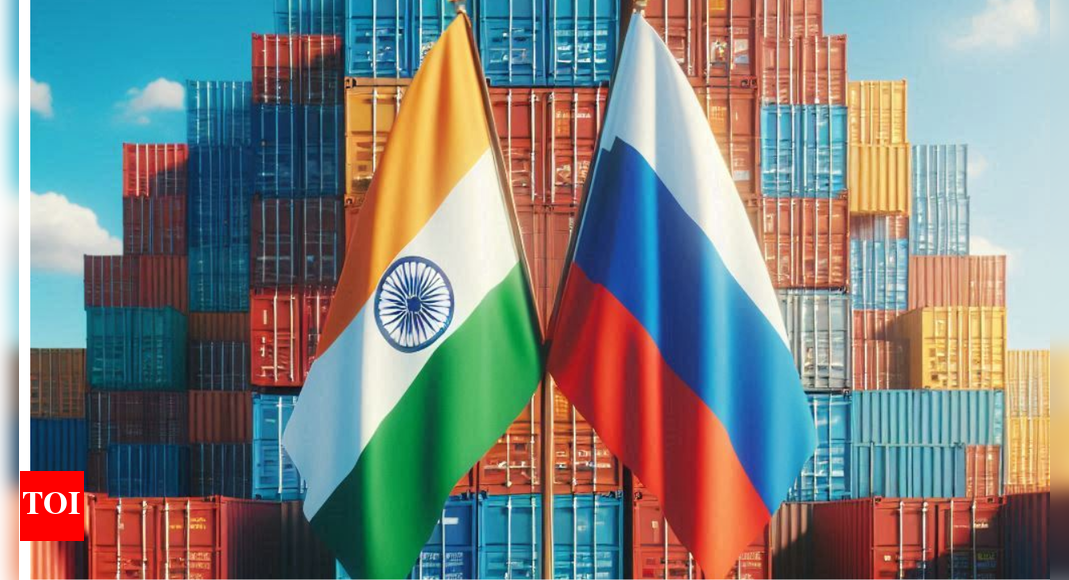
India has the potential to increase its merchandise exports to Russia seven-fold—from $5 billion to $35 billion by 2030—if it secures market access in food, pharmaceuticals, textiles and machinery, according to Global Trade and Research Initiative (GTRI) founder Ajay Srivastava. The report comes as President Vladimir Putin visits Delhi and as Moscow reiterates its goal of lifting bilateral trade to $100 billion by the end of the decade.Although total trade is now approaching $70 billion, India’s exports remain stuck below $5 billion, while imports—dominated by crude oil—continue to surge. In FY2025, India exported $4.9 billion worth of goods to Russia but imported $63.8 billion, leaving a $58.9 billion trade deficit. Crude oil alone accounted for $50.3 billion, underlining how bilateral commerce has become “an oil-heavy relationship rather than a balanced partnership,” as Srivastava noted.Where India is missing the Russian marketGTRI mapped sectors where Russia is a major global importer, India is a major global exporter, but India’s market share in Russia is below 5%.In 2024, Russia imported $202.6 billion worth of goods, but Indian shipments accounted for just $4.84 billion—a 2.4% share.The widest gaps appear in food and agriculture. Russia imported $4.34bn of fruits and nuts, $1.62bn of oilseeds, $1.21bn of edible oils, $889m of meat and $518m of dairy. India’s combined exports across these categories were under $250 million—despite being a major global exporter of meat ($3.95bn), oilseeds ($2.17bn) and fruits ($1.67bn).Processed food mirrors the same imbalance. Russia spent $689m on cereal-based preparations and $1.15bn on processed fruit and vegetables; India sold just $0.6m and $42.7m respectively. Tobacco imports stood at $966m, while India contributed $37.5m.Fast-moving consumer goods and chemicals show a similar gap. Russia imported $3.13bn of perfumery and essential oils and $1.07bn of soaps and detergents, but India exported only $21.8m and $29.1m. In inorganic chemicals, Russia imported $5bn, while India shipped $219m.Pharmaceuticals—India’s strongest globally—are also under-represented. Russia imported $11.8bn of medicines, while India exported $413.5m, a 3.5% share despite being a $23bn-plus global pharma supplier.Textiles and apparel present even sharper gaps. Russia imported $730m of man-made filaments, $566m of fibres and $740m of knitted fabrics—but India exported $25.6m, $9m and zero respectively. In clothing, Russia imported $3.65bn of knitwear and $3.03bn of woven garments; India supplied just $24m and $76m.Engineering and manufacturing display breadth without depth. Russia imported $3bn of iron and steel and $3.5bn of fabricated metal products. India exported $140m and $76m. In industrial machinery, Russia imported $37bn, while India supplied $1.1bn. Electrical equipment imports were $20.5bn, but Indian exports were $424m. In optical and medical instruments, Russia bought nearly $7bn, while India exported $130m.The gap is widest in consumer industries. Russia imported $29bn of vehicles, but India exported just $45m. In furniture, Russia imported $2.3bn, while India sent less than $4m. Toys and sports goods saw Russian imports of $1.9bn, while India exported $6m.Why exports are stuck: the payments problemGTRI stresses that the absence of a predictable, efficient payment system is the single biggest barrier to Indian exporters. With Russian banks cut off from SWIFT, transactions have become slow, costly, and uncertain, limiting exporters’ willingness to enter the market.“Without a modern rupee–rouble settlement system, Russia may remain India’s largest oil supplier—but not a serious export market,” Srivastava noted.In the Soviet era, India and the USSR used a fixed rupee–rouble mechanism where trade was settled at a pre-agreed exchange rate, bypassing dollar dependence. A modern equivalent, the report argues, is essential to:
- reduce currency and settlement risks
- restore predictability to payments
- encourage long-term contracts
- allow SMEs to enter the Russian market
- expand sectoral trade beyond hydrocarbons
Alongside currency reform, the report calls for sector-specific buyer–seller meets, dedicated trade missions, and institutional support to push Indian goods into Russian supermarkets, factories and distribution networks.What India must build to reach $35bnTo deepen its foothold in a $202bn Russian import market, India needs a multi-pronged approach. This includes:
- a reliable local-currency settlement system
- stronger logistics and certification frameworks
- targeted trade promotion for food, pharma and textiles
- institutional mechanisms to support exporters navigating compliance, payments and distribution challenges
If these structural reforms are implemented, GTRI estimates India can lift exports from $5bn to $35bn by 2030, dramatically narrowing the trade deficit and expanding India’s economic footprint in Eurasia.



Natalie ShermanBusiness reporter
 Getty Images
US President Donald Trump appeared on course for a setback at America’s top court on Wednesday over his unprecedented move to fire a central bank governor.
Supreme Court justices from the left and right asked why they should speed through such an impactful decision, citing concerns about process and implications for central bank independence and the wider economy.
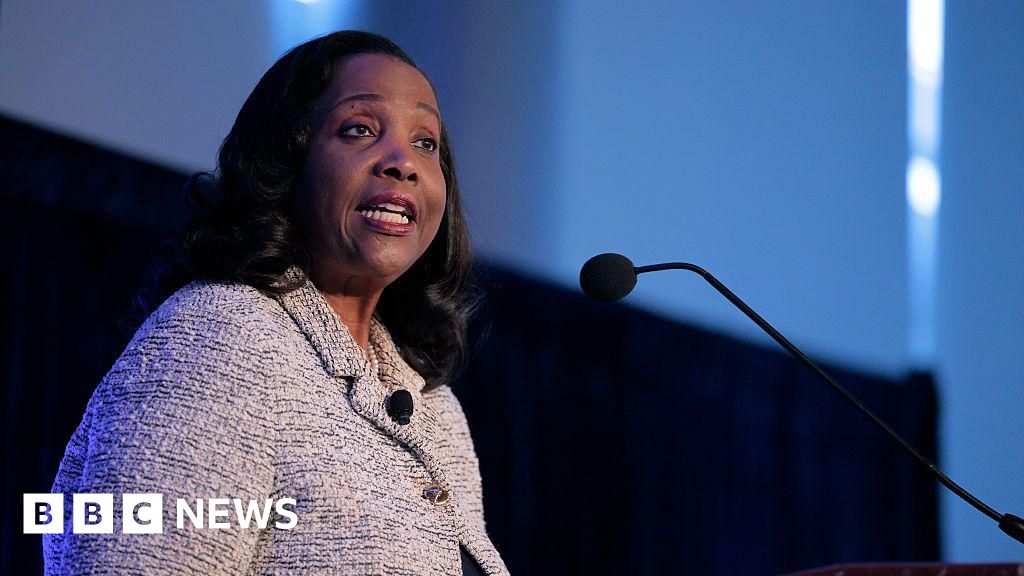
Trump in August said he was removing Federal Reserve governor Lisa Cook, accusing her of engaging in mortgage fraud, which she has denied.
Cook has argued she did not receive due process to dispute those claims, which Fed defenders say were a pretext to allow Trump to assert more control over the bank.
Justice Brett Kavanaugh, a conservative who was appointed by Trump, was among the justices to express sympathy with Cook’s arguments, asking: “What’s the fear of more process here?”
He later warned the administration’s interpretation of the law would “weaken, if not shatter, the independence of the Federal Reserve”.
‘Quite a big mistake’
By law, a president can only remove governors of the Federal Reserve “for cause”.
That requirement was intended to shield the central bank from political pressure and allow it to make policy independently.
The White House contends it has met that bar, accusing Cook of filing mortgage forms claiming two different principal residences at the same time. Banks typically offer lower interest rates for primary homes.
The Trump administration has asked the court to allow the president to remove Cook, a move lower courts had blocked while the case played out.
“Even if it’s inadvertent or a mistake, it’s quite a big mistake,” said solicitor general D John Sauer, who was arguing the case for the administration.
He said such conduct could undermine confidence in the bank and that courts were bound to defer to the president’s judgement when it comes to finding a cause.
He dismissed questions about process, noting that Trump had alerted Cook to the issue on social media before formally firing her.
“There was a social media post,” he said. “And the response was defiance.”
‘Nothing criminal whatsoever’
Cook has denied committing fraud.
In a November letter to the Justice Department, her lawyers said the claims were based on “cherry-picked, incomplete snippets of the full documents”.
They said there was “one stray reference to primary residence” in a mortgage application for an apartment in Alabama, but noted that the file also contained “truthful and more specific disclosures about the property’s use”.
“There is no fraud, no intent to deceive, nothing whatsoever criminal or remotely a basis to allege mortgage fraud,” her lawyers wrote.
Arguing on behalf of Cook, Paul Clement said people in her position should have the chance to present their evidence and be shielded from having a decision made in advance.
He said the administration’s interpretation of the law would make the protection that Congress intended by inserting the “for cause” requirement “toothless”.
Some justices indicated that they shared those concerns.
The “position that there’s no judicial review, no process required, no remedy available, very low bar for cause that the president alone determines – that would weaken if not shatter the independence of the Federal Reserve,” Kavanaugh said.
The lawsuit is seen as high stakes, given swirling debate about Trump’s efforts to influence the Fed, which he wants to lower interest rates more aggressively to boost economic growth.
Federal Reserve chairman Jerome Powell was among the officials expected to attend. He is facing his own criminal probe related to cost overruns during renovations of Fed properties – concerns he has called “pretexts”.
In other recent cases, the Supreme Court, which has a 6-3 conservative majority, has allowed the White House to proceed with firings.
But it has signalled that it views the Federal Reserve, which was designed to set policy independently from the White House, as different.
In a statement after the hearing, Cook’s lawyers said they were “hopeful” the court would recognise the importance of the Fed being able to operate free from political interference.
In her own statement, Cook said: “This case is about whether the Federal Reserve will set key interest rates guided by evidence and independent judgment or will succumb to political pressure.
“For as long as I serve at the Federal Reserve, I will uphold the principle of political independence in service to the American people.”
Several justices, including conservatives, indicated they were hesitant to greenlight Cook’s removal without courts having resolved issues like whether the mortgage filings, which were made before Cook was appointed, would meet the bar for a “for cause” firing.
“We know that the independence of the agency is very important and that that independence is harmed if we decide these issues too quickly and without due consideration,” said Justice Sonia Sotomayor, a liberal. “So to me, waiting to have at least the lower courts look at these issues first makes the most sense.”
“Is there any reason why this whole matter had to be handled by everybody… in such a hurried manner?” asked Justice Samuel Alito, a conservative.
Justice Amy Coney Barrett, another Trump appointee, pressed Sauer to explain what harm the president would suffer by waiting, noting that the court had been warned of potentially dire economic consequences of a decision that could weaken belief in the central bank’s independence.
“There’s a risk,” she said. “Doesn’t that counsel… caution on our part?”
Business
Jamie Dimon says U.S. should impose Trump’s credit card rate cap in Vermont and Massachusetts

Jamie Dimon, CEO of JPMorgan Chase, speaks at the American Business Forum at the Kaseya Center in Miami on Nov. 6, 2025.
Chandan Khanna | AFP | Getty Images
JPMorgan Chase CEO Jamie Dimon on Wednesday advocated for a test of President Donald Trump‘s proposed 10% cap on credit card interest rates in two U.S. states: Vermont and Massachusetts.
Dimon, speaking on a panel at the World Economic Forum at Davos, Switzerland, addressed a question about Trump’s order for banks to voluntarily limit their interest rates for a year. The president had called for the lower rates to take effect Tuesday.
Several large credit card lenders contacted by CNBC on Tuesday said they had made no changes to their interest rates, but they all declined to be identified as defying Trump’s proposal.
“It would be an economic disaster,” Dimon said Wednesday. “In the worst case, you’d have a drastic reduction of the credit card business” for 80% of Americans, he said.
In earnings conference calls last week and behind the scenes, banks have pushed back against Trump’s order this month to voluntarily forgo billions of dollars in revenue.
Their main argument, that price controls will result in lenders canceling accounts for many card customers, has resonated with several Republican lawmakers, including House Speaker Mike Johnson. Most banking analysts believe that Trump would need legislation to enact a nationwide cap on card rates.
‘A great idea’
Dimon then said he had a “great idea” to help quell disagreement over the proposed card cap, suggesting that the U.S. government impose the pricing controls on Americans in just two states.
Vermont and Massachusetts are the home states of Sens. Bernie Sanders and Elizabeth Warren, respectively, both of whom support a bill capping card rates at 10% for five years. Dimon didn’t mention the lawmakers by name Wednesday.
The U.S. government “should force all the banks to do it in two states, Vermont and Massachusetts, and see what happens,” Dimon said, drawing laughter from the audience.
Dimon said “the left” and people who argue for price controls “will learn a real lesson, and the people crying the most won’t be the credit card companies,” he said.
“It’ll be the restaurants, the retailers, the travel companies, the schools, the municipalities, because people miss their water payments,” he said. “It would be something else to watch.”
The offices of Sanders and Warren did not immediately return calls for comment.
Dimon added that JPMorgan was planning on giving the Trump administration its analysis on what would happen under a national credit card rate cap.
“I think it’s wrong for the government to get involved extensively in pricing of stuff, but I got to deal with the world I got,” Dimon said.
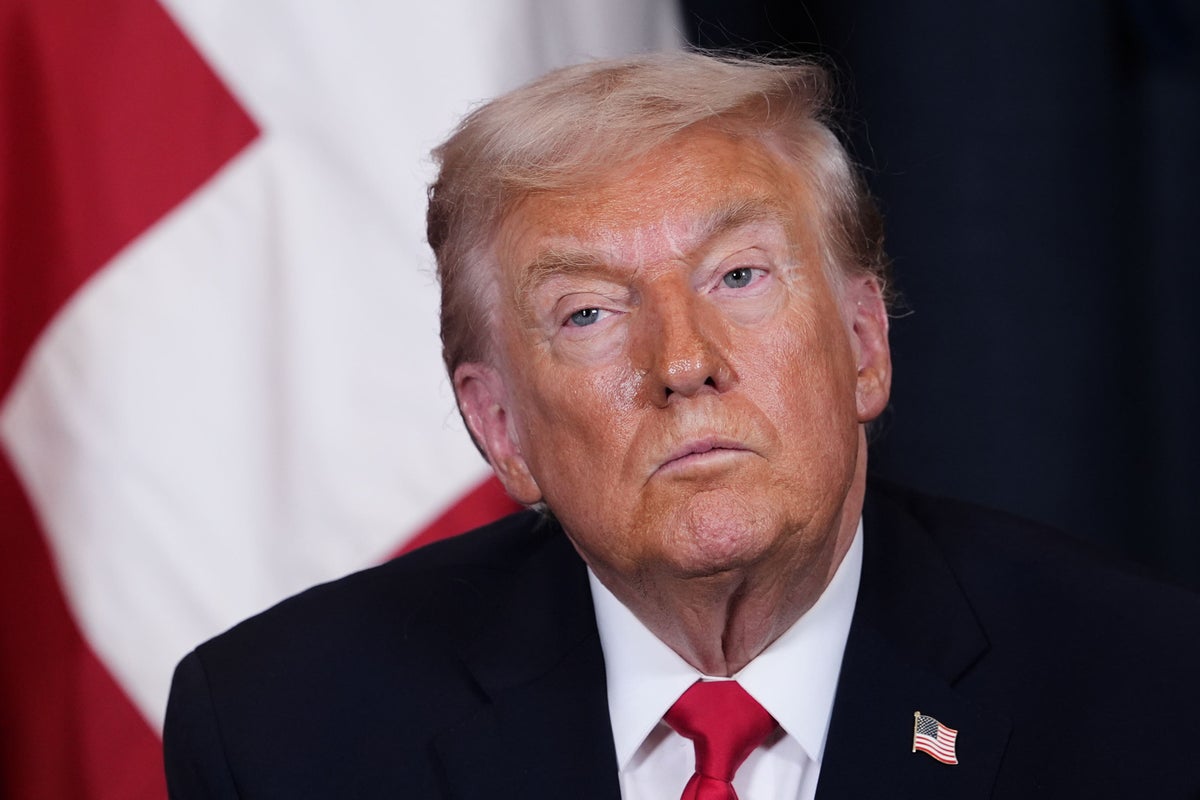
The FTSE 100 shrugged off a weak start to close slightly higher on Wednesday after US president Donald Trump said he would not use force to take control of Greenland, but insisted America must still have “ownership” of it.
Kathleen Brooks, research director at XTB, said Mr Trump’s speech at Davos, in Switzerland, had two key takeaways for markets.
“Firstly, Trump will not take Greenland by force and second, Trump wants the economy to run hot to send US stocks flying north,” she said.
The FTSE 100 index closed up 11.31 points, 0.1%, at 10,138.09.
The FTSE 250 ended 113.42 points higher, 0.5%, at 23,071.29, and the AIM All-Share closed up 7.45 points, 0.9%, at 808.59.
In a wide-ranging, often rambling speech at the World Economic Forum, Mr Trump said: “We probably won’t get anything unless I decide to use excessive strength and force where we would be, frankly, unstoppable, but I won’t do that.”
But he demanded “immediate” talks on Washington’s acquisition of Greenland, renewing his push to seize control of the autonomous territory from Nato ally Denmark.
“It’s the US alone that can protect this giant mass of land, this giant piece of ice, develop it and improve it,” Mr Trump told world leaders.
“That’s the reason I’m seeking immediate negotiations to once again discuss the acquisition of Greenland by the US.”
Prime Minister Sir Keir Starmer earlier told Parliament he would not give in to pressure from Mr Trump over the future of Greenland.
“I will not yield, Britain will not yield on our principles and values about the future of Greenland under threats of tariffs, and that is my clear position,” he told MPs, adding that he would host Danish counterpart Mette Frederiksen in London on Thursday.
Mr Trump has threatened to slap tariffs on Britain and other European countries for opposing his claims on Greenland.
“Greenland could still be an issue for financial markets, since Trump has said that he wants to gain control of Greenland and will start immediate negotiations to do so. However, today’s speech suggests that Nato is not under immediate threat, for now,” Ms Brooks said.
In European equities on Wednesday, markets were mixed. The CAC 40 in Paris closed up 0.1%, while the DAX 40 in Frankfurt ended 0.6% lower.
In New York, financial markets were higher at the time of the London equity market close.
The Dow Jones Industrial Average was up 0.9%, as was the S&P 500, while the Nasdaq Composite climbed 1.0%.
Bond markets were calmer after Tuesday’s sharp moves. The yield on the US 10-year Treasury was quoted at 4.27%, trimmed from 4.28% on Tuesday. The yield on the US 30-year Treasury was quoted at 4.89%, narrowed from 4.91%.
Back in London, analysts played down a surprise spike in UK inflation, calling it a “blip”.
“It was always likely that the December figures would post a rebound on account of the rise in tobacco duty rates showing up in the December data rather than November (as it did in 2024) due to the later timing of last year’s budget,” analysts at Lloyds Bank said.
“Some unwinding of the ‘early’ Black Friday discounting seen in the November data also looks to have been behind the upward move, as well as base effects associated with a sharp rise in airfares last month relative to a more subdued increase in December 2024,” the bank added.
Headline consumer prices index (CPI) inflation accelerated in December, with CPI rising by 3.4% year-on-year, up from 3.2% in November, according to data published on Wednesday by the Office for National Statistics (ONS). It was ahead of the FXStreet-cited consensus of 3.3%.
It was the first time headline inflation has risen since July, when the annual rate rose to 3.8% from 3.6% in June. Figures for October at 3.6% and November at 3.2% were lower than the consensus forecast at the time.
The ONS said alcohol, tobacco and transport made the largest upward contributions to the monthly change.
Core CPI, which excludes energy, food, alcohol and tobacco, was unchanged at 3.2%, better than the 3.3% consensus.
The CPI goods annual rate rose to 2.2% from 2.1%, while the CPI services annual rate rose to 4.5% from 4.4%, but below the 4.6% consensus.
RBC Capital Markets expects the December “blip” to fall away sharply in the first half of 2026.
“Not only therefore did the December outturn leave services and headline CPI inflation broadly in line with the BoE’s (Bank of England’s) projections from November but also the main upward contributions to both headline and CPI were concentrated in non-core or more volatile categories,” the broker said.
Deutsche Bank expects inflation will take a big step down in January, pushing to near 3% year-on-year.
And by spring, the bank expects the BoE’s 2% inflation target “to be in sight”.
The pound was quoted lower at 1.3437 US dollars at the time of the London equities close on Wednesday, compared to 1.3462 dollars on Tuesday.
The euro stood at 1.1707 dollars, lower against 1.1733 dollars. Against the yen, the dollar was trading at 158.18 yen, higher from 157.95 yen.
On the FTSE 100, trading statements boosted Burberry but weighed on Experian.
Luxury goods manufacturer Burberry rose 5.0% after announcing an increase in comparable store sales over the festive period, while it expects its annual adjusted operating profit to be in line with analyst consensus estimates.
Comparable sales by region in the third quarter of financial year 2026, which runs until March 28, were up 6% in Greater China and 5% higher in Asia Pacific. They were up 2% in the Americas. Further, comparable sales were flat in Europe, Middle East, India & Africa due to declines in tourist spend.
Miners were in demand with Rio Tinto, up 5.2% after a well-received fourth quarter production update, and Glencore, which Rio is trying to buy, up 3.7%.
Bank of America said it believes “GlenTinto” – should a deal be sealed – offers “compelling value”.
Rio has until February to firm up an approach for Glencore.
Heading south, insurer Admiral, down 4.2%, after Goldman Sachs downgraded to “sell” from “buy”, while Experian slipped 4.9% despite reporting in-line trading.
On the FTSE 250, Currys shares sparked 7.7% higher as the electricals retailer rose profit guidance, while Premier Foods climbed 7.1% after it signalled top-end full-year profits.
But pub chain JD Wetherspoon failed to cheer investors, with shares down 8.1%, as it said higher costs were offsetting growth in sales.
Brent oil traded lower at 64.82 dollars a barrel on Wednesday, down from 64.89 dollars late on Tuesday.
Gold was quoted at 4,833.66 dollars an ounce on Wednesday, after hitting another record high, up from 4,742.56 dollars on Tuesday.
The biggest risers on the FTSE 100 were Rio Tinto, up 327.00 pence at 6,641.00p, Burberry, up 61.00p at 1,280.00p, Bunzl, up 97.00p at 2,086.00p, Anglo American, up 158.00p at 3,401.00p, and JD Sports Fashion, up 3.78p at 82.06p.
The biggest fallers on the FTSE 100 were Experian, down 157.00p at 3,070.00p, Admiral Group, down 128.00p at 2,948.00p, London Stock Exchange, down 198.00p at 8,782.00p, Rolls Royce, down 26.00p at 1,255.00p and Sage Group, down 16.50p at 1,025.00p.
Thursday’s global economic calendar has public sector net borrowing figures, plus GDP data, initial jobless claims and personal consumption expenditures data.
Thursday’s UK corporate calendar has trading statements from discount retail chain B&M European Value Retail and trading platform AJ Bell.
Contributed by Alliance News


YouTuber celebrates 21st birthday in Lagos with 50mn subscribers

Blake Lively emails Ben Affleck complaining about Justin Baldoni
Supreme Court sceptical of Trump firing of Lisa Cook

-

 Entertainment1 week ago
X (formerly Twitter) recovers after brief global outage affects thousands
-

 Politics5 days ago
Saudi King Salman leaves hospital after medical tests
-

 Sports7 days ago
Pak-Australia T20 series tickets sale to begin tomorrow – SUCH TV
-
 Business6 days ago
Trump’s proposed ban on buying single-family homes introduces uncertainty for family offices
-

 Fashion5 days ago
Bangladesh, Nepal agree to fast-track proposed PTA
-

 Tech1 week ago
Two Thinking Machines Lab Cofounders Are Leaving to Rejoin OpenAI
-

 Tech6 days ago
Meta’s Layoffs Leave Supernatural Fitness Users in Mourning
-

 Tech5 days ago
Petlibro Offers: Cat Automatic Feeders, Water Fountains and Smart Pet Care Deals