Connect with us

Business

Indian Stock Markets Open Lower Amid Profit Booking; Sensex Slips 380 Points

Published

on

Indian Stock Markets Open Lower Amid Profit Booking; Sensex Slips 380 Points


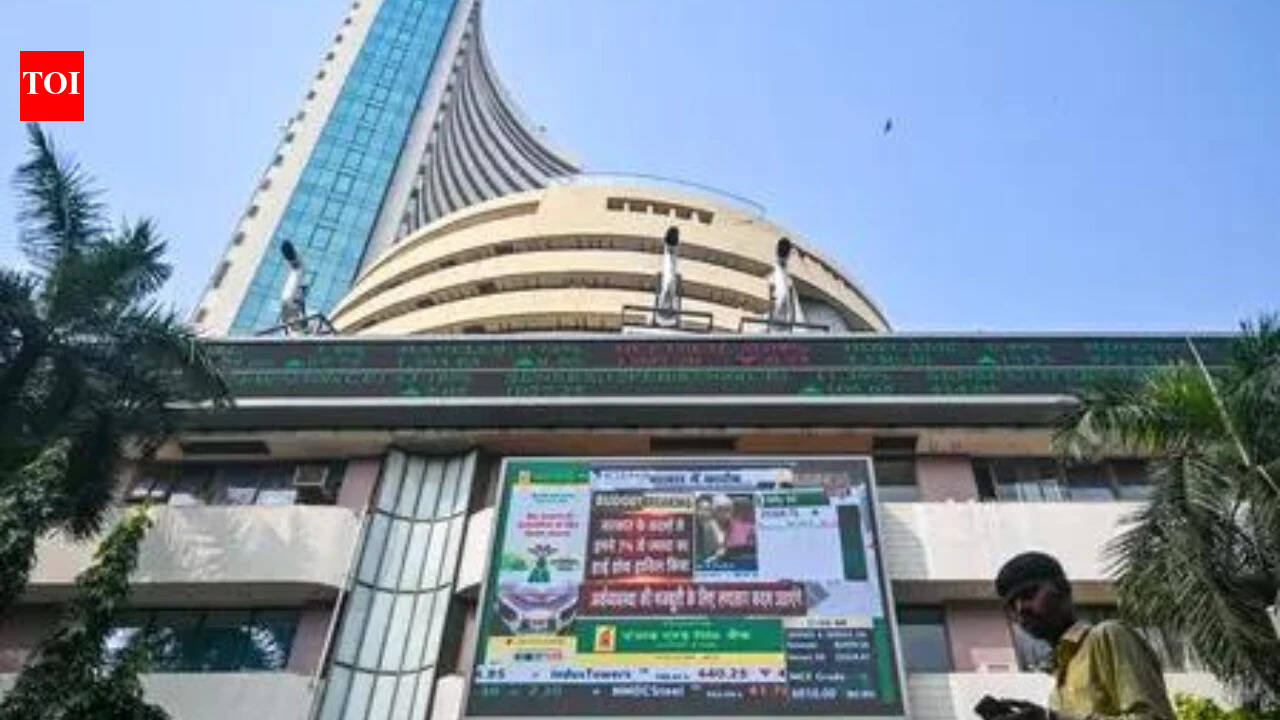
Mumbai: Indian stock markets opened sharply lower on Tuesday as investors booked profits after the recent rally.  

Sentiment weakened further after reports suggested that US President Donald Trump may consider imposing new tariffs on Indian rice, raising fresh worries about unresolved trade issues between Washington and New Delhi.

The Sensex slipped 380 points, or 0.45 per cent, to 84,723 in early trade. The Nifty also moved in the same direction, falling 124 points, or 0.48 per cent, to 25,837.

Add Zee News as a Preferred Source


“On the technical front, the Nifty now holds immediate support in the 25,800–25,850 range, while resistance is seen around 26,100–26,150, where repeated intra-day rejection highlights strong overhead supply,” experts said.

“A decisive breakout above this area will be essential for the index to regain upward momentum, while a sustained move below support may extend the ongoing consolidation,” they added.

The tone in the market remained cautious as major heavyweight stocks came under pressure.

Several blue-chip companies led the decline on the Sensex. Asian Paints, Tech Mahindra, Trent, Eternal, Reliance Industries, TCS, Ultratech Cement, Tata Steel, M&M, Tata Motors PV, HCL Tech, and BEL were among the top laggards, with losses of up to 2.5 per cent.

Only Hindustan Unilever and Bharti Airtel managed to stay in positive territory on the 30-share index.

The weakness was visible across the broader market as well. The Nifty MidCap index dropped 0.64 per cent, while the Nifty SmallCap index was down 0.61 per cent.

Sector-wise, the Nifty IT and Metal indices were among the worst performers, slipping 0.9 per cent and 0.8 per cent, respectively.

The Nifty Auto index also fell 0.8 per cent, while the Realty index declined 0.6 per cent.

Analysts said that the market mood turned cautious as global trade concerns resurfaced, prompting investors to trim their positions and wait for further clarity.




Source link

Business

Fed cuts rate but future easing uncertain

Published

on

Fed cuts rate but future easing uncertain


Danielle KayeBusiness reporter

Reuters A man wearing a suit speaks in front of a podium. An American flag hangs in the background.Reuters

US Federal Reserve Chair Jerome Powell

The US Federal Reserve has lowered interest rates for the third time this year, even as internal divisions create uncertainty about additional cuts in the coming months.

The central bank said on Wednesday it was lowering the target for its key lending rate by 0.25 percentage points, putting it in a range of 3.50% to 3.75% – its lowest level in three years.

But policymakers disagree about how the Fed should balance competing priorities: a weakening job market on the one hand, and rising prices on the other.

The Fed’s economic projections released on Wednesday suggest one rate cut will take place next year, although new data could change this.

Fed chair Jerome Powell said central bankers need time to see how the Fed’s three cuts this year work their way through the US economy. Policymakers will closely examine incoming data leading up to Fed’s next meeting in January, he added.

“We are well-positioned to wait to see how the economy evolves,” Powell told reporters.

Those hoping for interest rates to keep coming down, including President Donald Trump, might have to wait.

The Fed is facing a “very challenging situation” as it confronts risks of rising inflation and unemployment, Powell said, adding: “you can’t do two things at once”.

The decision to lower rates on Wednesday was not unanimous, suggesting widening divisions among central bankers over the outlook for the US economy.

Three Fed officials broke ranks and officially dissented.

Stephen Miran, who is on leave from his post leading Trump’s Council of Economic Advisers, voted for a larger 0.5 percentage point cut.

Austan Goolsbee, president of the Federal Reserve Bank of Chicago, and Jeffrey Schmid, president of the Federal Reserve Bank of Kansas City, voted to hold rates steady.

Trump, who has repeatedly urged Powell to lower rates, said after the meeting on Wednesday that the Fed’s cut could have been “at least doubled”.

“Our rates should be much lower,” he said at a roundtable at the White House. “We should have the lowest rates in the world.”

A data blackout during the longest-ever US government shutdown, which ended in November, has left policymakers partially in the dark about the state of the economy. But concerns about a slowing job market continue to outweigh inflation fears, at least for now.

The unemployment rate ticked up from 4.3% to 4.4% in September, Labor Department figures showed in a delayed report released last month. Cutting interest rates is aimed at stimulating the job market by creating lower borrowing costs for businesses.

Fears about tariff-driven inflation had taken centre stage earlier this year when Trump pushed forward with sweeping tariffs on many of the country’s largest trading partners.

Inflation is still above the Fed’s 2% target. In September, it hit 3% for the first time since January.

But while tariffs appear to be boosting some consumer prices, recent milder-than-expected inflation readings have allowed the Fed to focus on boosting the labour market by lowering rates, analysts said.

Dissents and disagreements

Still, policymakers remain divided over the path forward for interest rates.

Asked about disagreement among policymakers, Powell acknowledged that it’s “unusual” to have “persistent tension” between the Fed’s two mandates to keep prices stable and unemployment low.

“And when you do, this is what you see,” he said, referring to growing divisions.

Still, Powell characterised the internal debate between Fed officials as thoughtful and respectful.

“We come together and we reach a place where we can make a decision,” he said.

The central bank’s so-called dot plot, a quarterly anonymous economic forecast, showed on Wednesday a median expectation for one additional 0.25 percentage point cut in 2026.

That prediction was unchanged from the previous dot plot in September.

Central bankers are poised to have a bit more clarity next week, with the expected release of official data on the labour market and inflation for November.

The incoming data could shift policymakers’ outlook, potentially bolstering calls for further easing next year if there are new signs that the job market is stalling.

Who will succeed Powell?

Trump’s search for Powell’s replacement as Fed chair, once his term ends next May, is adding to uncertainty about the path forward for Fed policy.

Trump could announce his pick as soon as within the next few weeks.

Kevin Hassett, a long-time conservative economist and key Trump economic adviser, is seen as the front-runner to succeed Powell.

A Trump loyalist, Hassett served as chair of the White House Council of Economic Advisers during Trump’s first term and now leads the National Economic Council.

He has been a stalwart defender of Trump’s economic policies, downplaying data showing signs of weakness in the US economy, doubling down on allegations of bias at the Bureau of Labor Statistics and backing Trump’s handling of the Fed.

Hassett’s allegiance to the president has drawn questions from analysts about whether he would act independently and how much sway he would have with other members of the board.

Other names that have been floated for the Fed chair include economist Kevin Warsh, current Fed Governor Christopher Waller and even Treasury Secretary Scott Bessent.

Trump is “still making up his mind, and he’s looking for someone who will be in his way of thinking,” Thomas Hoenig, a distinguished senior fellow at the Mercatus Center, told the BBC.

The candidates, he added, “have to project that they will be independent, or the markets will become quite nervous – and that will create more volatility”.

Asked on Wednesday whether Trump’s search for a new Fed chair is hindering his job or changing his thinking, Powell responded with a resounding “no”.


Source link

Continue Reading

Business

Southwest CEO says airline ‘actively pursuing’ network of airport lounges

Published

on

Southwest CEO says airline ‘actively pursuing’ network of airport lounges


A Southwest Airlines plane takes off from Minneapolis–Saint Paul International Airport in Minneapolis, Minnesota, U.S., November 7, 2025.

Tim Evans | Reuters

Southwest Airlines is “actively pursuing” the possibility of opening a network of airport lounges, CEO Bob Jordan told CNBC on Wednesday, as the airline industry continues to fight over premium travelers.

“I think lounges would be a huge, next benefit for our customers,” Jordan said in an interview. “And you [would] have a lounge network that allows you to offer that premium credit card that provides lounge access.”

Southwest is discussing airport leases and lounge possibilities, along with its credit card partner, Chase. The Dallas-based airline in October won approval for an airport lounge at Honolulu’s Daniel K. Inouye International Airport.

Jordan declined to provide a time frame for opening what would likely be a “network” of airport lounges but said “it’s clear our customers want lounges, and we’re pursuing the customer.”

“We’re gonna make sure that we have a network of lounges that meets the needs of the network that we have,” he said.

Read more CNBC airline news

Large carriers from Delta Air Lines to smaller ones like JetBlue Airways, along with credit card companies like American Express, Capital One and Chase have been building airport lounges, spaces they’ve leaned on to reel in and retain higher-spending consumers.

A J.D. Power report released Wednesday said 82% of people it surveyed said they chose an airline based on lounge access.

Southwest, which carries more customers domestically than any other airline, has drastically changed its business model over the past year to scrap open seating in favor of assigned seats, among other things. It even started charging customers to check bags earlier this year to increase revenue as pressure ramped up from activist Elliott Investment Management.

Southwest this fall started offering free Wi-Fi to members of its loyalty program. Jordan said the company is open to pursuing other onboard providers for in-flight internet, including Space X’s Starlink, the service United Airlines recently started using.


Source link

Continue Reading

Business

Post Office releases final dates for sending Christmas cards and gifts

Published

on

Post Office releases final dates for sending Christmas cards and gifts


The Post Office has released its last dates for Christmas posting to help people ensure their gifts arrive in time for the big day.

Some 67% of Britons have received Christmas cards and presents in the post after December 25, a survey for the Post Office found.

The majority of last international posting dates have passed but some carriers can still offer Christmas delivery to select countries until December 15.

Postmasters are urging the public to send early to avoid being part of the 17% of those who have left it too late in previous years.

The final date for posting gifts and cards for those prepared to pay for Royal Mail’s Special Delivery Guaranteed or DPD Gold – which both guarantee a next day delivery or your money back – is December 23.

Postmaster Arif Matadar said: “After 15 years as a postmaster, I’ve seen it all when it comes to festive sending, and a little preparation really helps everything go smoothly so here are my top tips to ensure precious gifts arrive on time.

“When you’re posting a parcel, we’ll always ask what’s inside as we need to find out if it’s safe to post and make sure your item can be sent to its destination. For example, perfume can be sent within the UK but not overseas.

“We’ll also check the value, how quickly you want it delivered and what tracking you want which helps us recommend the best delivery option.”

Mr Matadar urged consumers to package parcels securely to ensure they are protected and to write addresses, including a return, as clearly as possible.

If sending abroad, details about the contents will have to be provided to ensure correct customs information meets international regulations.

The Post Office offers delivery options from carriers other than Royal Mail and Parcelforce Worldwide, with options from Evri and DPD offered in selected branches.

Candice Ohandjanian, mails and parcels director at the Post Office, said: “We’re at that time of year when celebrations are in full swing but we still have important last-minute present-buying to do.

“We know customers want to make the most of the festive season – not wait at home for deliveries. That’s why our convenient Pick Up and Drop Off service continues to be a favourite, especially during this busy period.

“By choosing your local Post Office branch as a delivery address, customers can collect parcels at a time that suits them, with the reassurance that we’ll keep everything safe and secure. It’s all part of our commitment to being the one-stop shop for all your posting and parcel needs this festive season.”

The last posting dates are:

Last Royal Mail 2nd Class: Wednesday December 17Last Parcelforce express48 date: Friday December 19Last Royal Mail Tracked 48 date: Friday December 19Last Evri Standard date: Friday December 19Last Royal Mail 1st Class date: Saturday December 20Last DPD 2Day date: Saturday December 20Last Parcelforce express24 date: Monday December 22Last Royal Mail Tracked 24 date: Monday December 22Last Evri Next Day date: Monday December 22Last DPD Next Day date: Monday December 22 (some postcode exceptions)Royal Mail’s Special Delivery Guaranteed: Tuesday December 23DPD Gold: Tuesday December 23


Source link

Continue Reading

Trending