

Business
Interest rates expected to be held by Bank of England

Kevin PeacheyCost of living correspondent
 Getty Images
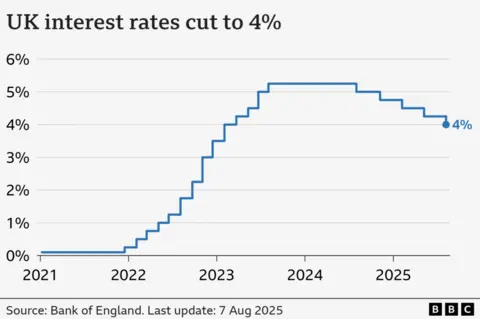
Interest rates are widely expected to be held at 4% when policymakers at the Bank of England meet on Thursday.
The Bank rate, which heavily influences borrowing costs and savings rates, was cut from 4.25% to 4% by the Bank’s Monetary Policy Committee (MPC) at its last meeting in August.
It took the rate down to its lowest level for more than two years, but many analysts believe there will be no further cuts during the rest of this year.
The decision will be revealed at 12:00 BST and comes after official data on Wednesday showed prices were rising at nearly twice the target level, driven by the higher cost of food.
The rate of inflation remained at 3.8% in August, well above the 2% target. The Bank rate is policymakers’ main tool for controlling inflation.
In theory, making borrowing more expensive means people have less money to spend, which slows prices rises. However, increasing borrowing costs can also harm the economy.
Closely-watched vote
The decision to cut the Bank rate in August was taken after an unprecedented second vote by the nine members of the MPC.
Andrew Bailey, governor of the Bank, said the decision to cut interest rates was “finely balanced”.
Analysts expect Thursday’s vote to be more clear cut, with no change expected.
The relatively high rate of inflation means policymakers are unlikely to risk pushing that higher by cutting the Bank rate.
However, they do expect the inflation rate to start to drop soon, which leaves the possibility open of further interest rate cuts.

The Bank rate has a big impact on the interest homeowners face when taking out a new fixed-rate mortgage.
Lenders use the Bank rate to set their own rates. As a result, the expectation of interest rate rises can push up mortgage rates while the expectation of interest rate cuts can pull mortgage rates down.
Mortgage rates have dropped very slightly since the MPC’s last meeting in August, but further moves are uncertain, according to Rachel Springall, from the financial information service Moneyfacts.
“Many will be waiting with bated breath for the Budget. This waiting game, alongside forecasts for inflation to remain above target, makes it less likely for the Bank of England to make further rate cuts this year,” she said.
She said that savers had seen a downward trend in returns during the time when the Bank has been lowering the Bank rate.
“The average easy access [savings] rate has fallen further below 3%, so savers must act now and switch their variable rate account if it no longer pays a decent return on their hard-earned cash,” she said.
Global picture
The government would be keen to see interest rates fall further, to boost growth in the UK economy.
The Resolution Foundation think-tank, which which focuses on those on low to middle incomes, said living standards needed to improve after a “lost” 20 years of growth.
But ministers will be aware of the inflationary risk that remains in the UK, especially as prices are rising slower in countries such as the US, Germany, and France.
Thursday’s MPC decision will come after the US central bank chose to cut interest rates on Wednesday to a range of 4% to 4.25% for the first time since December.
Last Thursday, the European Central Bank chose to hold its interest its at 2%.

The UK’s competition watchdog says it is looking at five firms in its investigation into misleading online reviews.
Source link

A key survey indicates growing doubt among shoppers over prospects for the UK economy in the next year.
Source link

Food delivery giant Just Eat, funeral firm Dignity and motor platform Autotrader are among five firms under investigation by the UK’s competition watchdog as part of its crackdown on fake and misleading online reviews.
The Competition and Markets Authority (CMA) said it had launched probes against the companies – also including customer review and feedback firm Feefo and Pasta Evangelists – to see whether consumer laws have been broken.
Since April last year, companies have been banned from certain tactics around online reviews under law, such as fake posts, paid-for reviews that are not clearly marked as incentivised, as well as for hiding negative feedback.
Sarah Cardell, chief executive of the CMA, said: “Fake reviews strike at the heart of consumer trust – with many of us worrying about misleading content when looking at reviews online.
“With household budgets under pressure, people need to know they’re getting genuine information – not reviews or star ratings that have been manipulated to push them towards the wrong choice.
“We’ve given businesses the time to get things right. Now we’re deploying our new powers to tackle some of the most harmful practices head on.”
The CMA said it was looking into whether Just Eat’s ratings system had inflated some restaurant and grocer star ratings, giving a misleading picture of quality.
For Autotrader and Feefo, the CMA is investigating whether a number of one-star reviews – moderated by Feefo, which handles reviews for the new and used car site – were hidden on the platform and did not count towards the star ratings.
Dignity is under investigation by the CMA into whether it asked staff to write positive reviews about the firm’s crematoria services.
And artisan fresh pasta chain Pasta Evangelists is being probed over allegations it offered customers discounts for leaving five-star reviews on delivery apps without this being disclosed.
If the CMA finds the firms have broken the law, it can order them to change their practices and fine them up to 10% of their annual global sales.
An Autotrader spokesperson said: “We endeavour always to operate as a responsible and compliant business and will co-operate fully with the CMA’s investigation.”
It comes after the CMA recently secured commitments from Google and Amazon to beef up their systems to identify and remove fake reviews.
Amazon last June agreed to put in place “robust processes” to quickly detect and remove fake reviews alongside sanctions for rogue sellers and businesses after an investigation by the CMA to curb the customer hazard.
The tech giant said it would sanction businesses that boost their star ratings via bogus reviews or catalogue abuse, including bans from selling on the website, while users could also be banned for posting fake reviews.
Consumer group Which? welcomed the investigations and said the CMA must “get tough” on firms found to be breaking the law with reviews.
Sue Davies, head of consumer rights policy at Which?, said: “Investigations are a welcome first step, but enforcement will be key – the regulator must be prepared to get tough, use its powers and issue serious fines if these companies aren’t playing by the rules.”
The CMA said it swept more than 100 review publishers as part of the clampdown and sent advisory letters to 54 firms to improve their compliance with the law, with 90% having made changes in response and 75% telling the watchdog they better understood the rules.

JustEat and Autotrader among firms investigated in fake reviews probe

EU Parliament members set conditions for lowering tariffs on US items

Cam Newton views adding 18th regular-season game as ‘good business,’ questions how preseason games will work

-

 Entertainment1 week ago
Val Kilmer revived 1 year after death through AI
-
 Fashion1 week ago
US’ G-III Apparel’s FY26 sales fall 7% to $2.96 bn
-

 Sports1 week ago
March Madness 2026 – How to watch in SA, start time, schedule, TV channel for NCAA championship basketball tournament
-
 Business1 week ago
Brits cashing in jewellery as gold price hits record high
-

 Fashion6 days ago
China’s textile & apparel exports surge 17% to $50 bn in Jan-Feb 2026
-
 Business6 days ago
Flipkart group CFO to leave co amid IPO plans – The Times of India
-
 Business1 week ago
Video: The Effects of High Oil Prices
-

 Sports7 days ago
Rating Adidas’ 2026 World Cup away shirts: Argentina, Spain, Mexico and more