As a play on the word “genesis”, the company’s brand evokes beginnings and new life, but for chief sustainability officer (CSO) Bridgette McAdoo, arriving at Genesys was founded in a series of roles and achievements, delivering broad and deep knowledge and experience.
McAdoo started as an engineer at Nasa before moving into sustainability via pivotal roles at Yum! Brands and the Worldwide Fund for Nature (WWF, formerly the World Wildlife Fund). She joined Genesys in 2020.
With her engineering degree supplemented by a master’s in business administration (MBA) from the Drucker School of Management, she understands challenges and devises solutions from practical, empirical, science-based and business perspectives.
At Genesys, she has worked on integrating sustainability into business key performance indicators (KPIs) with transparency and measurable outcomes, embedding sustainability into innovation and operations. Indeed, McAdoo emphasises an evolution towards formalised strategies and concrete practice since 2008.
“Back then, they had constraints, where people did not feel it was a business imperative. You didn’t understand how to move the needle, versus today we have established what we think ‘good’ looks like, what the need is, and why it’s such a value driver,” she tells Computer Weekly.
“And the unfortunate reality is now you’re facing a different battle of how to work with the inconsistencies across different regions on the importance of this space,” she says. “There’s so much misinformation now around sustainability.”
By the time McAdoo was finishing her MBA in 2010, she had been working as a contractor at Nasa for almost 10 years. That had included “good core engineering work” on the space programme for different companies, including Hamilton engineering and aerospace firms Sundstrand and United Technologies. The latter is now merged with Raytheon.
“Once I was taking my MBA classes, I really got into social responsibility and principles from Peter Drucker,” she says.
A 20th-century academic, Drucker became known for a human-oriented approach to organisational thinking and management science.
“I fell in love with this idea that my work could be my legacy, working to benefit society,” McAdoo confirms.
A taste of the supply chain
After a chance meeting for the National Black MBA Association at a conference, Yum! Brands’ then chief sustainability officer put to McAdoo that her specific background was valuable.
“He wanted me to come in and focus on the supply chain and the ops part of sustainability for them globally. So that’s what I did,” she says.
PepsiCo spin-off Yum! includes fast food giants KFC, Taco Bell and Pizza Hut. McAdoo was tasked with looking at ways to ensure the company examined the sourcing for its products, including how foodstuffs were grown. In addition, she had a focus on external relations on sustainability issues.
“I got into social responsibility and principles from Peter Drucker. I fell in love with this idea that my work could be my legacy, working to benefit society”
Bridgette McAdoo, Genesys
McAdoo “kind of fell in love” with the topic. One partner was the WWF, so she followed that up with the non-profit role at WWF eight years later.
“They were such a strong partner,” she says. “I loved working with WWF on that intersection between the food and water organisations. So all the restaurants, hotels, anything you can think of that has a large supply chain and food and water code, Pepsi had worked with them.”
The mission was partly to help WWF counter the fact that a lot of the time, while conservation organisations want conversations and want to work with businesses, they’re deep into the science – as they should be – it can come across to profit-driven entities as impractical, she explains.
Of course, science done right is not based on flights of fancy. It can be the most practical thing ever.
But McAdoo points out that sometimes science-based organisations, perhaps especially non-profits, can include stakeholders who have never been in a business environment. There’s not a shared language to have productive conversations about how to drive practical changes or integrate them into a business.
That can end up being seen as a utopian perspective with little reference to the day-by-day realities of earning revenues and staying sustainable in the business sense.
“That’s where the disconnect happens,” she says. “So you still have to show that there’s a business case behind it. Most companies want to do the right thing, but they also have to make a profit. You have to show them that you can do both. And that’s the power of the sustainability role.”
Onwards and upwards
Moving to Genesys in late 2020 realised a new opportunity for McAdoo to progress her mission.
You have to show that there’s a business case behind [sustainability]. Most companies want to do the right thing, but they also have to make a profit. You have to show them that you can do both. And that’s the power of the sustainability role Bridgette McAdoo, Genesys
“It’s been an absolutely beautiful ride. Night and day, people ask how you go from space shuttles to tacos and pizzas, to ‘being a panda’ (referencing the WWF logo), and into the AI [artificial intelligence] space and tech, and I always tell them it’s very intentional,” she says.
Regardless of product or sector, the overarching goals have been about ensuring knowledge and applying it. Organisations must have proper protocols and processes in place to scale responsibly. At the same time, they need to understand how employees can have a place where they feel seen and belong, while ensuring societal impacts do not hinder or harm the workplace or its growth.
“That’s the same, regardless. I’m just blessed that I get to do it at Genesys, a company 100% committed to it, top down and bottom up,” says McAdoo.
Every month or year, there’s something new to talk about when it comes to sustainability. At the same time, the role reinforces her “unwavering commitment to the work” of leaving society better than she found it.
McAdoo emphasises the need for transparency coupled with good, accurate, appropriate data, especially throughout the supply chain. For years, obtaining reliable data and information on which to base sustainability decisions, that don’t also harm a business in a two steps forward, three steps back kind of way, has been challenging. Only now is sustainability coming to the fore for many, if not all, businesses, partly as a result of CSO efforts.
It’s harder than it might sound. It’s about getting everyone to make sure they are being transparent and that the necessary supply chain information is available. It includes doing all diligence around developing and implementing guidelines that facilitate information sharing that ultimately feeds sustainability initiatives and environment, social and governance (ESG) audits.
“For any organisation, supply chain data is always going to be the hardest part, getting that transparency for your ecosystem,” says McAdoo.
Genesys has been reporting on its related strategy and measurable outcomes for almost five years now, showing “progress and momentum year on year”. That includes emissions reduction, growth in volunteerism, sustainable scalability, and sustainable design implementation and practices. This, too, has been quite intentional – it doesn’t occur by accident, she emphasises.
“We’ve integrated sustainability into our business KPIs. It’s become just an organic extension of how we work and how we grow. And it’s a passion for me whenever I get to merge my personal and professional values because of Genesys,” she says. “Because sustainability hasn’t just been an add-on. We’re not checking boxes.”
Sustaining the energy
McAdoo also says that, despite the politics of the past nine months or so – especially, as a casual observer might note, in the US – “the energy was already there” and has been sustained. The task of embedding and sustaining better policy and practice, setting goals and reporting on those goals continues. It was already embedded into how Genesys innovates and how it operates and grows.
We’ve integrated sustainability into our business KPIs. It’s become just an organic extension of how we work and how we grow Bridgette McAdoo, Genesys
Its sustainable supply chain initiatives continue, therefore, including the implementation of strategies to tackle Scope 3 emissions and green events and internal emissions management. The work of implementing and enhancing procurement guidelines in line with ESG audits, overseen by Leadership in Energy and Environmental Design (LEED)-certified offices across the globe, also continues. Three new such offices have opened in the past year – in Budapest, Riyadh and Manila.
McAdoo adds that it also means thinking seriously about AI, working with the engineering and product teams on sustainable AI by design, to avoid wasting energy, including in the cloud.
“There’s a multi-layered approach. Different things that happen across our business and across our ecosystem to ensure that we continue to reduce our emissions,” she says. “Every decision we make is measured, not just by our business outcomes, but also the impact that’s going to have, with the future in mind.”
Regional differences in applicability remain, of course, not least with respect to inconsistent or patchy regulatory frameworks. Politics does and will likely always influence reporting requirements, including around climate and the environment.
McAdoo agrees that regions and governments could work together better sometimes, accelerating emissions reduction and sustainability. But that doesn’t mean companies are taking their eyes off the ball or expect to relax their commitments. Apart from anything else, sustainability remains a differentiator for Genesys, not least because that matters to customers.
There’s often a “very precarious balance” to strike, especially for global entities that must meet the needs of customers worldwide. And there have been headwinds. Rollbacks and dilutions thus far include anticipated US Securities Exchange Commission (SEC) climate rules and European Union Corporate Sustainability Reporting Directive (CSRD) guidelines, she notes.
“I think that’s what people were hoping was going to happen with the CSRD, and then that got rolled back with all the political changes around climate reporting and just climate in general, whether it’s in the US or the UK,” says McAdoo. “But we’re going to continue to do the work.”
Over the weekend in China, a humanoid robot shattered world half-marathon record—the human record—by seven minutes.
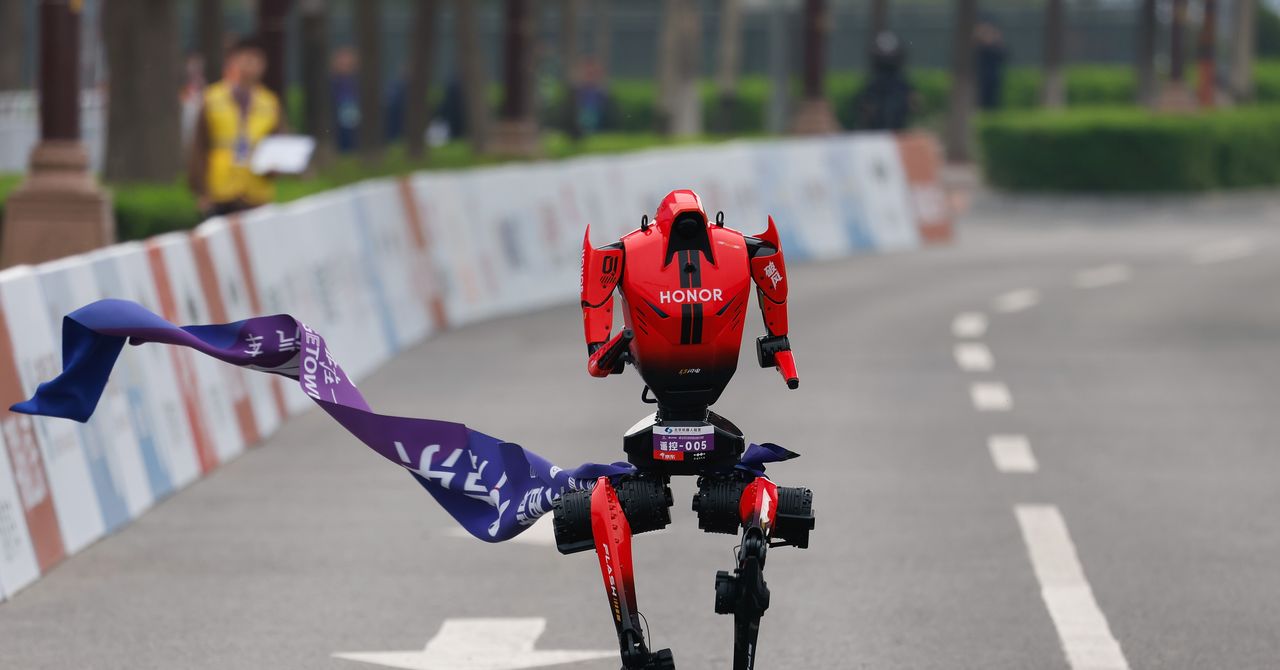
The star performer was a robot developed by the Chinese company Honor (the smartphone maker), which finished the 13.1-mile race in 50 minutes, 26 seconds. The human record, set by Ugandan Olympic medalist Jacob Kiplimo, is 57 minutes, 20 seconds. The result marks an impressive milestone especially considering that, just a year earlier, the fastest robot at this half-marathon event took two and a half hours to complete the same distance.
But Honor’s robot was not the only participant. The event consisted of more than 100 humanoid robots from 76 institutions across China. The robots lined up alongside 12,000 human runners in Beijing’s E-Town, albeit on separate courses to avoid accidents. The contrast in performance between humans and robots was more than evident.
Run, Robot, Run
A humanoid robot is designed to mimic the structure and movement of the human body, with legs, arms, and sensors that allow it to interact with its environment. In this case, the winning robot incorporated features inspired by elite runners: long legs (almost a meter), advanced balance systems, and a liquid cooling mechanism, similar to that of smartphones, to prevent overheating during the race.
In addition, many of the participating robots operated autonomously, meaning without direct human control. Thanks to artificial intelligence algorithms, they could adjust their pace, maintain balance, and adapt to the terrain in real time. Notably, the Honor robot that achieved the 50-minute mark operated autonomously. The Chinese manufacturer presented another robot, operated by remote control, that ran the same stretch in even less time: 48 minutes, 19 seconds.
As expected, there were some accidents in the race. Some robots fell down, others veered off the path, and several needed technical assistance along the way. While the physical performance of humanoid robots has advanced rapidly, their reliability is still developing. Of course, the laughter and jeers are no longer as frequent as they used to be, replaced by applause and exclamations of surprise.
The winning robot, “Blitz,” from smartphone manufacturer Honor was on display at the awards ceremony after the Beijing E-Town Robot Half Marathon.
Photograph: Lintao Zhang/Getty Images
Robot Superiority
Just like the robots that went viral for their impressive martial arts display a few weeks ago, this long-distance race is part of a broader strategy by China to show off its leadership in the development of advanced robots.
You don’t need to be a robotics expert to see that this achievement demonstrates that machines can outperform humans at specific physical tasks under controlled conditions. (It’s hard to imagine that the winning robot could achieve the same result, for example, if it started to rain during the race.) But humans still have a few tricks up their sleeve: Running in a straight line is very different from performing complex real-world activities, such as manipulating delicate objects or interacting socially.
However, it’s understandable that the image of a robot crossing the finish line in record time, ahead of human athletes, raises several questions. Is this the beginning of a new era in which machines redefine physical limits?
One could argue that a car is a machine, and those have always been faster than humans. But a humanoid robot is designed to mimic humans. It’s more alarming to see one beat humanity at its own game—even if so many of them are still tripping over themselves.
This story originally appeared in WIRED en Español and has been translated from Spanish.
As ceasefire announcements between the US and Iran—and separately between Israel and Lebanon—dominated headlines over the past two weeks, they also prompted a look back at how war spread online: through memes.
There were jokes about conscription. Captions about getting drafted, but at least with a Bluetooth device. The song “Bazooka” went viral, with users lip-syncing to: “Rest in peace my granny, she got hit by a bazooka.” Military filters followed. So did posts about Americans wanting to be sent to Dubai “to save all the IG models.”
Across the Gulf, the tone was different but the instinct was the same. Memes joked that Iran was replying to Israel faster than the person you’re thinking about. Delivery drivers were shown “dodging missiles.” “Eid fits” became hazmat suits and tactical vests.
Dark humor is one of the oldest responses to fear, a way of reclaiming control, however briefly, over events that offer none. Variations of that idea appear across psychology and philosophy, including Freud’s relief theory, which frames humor as a release of tension.
But social media changes the scale and speed of that instinct.
A joke once shared within a small community can become a global template in minutes. Algorithms do not reward depth or accuracy; they reward engagement. The memes that travel fastest are usually stripped of context, easy to recognize and simple to remix.
Middle East scholar and media analyst Adel Iskandar traces political satire back centuries, from banned satirical papyri in ancient Egypt to cartoons during revolutions and gallows humor in modern wars. “Where there is hardship, there is satire,” he says. “Where there is loss of hope, there is hope in comedy.”
That tradition still exists online. But today it is fused with recommendation systems designed to keep attention moving.
Memes Spread Faster Than Facts
The word “meme” was coined by Richard Dawkins in his 1976 book The Selfish Gene, where he described how ideas replicate like genes. On today’s internet, replication follows platform logic.
Fitness means generality. A meme does not need to be accurate. It needs to feel familiar. It needs the right format, paired with trending audio and the right emotional shorthand.
“A meme is like a virus,” Iskandar says. “If it doesn’t travel, it’ll die.”
The most visible response online is not always the truest one. It is often just the easiest to spread. And once context disappears, one crisis can start to resemble any other.
Geography shapes humor too, and adds another level of tension. “If you live far away from the threat, you’re capable of producing content that ridicules it with an element of safety,” says Iskandar. “Whereas if you happen to be within close proximity, it is more of a fatalism.”
That divide matters. For some users, war exists mainly as mediated spectacle: clips, edits, graphics, headlines, and reaction posts. For others, it is sirens, uncertainty, disrupted flights, rising prices, and messages checking who is safe.
The same meme can function as entertainment in one country and emotional survival in another. Take the American experience of violence, which Sut Jhally, professor of communication at the University of Massachusetts Amherst, says “is very mediated.”
What much of the Western world has consumed instead is what cultural critic George Gerbner called “happy violence”: spectacular, consequence-free, and detached from the aftermath.
Jhally argues that the September 11 attacks remain the defining modern American experience of war-adjacent political violence. Much else has been cinematic: distant invasions, blockbuster destruction, video-game logic, apocalypse franchises.
The teenager from the Midwest joking about being drafted is drawing from zombie films and superhero apocalypses. “There is almost no discussion about what an actual Third World War would look like,” he says. “People do not have a perception of what that really looks like.”
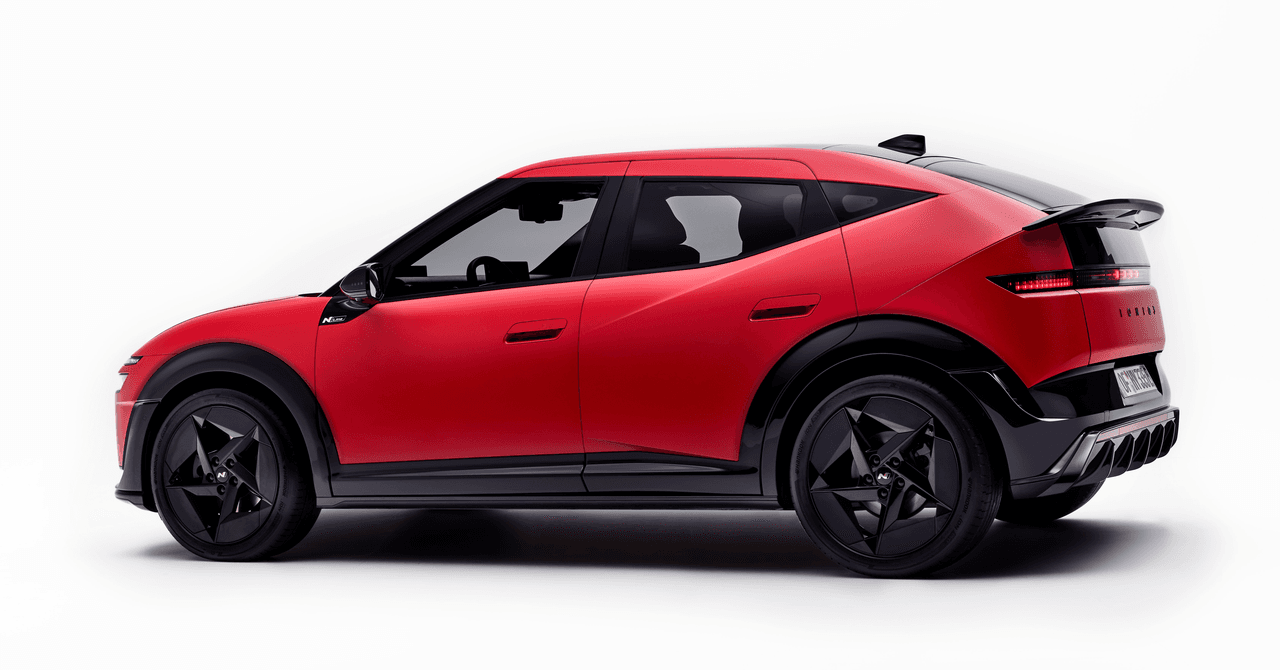
Hyundai has unveiled its Ioniq 3, a fully electric compact hatchback for urban driving designed to be as aerodynamically efficient as possible yet still offer up a surprisingly spacious interior—a trick the carmaker is loftily calling Aero Hatch. The 3 is intended to fill the gap between Hyundai’s Inster supermini and Ioniq 5 crossover.
In profile, the Ioniq 3 has a sleek front end that transitions into a roofline that stays straight over both front and rear occupants before dropping to merge with the rear spoiler. It’s this roofline that maximizes interior headroom for the rear passengers, but it also offers a supposed class-leading drag coefficient of 0.263.
The Ioniq 3’s impressive aerodynamics will supposedly help it get more than 300 miles on a single charge.
Photograph: Courtesy of Hyundai
The car has the same underpinnings as its sibling brand, Kia’s EV2. Two battery options will deliver a projected WLTP distance of 344 km (around 214 miles) for the Standard Range Ioniq 3; the Long Range version is supposedly good for a competitive 308-mile range. Built on the group’s Electric-Global Modular Platform (E-GMP), the car has a 400-volt architecture to lower costs rather than the 800-volt system of the Ioniq 5 N, 6, or 9 SUV. Still, this means that if you can find sufficiently fast DC charging, you can, in theory, top up from 10 to 80 percent in approximately 29 minutes (AC charging capability is up to 22 kW).
This is fine, but it is not a match for BYD’s new Blade 2.0 battery tech that WIRED tried, astonishingly allowing the Denza Z9 GT to charge its battery in just over nine minutes from 10 percent. True, that battery tech was in a $100,000 “premium” EV, but it’s coming to BYD’s wider models. And if BYD makes good on its plans to deliver a charging network to rival Tesla’s Supercharger, then very soon buyers will be expecting comparable charge times, and 30 minutes will quickly feel awfully long.
I asked José Muñoz, Hyundai Motor Company president and CEO, whether this new battery technology from BYD concerns him, whether Hyundai—leading the EV pack with 800-volt architectures for so long—needs to match the Blade 2.0’s performance. “We welcome the challenge,” Muñoz tells me. “Every challenge is an opportunity to do better. And I can tell you that, lately, we have a lot of opportunities to do better.”
“We are also working on fast charging,” Muñoz says, adding that Hyundai’s success will be built on not merely one leading technology but many. “There are not more elements that may be offered by the Chinese that we can offer. It’s only a matter of how you mix them. A lot of times, you get stuck into one indicator. I’m an engineer. And we always have the example of the airplanes: What is more important in an airplane, altitude or speed? There is only one answer. You need to achieve both.”









 Fashion5 days ago
 Sports1 week ago
 Entertainment1 week ago

 Entertainment5 days ago
 Fashion1 week ago

 Tech1 week ago