Diana Schildhouse, chief data and analytics officer at Colgate-Palmolive, describes herself as a data storyteller – but what does that mean in terms of day-to-day delivery?
“To be successful in roles like this, you must have a deep connection with the business and understand what you’re trying to solve, what their questions are, and then devise solutions,” she says.
“Those solutions could use advanced analytics. Sometimes, it’s about creating simpler solutions. But success is always about solving that business need.”
Schildhouse joined Colgate-Palmolive in April 2021 as chief analytics and insights officer. She was previously at Mattel for eight years, latterly as senior vice-president for global strategy, insights and analytics. Schildhouse has also worked for Westfield, Merrill Lynch and Disney.
“Most of my experience has been in consumer-facing companies,” she says.
“In terms of my career, I’ve always been in functions like advanced analytics, insights and strategy. When I saw the opportunity with Colgate-Palmolive, I thought about the breadth and scale of the company. It was an exciting opportunity for me to come in and build from the ground up, while leveraging the scale of the business.”
Schildhouse joined the company in a newly created role to develop an analytics and insights strategy for an organisation that operates in over 200 countries and territories globally. After proving her success in this role, she assumed her current position in June 2025, where the breadth of responsibilities increased to include oversight for data and artificial intelligence (AI).
“I had already been running some of those areas, but it made sense for us to bring everything together,” she says.
“You can’t build and scale all the exciting, advanced analytics solutions and everything with AI unless you have data foundations. Many companies are on this journey. They recognise that gaining value from all this data-enabled technology depends on key elements like data strategy, data governance, and a series of related topics.”
Supporting growth
Schildhouse reports to Colgate-Palmolive’s chief growth officer. Her peers include executives responsible for digital transformation, supply chain, innovation, research and development, global marketing, strategy and sustainability. She says the organisational structure makes it easier to tie data to long-term aims.
“The farther away you are from the business, the harder it is to make connections and drive impact,” she says.
“What appealed to me here was the fact that analytics and insights were part of the business and growth area of the company. I thought that would position me well to drive value through the work that I’m doing.”
“You can’t build and scale all the exciting, advanced analytics solutions and everything with AI unless you have data foundations. Gaining value from all this data-enabled technology depends on key elements like data strategy, data governance, and a series of related topics”
Diana Schildhouse, Colgate-Palmolive
Almost five years into her work with the company, Schildhouse says it’s been an exciting and enjoyable ride.
“We’ve had lots of success in what we’ve done with our analytics and data transformations here,” she says. “It’s fulfilling to see that my amazing team is driving a lot of that success.”
Joining the company in a new role meant she had a blank page for analytics and insight strategy. She began by asking the business about its major challenges and exploring the potential of technology to help solve those concerns. As part of her efforts, she tracked and traced performance to ensure success.
“That’s something I’m obsessed with, because if we can’t show the value and impact we’re getting, then we could be building the most brilliant solutions and passing them over the fence to the business, but if they don’t actually use them, then we didn’t achieve what we were trying to do,” she says.
Whether it’s for pricing analytics, revenue generation, cost optimisation, or intellectual property creation, Schildhouse has developed frameworks that ensure the solutions her team creates can be scaled globally to deliver value. She says the general direction of travel for data-led transformation at Colgate-Palmolive is about giving the people in the business tools to make better decisions quickly.
“We want them to have information at their disposal,” she says. “Some of the things we’ve built internally can compute billions of scenarios. So, it’s not just a matter of changing where teams spend their time. Some of the things we can do now, you couldn’t have completed a few years ago. Our work is about helping business teams use data and analytics in predictive, diagnostic and then prescriptive ways to make faster, more informed decisions.”
Embracing AI
Schildhouse’s team conceptualises, builds, deploys and embeds AI-enabled solutions, including machine learning models and predictive and prescriptive analytics, across Colgate-Palmolive globally. One example includes revenue growth management (RGM) analytics, which covers key concerns such as pricing and trade promotions.
She says RGM was identified as one of the areas where her team could have the biggest impact when she joined the company. They developed an in-house diagnostic and predictive tool that helped staff on the ground understand scenarios and make faster pricing decisions. That tool was scaled globally. The team also tracked usage to ensure the technology was effective.
The team used successes in RGM as a platform for developments in other areas. Schildhouse refers to promotion and calendar optimisation technology, which business users suggested was an area that could benefit from better analytics. They piloted, tested and refined this tool and are now pushing it out globally to boost pricing and promotions analysis.
Schildhouse’s team is also exploring generative AI (GenAI) in product innovation. Guided by a business-first approach, her team assessed potential technological solutions. They mapped out how the company’s marketers create and test new product concepts, and considered how AI could be deployed to make that process faster, easier and more effective.
Along with technology partner Market Logic, the data team created an insights hub. Marketers can use natural language to query data and receive instant insights from the hub.
“That was the first step that helped us understand unmet consumer needs,” she says.
As a second stage, they developed a tool to help support the creation of product concepts that fit these consumer needs. As part of an innovation funnel, Schildhouse says marketers can test their ideas rapidly in a digital twin. Developed in-house, the twin allows professionals to test their concepts cost-effectively for specific demographic groups.
“This multi-stage approach has been one of our most successful applications of GenAI to an important business area,” she says. “It’s about ensuring there’s a human in the loop and helping our innovation teams get to faster insights and to develop many more concept ideas.”
Establishing priorities
Schildhouse says one of her team’s main priorities is to innovate in an area known as omni-demand generation, which she explains is an approach that helps the company meet its consumers with the products they need. This work will incorporate progress in key areas, such as RGM, plus media, marketing and e-commerce analytics.
“We have some exciting things planned there,” she says, referring to her team’s aims. “Then I would just definitely say AI – so, continued experimentation, and moving to scale on many of the things that we’ve already piloted within that area.”
Schildhouse says her team considers AI initiatives via a framework that explores both horizontal and vertical elements. The horizontal elements are the underpinning tools and foundations that allow the company to scale its successful AI initiatives globally and effectively. The vertical elements, meanwhile, are the company’s priority areas for GenAI.
“Our plans for the next couple of years are very closely tied to that framework, but innovation always starts with our strategy – that’s key in helping us know where to focus,” she says.
Over the next 24 months, her internal team will continue to focus on the data strategy and governance foundations that she says are crucial to scaling analytics and AI initiatives.
“We’ll be putting a lot more focus on data transformation, and we’ve already made really great strides in that area, as well as building and launching data products that are reusable and governed. We’ll also be looking at AI and what’s the next generation for us,” she says, including developing data-enabled services for the company’s customers.
“There’s always a portion of what we’re doing that’s focused on exploring those edge cases of what could be the next most impactful area for the company. We want to create products that delight customers, meet their needs and provide the benefits that they’re looking for.”
Learning lessons
Schildhouse feels positive when she considers the future of the data leader role. There’s no doubting, she says, that information and insight continue to be increasingly important for modern companies. However, she reasserts that data leaders must ensure their AI and analytics initiatives are built on strong foundations.
In a world where companies are looking to get actual, tangible value from all their analytics and AI solutions, if your data is not in the right place and it’s not organised, and you don’t have the right datasets, that slows down the whole process Diana Schildhouse, Colgate-Palmolive
“In a world where companies are looking to get actual, tangible value from all their analytics and AI solutions, if your data is not in the right place and it’s not organised, and you don’t have the right datasets, that slows down the whole process,” she says.
“One of the reasons we were able to scale the RGM analytics tool that we built in-house is because, at the same time as we were creating that, we also started working on the data foundations.”
Schildhouse says her team consolidated and harmonised data from 500 sources in a global view for the RGM project. Lessons learned in this initiative have helped inform others. Yet, regardless of the project, she says one thing remains constant – data leaders must be guided by enterprise demands rather than technological features.
“You must have a business lens,” she says. “Data leaders need to bring that focus and understand how the work of their team translates to something meaningful for their organisation and their industry. That awareness is so key in the role, and that’s where you see the more successful data leaders when I look at some of my peers.”
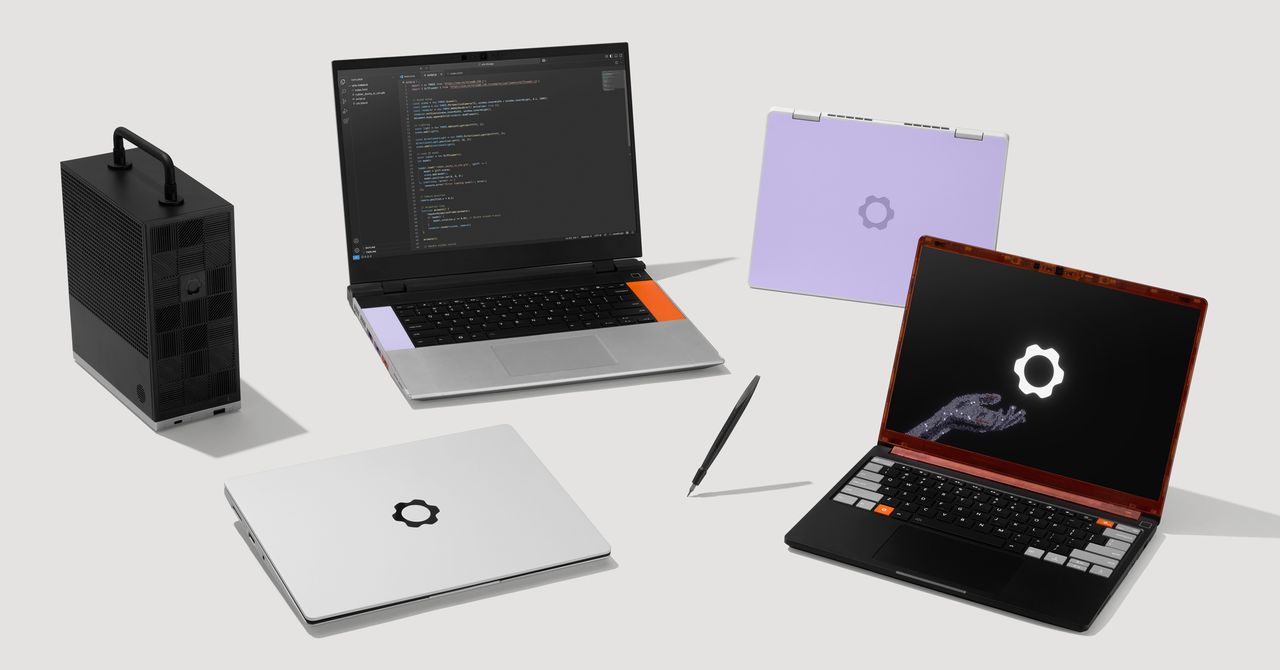
Framework, the company that makes laptops designed for optimal repairability, announced a new version of its main product, a 13-inch screen laptop. It’s called the Framework Laptop 13 Pro, and it has far better battery life, a touchscreen, a haptic touchpad, and is fitted with Intel processors.
At an event in San Francisco today, Framework CEO Nirav Patel showed off the company’s new tech, opening with a joke about making Framework AI—something the company is very much not doing. Framework’s whole thing, after all, is aiming to give users control over the physical tech they use.
“That industry is fighting for you to own nothing, and they own everything,” Patel said about the AI industry. “We’re fighting for a future where you can own everything and be free.”
Framework used the event to detail other updates coming to its 16-inch laptop. It also showed off previews of an official developer kit and a wireless keyboard for controlling your rig from the couch.
Framework 13 Pro
The Framework Laptop 13 Pro.
Courtesy of Framework
As the name implies, the 13 Pro is a step up from the company’s last version, the Framework 13. It’s also pricier, starting at $1,199 for a DIY Edition that requires assembling the computer yourself. Pre-built units start at $1,499 but can be upgraded with more features. Framework says it will start shipping the 13 Pro in June.
Framework’s signature move for its products is the ability to take the thing apart. The 13 Pro is made with that ethos in mind, so its parts can be easily swapped out, upgraded, or replaced. Four Thunderbolt 4 interfaces let you pick which ports (USB-C, HDMI, etc.) you want and then choose where to place them. Framework says it planned the laptop with cross-generation compatibility in mind, so current Framebook 13 laptop owners will be able to use new 13 Pro parts like the mainboard, display, and battery, and put them into their existing machine.
The big changes in the guts of the 13 Pro come from Framework’s shift away from using an AMD processor to Intel’s Core Ultra Series 3 processors, which Framework described in its press release as “just insanely efficient.” That efficiency, along with a bigger battery, translates to more than 20 hours of battery life while streaming 4K Netflix videos, at least that’s the claim. That’s almost 12 hours longer than the Framework 13.
OpenAI launched a new image generation AI model on Tuesday, dubbed ChatGPT Images 2.0. This model can generate more than one image from a single prompt, like an entire study booklet, as well as output text, including in non-English languages, like Chinese and Hindi. This release is available globally for ChatGPT and Codex users, with a more powerful version available for paying subscribers.
When any major AI company releases a new image model, it can revive interest and boost usage, especially if social media users adopt a meme-able trend, transforming images of themselves. Last year, Google’s launch of the Nano Banana model was a major moment for the company, especially when users started posting hyperrealistic figurines of themselves online. Earlier this year, ChatGPT Images made waves on social media as users shared AI-generated caricatures.
What’s Different?
Since the new model can tap into ChatGPT’s “reasoning” capabilities, Images 2.0 can search the internet for recent information and generate more than one image at a time. In essence, the bot can use additional steps to output more thorough generations from a single prompt. Images 2.0 also has a more recent knowledge cutoff date: December 2025.
This also means that outputs from the new model are more granular. For example, I generated an infographic with San Francisco’s weather forecast for the next day, as well as activities worth doing. The image ChatGPT generated included accurate weather details for the rainy day, along with accurate-looking drawings of the Ferry Building, Castro Theater, Painted Ladies houses, and Transamerica Pyramid.
Additionally, Images 2.0 is more customizable for users who want unique aspect ratios for image outputs. The new model can generate images, ranging from 3:1 wide to 1:3 tall, and users can adjust the image’s size as part of their prompt to the AI tool.
First Impressions
After a few hours of generating images with the new model, I was generally impressed with the text rendering capabilities, in English at least. Not that long ago, image outputs featuring text, from any of the major models, often included numerous malformed characters or words with errant extra letters. ChatGPT struggled to label images accurately two years prior, so the cleaner, more complex outputs from Images 2.0 are a sign of continued improvement. Google has also focused on improving image outputs featuring text in its recent iterations of Nano Banana.
No doubt looking to find some breathing space after the hubbub of Watches and Wonders last week, TAG Heuer has dropped an update to its 2025 revamped collection of the brand’s iconic plastic-cased 1980s watch, the “Formula 1.”
The five new pieces are called the “pastel collection” by TAG, and all are built on the same solar-powered Formula 1 Solargraph 38 mm that launched in March last year. Two models feature a sandblasted stainless steel case, while the remaining three have cases made from TAG’s proprietary bio-polamide plastic, Polylight.
It’s these Polylight versions that, for WIRED, are the stars of the new mini collection. Coming in pastel blue, beige, and pink, and sporting case-matching rubber straps and bidirectional-rotating Polylight bezels, they reference classic F1 designs that made the line iconic in the first place.
The new Polylight beige.
Courtesy of TAG Heuer
The “pastel green” steel F1 Solargraphs.
Courtesy of TAG Heuer
The stainless steel models have a 3-link sandblasted steel bracelet and either a “pastel green” or “lavender blue” dial with matching Polylight bezels. The dials on both watches also see eight diamonds replace the circular hour markers. TAG says these models add “a touch of refinement for those seeking sophistication,” but considering these “luxury” F1s will retail at $2,800, as opposed to the already punchy $1,950 full Polylight versions, our pick is most definitely the plastic pieces.
Not only do these blue, beige, and pink versions pleasingly hark back to vintage F1 designs—though now 38 mm in size instead of the original 35 mm—but also, just like all F1 Solargraphs, they come equipped with screw-down crowns and casebacks, making for 100 meters of water resistance and ensuring these will serve well as dive and sports watches. My recommendation? Go for the pink, it looks superb on the wrist. The beige is a very close second.
Pretty in pink: The new Polylight pink F1 is limited to 1,110 pieces for the 110th anniversary of the Indy 500.














 Fashion5 days ago
 Sports1 week ago
 Entertainment1 week ago

 Entertainment6 days ago
 Fashion1 week ago

 Fashion1 week ago