Sacha Vaughan, chief supply chain officer at houseware manufacturer Joseph Joseph, is in a fortunate position – her board recognises the critical role of the supply chain in a digital age, which she suggests isn’t always the case.
“Many brands see the supply chain as simply moving boxes from one place to another,” she says. “The consensus is often that, ‘It’s not that difficult.’ However, we’ve had some pain in the past. The board realises that the supply chain is more than just moving boxes from A to B, and it’s a huge lever for cost control. Therefore, they treat the supply chain strategically.”
Vaughan says this recognition of the importance of product fulfilment isn’t just a result of internal cost pressures. She suggests supply chain chiefs have had an interesting decade, characterised by a series of disruptions, including the coronavirus pandemic, Brexit and the implementation of new tariffs following the change in US administration.
“We’ve been fortunate and unfortunate at the same time,” she says. “The world has been particularly volatile from a supply chain perspective. However, the impact of these disruptions has helped to elevate the supply chain from the basement into the boardroom.”
Embracing supply chain transformation
Vaughan joined Joseph Joseph in February 2025. Having fulfilled senior operations roles with Forma, Charlotte Tilbury and Shiseido, her previous position was as global operations and manufacturing director at Dyson. She was approached about the opportunity to become chief supply chain officer at Joseph Joseph and was impressed after a discussion with the firm’s co-founder, co-owner and CEO, Richard Joseph.
“I was sold the moment I met him,” she says. “He’s super smart and a great businessman who’s really clear on what he wants. He was someone I knew I could work for, and I bought into his vision. I absolutely love the product, and the founders – both Richard and Anthony – are delightful to work with.”
Vaughan recognises there are similarities between her current and former employers, as both are design-led businesses where the founders remain heavily involved. However, climbing higher up the career ladder at Dyson required a move to Singapore. She says joining Joseph Joseph allowed her to achieve her career aspirations in the UK at an organisation she admired.
“Chief supply chain officer was definitely my trajectory – it was the role I wanted,” she says. “And they were offering that opportunity at an exciting time. They were looking for someone to completely transform their supply chain, not do more of the same. I really believed in that vision. And seven months later, that’s exactly what we’ve done.”
Vaughan says the supply chain she inherited was a bit underdeveloped. She describes the existing supply chain as sedentary and traditional – she was given the remit to drive changes and create a modern, technology-enabled approach. Vaughan is focusing on transformation with the aim of developing an award-winning supply chain.
“That’s the motivation,” she says. “We’re not there now, but we will be. The talent within Joseph Joseph is quite phenomenal. I have a team of 50 people. We’re not a huge company, and yet we’re taking the supply chain seriously. And within that team, I have some smart individuals that I’m just grateful to work with every day.”
Making the most of digital and data
Vaughan reports to Richard Joseph and is a member of the executive board. She manages the end-to-end supply chain and the strategic sourcing of the firm’s products, which draws on the specialist procurement team under her wing.
“So, the beautiful designs that we come up with in London, we go and find somebody who can manufacture that product to our high standards,” she says. “It’s about ensuring we can do that task at the right price and time.” Other areas of responsibility include demand and supply planning, customer service and order management.
Digital and data play a crucial role in modern supply chain operations at Joseph Joseph. “Technology becomes more critical every month as things move on,” she says. “Ultimately, the world is too complex these days for us to have someone handing around pieces of paper. We need to be systemically controlled.”
“Technology becomes more critical every month as things move on. Ultimately, the world is too complex these days for us to have someone handing around pieces of paper. We need to be systemically controlled”
Sacha Vaughan, Joseph Joseph
The company’s enterprise resource planning (ERP) system runs on SAP. While this platform is critical for day-to-day operations, Vaughan says other areas of IT supporting the supply chain need work. However, dealing with that situation carefully is part of her long-term plan to transform the company’s operational activities.
“I’ve purposely kept us a little bit undeveloped this year because I want to work out how we want to run things here. I think some organisations jump into picking the new shiny technology and then try to bend their processes around what that technology can do, and you end up with suboptimal supply chains,” she says.
“What I want to do is be super clear on aims. Then we’ll go shopping for the right systems that meet those requirements, as opposed to buying a demand planning system that doesn’t deliver what the business needs. I want end-to-end integrations with systems that all work in the same direction and talk to each other seamlessly.”
Vaughan says that making those decisions will rely on working out how to integrate with customers and suppliers, allied to a careful consideration of how suppliers can help the business manage its inventory in the future: “We are looking at everything as an area of opportunity while we work out how we do things around here.”
Working with trusted partners
When it comes to the general direction of travel for supply chain technology at Joseph Joseph, Vaughan says application programming interfaces (APIs) are already the standard way of communicating with partner organisations. She’s interested in exploring the potential of emerging technology, such as artificial intelligence (AI), at the right time for the business.
“We have some elements of AI in our demand planning area, where we make predictions about what our customers are going to buy and when they’re going to buy it,” she says. “I think that’s a basic way of using AI, but there are more possibilities that we can leverage. However, they’re not firmly on our roadmap at the moment.”
Vaughan says any decision to use emerging technology is made in concert with the company’s IT director. Her team works closely with the technology department. While the IT department might like to move faster, Vaughan says it’s important to temper expectations as she sets her supply chain strategy in stone.
“They’re like, ‘Oh, Sacha, this is all the great technology out there that we could use.’ And I’m saying, ‘Yeah, that looks good. However, just let me get my house in order.’ I don’t want to put sticky plasters over things and have a problem recur in six months. [I want to] take a step back and fix our business challenges with technology forever,” she says.
I don’t want to put sticky plasters over things and have a problem recur in six months. [I want to] take a step back and fix our business challenges with technology forever Sacha Vaughan, Joseph Joseph
One of Vaughan’s most important moves was to establish a new partnership for third-party distribution centres in the UK. Her team ran a major procurement exercise after she joined in February. In July, Joseph Joseph’s end-to-end supply chain partnership with XPO Logistics became operational, and technology plays a key role in the approach.
“Everything’s got to be well controlled,” she says. “I was looking for a third-party partner who could ensure that we’re properly, systemically controlled. The data interface between us and XPO is seamless, with the right data in the right place at the right time, and interfaces that support our business, rather than a scrambled approach.”
Focusing on core activities
Joseph Joseph ships its stock to XPO’s third-party distribution centre in Rugby, where the logistics firm manages omnichannel fulfilment, warehousing, pre-retailing and distribution services for customers – both major retailers and individual consumers. Vaughan says the partnership allows her team to focus on growing the business rather than firefighting.
“You’ve got to know where your business is and what is core to you and where you want to focus,” she says. “I firmly believe that if you get the right partner, then logistics becomes a quiet part of the business. Because it’s the end of the chain, it can be super noisy. However, when fulfilment goes well, nobody talks about it, it’s super quiet, and you can get on with the stuff that’s going to control your costs and grow your business.”
Vaughan recognises that some companies choose to take control of fulfilment internally. In many cases, particularly for large firms, she says that’s a misguided approach. Successful digital transformation is a tricky process, and using the knowledge of an expert like XPO Logistics means her team can help Joseph Joseph deliver better customer experiences.
“Warehouse management systems are expensive – they take a lot of development, and a lot of technology is required to make things seamless,” she says. “It’s a lot of work running the distribution centres, and it’s a distraction from your core business. Giving this responsibility to people who are experts, and who can do it in a sustainable, repeatable, scalable way, is much more efficient, especially for a growing business.”
Vaughan reflects on the changes she’s seen during her time on the operational front line and is positive about the role of supply chain officers in the digital age. As more boards wake up to the opportunity to use high-quality fulfilment as a strategic lever for growth, she says the opportunities for her peers are significant, so long as they recognise the important role of digital transformation.
She says: “We need to think about key questions, such as, ‘How can you start with the customer and work back to make things frictionless?’ That’s where technology and supply chain should be focused. More and more, that’s the direction of travel, and supply chain leaders who are successful will be the ones who are really focused on the customer.”
Do you like having a second screen with your computer setup? What if your laptop could carry a second screen for you? That’s the idea behind Lenovo’s latest proof of concept, the ThinkBook Modular AI PC, announced at Mobile World Congress in Barcelona.
At MWC 2026, Lenovo trotted out three concepts. While it’s unclear whether any of them will become real, purchasable products, there’s some unique utility here, and a peek at how computing experiences could change in the future.
A Laptop With a Built-In Portable Screen
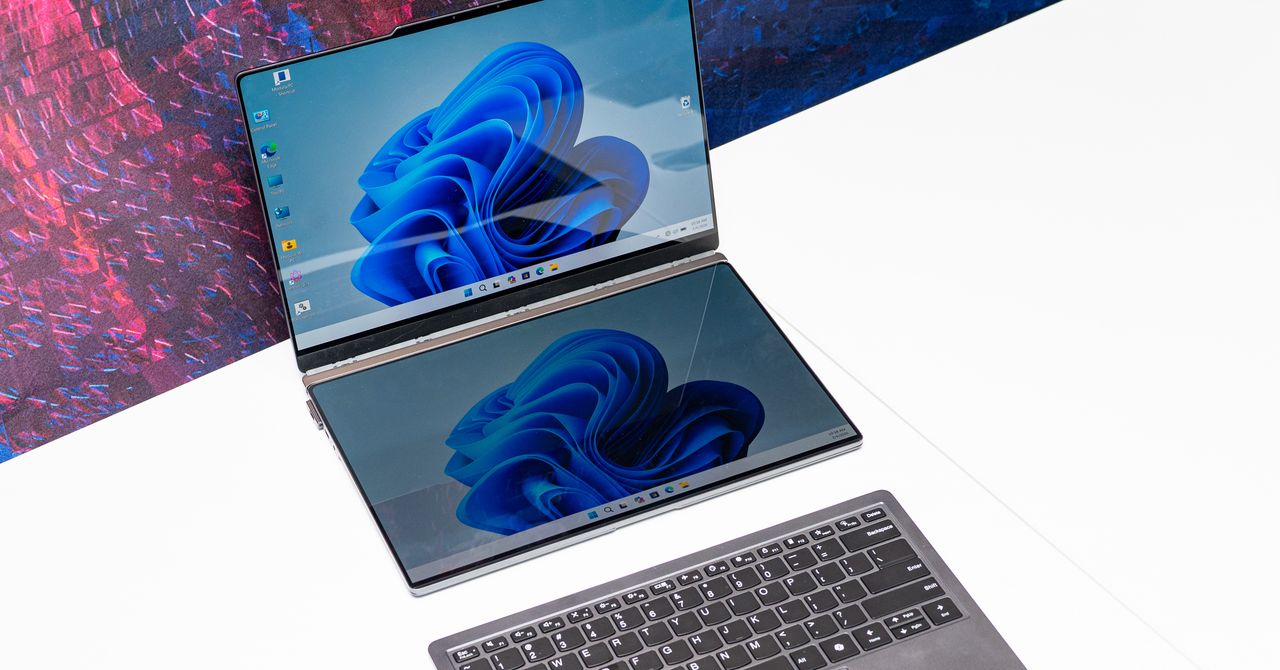
The ThinkBook Modular AI PC has a second screen hanging magnetically off the back of the laptop, and it can show content to people sitting in front of you.
Photograph: Julian Chokkattu
This is with the second screen removed from the back and placed in front of the main display. The keyboard is removable and works via Bluetooth.
Photograph: Julian Chokkattu
As someone with a multi-screen setup at home and a fondness for portable monitors, the ThinkBook Modular AI PC appeals to me the most. At first glance, it looks like a normal laptop. Take a look behind, and you’ll notice there’s a second screen magnetically hanging off the back of the laptop, like a koala carrying a baby on its back.
The screen is connected to the laptop using pogo-pin connectors, so you can use it in this state to display content to people in front of you, say, if you were making a presentation during a meeting. Alternatively, you can pop this second screen off, remove a hidden kickstand resting under the laptop, and magnetically attach it to the 14-inch screen so that you have a traditional portable monitor experience. (You’ll need to connect this to the laptop via a USB-C cable in this orientation.)
If you don’t have the desk space for that orientation, you can always remove the keyboard from the base and pop the second screen there—it’ll auto-connect to the laptop via the pogo pins, and you’ll be able to use the Bluetooth keyboard to type on a dual-screen setup that resembles the Asus ZenBook Duo. The whole system is a fantastically portable method of improving productivity on the go, and the laptop isn’t too thick or cumbersome.
More recently, Iran has been a regular adversary in cyberspace—and while it hasn’t demonstrated quite the acuity of Russia or China, Iran is “good at finding ways to maximize the impact of their capabilities,” says Jeff Greene, the former executive assistant director of cybersecurity at CISA. Iran, in particular, famously was responsible for a series of distributed-denial-of-service attacks on Wall Street institutions that worried financial markets, and its 2012 attack on Saudi Aramco and Qatar’s Rasgas marked some of the earliest destructive infrastructure cyberattacks.
Today, surely, Iran is weighing which of these tools, networks, and operatives it might press into a response—and where, exactly, that response might come. Given its history of terror campaigns and cyberattacks, there’s no reason to think that Iran’s retaliatory options are limited to missiles alone—or even to the Middle East at all.
Which leads to the biggest known unknown of all:
5. How does this end? There’s an apocryphal story about a 1970s conversation between Henry Kissinger and a Chinese leader—it’s told variously as either Mao-Tse Tung or Zhou Enlai. Asked about the legacy of the French revolution, the Chinese leader quipped, “Too soon to tell.” The story almost surely didn’t happen, but it’s useful in speaking to a larger truth particularly in societies as old as the 2,500-year-old Persian empire: History has a long tail.
As much as Trump (and the world) might hope that democracy breaks out in Iran this spring, the CIA’s official assessment in February was that if Khamenei was killed, he would be likely replaced with hardline figures from the Islamic Revolutionary Guard Corps. And indeed, the fact that Iran’s retaliatory strikes against other targets in the Middle East continued throughout Saturday, even after the death of many senior regime officials—including, purportedly, the defense minister—belied the hope that the government was close to collapse.
The post-World War II history of Iran has surely hinged on three moments and its intersections with American foreign policy—the 1953 CIA coup, the 1979 revolution that removed the shah, and now the 2026 US attacks that have killed its supreme leader. In his recent bestselling book King of Kings, on the fall of the shah, longtime foreign correspondent Scott Anderson writes of 1979, “If one were to make a list of that small handful of revolutions that spurred change on a truly global scale in the modern era, that caused a paradigm shift in the way the world works, to the American, French, and Russian Revolutions might be added the Iranian.”
It is hard not to think today that we are living through a moment equally important in ways that we cannot yet fathom or imagine—and that we should be especially wary of any premature celebration or declarations of success given just how far-reaching Iran’s past turmoils have been.
Defense Secretary Pete Hegseth has repeatedly bragged about how he sees the military and Trump administration’s foreign policy as sending a message to America’s adversaries: “F-A-F-O,” playing off the vulgar colloquialism. Now, though, it’s the US doing the “F-A” portion in the skies over Iran—and the long arc of Iran’s history tells us that we’re a long, long way from the “F-O” part where we understand the consequences.
Let us know what you think about this article. Submit a letter to the editor atmail@wired.com.
While my love of smoked meats is well-documented, my own journey into actually tending the fire started just last spring when I jumped at the opportunity to review the Traeger Woodridge Pro. When Recteq came calling with a similar offer to check out the Flagship 1600, I figured it would be a good way to stay warm all winter.
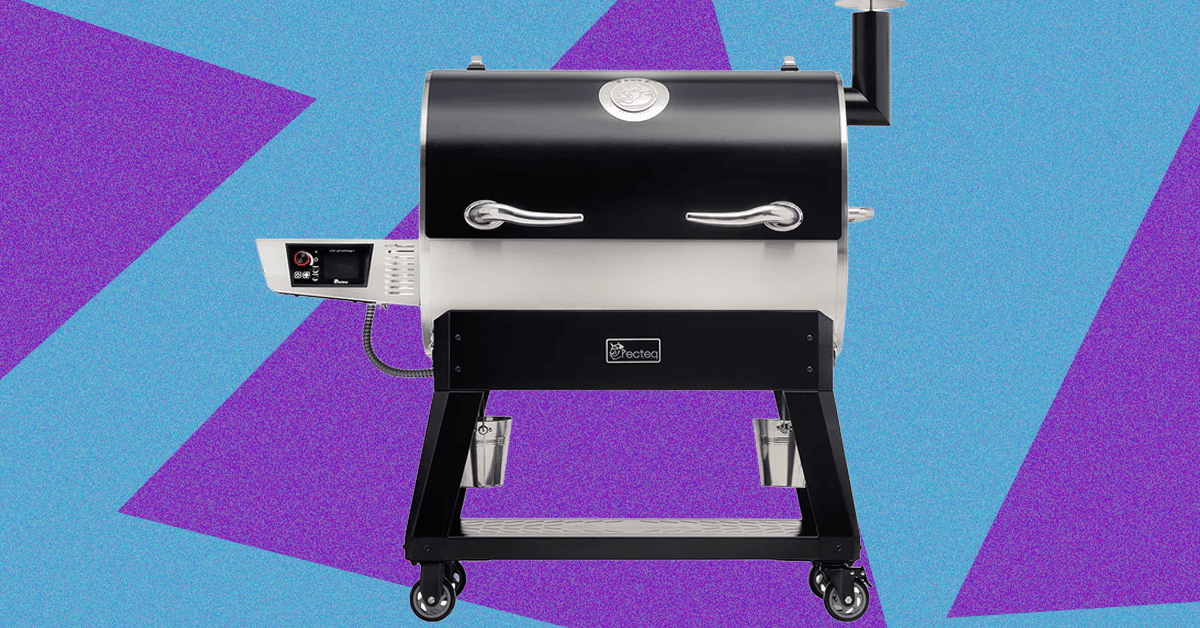
While the two smokers have a lot in common, the Recteq definitely feels like an upgrade from the Traeger I’ve been using. Not only does it have nearly twice the cooking space, but the huge pellet hopper, rounded barrel, and proper smokestack help me feel like a real pitmaster.
The trade-off is losing some of the usability features that make the Woodridge Pro a great first smoker. The setup isn’t as quite as simple, and the larger footprint and less ergonomic conditions require a little more experience or patience. With both options, excellent smoked meat is just a few button presses away, but speaking as someone with both in their backyard, I’ve been firing up the Recteq more often.
Getting Settled
Photograph: Brad Bourque
Setting up the Recteq wasn’t as time-consuming as the Woodridge, but it was more difficult to manage on my own. Some of the steps, like attaching the bull horns to the lid, or flipping the barrel onto its stand, would really benefit from a patient friend or loved one. Like most smokers, you’ll need to run a burn-in cycle at 400 degrees Fahrenheit to make sure there’s nothing left over from manufacturing or shipping. Given the amount of setup time and need to cool down the smoker after, I would recommend setting this up Friday afternoon if you want to smoke on a Saturday.












 Sports1 week ago
 Tech1 week ago
 Entertainment1 week ago
 Sports1 week ago
 Entertainment1 week ago