“Increasingly, I’m coming back to running product and working with the vice president of tech on some artificial intelligence (AI) projects and getting very hands-on myself,” says Wolf & Badger CEO and co-founder George Graham.
“It’s intellectually challenging, stimulating and intriguing – and I want to learn more about it. I’m trying to get as much info as I can on what I consider to be the most interesting tech advancement of my professional work lifetime.”
Not the words of a head of engineering, CIO, or technology executive, but those of the CEO of the online marketplace, whose business world continues to be lit up by the opportunity to use AI across multiple operations.
And why not? In January 2026, Wolf & Badger released a performance update to mark 15 years of trading, reporting it had now surpassed $500m in cumulative sales since inception and achieved almost 40 million website visits in 2025 alone, while reinforcing its reputation as an ethical platform by securing B-Corp recertification.
Wolf & Badger partners with independent brands promising strong ethics, and effectively becomes their tech stack and online operations provider. It is the conduit for these brands to achieve the scale that few organisations of their size can achieve alone.
The business achieved annual sales of $100m (£75m) in 2024, with more than 2,000 brand partners now in place, helping the London-headquartered operation grow globally. And ongoing investment in “AI-driven discovery and on-site personalisation” is delivering a measurable impact, with the company talking about £3.2m of directly attributable incremental sales from recent AI initiatives.
“There’s tremendous opportunity to improve the efficiency and discovery on Wolf & Badger by better understanding our shoppers and our brands and the products they sell,” he says.
“There’s lots around AI on image recognition and product tagging to build out better information related to style or what event a product would be suitable for, and using that to surface more relevant products to the user at the right time – all with the end point of making life more exciting and creating inspirational shopping experiences.”
Are we all product managers now?
While the work on using AI to power the online experience is not uncommon in e-commerce today, Graham’s attitude as CEO of the marketplace is. He is a CEO getting his hands dirty with the tech, which is rare in retail.
“I have personally spent many hundreds of hours over the past three months getting my head around AI and the future of commerce – with agentic commerce in mind,” he explains.
I have personally spent many hundreds of hours over the past three months getting my head around AI and the future of commerce – with agentic commerce in mind George Graham, Wolf & Badger
“Claude Code has become my go-to app. I have built a fairly bespoke AI agent ‘chief of staff’ that is connected to my tools via MCPs [model context protocols] or APIs [application programming interfaces], with a bunch of bespoke skills and scripts that I have ended up building into that.”
Graham says the collective memory stack is getting more powerful by the day, and using it has improved his own working practices.
“I feel twice as efficient as I was six months ago. I have taken that time and – in the short term – continued reinvesting it in understanding AI.”
The AI assistant Graham has developed is being made accessible via Stack internally, and the wider team is getting set up on Claude Code themselves with access to their own version.
The CEO acknowledges he isn’t an engineer or coder, but as a teenager, he would make games in Basic (Beginner’s All-purpose Symbolic Instruction Code) and design websites with HTML. After studying business at university, he joined PwC as a strategy consultant. By the age of 23, he was starting Wolf & Badger and “had to figure out how to build a marketplace as there wasn’t really marketplace software out there”.
When development at Wolf & Badger was brought in-house – today, it has a vice-president of technology, around a dozen people in engineering and others in product management and design – Graham continued to play a part in building out features to support brand partners and customers.
“I have always found all that fascinating,” he explains.
“Over the years, I stepped away as we brought the experts in – but, increasingly, I’m coming back to running product and working with our vice-president of tech on some of the AI projects and getting very hands-on myself.”
Graham, who founded Wolf & Badger with his brother Henry in 2010, admits he doesn’t fully understand the finer nuances of coding and doesn’t have the experienced engineer’s eye. But with the new tech available, he suggests “anyone can be a product manager or software developer” now.
“I have been able to create prototypes – I have built things that assess brands coming on the platform and help the sustainability team with vetting,” he says.
The software his internal teams are now using is set up on GitHub, and built on Eversell MSL front-end, Superbase, and other apps. “Everything is hooked up in what I think is reasonably robust for internal use,” he adds.
He urges other leaders in retail and wider business not to be afraid, and to experiment with the tools now available. There’s a lot that can be built on just a small monthly tech subscription outlay, he notes.
The wider tech team at Wolf & Badger initially experimented with solutions such as Microsoft Copilot and then Cursor.
“Only in the past few months have our engineers found the quality is at a point where they can lean on it more to start actually writing code. We’re keeping clear of the vibe coding in key sensitive areas, of course, but we can experiment in lots of spaces.”
The tech exploration work Graham has taken on – and there is much more to come, he says – is to “ready ourselves for agentic commerce and make sure we’re ahead of the pack”.
Since the turn of the year, there have already been some noteworthy developments in agentic commerce that further underline it as a future direction of travel for e-commerce and, therefore, something e-commerce and retail leaders must better grasp an understanding of.
Agentic commerce and UCP
The new year started with JD Sports announcing it is enabling consumers to use AI platforms to search for and purchase products – all in a single click, without leaving the apps.
JD customers in the US can purchase directly through Copilot, and – in due course – this will be followed by the ability to do so via Google Gemini and ChatGPT. JD is leveraging the agentic commerce suite of tech players Commercetools and Stripe.
Jetan Chowk, JD’s chief technology and transformation officer, said the move was about meeting customers “where they are”. It came after OpenAI announced in September that US shoppers could buy from Etsy directly through ChatGPT.
It started with an “instant checkout” to support single-item purchases, but multi-item carts are now on their way to being a reality.
Then, at the January 2026 NRF Big Show in New York, where many from the retail technology community congregate every year, Google launched the Universal Commerce Protocol (UCP), an open standard for agentic commerce that aims to establish a common language for AI agents and systems to operate together across consumer surfaces, businesses and payment providers.
The work Stripe is doing with agentic commerce protocol and standardising the mechanism by which people can shop directly via the [AI] agents is super interesting George Graham, Wolf & Badger
This is a fast-moving space, but was co-developed with prominent retail industry players such as Shopify, Etsy, Wayfair, Target and Walmart, and endorsed by more than 20 others across the ecosystem, including payments companies Adyen, American Express, MasterCard and Visa.
Graham is in close conversations with Stripe and Google, attending their events and regularly tuning into their updates.
“The work Stripe is doing with agentic commerce protocol and standardising the mechanism by which people can shop directly via the agents is super interesting,” he says. “Google and Shopify UCP is a further move towards a standardisation of how this is going to work.”
Graham is confident there will be more consumer discovery conducted on Google’s AI-powered platforms, ChatGPT, Perplexity, and other similar spaces.
“We need to ensure we’re supporting the 2,000 brands we’re working with to appear in the right way on those channels and facilitate the tech that can support one- or zero-click checkout, where an agent has the ability to buy on a consumer’s behalf.”
He is confident that a platform such as Wolf & Badger can play a key role in the agentic space. Individual brands are typically going to struggle to really build out the right metadata and set up UCP to be recognised by the human in the loop or an AI agent.
Graham says: “If we can wrap together the best independent brands and collectively go to a shopping agent to ensure those brands appear in the right places, we’re well placed to capture some of that demand and drive it towards the individual brands we work with, rather than the resulting purchases ending up with the bigger homogenised brands in our space.”
He adds that Wolf & Badger’s presence harks back to the pre-digital days of boutique shopping in-store, but with the right technology investment and focus now, it can deliver this in a “scaled way” online and through its showrooms.
“Our editorial and marketing team still make the creative calls, but we’re able to drive it forward with some of these new bits of tech,” he says, adding that as Wolf & Badger extends its technological nous, it can enable its brands to focus on “the difficult part” of commerce – meaning the design and manufacturing of compelling garments and consumer products.
Rapidly evolving space
As for the immediate future at Wolf & Badger, the US expansion is a key focus – as are ventures across Europe and into the Middle East. An expanded brand partnerships function within the business is expected to support the onboarding of new designers from around the world.
But AI continues to be an area of significant exploration, with Graham confident that his experimentation and use of cost-effective tools are improving how the business operates.
“It’s a rapidly evolving space – everything is changing these days,” he says, adding that it’s getting increasingly difficult to understand what will come next due to the acceleration of technological capability.
“You just have to try to stay ahead,” he says. “We’re repositioning ourselves in making sure we are embracing AI in the way I think any forward-thinking growth company should, and recognising the power it can bring to enable us to do much more for our brands and shoppers.”
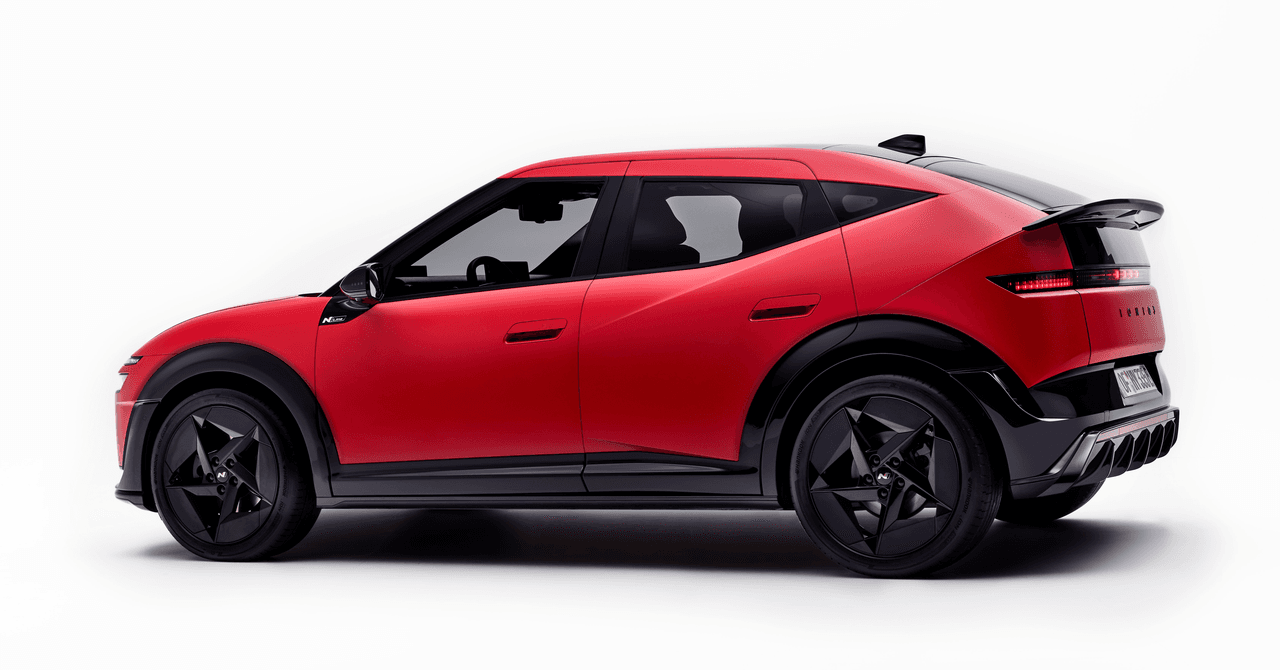
Hyundai has unveiled its Ioniq 3, a fully electric compact hatchback for urban driving designed to be as aerodynamically efficient as possible yet still offer up a surprisingly spacious interior—a trick the carmaker is loftily calling Aero Hatch. The 3 is intended to fill the gap between Hyundai’s Inster supermini and Ioniq 5 crossover.
In profile, the Ioniq 3 has a sleek front end that transitions into a roofline that stays straight over both front and rear occupants before dropping to merge with the rear spoiler. It’s this roofline that maximizes interior headroom for the rear passengers, but it also offers a supposed class-leading drag coefficient of 0.263.
The Ioniq 3’s impressive aerodynamics will supposedly help it get more than 300 miles on a single charge.
Photograph: Courtesy of Hyundai
The car has the same underpinnings as its sibling brand, Kia’s EV2. Two battery options will deliver a projected WLTP distance of 344 km (around 214 miles) for the Standard Range Ioniq 3; the Long Range version is supposedly good for a competitive 308-mile range. Built on the group’s Electric-Global Modular Platform (E-GMP), the car has a 400-volt architecture to lower costs rather than the 800-volt system of the Ioniq 5 N, 6, or 9 SUV. Still, this means that if you can find sufficiently fast DC charging, you can, in theory, top up from 10 to 80 percent in approximately 29 minutes (AC charging capability is up to 22 kW).
This is fine, but it is not a match for BYD’s new Blade 2.0 battery tech that WIRED tried, astonishingly allowing the Denza Z9 GT to charge its battery in just over nine minutes from 10 percent. True, that battery tech was in a $100,000 “premium” EV, but it’s coming to BYD’s wider models. And if BYD makes good on its plans to deliver a charging network to rival Tesla’s Supercharger, then very soon buyers will be expecting comparable charge times, and 30 minutes will quickly feel awfully long.
I asked José Muñoz, Hyundai Motor Company president and CEO, whether this new battery technology from BYD concerns him, whether Hyundai—leading the EV pack with 800-volt architectures for so long—needs to match the Blade 2.0’s performance. “We welcome the challenge,” Muñoz tells me. “Every challenge is an opportunity to do better. And I can tell you that, lately, we have a lot of opportunities to do better.”
“We are also working on fast charging,” Muñoz says, adding that Hyundai’s success will be built on not merely one leading technology but many. “There are not more elements that may be offered by the Chinese that we can offer. It’s only a matter of how you mix them. A lot of times, you get stuck into one indicator. I’m an engineer. And we always have the example of the airplanes: What is more important in an airplane, altitude or speed? There is only one answer. You need to achieve both.”
Prego, the pasta sauce company, is getting into hardware with a device that sits on your table and records dinner conversations. No, this isn’t April Fools’.
The Connection Keeper is a round puck that houses two microphones for recording around the table. The recorder was developed in partnership with StoryCorps, the 20-year-old nonprofit that has recorded conversations with more than 720,000 people about their lives.
The Connection Keeper is more of a publicity stunt than a readily available product. Fewer than 100 will be made. The pucks look more like a tuna can than what you’d associate with the pasta sauce brand—small and meant to be tucked aside so as not to attract attention. The whole goal here, Prego and StoryCorps say, is to advocate for keeping people off their phones during dinner.
“Everything now is AI, and everyone has their phones on the table,” says Elyce Henkin, a managing director of StoryCorps studios and brand partnerships. “It interrupts the conversation and the flow. We wanted to get rid of that and go back to the basics and have everyone talking to each other.”
The pucks come packaged with cards inspired by StoryCorps, designed to prompt conversations between family members. Some are aimed at kids; some are aimed at parents or other family members.
The device doesn’t record automatically. Press a button, and the device begins recording CD-quality audio. Push the button again to stop. It records all the audio on a 16-GB microSD card that can hold up to eight hours of audio at a time. Those recordings can then be saved on a StoryCorps microsite or the family’s own storage. There is no cloud connection, no Wi-Fi, and no artificial intelligence features whatsoever.
The more communal element of the project is that StoryCorps will allow users to share their recordings on its website (or keep them private). Anything that has been voluntarily shared will also be physically preserved as a recording along with the larger StoryCorps collection within the US Library of Congress.
Prego is a US company, named after the Italian word for “you’re welcome.” I’ll tell you this from experience growing up in an Italian-American extended family: The Connection Keeper is going to have a hell of a time keeping track of a conversation at a table full of loud uncles and your wine-drunk grandma, who all talk at the same time.
“I think it’s how a lot of families are,” Henkin says. “What StoryCorps does is that it reminds us of our similarities and the humanity that’s in us all, even though we are all different. I imagine that if someone were to go through and listen to the collection, there would be rowdy moments, and there would be kids laughing and moms saying, ‘Don’t eat with your mouth full.’ That’s all part of the truth of it.”
Bose’s QuietComfort Ultra 2 earbuds are the best noise-canceling earbuds you can buy. Right now, they’re $50 off, which matches the best price we tend to see outside of special events like Black Friday and Cyber Monday. If you want to wait until November, they might hit $200 again, but otherwise $250 is a very fair deal—especially since they pop back up to $300 regularly. The discounted price applies to all five color options, including Black, Deep Plum, Desert Gold, Midnight Violet, and White Smoke (another rarity, as usually only the vivid colors go on sale).
Bose
QuietComfort Ultra 2 Earbuds
Sometimes you just need to quiet the world. Whether it’s to play 10 hours of Coconut Mall on a loop to help you lock in and meet your Friday deadlines (thanks to my colleague Julia Forbes for that suggestion); muffle the crying babies, sniffling neighbors, and mysterious, potentially concerning clunking noises on an airplane; or to help you better appreciate the mix on Space Laces’ Vaultage 004 EP, active noise cancellation makes a huge difference to your listening experience.
The Bose QuietComfort Ultra 2 earbuds also have some of the best active noise cancellation you can find. They sound great out of the box, thanks to a custom sound profile based on the shape of your ears, but you can customize the EQ by using the app. The app also allows you to tweak touch controls and spatial audio.
The battery life lasts for about six hours, or 24 with the charging case. And while the noise cancellation can’t be beaten, these also have a pass-through feature called Aware mode, which filters in outside noise but smooths the loudest bits. That means you’ll be able to hear what’s going on, but you won’t be startled. True-crime podcast listeners, this one’s for you.
In fact, just about the only drawback we can find is that these might not be ideal for folks with super-small ears. Otherwise, they’re great all around, with solid call quality, excellent sound overall, and a sleek aesthetic. We think they offer good value at full price, so an extra $50 off is especially nice.











 Fashion4 days ago
 Sports1 week ago
 Entertainment1 week ago

 Entertainment5 days ago
 Fashion1 week ago

 Tech1 week ago