

Entertainment
Iran at war

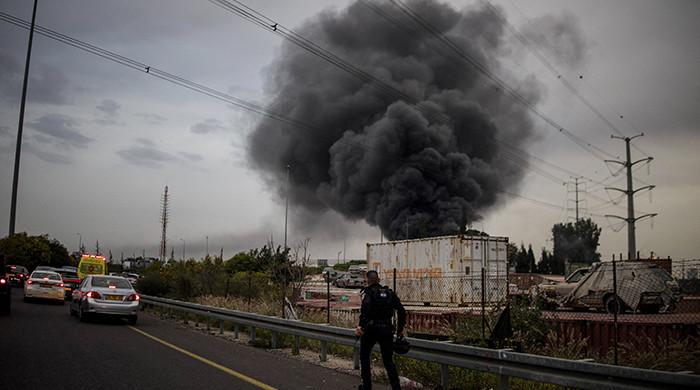
Ages ago, when our war with India in 1965 began, I had just become a young reporter in an English eveninger. It so happened that I was asked to write a column on the war for the group’s Urdu daily, ‘Hurriyet’. And the directive was to find historical examples to raise people’s morale and promote their patriotism.
I had read a review of a new book titled ‘Russia at war 1941-45’, written by Alexander Werth, who had been a BBC correspondent in the Soviet Union during the Second World War. I was able to get it and was fascinated by its contents. Based on his personal experiences, Werth had described and explained the great resistance of the Soviet people. He told the story of the Russians in startling human terms.
That has remained one of the books that I cherish. I still have it, though it is now in poor condition. I searched it out this week from the chaos that my collection has become and have been browsing through it while mentally and emotionally preoccupied with the war that is raging in Iran and the Middle-East.
Naturally, I am also reminded, with a touch of nostalgia, of what I had picked from this book to write my Urdu columns. I found so much material in the book that only a few references were possible. The most touching was the story of Leningrad, now renamed Saint Petersburg, and how its citizens braved the siege and the famine.
One column that I fondly recall was on a poem: ‘Wait for me’. A soldier, leaving for the front, tells his beloved: “Wait for me, and I will return, only wait very hard”. To quote Werth: “It is difficult at this distance, except for those who were in Russia at that time, to realise how important a poem like this was to literally millions of Russian women; no one could tell how many hundreds of thousands had died at the front or had been taken prisoner or were otherwise missing”.
As an aside, I want to point out this astounding fact that the Soviet Union suffered the highest number of casualties in the Second World War, with total deaths estimated to be around 24 to 27 million people.
Now, this may seem like a distraction. But I thought of it as a point of departure to underline the importance of the morale of a people during a war or a time of deep crisis. A nation is to be judged by the quality of its people. That is how some nations are stronger than others. The patriotic strength of the Russian people was demonstrated during the Great War, even though they were ruled by an authoritarian system, with Joseph Stalin at the helm.
Initially, I was thinking of reviewing the state of the people of Pakistan in this context. We, as a country, are certainly in a very difficult situation because of the complexity of our relations with Iran and the US and the Gulf countries. Specifically, we are bound by a security pact with Saudi Arabia. In addition, we are at war with Afghanistan. It is a critical situation and anything can happen at any time.
So, what kind of social capital does Pakistan have? Are its citizens capable of bearing hardships in a disciplined manner? One may refer to the significant rise in petrol prices and the austerity measures announced by Prime Minister Shehbaz Sharif, both relevant from an economic point of view. But the real strength of a society lies in its civilisational and moral values, and in the people’s spirit of sacrifice in the national interest.
Considering the increasing tempo of the war and the intensity of American and Israeli attacks on Iran, it is the resilience of the Iranian forces that has surprised the world. One expects that some historians and journalists are documenting the human stories of this monumental encounter between Iran and the most powerful military in the world.
Already, a number of social media analysts are meaningfully exploring the reasons why Operation Epic Fury is not able to bring about a regime change in Iran or achieve whatever goals that have confusedly been articulated by President Trump. Meanwhile, the cost of this war is becoming unbearable for the world, mainly due to the energy crisis.
Actually, Iran at war is a spectacle that has baffled many in the world. One aspect of this has perceptively been explained by noted Iranian writer and scholar of religion, Reza Aslan, in a longish piece published last week in The New York Times. Based in Los Angeles, he belongs to the Iranian diaspora. But he rejects the thought that an American president can be Iran’s liberator. Hence the title of his article: ‘The mistake that Iranians make about America’. I also heard him repeat his views in an interview with Christiane Amanpour on CNN on Friday.
Reza Aslan concedes that when American leaders speak of helping Iranians to take over their government, they are tapping into “a powerful longing”, but recent history confirms that regime change delivered from outside “rarely produces the democracy imagined in the inside”.
One excerpt from his article: “Here is what I know for certain: Iran is older than any regime that has ruled it – older than the revolution, older than the shahs, older than the foreign powers that have sought to shape its fate. Across three millenniums of poetry, philosophy, empire and renewal, this civilisation has outlasted conquerors and kings, clerics and generals. It has done so not because a saviour from abroad intervened but because its people endured – sustained by a fierce pride in their language and heritage, by a literary and intellectual tradition that has survived invasion and upheaval, by a collective memory shaped as much by resistance as by rule”.
The ongoing war is a manifestation of Iran’s resistance. A time will come when other battles are fought in another arena.
The writer is a senior journalist. He can be reached at: [email protected]
- Shahrah-e-Bhutto to reduce traffic pressure within city: Sindh CM.
- CM directs completion of all mixed-traffic lanes along Red Line.
- Work on BRT Red Line project progressing at pace: Sindh minister.
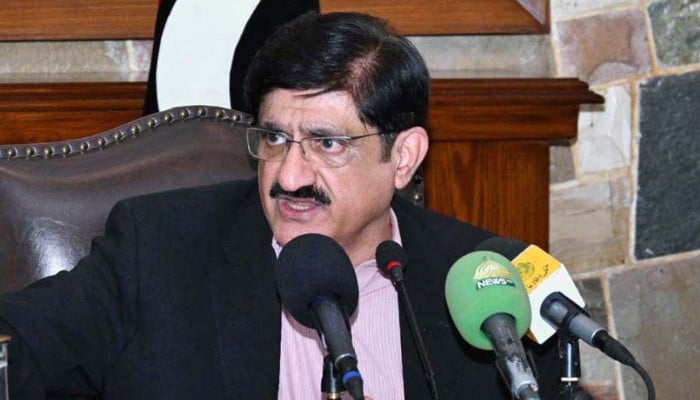
Sindh Chief Minister Murad Ali Shah on Sunday announced that Shahrah-e-Bhutto would be opened for traffic before Eid ul Adha, describing the road’s opening as an “Eid gift for the people of Karachi”.
The Sindh CM made the announcement following an inspection of major infrastructure projects across the city.
“Shahrah-e-Bhutto will significantly reduce traffic pressure within the city and improve connectivity between the M-9 and N-5 highways,” he said, adding that heavy traffic will shift outside the city, bringing relief to Karachi’s residents.
“This road is not just another project; it will serve as a lifeline for Karachi’s economy,” the Sindh CM said.
During an inspection of the under-construction Azeempura flyover at Shah Faisal Colony, he directed Karachi Mayor Murtaza Wahab to complete the project within 90 days.
The flyover is part of Shahrah-e-Bhutto, which is being constructed near the Shah Faisal Interchange to provide a signal-free passage for traffic to and from Jinnah Terminal and the adjoining areas.
The Sindh CM also directed authorities to accelerate work on the Karachi Bus Rapid Transit (BRT) Red Line corridor, saying that all mixed-traffic lanes along the Red Line corridor should be completed within two months.
“The Red Line and Shahrah-e-Bhutto are critical corridors for the city, and there will be no unnecessary delays or compromise on quality,” he added.
Separately, Sindh Senior Minister Sharjeel Inam Memon defended delays in the BRT Red Line project, saying that difficult but necessary decisions had been taken to move work forward.
“This delay was not due to government negligence,” Memon told the media during his visit to the Red Line project site.
He said work on Lot-1 and Lot-2 was progressing at a pace, particularly after the Frontier Works Organisation (FWO) was assigned responsibilities.
The minister added that the previous contractor had been issued warnings and payments were cleared, but the pace of work did not improve.
Acknowledging the public inconvenience, Memon said the authorities were aware of the hardships faced by commuters due to the ongoing construction.
However, he emphasised that infrastructure work in urban centres like Karachi presented unique challenges.
Work in cities is far more complicated, he said, explaining that authorities cannot immediately shut down gas, electricity and water lines.
The minister said that efforts were underway to reopen mixed traffic lanes by the end of July to ease congestion.
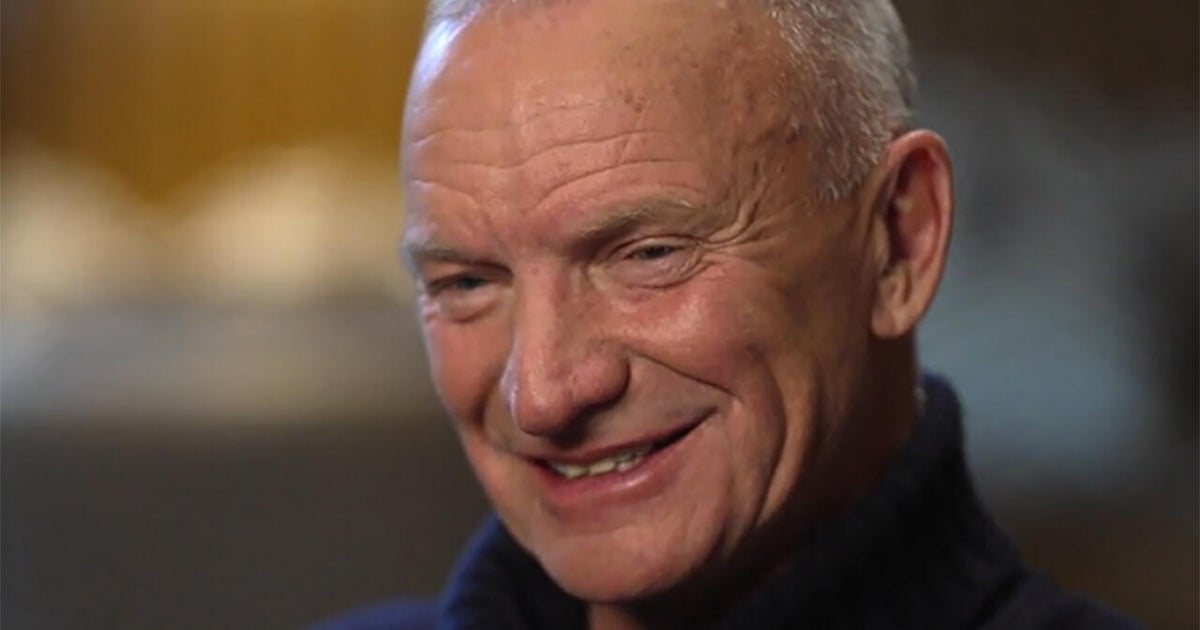
When Sting comes back to his hometown these days, it’s not to the same place he left more than five decades ago. The city of Newcastle, tucked up in the northeast corner of England, now presents a tranquil vista where modern architecture spans calm waters. But for centuries, Newcastle was a hard-scrabble, noisy, industrial powerhouse. It built ships.
And Sting, a boy from a working-class family, was given some fatherly advice he didn’t want to hear: “He’d say, ‘Son, go to sea. See the world, make something of yourself.’ Of course, I disappointed him!”
CBS News
All Sting did was become one of the most successful songwriters and pop performers of his generation, starting with his 1970s band The Police, and through many variations since. His most popular songs – “Every Breath You Take,” “Roxanne,” “Message In A Bottle,” “Every Little Thing She Does Is Magic,” “Fields of Gold,” “Shape of My Heart” – have streamed in the billions.
Asked if he keeps score of awards won and albums sold, Sting replied, “The answer is, enough. I have had more than enough success and affirmation. I don’t actually need any more. It’s lovely, but it’s not something I particularly think about. I don’t think of myself as a celebrity. I don’t like to. I like to think of myself as a working musician with a story to tell” – a story about his hometown.
“I just wanted a bigger life than the one I was being offered,” he said, “and it was only later that I realized that where I’d been brought up was actually a gift.”
How so? “Because of these very profound symbols to wake up to every morning: A gigantic ship hanging over the street; an army of men walking to work; the ship being built, launched into the river, out to sea. Those are very powerful images for an artist. I wanted to honor where I came from, because what they gave me was a sense of identity, a work ethic. So, I wanted to repay that.”
Sting’s musical (which he’s been working on for more than a decade) is called “The Last Ship,” and it recounts the demise of Newcastle’s shipyards. Now he’s taking it on tour, with the advantage of added star power – namely, Sting, and his good friend, Mr. “Bombastic” himself, Shaggy.
“The Last Ship” 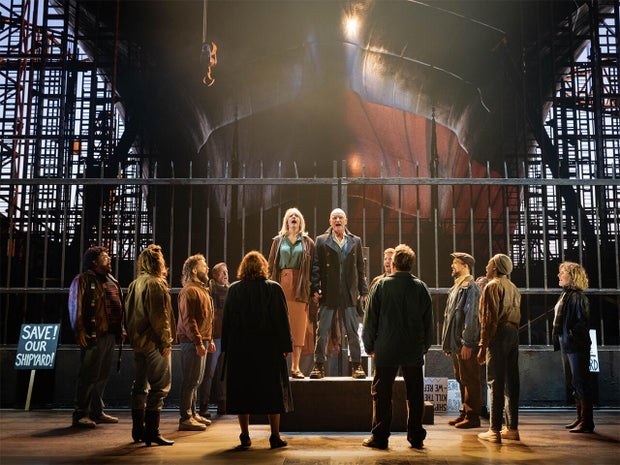
The reggae star told us he’s never done anything quite as bombastic as “The Last Ship”: “Not quite on this scale,” he said. “I’m still sitting here and I’m saying, what have I gotten myself into?“
Why Shaggy? Working together has paid off before, when he and Sting won a Grammy for best reggae album in 2019, for “44/876.”
CBS News 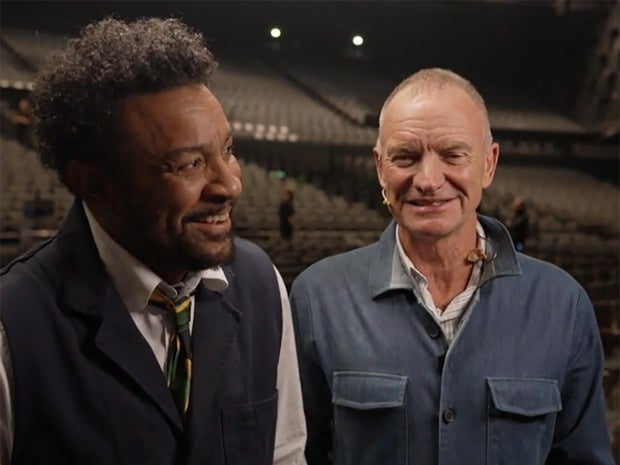
“I immediately knew Shaggy was the perfect man for the job,” said Sting. “He has a great sense of mischief, a great sense of joy, but he’s also a natural actor.”
“He knows me better than me!” Shaggy said. “I was like, ‘I can’t really,’ and he was like, ‘No, you can do that.’ And then I’m doing it and I was like, I hate admitting that he was right!“
The show has already played to sold-out halls in Europe and Australia, and is set for a run at the Metropolitan Opera House in New York. An earlier incarnation of “The Last Ship” played on Broadway in 2014. The show has had its book revised.
Asked why the project has meant to much to him, that he has stubbornly pursued it for more than a decade, Sting replied, “I’m tenacious. If I believe in something, I will stick at it. And I do not conflate commercial success with excellence or quality at all. I think this play, even though it’s set in the 1980s, has something to say to people now. All of us are in danger of losing our work to AI. All of us. “
Asked if he wants to be taken “seriously” as a theatre composer, as distinct from his pop career, he said, “I’m very grateful for the pop career, and it was a certain time in my life when I was of a certain age and looked a certain way and made a certain kind of music. But it can’t be my entire life. I don’t want to be just defined from how I was at the age of 25. I’m 74 now.”
Sting, born Gordon Sumner, was given his stage name because of the striped yellow-and-black top he used to wear that someone said made him look like a wasp. And there’s been plenty of buzz about his career ever since, including about the real meaning of his biggest hit, “Every Breath You Take.”
“Some people interpret that song as being a very romantic love song, or it’s about a stalker – this obsessive watching, I’ll be watching you,” said Sting. “I don’t contradict people in their individual interpretation of the song. I think it enriches the song. I think gives it its power. It’s about both things.
“Some people get married to that, so God bless them!”
Sting’s life has been about many things. Now it’s about coming home – spiritually at least – as when he came with our cameras to a Newcastle pub. “They have come to bring me home, to shoot some local color, which would be you,” he told the crowd. “So, please be as colorful as you are!”
CBS News 
If ever there was a “local boy makes good” story, this is it. And everybody here seems to know the words to “Message In a Bottle.”
We asked Sting if he ever thinks of taking a vacation. “Explain that concept to me,” was his response.
But why is he still doing this? “Because I like to work,” he replied. “Could I retire? I’m not sure I could do it. I haven’t developed that skill to just sit and do nothing. Perhaps I’m afraid of it. I haven’t prepared myself for it. But while I’m still fit enough to do my work, I will continue. At some point, I hope I have the objectivity to say, OK, you’ve done enough. Go and sit on the farm.“
Could he do that? “I’m not sure!” he laughed.
WEB EXCLUSIVE: Watch an extended interview with Sting (Video)
For more info:
Story produced by Mikaela Bufano. Editor: Carol Ross.
See also:
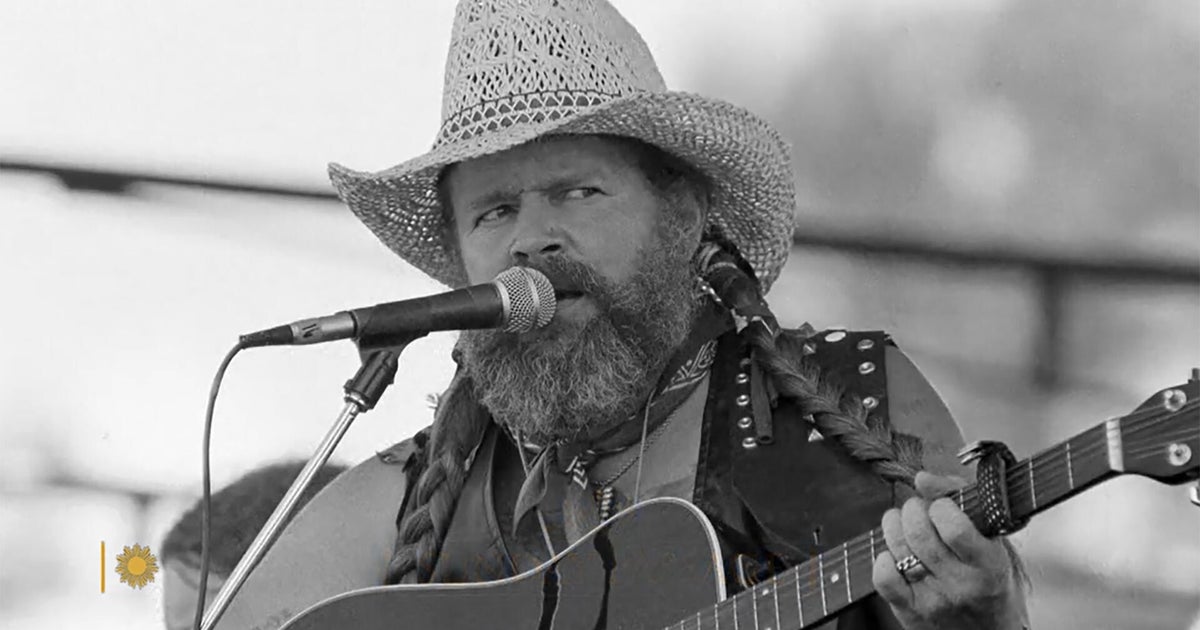
“Sunday Morning” remembers some of the notable figures who left us this week, including songwriter David Allan Coe, famous for his country hit “Take This Job and Shove It.”
Source link


Karachi’s Shahrah-e-Bhutto to open before Eid ul Adha, announces CM Murad

Sting embarks on “The Last Ship”

Passage: In memoriam

-

 Tech6 days ago
A Brain Implant for Depression Is About to Be Tested in Humans
-

 Tech6 days ago
Almost 90% of women leave tech industry within 10 years | Computer Weekly
-
 Business6 days ago
‘I had £20,000 stolen and had to fight a 13-month fraud reporting rule to get it back’
-
 Business1 week ago
Pakistan’s oil market is fuelling the crisis | The Express Tribune
-

 Tech5 days ago
This Ambitious Laptop Doesn’t Leave Much Room for Your Hands
-

 Sports5 days ago
Pro wrestling star Steph De Lander reveals how colleague’s advice helped lead her to title triumph at ACW
-

 Entertainment6 days ago
Melania Trump says ABC should ‘take a stand’ on late-night host Kimmel
-

 Tech6 days ago
Are tech leaders risking a cyber resourcing crisis? | Computer Weekly