

Politics
Israel tells US it is ‘running critically low’ on interceptors amid Iran war

- Interceptor shortage strains Israel’s air defences.
- US says it expected Israel’s shortfall.
- Washington says its own stocks remain sufficient.
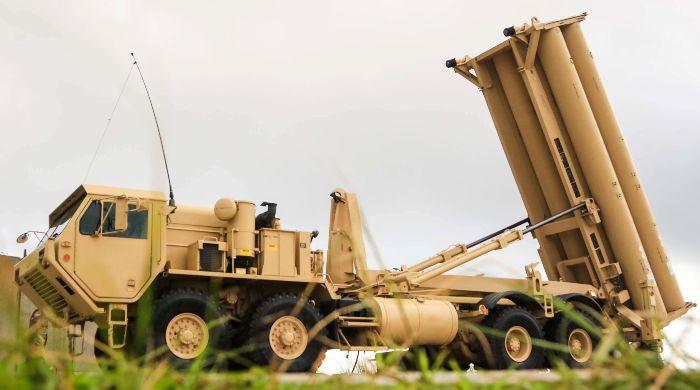
Israel has warned the United States that it is running critically low on ballistic missile interceptors as its conflict with Iran continues, Semafor reported, citing US officials.
According to the report, Israel entered the conflict already short of interceptors after using many during last summer’s clashes with Iran. Its long-range air defence system has since come under further strain from Iranian attacks, while CNN reported that Iran had begun adding cluster munitions to its missiles, potentially accelerating the depletion.
One US official told Semafor that Washington had been aware of Israel’s limited interceptor capacity for months, saying it was “something we expected and anticipated.”
The official added that the United States was not facing a similar shortage of its own interceptors, though it remains unclear whether Washington would sell or share any with Israel, a move that could place added pressure on US domestic supplies.
“We have all that we need to protect our bases, our personnel in the region and our interests,” the official said, adding that Israel was “working on solutions to address” the shortage.
Semafor reported that Israel still has other ways to defend against Iranian missiles, including fighter jets. However, interceptors remain among its most effective defences against long-range attacks, while the Iron Dome system is designed to counter shorter-range threats.
President Donald Trump said earlier this month that the United States had a “virtually unlimited” stockpile of munitions, although analysts have long argued that US reserves are lower than the military would prefer.
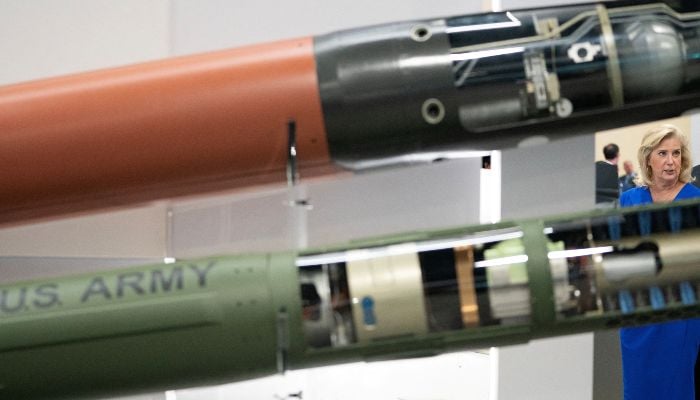
Last June, the United States fired more than 150 THAAD interceptors during the 12-day war with Iran, according to the Centre for Strategic and International Studies, a number believed to represent roughly a quarter of the US inventory at the time. Some reports have also suggested the United States used about $2.4 billion worth of Patriot interceptors in the first five days of the current conflict.
In January, the Pentagon began efforts to significantly increase production of the THAAD missile defence system. The US official told Semafor the administration still had sufficient THAAD systems, fighter jets and mid-level interceptors.
Chief Pentagon spokesman Sean Parnell said the department “has everything it needs to execute any mission at the time and place of” Trump’s choosing.
After publication of Semafor’s report, White House press secretary Karoline Leavitt said US stockpiles were “more than enough” to achieve Trump’s goals against Iran “and beyond”.
“The United States military’s accomplishments alongside the Israel Defence Forces speak for themselves — Iranian drone attacks are down 95%, ballistic missile attacks are down 90%, and the regime’s dire situation will only worsen,” she said.
The Israel Defence Forces (IDF) did not immediately respond to requests for comment, Semafor said.
Trump has said the war could end “soon” and described it as a “short-term excursion.” However, the United States, Israel and Iran have all signalled they are preparing for a prolonged conflict.
Politics
‘No miscalculation’: US Israel committing war crimes by attacking hospitals, schools: WHO chief


World Health Organization (WHO) director general has denounced the US-Israeli bombings of hospitals and schools as “war crimes” that cannot be justified as “miscalculations.”
In a post published on X on Sunday, Tedros Adhanom Ghebreyesus wrote: “Bombing a hospital or a school is not a ‘miscalculation’.”
“Killing a paramedic is not ‘collateral damage.’ Starving civilian is not ‘negotiating tactic.’ These are war crimes. Call it what it is. Full stop,” he added.
The US and Israeli armed forces began their latest military aggression against Iran on February 28 by attacking 30 targets across Tehran, killing several senior Iranian officials, including the Leader of the Islamic Republic, Ayatollah Sayyed Ali Khamenei.
Since then, Iranian armed forces have decisively retaliated against the strikes by launching barrages of missiles and drones against Israeli-occupied territories as well as on US bases in region.
During their aggression against Iran, the Israeli regime and the US have bombed several schools and hospitals as well as other civilian infrastructure.
In one instance, the US military bombed a school in Minab, Hormozgan Province, killing 168 schoolgirls.
According to the latest figures announced by Iranian health authorities more than 1,300 people have been martyred and over 10,000 wounded in the attacks.
Among those killed are 200 children under the age of 12, including 11 children under five, as well as more than 200 women.
The casualties also include 206 students and teachers, highlighting the heavy toll on the education sector.
Health Ministry data on the injured show that women make up 17 percent of the total wounded.
At least 1,040 of the injured are under the age of 18, including 65 children younger than five.
Damage assessments by the Iranian Red Crescent show widespread destruction of civilian infrastructure.
A total of 19,734 civilian and residential units have been damaged, including 16,191 residential homes.
The attacks have also damaged 77 medical centers and pharmacies, 65 schools and educational centers, and 16 Red Crescent facilities.
Israel has also killed more than 72,000 Palestinians, most of them women and children, in its two-year war on Gaza, where more than 90 percent of homes are estimated to have been damaged or destroyed and healthcare, water, sanitation, and hygiene systems have largely collapsed.

- Talks to focus on tariffs, rare earths, high-tech export controls.
- Analysts see little prospect for breakthrough due to Iran war.
- New US trade probes could lead to more tariffs on China.
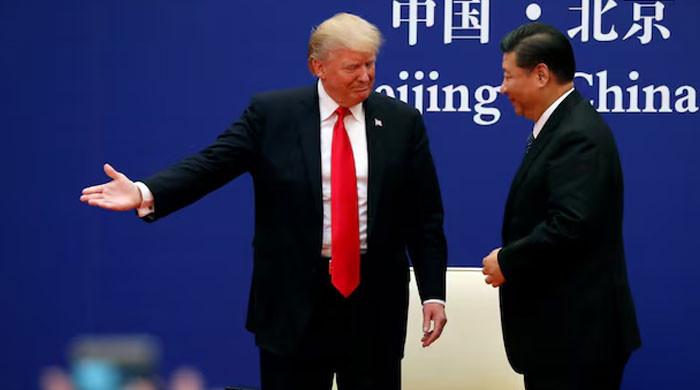
PARIS: Top US and Chinese economic officials are set to launch a new round of talks in Paris on Sunday to iron out kinks in their trade truce and clear a smooth path for US President Donald Trump’s trip to Beijing to meet with Chinese President Xi Jinping at the end of March.
The discussions, led by US Treasury Secretary Scott Bessent and Chinese Vice Premier He Lifeng, are expected to focus on shifting US tariffs, the flow of Chinese-produced rare earth minerals and magnets to US buyers, American high-tech export controls and Chinese purchases of US agricultural products.
The two sides will meet at the Paris headquarters of the Organisation for Economic Cooperation and Development, a source familiar with their planning said. China is not a member of the club of 38 mostly wealthy democracies and considers itself a developing country.
US Trade Representative Jamieson Greer will also join the talks, which continue a string of meetings in European cities last year aimed at easing tensions that threatened a near collapse of trade between the world’s two largest economies.
US-China trade analysts said that with little time to prepare and Washington’s attention focused on the US-Israeli war with Iran, prospects for a major trade breakthrough are limited, in Paris or at the Beijing summit.
“Both sides, I think have a minimum goal of having a meeting, which sort of keeps things together and avoids a rupture and re-escalation of tensions,” said Scott Kennedy, a China economics expert at the Centre for Strategic and International Studies in Washington.
Trump may want to come away from Beijing with major Chinese commitments to order new Boeing aircraft and buy more US liquefied natural gas and soybeans, but to get that he may need to offer some concessions on US export controls, Kennedy added.
Instead, Kennedy said chances were high for a summit that “superficially suggests progress but that really just leaves things about where they’ve been for the last four months.”
Trump and Xi could potentially meet three other times this year, including at a China-hosted APEC summit in November and a US-hosted G20 summit in December that could yield more tangible progress.
Iran war and oil concerns
The US-Israeli war on Iran will likely come up at the Paris talks, especially in reference to the spike in oil prices and the closure of the Strait of Hormuz, through which China gets 45% of its oil. Bessent on Thursday night announced a 30-day waiver of sanctions to allow the sale of Russian oil stranded at sea in tankers, a move to raise supplies.
On Saturday, Trump urged other nations to help protect shipping in the Strait of Hormuz, after Washington bombed military targets on Iran’s Kharg Island oil loading hub and Iran threatened to retaliate.
“Meaningful” progress in Sino‑US economic cooperation could restore confidence to an increasingly fragile global economy, China’s state-run Xinhua news agency said in a commentary on Sunday.
Trade truce
The two sides are expected to review their progress in meeting commitments under the October 2025 trade truce declared by Trump and Xi in Busan, South Korea. The deal forestalled a major flare-up in tensions, trimmed US tariffs on Chinese imports, and paused for a year China’s draconian export controls on rare earths. It also paused the expansion of a US blacklist of Chinese companies banned from buying high-technology US goods such as semiconductor manufacturing equipment.
China also agreed to buy 12 million metric tons of US soybeans during the 2025 marketing year and 25 million tons in the 2026 season, which will start with the fall harvest.
US officials, including Bessent, have said that China has so far met its commitments under the Busan deal, citing soybean purchases that met initial goals.
But while some industries are receiving rare earth exports from China, which dominates global production, US aerospace and semiconductor firms are not and are facing worsening shortages of key materials, including yttrium, used in heat-resistant coatings for jet engines.
“US priorities will likely be about agricultural purchases by China and greater access to Chinese rare earths in the short term” at the Paris talks, said William Chou, a senior fellow at the Hudson Institute, a Washington think tank.
Trade probes
Greer and Bessent also bring a new irritant to the Paris talks, a new “Section 301” investigation into unfair trade practices targeting China and 15 other major trading partners over alleged excess industrial capacity that could lead to a new round of tariffs within months. Greer also launched a similar probe into alleged forced labour practices in 60 countries, including China, that could ban certain imports into the US
The probes aim to rebuild Trump’s tariff pressure on trading partners after the US Supreme Court struck down Trump’s global tariffs under an emergency law as illegal. The ruling effectively reduced Trump’s tariffs on Chinese goods by 20 percentage points, but he immediately imposed a 10% global tariff under another trade law.
China on Friday denounced the probes and said it reserved the right to take countermeasures. An editorial by state-run China Daily added that the probes were representative of unilateral actions that complicate negotiations.
“The new round of talks is both an opportunity and a test,” Xinhua said.
“Whether the upcoming talks can achieve progress will largely depend on the US side. Washington needs to approach the negotiations with a rational and pragmatic mindset and act in line with the principles that underpin stable China-US economic relations.”
- US threatens to bomb shoreline, destroy Iranian boats repeatedly.
- Trump says global partners including China, UK, Japan may join.
- Maritime traffic remains halted as oil prices spike sharply worldwide.
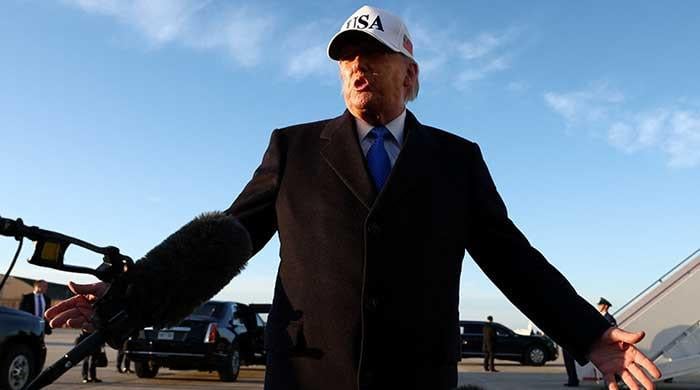
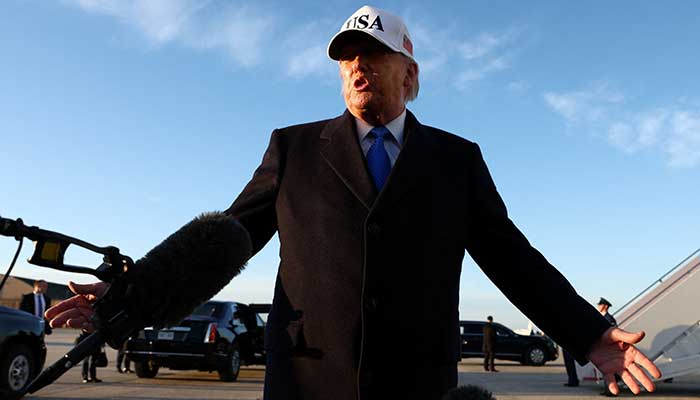
US President Donald Trump on Saturday urged other nations to send ships to help secure the Strait of Hormuz, the critical chokepoint for global oil supplies, disrupted by the Mideast war.
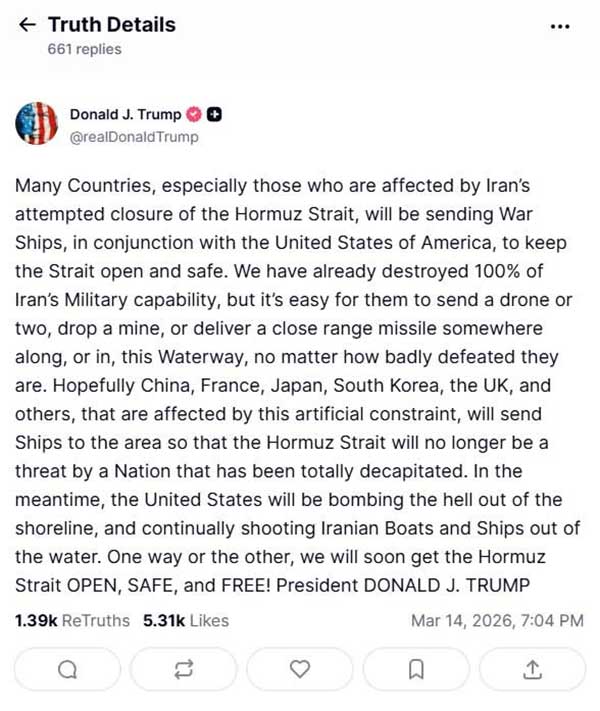
Trump, who has said the United States will soon start escorting tankers through the strait, posted on Truth Social that “Many countries, especially those who are affected by Iran’s attempted closure of the Hormuz Strait, will be sending War Ships, in conjunction with the United States of America, to keep the Strait open and safe.”
The US president added: “Hopefully China, France, Japan, South Korea, the UK, and others, that are affected by this artificial constraint, will send Ships to the area.”
Iranian strikes have all but halted maritime traffic in the strait, through which a fifth of global crude oil and liquefied natural gas normally pass. It is just 54 kilometres (34 miles) wide at its narrowest point.
With oil prices spiking, Trump was asked on Friday when the US Navy would begin escorting tankers through the Strait of Hormuz. “It’ll happen soon, very soon,” he said.
In his post on Saturday, Trump asserted that Iran’s military capability had been eliminated, but he conceded that it was still able to attack the strait.
“We have already destroyed 100% of Iran’s Military capability, but it’s easy for them to send a drone or two, drop a mine, or deliver a close range missile somewhere along, or in, this Waterway, no matter how badly defeated they are,” he wrote.
As he urged nations to send ships to the strait, he added that “the United States will be bombing the hell out of the shoreline, and continually shooting Iranian Boats and Ships out of the water. One way or the other, we will soon get the Hormuz Strait OPEN, SAFE, and FREE!”


Sarfaraz Ahmed announces retirement from international cricket

‘No miscalculation’: US Israel committing war crimes by attacking hospitals, schools: WHO chief

The 2026 Oscars are tonight. Here’s how to watch live and what to know.

-
 Politics1 week ago
India let Iran warship dock the day US sank another off Sri Lanka, say officials
-

 Sports1 week ago
Pakistan set for FIH Pro League debut | The Express Tribune
-

 Entertainment1 week ago
Harry Styles kicks off new era with ‘One Night Only’ comeback show
-
 Business1 week ago
Restaurant group changes name after bid to buys pubs across the UK
-
 Business3 days ago
Stock market crash today (March 12, 2026): Nifty50 opens below 23,600; BSE Sensex down over 900 points on continuing US-Iran war – The Times of India
-
 Business1 week ago
Home heating oil: ‘Most of my pension has gone on home heating oil’
-

 Sports1 week ago
Winners and losers of the 2026 NHL trade deadline
-

 Entertainment1 week ago
Kanye ‘Ye’ West trips during trial: ‘Is he asleep?’