

Politics
Israeli PM’s fate unclear after ‘surprise’ missile attack on his office: IRGC

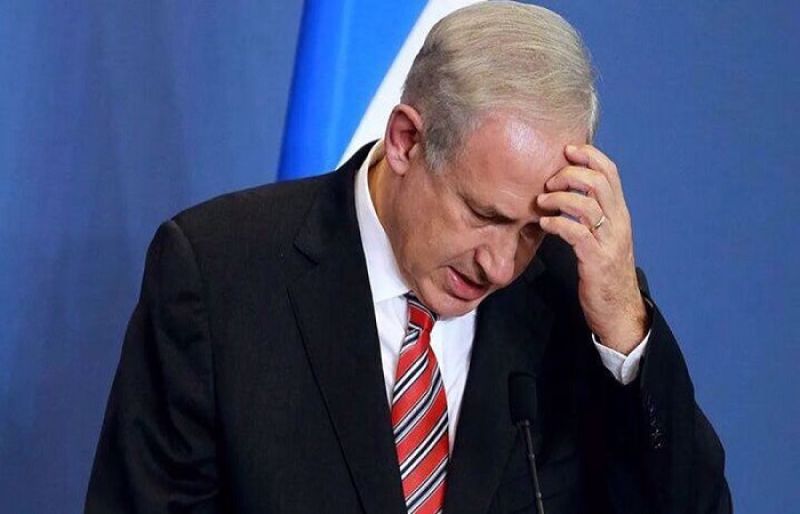

The Islamic Revolution Guards Corps (IRGC) says the fate of Israeli prime minister Benjamin Netanyahu is uncertain following “purposeful and surprise” attacks on his office and the residence of the regime’s air force commander.
In a statement on Monday, the IRGC said Iranian Armed Forces heavily attacked the office of Israel’s criminal prime minister and the residence of commander of the Israeli air force.
They were hit during “purposeful and surprise” attacks by Kheybar missiles, the elite force stated.
According to the statement, the 10th phase of Iran’s successful missile attacks on occupied territories focuses on the Israeli regime’s premises.
The IRGC said it would later announce the achievements of the attacks and provide further information.
The United States and Israel launched a joint war of aggression against Iran early on Saturday, assassinating Leader of the Islamic Revolution Ayatollah Seyyed Ali Khamenei and several senior military commanders before attacking military and civilian sites across the country.
Iranian armed forces have responded with massive missile and drone strikes, hitting strategic targets deep inside the Israeli-occupied territories as well as American military bases scattered across the region.
Iranian authorities say the retaliatory attacks will continue as long as necessary and that it will be the Islamic Republic that will decide when and how the war will end.
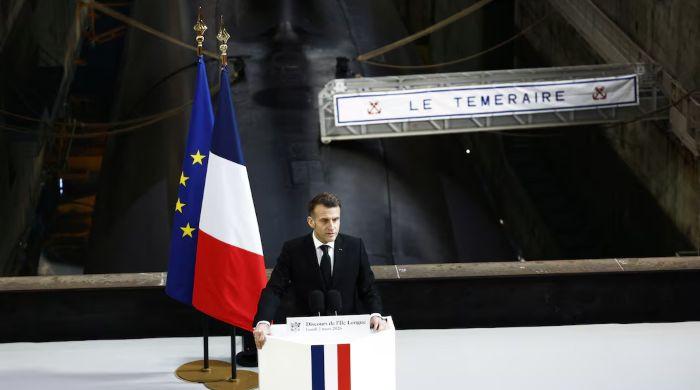
- France to expand nuclear arsenal amid geopolitical risks.
- European allies to join French nuclear wargames.
- France-Germany nuclear steering group to start cooperation.
PARIS: France will expand its nuclear arsenal and will potentially allow European partners to host its aircraft on nuclear deterrence missions, President Emmanuel Macron said on Monday, signalling a major doctrine change for France and the continent.
Though France and Britain are both nuclear powers, most European countries have relied primarily on the United States for deterring any potential adversaries — a decades-old pillar of transatlantic security.
But Trump’s rapprochement with Russia on the Ukraine war and his harsher posture towards traditional allies have rattled European governments, and some countries have expressed interest in how Paris could protect them by extending its nuclear umbrella.
“We are currently experiencing a period of geopolitical upheaval fraught with risk,” Macron said in a speech delivered from a submarine base in Brittany, adding that a hardening of the French deterrence model was needed.
Unveiling the update to France’s nuclear doctrine, a once-per-term ritual for presidents, Macron promised more cooperation with European allies that have expressed interest.
Germany, but also Greece, Poland, the Netherlands, Belgium, Denmark and Sweden would be able to take part in French nuclear wargames.
“I believe I can say our partners are ready,” Macron said.
Still, Macron gave no details on how the enhanced nuclear drive would be funded, while making clear decision-making on nuclear strikes will remain solely in the hands of the French president.
Arming up together
German Chancellor Friedrich Merz said in a joint statement with Macron that France and Germany had established a nuclear steering group to discuss deterrence issues and would start concrete cooperation this year.
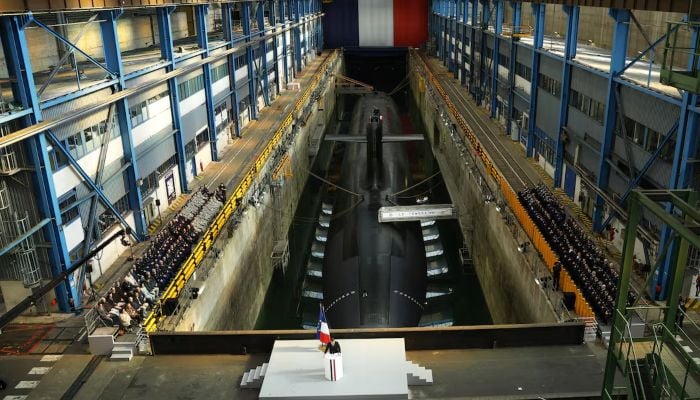
That would include participation by conventional German forces in French nuclear exercises and joint visits to strategic sites, as well as the development of non-nuclear capabilities with France and other European partners.
Polish Prime Minister Donald Tusk said on X Poland was in talks “with France and a group of closest European allies on the programme of advanced nuclear deterrence”.
“We are arming up together with our friends so that our enemies will never dare to attack us,” he added.
The French leader said it would be possible to establish, under unspecified circumstances, strategic assets in other European countries that would be part of what he called a new “forward deterrence” doctrine.
“Our strategic air forces could be spread deep into the European continent,” Macron said, without giving more details.
Although the size of France’s nuclear arsenal is based on a strategy of “strict sufficiency”, the number of French warheads will be increased, Macron said.
France spends roughly 5.6 billion euros ($6.04 billion) a year to maintain its stockpile of 290 submarine- and air-launched weapons — the world’s fourth-largest arsenal. Britain has 225 nuclear warheads. Russia and the United States have more than 5,000 each.
Macron said close ties on nuclear deterrence will continue with Britain. He also said the current rethink of French nuclear doctrine has been done in total transparency with Washington, and was complementary to Nato’s nuclear mission.
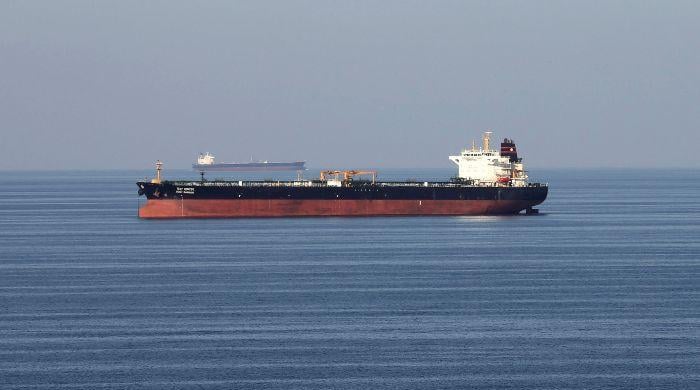
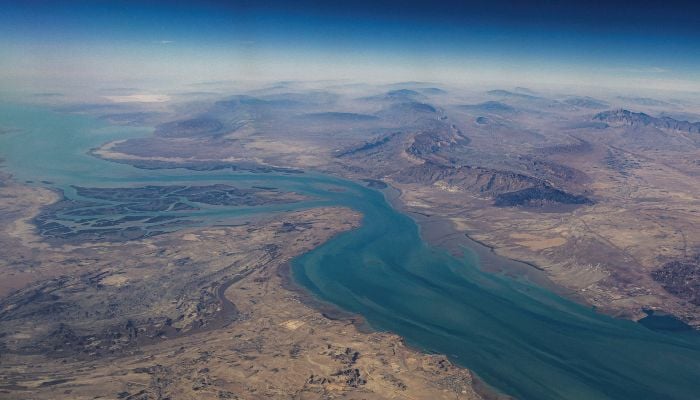
SINGAPORE: Global oil and gas shipping rates soared, with supertanker costs in the Middle East hitting all-time highs, as the US-Iran conflict intensified after Tehran targeted ships passing through the Strait of Hormuz, according to shipping data and industry sources on Tuesday.
Shipping through the Strait of Hormuz between Iran and Oman, which carries around one-fifth of oil consumed globally as well as large quantities of liquefied natural gas, has ground to a near halt after vessels in the area were hit as Iran retaliated to US and Israeli strikes.
The disruption and fears of prolonged closure have caused oil and European natural gas prices to jump, with Brent crude futures up nearly 10% this week as the conflict triggered multiple oil and gas shutdowns in the Middle East.
The benchmark freight rate for the very large crude carriers (VLCCs) used to ship 2 million barrels of oil from the Middle East to China, also known as TD3, rose to an all-time high of W419 on the Worldscale industry measure used to calculate freight rates, on Monday, or $423,736 per day, LSEG data showed.
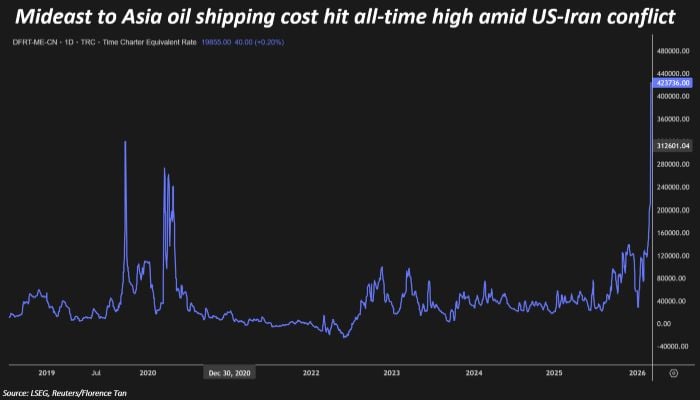
The rate doubled from Friday, extending gains from a six-year high last week, after the US and Israel attacked Iran and killed its Supreme Leader Ayatollah Khamenei on Saturday.
In retaliation, Iran has struck Gulf countries, prompting precautionary shutdowns at oil and gas facilities across the Middle East.
An Iranian Revolutionary Guards senior official said on Monday that the Strait of Hormuz is closed and Iran will fire on any ship trying to pass, Iranian media reported.
The US military’s Central Command said the Strait is not closed despite the Iranian statements, Fox News reported.
LNG shipping rates jump
Still, daily freight rates for LNG tankers jumped more than 40% on Monday after Qatar halted its production.
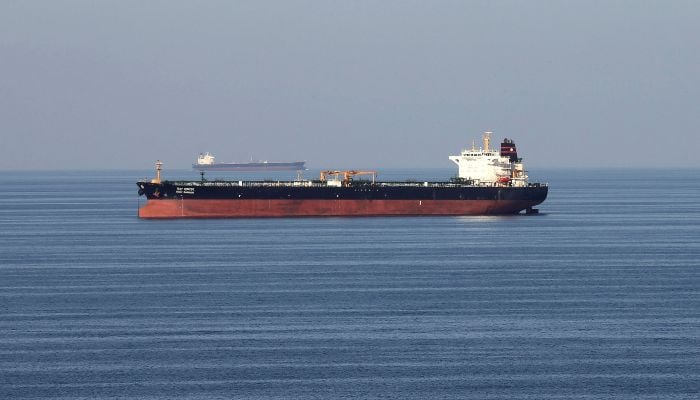
Atlantic rates rose to $61,500 per day on Monday, up 43%, or $18,750, from Friday, according to Spark Commodities, a pricing assessment agency for LNG shipping. Pacific rates rose to $41,000 per day, up 45%, or $12,750, from Friday.
Fraser Carson, principal analyst for global LNG at energy consultancy Wood Mackenzie, said spot daily LNG shipping rates could rise above $100,000 this week on tight supply.
“Vessel availability for the rest of March is considered weak as cargo operators try to work through the backlog created by weather disruptions during February,” he said.
“There will be very strong competition for any available vessels,” he added.
Until safe passage through the Strait of Hormuz can be assured, shipping will remain idle, Carson said.
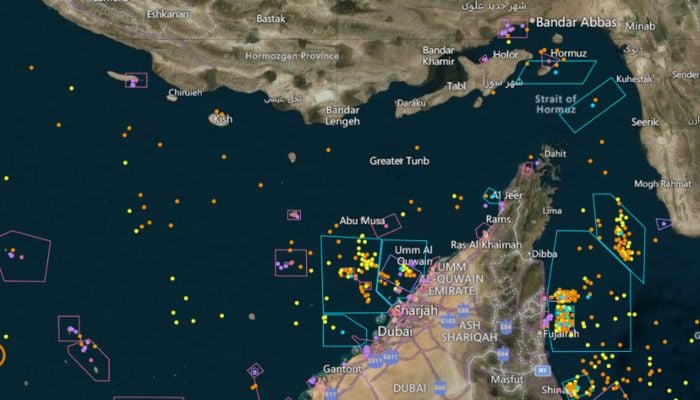
An oil shipbroker who declined to be named due to company policy said it is very difficult to assess shipping rates in the Gulf as several shipowners have suspended operations indefinitely.
South Korean shipping firm Hyundai Glovis said on Tuesday it is preparing contingency plans including securing alternative routes and ports in response to the Middle East conflict.
South Korea’s maritime ministry has issued a notice to South Korean shippers with vessels sailing in the Middle East, asking them to refrain from business operations in the region, an official told Reuters on Tuesday.
The ministry is holding a meeting to discuss further safety measures following Iran’s threat to attack any ship passing through the Strait of Hormuz, the official added.

According to the US State Department, the Embassy in Riyadh was hit by two unmanned aerial vehicles (UAVs). “Embassy Riyadh has been struck by two UAVs that hit the roof and the perimeter of the chancery. Post is sheltering in place and reported no injuries.” the State Department said.
The attack by two drones early Tuesday on the US embassy in Riyadh sparked a fire, a Saudi defence ministry spokesman said in a statement, while Iran pressed on with retaliatory strikes across the Gulf.
The growing war began on Saturday after joint US-Israeli strikes on Iran that Tehran said killed dozens of civilians and the country’s supreme leader.
“The US Embassy in Riyadh was attacked by two drones, according to initial assessments. The attack resulted in a limited fire and minor material damage to the building,” the statement said.
Two witnesses told AFP they saw fire engines around the embassy.
Earlier, witnesses said they had seen smoke over the building housing the US mission and heard loud explosions in the diplomatic quarter, home to foreign embassies in the Saudi capital.
A source close to the Saudi army, speaking on condition of anonymity to discuss the sensitive issue, told AFP that Saudi air defences intercepted four drones targeting Riyadh’s diplomatic quarter in the attack.
In the aftermath, the US embassy issued shelter in place notifications for Jeddah, Riyadh and Dhahran and limited non-essential travel to any military installations in the region.
Later on Tuesday, the Saudi defence ministry said it had intercepted more than half a dozen drones near capital Riyadh and the city of Al-Kharj. “Eight drones were intercepted and destroyed near the cities of Riyadh and Al-Kharj,” said defence ministry spokesman Major General Turki al-Malki on X.
The attacks in Saudi coincided with a wave of missiles and drones launched at Gulf states with the UAE defence ministry saying it was dealing with a barrage of ballistic missiles coming from Iran.
In Qatar, the military intercepted two ballistic missiles early Tuesday morning, the country’s defence ministry said in a statement.
Iran’s salvos have hit ports, airports, residential buildings and hotels along with military sites across the wealthy region of oil giants.
On Monday smoke poured out of Kuwait City’s US embassy, an AFP correspondent saw. Later, a Kuwait-based diplomat and a Western diplomat, speaking on condition of anonymity, told AFP the embassy had been damaged by several drones, while a second Kuwait-based diplomat said the building had been struck directly.
Trump warns of longer war
US President Donald Trump warned that his attack on Iran could extend longer than a month, as the war spread Tuesday with Israel bombarding Lebanon and Tehran targeting US allies in the Gulf.
Shortly after the United States urged Americans to flee all Middle Eastern nations from Egypt eastward, smoke rose above the US embassy in Riyadh after it was hit by two drones, a Saudi defence spokesman said, although there were no immediate reports of injuries.
New powerful explosions also shook windows in Tehran as fighter jets flew over the Iranian capital, AFP journalists witnessed, as the Pentagon boasted that it had achieved air superiority over the country ruled since 1979 by Islamic clerics virulently opposed to the United States.
Trump said that the war, which began Saturday with a strike that killed Iran’s supreme leader, Ayatollah Ali Khamenei, was going “substantially” ahead of schedule but that the United States was equipped for a prolonged conflict.
“From the beginning we projected four to five weeks, but we have capability to go far longer than that,” Trump said at the White House.
He also for the first time laid out objectives — destroying Iran’s missiles, navy and nuclear programme and stopping its support for armed groups across the region. The goals notably did not include toppling the Islamic republic, even though on Saturday Trump had urged the people of Iran to rise up and overthrow their government.
Secretary of State Marco Rubio presented a strikingly new narrative of how the conflict started, saying that the United States, which built up its military to levels not seen since the 2003 Iraq invasion, attacked only after learning that ally Israel was set to strike Iran.
Iran had been ready to strike US forces in the region in response to Israel, so Trump decided to intervene “pre-emptively” alongside Israel, Rubio asserted.
“The imminent threat was that we knew that if Iran was attacked — and we believed they would be attacked — that they would immediately come after us,” Rubio told reporters before briefing lawmakers.
Rival Democrats voiced disbelief, with Senator Mark Warner saying it was “unchartered territory” for the United States to be triggered into action by Israel’s perception of a threat.
Iran has responded to the attack by unleashing missiles and drones across the Middle East, threatening explicitly to drive up energy costs, which could wreak havoc on the global economy.
“We will burn any ship that tries to pass through the Strait of Hormuz,” Revolutionary Guards General Sardar Jabbari said of the strategic waterway to the Gulf through which about 20 percent of global seaborne oil travels.
European natural gas prices surged more than 39 percent after Qatar’s state-run energy firm said it had halted liquefied natural gas production following Iranian attacks.
Qatar, which had comparatively good relations with Iran before the war, said it shot down two Iranian bombers, the first time a Gulf Arab country has hit planes from their giant neighbour.
US doesn’t rule out troops
Trump warned that the United States had more firepower in store, saying, “The big wave hasn’t even happened.”
In an interview with the New York Post, Trump — who campaigned on promises to end US involvement in wars — refused to rule out deploying US ground troops to Iran “if they were necessary.”
Defense Secretary Pete Hegseth also signaled Monday that deploying troops inside Iran had not been ruled out.
In a combative public appearance, he rejected “stupid rules of engagement” that would constrain the United States and said, “We’ll go as far as we need to go.”
Ali Larijani, the head of Iran’s Supreme National Security Council, vowed that Iran would defend itself “regardless of the costs and will make the enemies sorry for their miscalculation.”
Tehran had the air of a ghost town on Monday, and many residents seemed to have left. Some, suitcases and luggage in hand, were preparing to do the same, AFP journalists saw.
Many residents were torn between fear of the bombings and hope that the government’s days might now be numbered.
“Every time we hear the noises, we get scared for just a second. But we experience some joy and excitement every time we hear a hit,” a 45-year-old lawyer said in a voice message to Europe.
Israel responds to latest missile strikes
Just after midnight local time Tuesday, Israel’s military said it was working to intercept a large wave of missiles launched from Iran targeting multiple locations, including Jerusalem.
“A short while ago, the IDF identified missiles launched from Iran toward the territory of the State of Israel. Defensive systems are operating to intercept the threat,” the military said.
Netanyahu: no ‘endless war’
Israeli Prime Minister Benjamin Netanyahu said in a Fox News interview Monday that the US-Israeli operation against Iran would be “a quick and decisive action,” later adding: “It may take some time, but it’s not going to take years.
New Israel strikes on Hezbollah
Israel’s military said Tuesday that it had launched strikes on Hezbollah targets including “command centres and weapons storage facilities” in Lebanon’s capital Beirut, after warning it would press ahead with its campaign against the Iran-backed group.
The Lebanese militant group said just after midnight that its rocket and drone attack on Israel was a “defensive act” after more than a year of Israeli strikes despite a ceasefire.
US warns citizens in Middle East to ‘depart now’
The US State Department urged Americans to leave much of the Middle East, including Egypt and Gulf states, due to the US-Israeli war on Iran.
The State Department “urges Americans to DEPART NOW from the countries below using available commercial transportation, due to serious safety risks,” wrote Mora Namdar, the assistant secretary of state for consular affairs, in a social media post.
The countries or territories included in the warning were Bahrain, Egypt, Iran, Iraq, Israel and the Palestinian territories, Jordan, Kuwait, Lebanon, Oman, Qatar, Saudi Arabia, Syria, the United Arab Emirates and Yemen.
Iran state broadcaster headquarters ‘struck and dismantled’
Israel’s military claimed it had “struck and dismantled” the headquarters of Iran’s state radio and television broadcaster, the Islamic Republic of Iran Broadcasting (IRIB), saying it had “called for the destruction of the State of Israel and for the use of nuclear weapons.”
The IRIB wrote on Telegram there had been explosions near its headquarters in Tehran but that there was no disruption to its operations.
NGO new Iran death toll
The US-based Human Rights Activists News Agency (HRANA) on Tuesday said there were 101 casualties inside Iran on the third day of the war, including “85 civilian deaths and 11 military personnel killed.”
Iran ‘will burn any ship’ in Hormuz
A general in Iran’s Revolutionary Guards threatened to “burn any ship” seeking to navigate the Strait of Hormuz, a vital route for oil and gas shipments.
“We will also attack oil pipelines and will not allow a single drop of oil to leave the region.
Oil price will reach $200 in the coming days,” General Sardar Jabbari said in a post on the Guards’ Telegram channel.
Israel was about to strike Iran, says Rubio
The United States attacked Iran after learning that ally Israel was going to strike, which would have meant retaliation against US forces, Secretary of State Marco Rubio said.
“We knew that if we didn’t preemptively go after them before they launched those attacks, we would suffer higher casualties,” Rubio told reporters.
US says hit 1,250 targets so far
The United States hit more than 1,250 targets in the first 48 hours of the war against Iran, the US military said.
Targets struck included command-and-control centers, ballistic missile sites, Iranian navy ships and submarines, and anti-ship missile sites, according to a fact sheet released by the US Central Command, which is responsible for American forces in the region.
Australia Middle East HQ hit
Australian Defence Minister Richard Marles said he could confirm reports that its military headquarters, the Al Minhad Air Base located just 24 kilometres (15 miles) south of Dubai in the UAE, had been hit over the weekend.


US producer price index for final demand up 0.5% in Jan 2026

Sialkot Stallionz renamed Multan Sultans after CD Ventures buyout

Ind-Ra expects India’s apparel retail revenues to grow 9% YoY in FY26

-

 Politics5 days ago
What are Iran’s ballistic missile capabilities?
-
 Business6 days ago
Households set for lower energy bills amid price cap shake-up
-

 Sports5 days ago
Sri Lanka’s Shanaka says constant criticism has affected players’ mental health
-

 Sports1 week ago
Top 50 USMNT players of 2026, ranked by club form: USMNT Player Performance Index returns
-

 Politics5 days ago
US arrests ex-Air Force pilot for ‘training’ Chinese military
-
 Business6 days ago
Lucid widely misses earnings expectations, forecasts continued EV growth in 2026
-

 Sports5 days ago
Cristiano Ronaldo purchases 25% stake in Spanish club Almeria
-

 Sports1 week ago
South Africa thrash India by 76 runs in T20 World Cup Super 8 – SUCH TV