

Entertainment
Jerry Adler, ‘Sopranos’ and ‘The Good Wife’ actor who spent decades backstage on Broadway, dies at 96


Jerry Adler, who spent decades behind the scenes of storied Broadway productions before pivoting to acting in his 60s, has died at 96.
Adler died Saturday, according to a brief family announcement confirmed by the Riverside Memorial Chapel in New York. Adler “passed peacefully in his sleep,” Paradigm Talent Agency’s Sarah Shulman said on behalf of his family. No immediate cause was given.
Among Adler’s acting credits are “The Sopranos,” on which he played Tony Soprano adviser Hesh Rabkin across all six seasons, and “The Good Wife,” where he played law partner Howard Lyman. But before Adler had ever stepped in front of a film or television camera, he had 53 Broadway productions to his name — all behind the scenes, serving as a stage manager, producer or director.
He hailed from an entertainment family with deep roots in Jewish and Yiddish theater, as he told the Jewish Ledger in 2014. His father, Philip Adler, was a general manager for the famed Group Theatre and Broadway productions, and his cousin Stella Adler was a legendary acting teacher.
“I’m a creature of nepotism,” Adler told TheaterMania in 2015. “I got my first job when I was at Syracuse University and my father, the general manager of Gentlemen Prefer Blondes, called me (because) there was an opening for an assistant stage manager. I skipped school.”
After a long theater career, which included the original production of “My Fair Lady” and working with the likes of Marlene Dietrich, Julie Andrews and Richard Burton, among many others, Adler left Broadway during its 1980s slump. He moved to California, where he worked on television productions like the soap opera “Santa Barbara.”
“I was really getting into the twilight of a mediocre career,” he told The New York Times in 1992.
But the retirement he was contemplating was staved off when Donna Isaacson, the casting director for “The Public Eye” and a longtime friend of one of Adler’s daughters, had a hunch about how to cast a hard-to-fill role, as The New York Times reported then. Adler had been on the other side of auditions, and, curious to experience how actors felt, agreed to try out. Director Howard Franklin, who auditioned dozens of actors for the role of a newspaper columnist in the Joe Pesci-starring film, had “chills” when Adler read for the part, the newspaper reported.
So began an acting career that had him working consistently in front of the camera for more than 30 years. An early role on the David Chase-written “Northern Exposure” paved the way for his time on a future Chase project, “The Sopranos.”
“When David was going to do the pilot for ‘The Sopranos’ he called and asked me if I would do a cameo of Hesh. It was just supposed to be a one-shot,” he told Forward in 2015. “But when they picked up the show they liked the character, and I would come on every fourth week.”
Films included Woody Allen’s “Manhattan Murder Mystery,” but Adler was perhaps best known for his television work. Those credits included stints on “Rescue Me,” “Mad About You,” “Transparent” and guest spots on shows ranging from “The West Wing” to “Broad City.”
He even returned to Broadway, this time onstage, in Elaine May’s “Taller Than a Dwarf” in 2000. In 2015, he appeared in Larry David’s writing and acting stage debut, “Fish in the Dark.”
“I do it because I really enjoy it. I think retirement is a road to nowhere,” Adler told Forward, on the subject of the play. “I wouldn’t know what to do if I were retired. I guess if nobody calls anymore, that’s when I’ll be retired. Meanwhile this is great.”
Adler published a memoir, “Too Funny for Words: Backstage Tales from Broadway, Television and the Movies,” last year. “I’m ready to go at a moment’s notice,” he told CT Insider then, when asked if he’d take more acting roles. In recent years, he and his wife, Joan Laxman, relocated from Connecticut back to his hometown of New York. Survivors include his four daughters, Shulman said.
For Adler, who once thought he was “too goofy-looking” to act, seeing himself on screen was odd, at least initially. And in multiple interviews with various outlets, he expressed how strange it was to be recognized by the public after spending so many years working behind the scenes. There was at least one advantage to being preserved on film, though, as he told The New York Times back in 1992.
“I’m immortal,” he said.







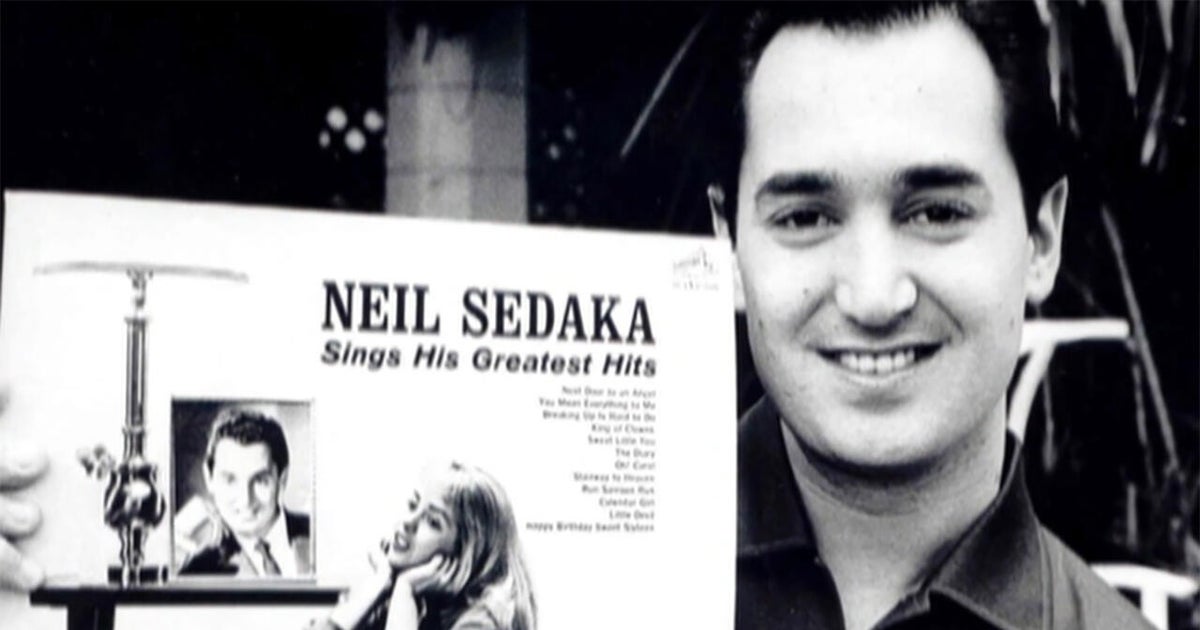
Neil Sedaka was one of America’s most popular singer-songwriters, twice!
As a boy growing up in Brooklyn, his talent was hard to miss. “I was a child prodigy,” he told “Sunday Morning” in 2020. “I started at nine years old. Got a scholarship to the prep school of Julliard.”
When he was 13, he met a kid in his apartment building named Howard Greenfield. He’d found his lyricist, and they quickly hit it big.
When we met six years ago, Sedaka told me about the song that made him a star, “Oh, Carol,” inspired by his relationship with high school classmate Carole King: “I did date Carole King for about two minutes,” he laughed. “Yes. I had a crush on Carole King.”
In the next few years, Sedaka composed-and performed one hit teen anthem after another, including “Calendar Girl” and “Stupid Cupid,”
Asked if there is a throughline as to what makes songs popular, Sedaka replied, “It always goes back to, ‘Oh, that song could be my life. That’s my story.'”
He landed his first #1 single in 1962, “Breaking Up Is Hard to Do.”
Neil Sedaka had become a superstar. Between 1958 and 1963, he sold 40 million records “I pushed three buttons on my car radio, and I heard ‘Oh Carol’ on three stations at the same time,” he said.
And then, suddenly it was over. In 1963, a new group arrived: The Beatles. Sedaka’s brand of bouncy pop quickly fell out of favor. He’d become a has-been at age 24. For 13 years, he was mostly forgotten. “I had 13 years of being off the charts – no plays, nothing,” he said.
And then, one night, at a party in England, he met a fellow musician named Elton John. “He said, ‘You know, I could make you a star again.'”
In 1974, John’s record company released a new album called “Sedaka’s Back.” That record included his first #1 hit in 12 years: “Laughter in the Rain.”
But even that song wasn’t as big a hit as the one recorded by the Captain and Tenille: “Love Will Keep Us Together.”
“I went from making $50,000 a year in 1974, to $6 million a year in 1975, with one record, one LP, and one song,” he said.
The second act of Sedaka’s career had begun. If you had any doubt, you just had to listen closely. In 1976, a new, slower version of “Breaking Up is Hard to Do” hit the charts again. “I think I’m the only person who did the same song twice, in a different tempo, number one both times,” he said.
On Friday, after a 70-year career, Neil Sedaka died at age 86. To him, making a song was a joyful, even mystical act.
“I think you’re chosen spiritually at that particular moment,” he said, “and you’d better sit very quietly, because you can actually feel the song being written by itself. And the song passes through your throat and through your fingers. It’s an extraordinary feeling!”
Story produced by Gabriel Falcon. Editor: Jennifer Falk.

Mumford & Sons served as the musical guest in the latest episode of Saturday Night Live on February 28, and they brought out a surprise guest along.
The folk-rock band based on Marcus Mumford, Ben Lovett, and Ted Dwane, took the stage to perform songs from their latest album, Prizefighter, and sang Rubber Band Man featuring Hozier.
Their performance also featured a cameo from The National’s Aaron Dessner which doubled the excitement for fans.
Videos of the performance taken from Studio 8H went viral all over social media, as fans expressed their delight at Mumford & Sons’ comeback, and the surprise guests.
The song Rubber Band Man is a collaboration between the Someone New hitmaker, and the band.
Prizefighter, which marked the second album since the band’s return after seven years, features many collaborations as the band described their project a collaborative effort between friends.
They co-produced and co-wrote the album with Dessner, and worked with Gracie Abrams and Chris Stapleton on tracks from the project.
The special SNL episode where Mumford & Sons performed, was hosted by Heated Rivalry star Connor Storie.

Kitty Song Covey is entering her senior year – and apparently, she still hasn’t discovered the concept of “chill.”
Anna Cathcart is back as everyone’s favourite chaos queen in season 3 of XO, Kitty, premiering on Netflix this spring. And according to the 22-year-old star, Kitty may want to consider a yoga class. Or three.
“She just needs to calm down a little bit,” Anna told People magazine. “I feel like Kitty has the most chaos [sic] of anyone I know, and that’s what we love about her.”
“But also, girl, you need to sit down sometimes,” she continued. “Take a deep breath, it’s okay. She kind of always has been [that way], but in a controlled way, I guess. She handles it well.”
Season 3 picks up after that cliffhanger (you know the one), and for the first time, fans will see a summer episode – yes, summer at KISS is officially unlocked.
“I’m finally allowed to talk about that because it’s been a secret forever,” Anna shared. “So very excited and I think they’re going to be surprised, but also super happy. So I can’t wait.”
And it’s not just poolside vibes. “[Kitty’s] making some big decisions in her life and it’s senior year, all of that, so I’m very excited for them to see,” she added.
Translation? Expect romance, identity spirals, possibly tears – and definitely Kitty-level impulsive decision-making.


2026 NFL combine buzz: Intel on free agency, trades, QBs

Neil Sedaka: An appreciation – CBS News

Khamenei dead, Middle East on edge: What will be the implications of Trump’s ‘Epic fury’ on stock markets, gold & oil? – The Times of India

-
 Business1 week ago
US Top Court Blocks Trump’s Tariff Orders: Does It Mean Zero Duties For Indian Goods?
-

 Fashion1 week ago
ICE cotton ticks higher on crude oil rally
-

 Entertainment1 week ago
The White Lotus” creator Mike White reflects on his time on “Survivor
-

 Politics1 week ago
Pakistan carries out precision strikes on seven militant hideouts in Afghanistan
-
 Business1 week ago
Eye-popping rise in one year: Betting on just gold and silver for long-term wealth creation? Think again! – The Times of India
-
 Sports1 week ago
Brett Favre blasts NFL for no longer appealing to ‘true’ fans: ‘There’s been a slight shift’
-

 Entertainment1 week ago
Viral monkey Punch makes IKEA toy global sensation: Here’s what it costs
-

 Sports1 week ago
Kansas’ Darryn Peterson misses most of 2nd half with cramping