

Sports
Kohli leads IPL charge | The Express Tribune

BENGALURU:
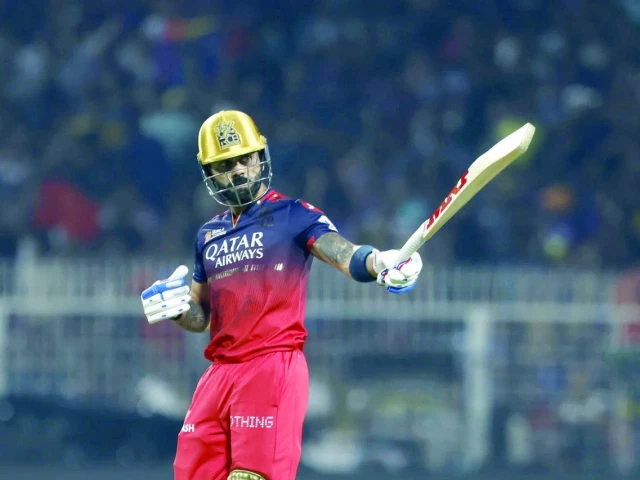
Virat Kohli’s decision to scale back his international commitments has not dampened his appetite for runs, with the former India captain guiding Royal Challengers Bengaluru to victory with an unbeaten 69 in the Indian Premier League opener.
The 37-year-old retired from Twenty20 Internationals after India’s 2024 World Cup triumph and brought the curtain down on his 123-test career last year, leaving one-day internationals as his sole format.
He featured in 13 ODIs last year, scoring 651 runs, and returned to the IPL after last playing for India in January.
Bengaluru captain Rajat Patidar told reporters after their six-wicket win over Sunrisers Hyderabad on Saturday that it was a pleasure to watch Kohli at the crease.
“Virat Kohli is our number one chase master,” he said.
“I always enjoy watching his batting from the dugout – the way he plays, the shots he picks, and how he reads situations.
“I feel he’s at his peak right now. From what I’ve seen in the nets, the energy and eagerness to perform and dominate are still the same.”
Kohli, who struck the winning runs as fans chanted his name at a packed stadium, said playing in a single format had helped him stay mentally fresh.
“The kind of scheduling that we’ve had over the last 15 years and the amount of cricket I’ve played, for me there was always a risk of getting burned out rather than being undercooked. So these breaks helped me immensely,” he added.
The win carried deeper resonance after last year’s maiden IPL title celebrations were overshadowed by a stampedeoutside the stadium that claimed 11 lives.
Bengaluru paid tribute by leaving 11 seats vacant, players wearing number 11 on their backs during the warm-up and black armbands throughout the match, before observing a minute’s silence ahead of the contest.
“They were like family members because everyone was supporting RCB for years. We miss them,” Patidar added.



This article was first published on March 20 and has been updated now that Igor Tudor has left by mutual consent.
LONDON — The Champions League anthem was played at the Tottenham Hotspur Stadium on March 18. Atletico Madrid were in town, and Spurs were playing in football’s premier club competition with the prize of a quarterfinal against Barcelona at stake.
Despite a 3-2 second-leg victory, Spurs suffered a 7-5 aggregate defeat that ended their Champions League dream. But now they’re faced with a relegation battle to save their Premier League status.
Who knows when the Champions League anthem will next ring out around Tottenham’s £1 billion stadium? Right now, it seems like it could be an eternity.
Spurs lost 3-0 at home to Nottingham Forest last Sunday — Spurs (17th) are a point above the relegation zone, while Forest (16th) are three points clear now — and next season’s fixture list will be more likely to include Championship games against Preston North End and Lincoln City than Champions League nights against Europe’s elite.
Spurs last suffered relegation in 1977. They bounced back after just one season, but in those pre-Premier League days, there was no financial hammer blow to dropping down a division. Clubs could ride it out, often keeping their team together and barely feeling the pain, but in the modern game, relegation can mean an instant £100 million hit and a player exodus. For a club the size of Spurs, the implications would be enormous.
But how has it come to this? Spurs were Champions League finalists under Mauricio Pochettino in 2019, they won the Europa League with Ange Postecoglou less than 12 months ago and their status as one of the Premier League’s ‘Big Six’ — alongside Arsenal, Chelsea, Liverpool, Manchester City and Manchester United — should make them too big and too wealthy to ever have to worry about relegation.
However, they are not too good to go down. Spurs haven’t won a Premier League game in 2026 — their last league win was a 1-0 victory at Crystal Palace on Dec. 28 — and since the start of last season, they have lost twice as many league games (37) as they won (18). Igor Tudor, appointed as head coach until the end of the season last month, was the club’s sixth appointment since Pochettino’s exit in November of 2019, and the club will now require a seventh after he failed to win a single game.
There has been turmoil off the field too, with Daniel Levy’s 24-year reign as chairman coming to an abrupt end last September. Sporting director Fabio Paratici followed Levy out the door in January.
All of the ingredients of a club in turmoil are there. Bad results, underperforming players, managerial change, instability in the boardroom and supporter unrest. But still: could Spurs really go down?
Where did it all go wrong?
The consensus among many connected with Spurs is that the 2019 Champions League final defeat against Liverpool in Madrid was the fork in the road, with the club ultimately picking the wrong direction.
Pochettino’s team included Harry Kane, Christian Eriksen, Son Heung-min, Hugo Lloris and emerging talent Dele Alli. The coach wanted to take Spurs to the next level, turn them into winners rather than challengers, but the summer transfer window saw potential, rather than proven, talent arrive in the shape of Jack Clarke, Tanguy Ndombele, Giovani Lo Celso and Ryan Sessegnon. By November, Pochettino was out and in came Jose Mourinho, a change that triggered the downward spiral.
“By the time Mauricio left, it was clear he had to go,” a boardroom source told ESPN. “He and Daniel [Levy] just weren’t getting along, I think they were both worn out by each other.
“But Daniel was listening to too many people, wrong people, and I think he was seduced by the idea of having Jose as his manager. Jose is a great manager, but he inherited a squad built for Pochettino — young players who need encouragement and development — and he is just too volatile and aggressive for a young squad. Spurs needed another Pochettino type after Mauricio left, but they went in another direction and it’s never been the same since.”
Ricky Sacks, who hosts the “Last Word on Spurs” podcast, echoes that perspective, saying that the failure to develop Pochettino’s team was the root cause of the problems the club’s now attempting to deal with.
“The club has gone round and round in circles since 2019,” Sacks told ESPN. “There has been no clear idea or identity, nobody knows what they want to do, because they have gone from one style of coach to another.
“They sacked Mourinho four days before the 2021 Carabao Cup final against Man City, failed to back Antonio Conte, and then went from Ange [Postecoglou] to Thomas Frank who, although he seems a good guy, was just never equipped to upscale from Brentford to a club like Spurs. It’s just been a mess.”
Alongside the managerial churn, Spurs have consistently failed to compete at the top end of the transfer market. Tottenham’s biggest-ever signing — forward Dominic Solanke arrived from Bournemouth for a £65 million fee in August, 2024 — is by far the smallest record-transfer among the ‘Big Six’, who have all spent in excess of £100 million for a player with the exception of United, whose record signing is the £89.3 million deal for Paul Pogba from Juventus in August 2016.
Spurs have also earned a reputation for being frugal on player wages. In their most recently published accounts, for the 2023-24 season, Tottenham’s wage bill stood at £222 million — almost half of the £413 million paid by City in the same period — but that figure meant they paid just 42% of their revenue on wages. By comparison, Aston Villa‘s most recent wages to revenue ratio was 71%, while Newcastle United‘s figure was 68%, so Spurs are also falling behind clubs outside of the ‘Big Six’ when it comes to competing for new signings.
Spurs’ owners, ENIC, which is run by the Lewis Family Trust, injected £100 million of new capital into the club last October, but ongoing speculation of a potential sale has not gone away despite ENIC’s denials that they are looking to sell what is, off the pitch at least, a major football club.
It is the magnificent 62,000-capacity stadium, the club’s century-old history and their huge fanbase, both in London and globally, that earns Spurs their place in the ‘Big Six’, but former manager Postecoglou recently questioned whether they deserve to described as a “big” club.
“Obviously, they’ve [Spurs] built an unbelievable stadium, unbelievable training facilities,” Postecoglou told “The Overlap,” a popular podcast. “But when you look at the expenditure, particularly in the wage structure, they’re not a big club.
“I saw that when we were trying to sign players, because we weren’t in the market for those players. I was looking at Pedro Neto, [Bryan] Mbeumo and [Antoine] Semenyo and Marc Guéhi, because if we’re going to go from fifth to there [challenging for trophies], that’s what the other big clubs would do in that moment.”
Instead, Spurs went for Archie Gray, Wilson Odobert and Lucas Bergvall — players for tomorrow rather than today, just like Ndombele, Sessegnon and Lo Celso were in 2019.
Despite the poor recruitment and managerial changes, former Spurs goalkeeper Robinson believes that Levy has been unfairly labelled as the major reason behind the club’s fall from grace.
“Daniel gets a lot of stick and came under a lot of pressure, but when things are right on the pitch, the eyes don’t turn towards the director’s box,” Robinson said. “Spurs have a great stadium and training ground — and Daniel Levy was part of that — but the fans are sick to death of hearing about it because the football side of things has been neglected.
“I think Daniel was badly advised at times, maybe listening to a lot of people as the club grew, but to his credit, he listened to the fans when they were clamoring for trophies and employed two ‘win-now’ managers in Mourinho and Conte. He just didn’t back them enough with win-now players to get them where they wanted.
“You can’t deny that recruitment has been really poor in recent years, but Spurs have also waved goodbye to their top scorers — Kane, Son and Brennan Johnson — from each of the last three seasons.”
0:41
Tudor: Tottenham’s win vs. Atletico Madrid important for morale
Igor Tudor reflects on Tottenham’s Champions League exit after their 7-5 aggregate loss against Atletico Madrid.
Tottenham’s failure to sign the players wanted by the manager at the time proved to be an issue right until the end of Levy’s time at the helm. Last summer, Frank wanted Crystal Palace forward Eberechi Eze, Forest midfielder Morgan Gibbs-White and his former Brentford striker Bryan Mbeumo, but the club missed out on all of them. They also tried and failed to Antoine Semenyo in January, with the Bournemouth forward opting instead to move to City.
One source told ESPN that a talent drain of senior figures within the hierarchy has also hurt the club — “they’ve never been good at retaining people,” the source said — with Victoria Hawksley (LIV Golf), Michael Edwards (Liverpool), Paul Barber (Brighton), Damien Comolli (Juventus) and former chief scout and technical director Steve Hitchen all cited as staff who have been allowed to leave Spurs during the Levy era.
But with Levy gone and CEO Vinai Venkatesham — who joined from Arsenal less than a year ago — telling Tottenham’s Fan Advisory Board earlier this month that “significant change” is needed after criticizing Levy’s running of the club, more upheaval is likely in the months ahead, no matter what division Spurs find themselves in.
Can Spurs really go down?
Despite Spurs being regarded as a sensible, well-run, but cautious, club — something for which Levy has been praised and criticized in equal measure — the financial catastrophe of relegation cannot be overstated.
According to UEFA’s 2025 European Club Finance report published last month, Spurs recorded the third-largest pre-tax loss (at £129 million) in Europe last year, after Chelsea and Lyon, despite generating a club record turnover of £580 million. Revenue was the ninth-highest in Europe due to the stadium’s commercial activity, including NFL fixtures and concerts, and competing in European football. The club’s net debt, due to borrowings for the new stadium, stood at £772.5 million, while reserves dropped from £198 million to £79 million.
Tottenham’s losses led CEO Venkatesham to warn the fan advisory board of a need to monitor the club’s compliance with Financial Fair Play regulations, so there is no question that relegation would create severe difficulties for the club.
Last season, Spurs earned £127.8 million in Premier League prize money despite finishing 17th. Relegation would be cushioned by three years of parachute payments, but they would drop from £48.95 million in year one to just £17.8 million in year three; at the same time, they would be earning just £5.7 million-per-year from the EFL’s broadcasting deal. Villa, Sunderland and Leeds United were forced to close full sections of the stadium after relegation due to the cost of maintaining them without fans to fill the seats.
Could the same happen at Spurs?
They would be the biggest club to go down since Leeds in 2003-04 and relegation led to a financial meltdown at Elland Road and the mass exodus of players. It took the club 16 years to return to the top flight.
“I think it would be more alarming and an even bigger story than Leeds if Spurs go down,” said Paul Robinson, who was part of the 2004 Leeds team. “Spurs have been a regular European team, they reached the Champions League final seven years and won the Europa League last year, so it would be much bigger.
“When a team is going down, players know they will be leaving. At Leeds, you would turn up for training not knowing whether somebody would still be there or if the club had moved them on for the finances. That’s what relegation brings — the initial destruction, and then the fight to come back. It’s not easy to do that.”
2:17
Gibbs: Tottenham draw Liverpool’s ‘story of the season’
Kieran Gibbs explains what’s going wrong at Liverpool this season following their late draw vs. Tottenham in the Premier League.
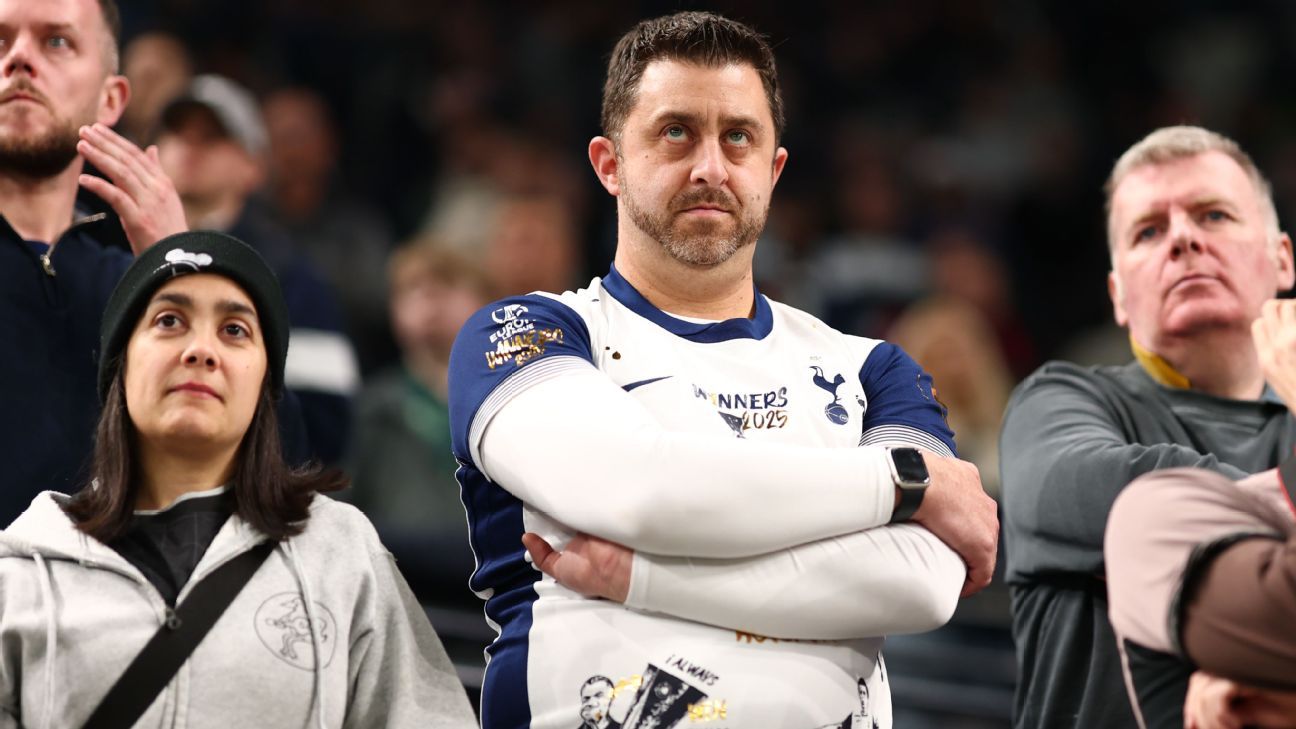
The threat of relegation has, however, led to unity among the Spurs fan base. Plans for a protest against the owners ahead of the Forest game were abandoned in favor of a wholehearted attempt to create an atmosphere of support and positivity, with supporters welcoming the team bus with flares and huge crowds. But it didn’t work.
The worst-case scenario of rivals Arsenal winning the league and being relegated by Chelsea in the penultimate game of the season at Stamford Bridge is keeping Spurs fans awake at night, as is the prospect of next season’s derby being against League One promotion-chasing Stevenage.
Richarlison‘s equalizer at Anfield, and Xavi Simons‘ match-winning performance against Atletico, had given Spurs hope before the Forest capitulation, so maybe the season isn’t headed for disaster. But this is Spurs, and their fans have become accustomed to expecting the worst and being proved right.
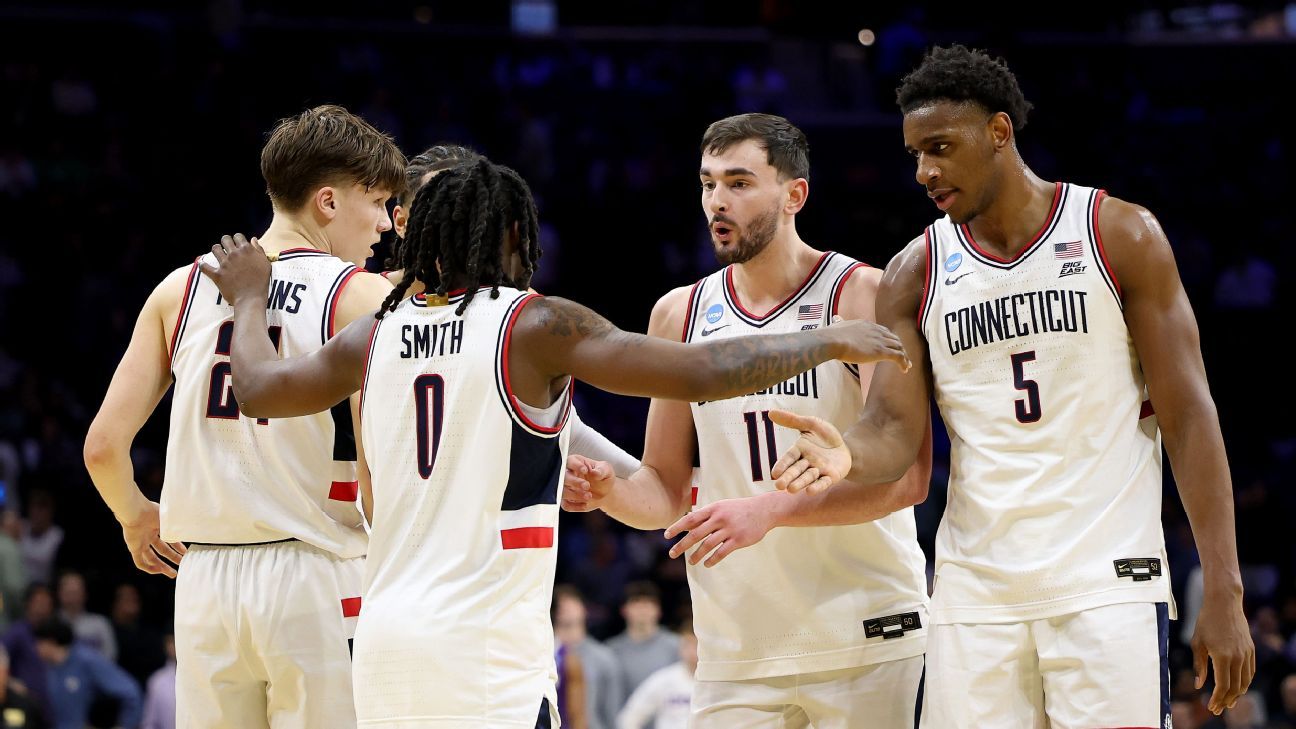
Arizona, Illinois and Michigan have punched their tickets to the Final Four. Now it’s time to decide whether Duke or UConn will join them in Indianapolis.
ESPN’s college basketball crew is tracking all the live action as the Elite Eight closes out in Washington, D.C.
Jump to: How Michigan won
Elite Eight live tracker
How Michigan won: The Wolverines delivered a knockout blow in the first half and cruised from there, displaying the passing, offensive variety and overall depth that makes them a bona fide contender to win their first national title since 1989. Michigan never looked back after a 21-0 run, and matched Tennessee’s tempo and offensive aggression early in the second half to stretch out its lead. Big Ten Player of the Year Yaxel Lendeborg was the best player at the Midwest regional, finishing with 27 points, seven rebounds, four assists and no turnovers against Tennessee. He received help from fellow transfers Aday Mara and Elliot Cadeau, who had a game-high 10 assists.
Tennessee’s only chance was to supplement its offensive rebounding talent with strong perimeter shooting, but the Vols didn’t have nearly enough offensive outside of Ja’Kobi Gillespie (21 points) to avoid dropping their third straight Elite Eight matchup. Michigan moves on to Indianapolis and will face Arizona in the Final Four. — Adam Rittenberg
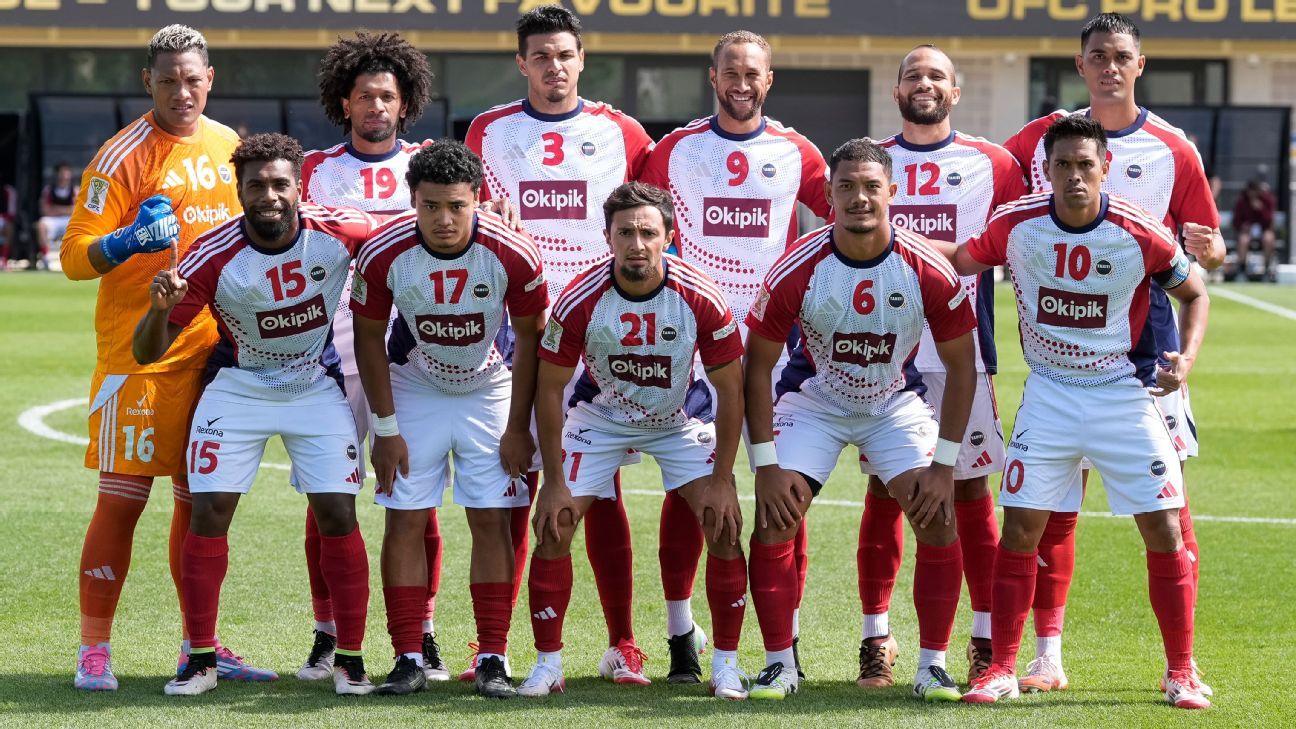
When you conjure an image of Tahiti, likely it will be of a tropical paradise with dazzling beaches and stunning azure waters where thousands of miles of the Pacific Ocean lie between you and the cares of your daily life. However, from a footballing perspective, it can be something of a headache being located so far from the rest of the world.
Take the case of Tahiti United, the only team in the world that skips a day forward in time every time it travels to play a match. And then, when it returns home, it arrives back yesterday.
The Tahitians, representing the largest island of French Polynesia, are making their bow in the inaugural OFC Pro League, Oceania’s first professional football competition. They are pitted against seven other teams from Australia, Fiji, New Zealand, Papua New Guinea, Solomon Islands and Vanuatu — all of which are located to the west of Tahiti, on the other side of the International Date Line.
– What is the OFC Professional League? All you need to know
– Soccer’s longest away trips: Which league hosts the ‘Distance Derby’?
– South Melbourne are in the OFC Pro League, but what about the A-League?
The line, which appears on maps running between the North and South Pole at roughly 180 degrees longitude (save for a few conspicuous kinks along the way to avoid passing directly through inhabited territories) is used globally to mark the point where one day ends and the next begins. Fiji, for example, is a little more than 2,000 miles away from Tahiti — about the same distance as New York City is from Phoenix — but it is 22 hours ahead.
Due to the substantial distances and travel costs involved, the games take place in circuits where the teams come together to play two fixtures each. For 2026, those circuits are being hosted in and around Auckland, Fiji, Honiara, Melbourne and Port Moresby.
This arrangement means that Tahiti United don’t have any home fixtures, leading to them racking up a prodigious number of air miles and multiple moves back and forth in the calendar. For those cheering them on from back home, each Tahiti United game as they follow it is being played tomorrow.
Teams from Tahiti are no stranger to long journeys. Clubs from French overseas departments and territories are allowed to enter the Coupe de France each year, creating some monumental away days. AS Vénus made a 20,000-mile round trip to face French fourth-tier side Trelissac FC in 2021, only to lose 2-0.
Despite the daunting schedule, the presence of Tahiti United in the OFC Pro League has given a huge boost to those in French Polynesia. Competing in a fully professional structure has fundamentally changed Tahiti’s relationship to the beautiful game.
“The logistical challenge is significant,” Tahiti United general manager Temaui Crolas told ESPN. “Squad management, training and travel coordination become more complex when you are constantly moving. You always have to think beyond the match itself.
“But this project is very important for Tahitian football and the professionalization of sports in Tahiti as a whole. We are the first Tahitian professional team in any sport, and we are showing that football here can be part of the biggest stage.”
For the players, the shift to full-time football has come with significant sacrifices. Some have had to quit jobs and leave behind the security of an alternative career outside the sport. All have had to accept long periods on the road and away from their loved ones.
“There is a human cost,” Crolas said. “The players have had to make a sporting transition but also a lifestyle change, moving away from work, family life and routines to meet the demands of professional football.”
Tahiti‘s national football team represents all of French Polynesia — an area of over 2,200 square miles, of which Tahiti is the most populous one of 75 inhabited islands and atolls. On the international stage, Tahiti have fared well in the Oceania Football Confederation and won the 2012 OFC Nations Cup, becoming the first team other than Australia and New Zealand to claim that accolade. In the process Tahiti qualified for the 2013 FIFA Confederations Cup in Brazil, where they lined up against the giants of Spain, Nigeria and Uruguay.
However, when Tahiti United secured their first win of the OFC Pro League season, a 1-0 win over Fiji’s Bula FC, it was a special and important moment. As a new club, Tahiti United have to build a fanbase from scratch and to convince those back home, watching in newly created fan zones in cafés, that they can succeed.
“Winning a match in a professional competition in Oceania is historic,” coach Samuel Garcia, who previously served as Tahiti’s national team boss for six years, told ESPN via email. “The response from home was overwhelmingly positive. For our supporters, our families, and everyone who has always believed in us, this victory was exceptional. More than anything, it confirmed the progress that we are making and that we’re going in the right direction.”
Garcia also pointed out that while the travel can be a challenge, the club knew this was what they signed up for and prepared accordingly.
By the end of the season, Tahiti United’s players and staff will have clocked somewhere in the region of 30,000 miles’ worth of travel and have spent close to an entire week in transit on their round-trips between circuit locations and home. With five circuits and then the final playoff round in May, that’s up to 12 jetlag-inducing journeys forward and back in time across the International Date Line over the course of the four-month campaign.
For Tahiti’s promising players, the OFC Pro League represents an exciting new chance to develop into a professional; something that has been hard to achieve until now.
“Tahiti United also offers a new pathway for young Polynesian players,” Garcia said. “Many families make significant sacrifices to send their children to Europe, but success rates are extremely low. Young players can now aspire to become professionals without leaving their home environment.”
A second win, 2-1 over PNG Hekari of Papua New Guinea, has helped lift Tahiti United away from the bottom of the OFC Pro League table. Club captain and Tahitian football legend Teaonui Tehau believes his side is settling into the new routine.
“Playing all our matches away and travelling for every round naturally has an impact on the group,” he told ESPN via email. “For many players, this is a completely new experience, and they are not used to this type of regular travel.
“Many did not expect us to perform at the level we have but our wins highlighted the strength and solidity of the team, which meant a lot to us. We are embracing the experience and adapting well. It’s strengthening us as a team.”
There are hopes that one day Tahiti United will finally get to be the hosts rather than the away side, but they may have to wait a while for their OFC Pro League home debut.
Tahiti is hosting the 2027 Pacific Games — a multisport event for athletes from all over Oceania. Football will be included, giving Tahiti a chance at glory if they can overcome the likes of New Caledonia and the Solomon Islands, but it will have an impact on Tahiti United’s plans.
“We want to host an OFC Pro League circuit in the future, but it is difficult because of the Pacific Games,” Crolas said. “Our home stadium is one of the grounds for that event, so for our first two OFC Pro League campaigns it won’t be possible. Our target is 2028 for our first home game.”
Tehau said: “Personally, I would love to play Pro League matches one day in Tahiti and finish my career at home, in front of our supporters.”
For now, Tahiti United’s supporters will have to settle for watching from afar. But while the International Date Line means Tahiti’s fans are forever in the past, they can look forward to their heroes’ homecoming somewhere in the future.


How Tottenham went from Europa League champs to relegation fight

Men’s March Madness live tracker: Duke-UConn updates, plus how Michigan won

Barry Manilow opens up about cancer recovery: ‘Been through hell’

-
 Business1 week ago
Flipkart group CFO to leave co amid IPO plans – The Times of India
-

 Fashion1 week ago
China’s textile & apparel exports surge 17% to $50 bn in Jan-Feb 2026
-

 Sports1 week ago
American Conference Commissioner Tim Pernetti thanks Trump for Army-Navy game executive order
-
 Business5 days ago
Property Play: Home flippers see smallest profits since the Great Recession, real estate data firm says
-

 Entertainment5 days ago
UN warns migratory freshwater fish numbers are spiralling
-

 Politics5 days ago
Afghanistan announces release of detained US citizen
-

 Sports1 week ago
Men’s March Madness live tracker: Updates on Saturday’s games
-

 Sports5 days ago
Broadcast industry CEO says consolidation is ‘essential’ to compete for NFL soaring media rights prices