

Business
Learner drivers may have to wait six months before taking test


Katy Austin,Transport correspondentand
Emer Moreau,Business reporter
 Getty Images
Learner drivers in England and Wales could face a minimum learning period of up to six months between sitting their theory and practical tests, the BBC can reveal.
The government will unveil the measure, which will be subject to consultation, as part of its wider road safety strategy launched on Wednesday.
The strategy will include proposals for a lower drink-driving limit in England and Wales, to bring them in line with Scotland.
The shake-up of driving laws is aimed at reducing the number of people killed or badly injured on Britain’s roads by 65% over the next decade, and by 70% for children under 16.
A fifth of all deaths or serious injuries from crashes involved a young car driver in 2024, according to official figures.
The government believes a minimum period between sitting the theory test and the practical test would help learner drivers develop their skills, including driving in different conditions.
The Department for Transport will consult on three or six months for the minimum learning period.
It would include any informal learning they may do with parents or guardians as well as formal lessons with a driving instructor.
Evidence from other countries suggests minimum learning periods could reduce collisions by up to 32%. Currently, learner drivers can take lessons from 17 and book a practical test as soon as they have passed a theory exam.
The majority of driving tests in Britain are taken by under-25s. In 2024-25, about 55% of tests were taken by drivers aged 17-24.
Learner drivers currently face a waiting time of around six months to take their practical tests anyway, due to a backlog from the Covid pandemic. The backlog is expected to last until late 2027.
The proposed changes could see an end to teenagers passing their tests days after turning 17, meaning the youngest drivers would be at least 17 and a half.
The road safety strategy is also expected to propose reducing the alcohol limit in for novice motorists and those within their two-year probation period from 80mg per 100ml of blood to around 20mg.
For all other drivers, the level would be lowered to around 50mg.
But some in the pub industry said it could hurt the sector.
The British Beer and Pub Association said the government would need to consider how to “mitigate the significant impact further restrictions would have for pubs, jobs and community hubs in rural areas, which may already suffer from little to no public transport”.
Graduated driving licences
There have been vociferous campaigns for “graduated driving licences” (GDLs) to be introduced in the UK. Different countries have varying types of GDLs, such as not allowing newly qualified drivers to carry passengers or not letting them drive at night.
Proponents of GDLs include some parents of young people who have died on the roads.
Sharron Huddleston started campaigning for GDLs to be introduced eight years ago after her daughter Caitlin was killed in a crash aged 18.


Sharron supports the proposed minimum learning period but said: “We need the post-test safety precautions as well.”
The driver, Skye Mitchell, who was also killed, had passed her test four months earlier.
Sharron believes Caitlin “would still be here” if the UK had graduated driving licences which forbade newly qualified, young drivers from carrying passengers their own age.
“All the girls [in the car] were 18,” she said.
“This is the strongest element of a graduated driving licence that would save many young lives.”
The AA has welcomed the measures announced by the government, but said not introducing GDLs was “a missed opportunity”.
Its president Edmund King told the BBC that “all the evidence, from Australia, from Canada, from other countries” shows that limiting the number of same-age passengers in a car for six months “will save lives”.
He said of the learning period: “That will help, but the question is: does it go far enough?”
The road safety strategy also contains plans to cut deaths by reducing speeding, drink and drug driving, not wearing seat belts and mobile phone use.
Technology, including built-in breathalysers that would prevent drunk drivers starting cars, will form a key plank of the strategy.
The government is also proposing new powers to suspend driving licences for people suspected of drink or drug-driving offences.
The BBC revealed in October that further research into headlight glare would be included in the strategy.
Alisa Fielder, 22 from Surrey, passed her test as a teenager but crashed a year ago as she was trying to overtake a lorry on a motorway. Nobody was injured, but her car was written off.
“I took too long checking the blind spot and all the cars in front had stopped,” she said.
“If I had maybe taken some more lessons then I would know that you can’t really take that long.”
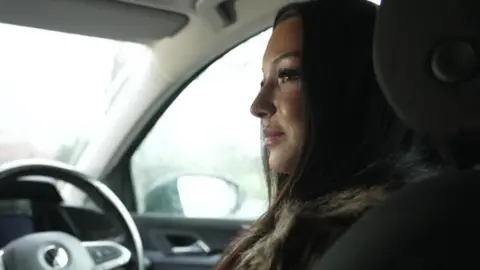
She didn’t drive for a year after the crash. She has since done an informal assessment with charity IAM RoadSmart to boost her confidence and figure out what she needs to work on.
“I wasn’t driving to the best standard and that’s why I had a crash.”
Alisa said the process of becoming a better driver should continue after a person passes their test. “Maybe more lessons that you’re required to take with a professional.”
Local Transport Minister Lilian Greenwood said young people make up just 6% of all drivers, but are involved in nearly a quarter of fatal and serious collisions.
“Inexperience puts drivers, their passengers, and other road users at greater risk,” she said.
The proposed learning period “is all about supporting young drivers to develop the confidence they need to stay safe and giving them more time to build their skills and gain experience in different driving conditions”.

Get our flagship newsletter with all the headlines you need to start the day. Sign up here.
Business
Top stocks to buy today: Stock recommendations for April 17, 2026 – check list – The Times of India

Stock market recommendations: Reliance Industries, and Varun Beverages are the top stock recommendations by Bajaj Broking Research for April 17, 2026.Reliance IndustriesBuy in the range of ₹ 1330.00-1350.00
Reliance Industries stock has undergone a corrective phase over the past three months and is currently consolidating near a crucial support zone of ₹1270–₹1300. This technical setup offers a favorable risk-reward profile, positioning the stock for a potential bullish reversal and the next leg of uptrend.This ₹1270–₹1300 range serves as a crucial support area, reinforced by the convergence of multiple technical factors: (a) 61.8% retracement of the previous April 2025-January 2026 up move (1115-1611) (b) 200 weeks EMA placed around 1292, which has historically acted as strong demand area for the stockThe ongoing corrective phase appears to be nearing exhaustion, with price action indicating the potential for a fresh bullish reversal. We anticipate the stock to resume its uptrend and head towards ₹ 1474 levels in the coming quarters being the high of February 2026 and the 61.8% retracement of the recent decline of the last 3 months ₹ 1611-1290.Varun BeveragesBuy in the range of 455-465
The share price of Varun Beverages has generated a breakout above the falling channel containing last 3 months decline signaling strength and offers fresh entry opportunity.The stock has also formed a higher high and higher low signaling resumption of up move after recent corrective decline.We expect the stock to head higher towards 503 levels in the coming weeks being the 80% retracement of the previous decline from 534 to 381.(Disclaimer: Recommendations and views on the stock market, other asset classes or personal finance management tips given by experts are their own. These opinions do not represent the views of The Times of India)
Experts say Mythos potentially has an unprecedented ability to identify and exploit cybersecurity weaknesses.
Source link
Business
Anthropic’s new AI model exposes fresh risks, flaws for cybersecurity, IT services – The Times of India
New Delhi: A powerful new AI model is forcing govts, banks, and technology firms to rethink the rules of cybersecurity – and in India, the stakes may be even higher.Claude Mythos, developed by Anthropic, has demonstrated the ability to autonomously detect and exploit software vulnerabilities, including flaws that have persisted for decades. Early tests revealed that the model could identify long-standing weaknesses and simulate complex, multi-step cyberattacks, prompting the company to restrict its wider release. Anthropic CEO Dario Amodei highlighted the shift, noting that AI systems are now capable of finding vulnerabilities “that humans have missed”, a signal of how quickly the cybersecurity landscape is changing.US Treasury Secretary Scott Bessent reportedly convened a meeting with top bank executives – including leaders from JPMorgan Chase, Goldman Sachs, Citigroup, BoA, and Morgan Stanley – to assess the risks posed by such advanced AI systems.That concern is not theoretical. According to Jaydeep Singh, GM for India at Kaspersky, the emergence of such systems represents a turning point not just for security professionals, but for everyday users. “We have been closely monitoring how AI is reshaping the threat landscape, and Claude Mythos represents a moment that every user, not just the cybersecurity industry, needs to understand,” Singh said.The dual-use nature of AI is at the heart of the concern. The same capability that strengthens defences can just as easily be weaponised. “The same capability that finds a 27-year-old vulnerability in hardened infrastructure is the capability that, in the wrong hands, turns every unpatched system into an open door,” Singh added.Cybersecurity firm Check Point Software Technologies echoed the warning. Sundar Balasubramanian, MD, India and South Asia, for Check Point, says, AI is “dramatically lowering the barrier to entry for cyber attackers,” enabling even less-skilled actors to identify and exploit vulnerabilities. He added that defensive tools can be repurposed offensively, compressing the traditional gap between attackers and defenders. Jayant Saran, partner, Deloitte India, described this as a “changed reality,” where organisations must prepare for risks that were previously invisible. He called AI a “double-edged sword…that cannot be reversed,” highlighting an accelerating race between those securing systems and those attempting to break them.In India, the risks are amplified by scale. From UPI to banking and govt platforms, millions depend on digital infrastructure – much of it built on legacy systems. These systems are often slower to patch, harder to monitor, and lack continuous threat intelligence, creating what Saran called an “asymmetric risk exposure.” Singh pointed out that this gap is especially critical in India, where legacy infrastructure serves hundreds of millions.Beyond cybersecurity, ripple effects could reach financial markets. Analysts say models like Mythos could automate parts of software development, testing, and security – core functions of IT services industry. While disruption may be gradual, labour-intensive outsourcing models could face pressure, while firms embracing AI may benefit.


Indonesia helicopter crash kills 8

USDA releases payments under 2026 Pima Cotton and Wool Trust Funds

Wings stifle questions about Azzi Fudd-Paige Bueckers relationship

-

 Entertainment1 week ago
Queen Elizabeth II emotional message for Archie, Lilibet sparks speculation
-

 Tech1 week ago
Azure customers up in arms over ‘full’ UK South region | Computer Weekly
-

 Tech1 week ago
As the Strait of Hormuz Reopens, Global Shipping Will Take Months to Recover
-

 Fashion1 week ago
CII submits 20-pt agenda to Indian govt to back firms hit by Iran war
-

 Tech1 week ago
This AI Button Wearable From Ex-Apple Engineers Looks Like an iPod Shuffle
-

 Politics7 days ago
Indian airlines hit hardest after Dubai limits foreign flights until May 31
-
Uncategorized1 week ago
[CinePlex360] Please moderate: “Trump considers
-

 Entertainment4 days ago
Palace left in shock as Prince William cancels grand ceremony