

Sports
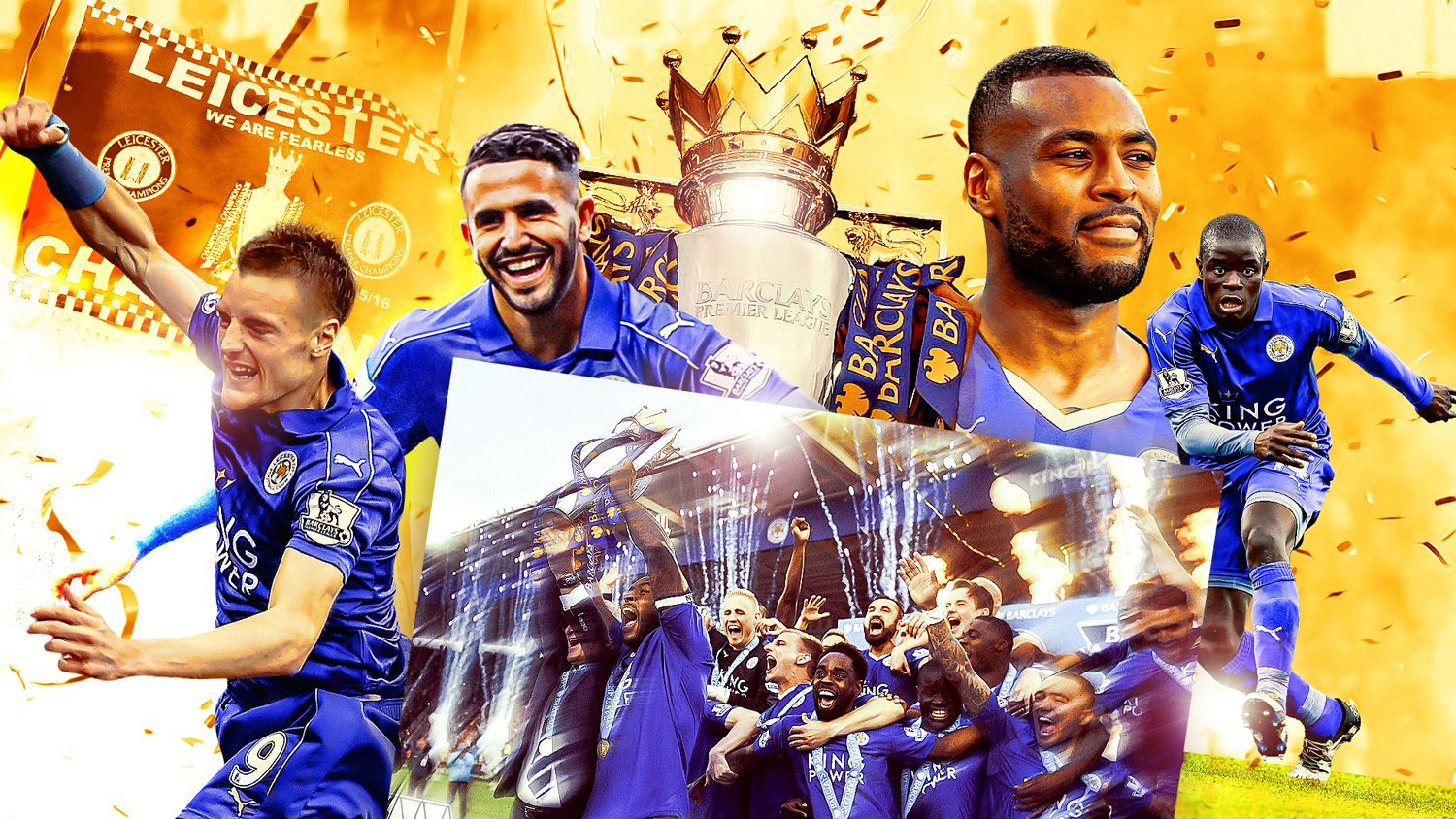
Leicester’s Premier League win, 10 years later: How did they do it, and could a team repeat it?

-
Bill Connelly
-
Tom Hamilton
Close
Tom Hamilton
Senior Writer
- • Joined ESPN in 2011
• Covered two Olympics, a pair of Rugby World Cups and two British & Irish Lions tours
• Previously rugby editor, and became senior writer in 2018
Gathered around the TV at Jamie Vardy’s house in Melton Mowbray, all Christian Fuchs and his teammates could do was watch.
It was May 2016, and after 36 matches, Leicester City’s unlikely heroes were finally admitting to themselves they might achieve the unthinkable: winning the Premier League. They needed nearest challengers Tottenham Hotspur to draw or lose to Chelsea for them to seal the title. “I described it back then as the toughest 90 minutes I’ve never played because you know what’s on the line,” Fuchs, Leicester’s starting left back, tells ESPN.
As the full-time whistle went at Stamford Bridge, confirming Spurs’ 2-2 draw, pandemonium ensued. “I saw people being dragged around the floor by their feet, by their arms, people screaming, people crying,” Fuchs remembers. Vardy’s TV was smashed, and crates of beer were either being flung into the air or consumed at rapid rates. The reality of what Leicester had achieved, winning the league despite entering the season as 5000-1 outsiders, started to dawn on them.
For some players, it was a moment of validation. Danny Simpson, their starting right back, left the celebrations soon after the whistle. He went outside into a quiet corner of Vardy’s vast garden and cried. “You go through so much in football, and so much rejection, whether it’s being told you’re too small, clubs not wanting you,” Simpson says. “You’re constantly thinking you’re not good enough. It was just a relief, a weight off my shoulders.
“I was on my own — Vards has a massive garden so he probably couldn’t see me. But everyone was ringing friends and family, celebrating with each other. It was a wonderful moment.”
Ten years later, however, each player remembers that season differently. Center back Robert Huth, retired in 2019, says he gives the win little thought. Second-choice veteran goalkeeper Mark Schwarzer didn’t play a minute and doesn’t regard himself as a Premier League winner. Fuchs smiles as he remembers the camaraderie in the team, and the pizza nights where the dough spent more time in the air than on the table. Captain Wes Morgan’s elder son, Rio, is more concerned with Leicester’s Championship existence these days than memories of his dad lifting the coveted Premier League trophy.
“I’m not sure it was a fairy tale, but it was unbelievable, one of the most astonishing achievements in the game,” Morgan says. “It was footballing non-fiction, fiction.”
It all raises the question — for those protagonists at the forefront of this triumph, nearly a decade on, how do they reflect on the most unlikely success in English top-flight history? Was it everything they thought it would be? Well, it depends on who you talk to. Just don’t say the words “fairy tale.”
Achieving the unthinkable
The Leicester team that started the 2015-16 season had already completed one miracle. The previous season, they were bottom of the league in mid-April, but won seven of their remaining nine matches to survive. Despite this comeback, manager Nigel Pearson was unceremoniously fired, with Claudio Ranieri appointed as his replacement.
They made nine signings in the summer, including Japanese forward Okazaki from Mainz and unknown French midfielder N’Golo Kanté from Ligue 2. Huth — who had endured two injury-disrupted seasons — arrived on a permanent deal from Stoke having spent six months on loan in 2014-15, and Fuchs was brought in from Schalke.
The Foxes went under the radar at the start of the season, losing just one of their first nine matches, but things clicked once Ranieri started Simpson and Fuchs at fullback. Between Dec. 29 and Feb. 6, they didn’t concede a goal in the Premier League and climbed to the top of the tree.
Players generally ignored the outside talk of an unlikely title, but looking back, there were two matches where they started to dream. The first was a 2-0 win over Liverpool on Feb. 2 remembered for that long-range Jamie Vardy goal, so often the snapshot highlight used to immortalize that season. “I was directly behind him and remember shouting at him, ‘Why are you shooting?'” Okazaki says. “And then it flew in. And I was like, ‘Whoa!'”
But it was the next match on Feb. 6, in which they outplayed Manchester City at the Etihad Stadium, that stays in their minds even more. “We were down 1-0, ended up winning 3-1 and blew them off the park at the Etihad,” Schwarzer says. “I think then we knew we were the real deal.” From there to the end of the season, they kept grinding out results — a run including four back-to-back 1-0 victories — and the win over Southampton on April 3 secured a top-four finish. “We are in Champions League — dilly ding, dilly dong!” Ranieri said.
On May 2, Tottenham drew 2-2 at Stamford Bridge, and Leicester were crowned champions. “I knew there was a chance, that very moment, but why should freaking Leicester win the Premier League? It doesn’t make sense,” Fuchs says. At the start of the season Leicester were favorites for relegation; nine months later, they were celebrating their first top-flight title in their 132-year history, ultimately finishing 10 points ahead of second-placed Arsenal.
The team partied at Vardy’s. Okazaki laughs as he says that evening was the most he’d ever drunk, and was stunned when at brunch the following day, the celebrations continued with even more alcohol.
“It was an emotional moment, 100%. You’ve been grinding it out for so long in your career and it all seemed hopeless and then this happens. My goal was to just play one game in the Premier League,” Morgan says. “I spent three years in League One, and most of my career up to kind of 30 years old in the Championship. So to play one match was amazing, but to do this? Well, it’s just unbelievable.”
– Where are Leicester’s 2015-16 champions now?
– The weird and wonderful careers of soccer’s greatest journeyman players
– O’Hanlon: Should Liverpool be worried about Mo Salah’s form?
The outside perception was that it was a sporting miracle. “Everyone calls it the fairy tale, but if you look at all the players, we’re all good players,” Huth says. “Sometimes I get annoyed because people say we were all misfits, but we had good careers. We had titles, international caps. It wasn’t a fluke.”
Others, though, aren’t too sure. “I mean, it’s iconic and it will never be repeated,” Schwarzer says. “I don’t think anyone really saw our group as potential Premier League winners. … I think it is a fairy tale. I really do.”
The players point to different reasons they won the league. On the field, simplicity was king. “Our tactics were very simple,” Fuchs says. “I’m very surprised that nobody figured it out. The tactics were simple as ‘protect the castle,’ which was our box, which was the goal. And then when you have the ball, find Jamie Vardy.” They had few injuries. “The gods were on our side with injuries,” Morgan says.
“Ranieri didn’t have a lot of tactics,” Okazaki adds. “It was defending, then counterattacking, and he always said to me in compact defense, ‘Don’t take risks. If you’re under pressure, play the long ball.'”
There was togetherness. “No one really sort of stood out in terms of, ‘I want to do it this way. I’ve got an ego.’ There were no a–holes,” Huth says. Fuchs adds: “Look, we were a bunch of rejects. You can compare it with an old Mercedes model that you know, it’s still nice to look at but it’s not really up to par anymore.
“… My goal was to go to England and I ended up at Leicester. That’s the background of the group. And knowing this and everybody knowing where they come from and knowing we may just have a couple more seasons playing at the highest level bonded us all.”
Then there were the midseason perks to keep the team motivated. “[The owner would] say, ‘If you win the next three or four matches, I’ll take you all to the casino and we’ll have a great night.'” Morgan said. “Just little things like that gave us an extra 5%.”
In August 2016, owner and chairman Vichai Srivaddhanaprabha surprised the 19 Premier League winners still at the club with “protonic blue” BMW i8s. While most players have gone on to sell the cars — “I don’t know if you’ve ever been in one, but they’re not the easiest to get in and out of,” Morgan says — goalkeeper Kasper Schmeichel has kept his, as has Okazaki.
Yet with success comes inevitable interest, and barely weeks after the title was confirmed, the team started to be picked apart — with Kante joining Chelsea the catalyst. On the field, Leicester came back to earth. Nine months after they won the league, they were one point above the relegation zone and Ranieri was sacked. Assistant Craig Shakespeare took charge, and Leicester’s 2016-17 Champions League adventure finished in the quarterfinals against Atletico Madrid. “That was the moment the dream kind of died for me,” Simpson says. “We were still doing the unexpected, and doing things people couldn’t believe we were capable of. But when that finished, we were back to normality.” They’d finish the season in 12th, and that summer, starting midfielder Danny Drinkwater signed for Chelsea. The outstanding Riyad Mahrez left in 2018 for Manchester City.
Then, in October 2018, Leicester City were in mourning after the death of owner Srivaddhanaprabha and four others in a helicopter crash outside the King Power Stadium. “I look at it, my time with [Srivaddhanaprabha], and he just brought so much to my life,” Huth says. “I think the unique thing about Leicester was how close we were to each other,” Morgan says. “So the owner, you know, it really hurt us and hit us deep when his tragedy happened.”
Though the club experienced a bit of a revival under Brendan Rodgers, who led them to an FA Cup triumph in 2021, they were relegated to the Championship in 2023 and 2025, earning promotion in between.
Some of the 2016 group met again for Vardy’s final match in a Leicester shirt on May 18 against Ipswich Town. Vardy was the last one of the Premier League winners standing, with Marc Albrighton having retired in 2024. And in July, the Leicester City Masters team, featuring Morgan, Simpson, Huth, Drinkwater and Albrighton, won the Soccer 7s Series Masters Cup competition in Singapore. “We got butterflies before the final,” Simpson says. “But it was so nice to spend time with everyone again. … When we won the tournament we had a bit of a joke about how we used to be good at winning and lifting trophies.” But whole-team reunions seldom happen.
They did meet when Shakespeare died in August 2024 after being diagnosed with cancer. “It’s one of those sad things but it’s normally weddings, birthdays or funerals where we catch up,” Morgan says. “It’s sad. You spend so much time together working hard and sweating blood and tears for each other. But that’s how it goes, I guess.” “Shaky was a special man,” Simpson says. “When I first got to Leicester [in 2014] I wasn’t in the team, and Shaky was the guy who kept us on the straight and narrow. He understood me, and would always be checking in. He was a top man, but also a great coach.”
With 10 seasons worth of water under the bridge, the players remember that glorious season differently. Schwarzer was an unused sub 37 times that season in the league. “I don’t consider myself a Premier League winner,” Schwarzer says. “I had one of the best seats in the house, and I saw it, felt it and lived it. But in terms of the league I don’t feel remotely a Premier League winner. … I just feel very privileged to have been there.”
Huth retired in January 2019 after persistent foot and ankle injuries. “I don’t have anything in my house that reminds me of football,” Huth says. “I’ve got two kids, I’ve got a wife, and that’s just more important to me than having a shirt up or my medal.
“Now that I’m retired, the Premier League win doesn’t really matter, if that makes sense. At the time it was amazing; in terms of my life, it doesn’t really have an impact on you. I don’t want to sound miserable, but it’s just not as good as you imagine it will be.”
Okazaki is still heavily involved in the sport. He is co-founder of Basara Mainz — a team in the sixth division of Germany focused on providing a pathway for Japanese players. “We started 10 years ago and are now in the sixth division of Germany,” he says. “We try to give the Japan players a pyramid and opportunity. They have a great environment here. We help the players with their technical side, tactic side and mental side.” The realistic goal is to get promoted to the fourth division.
“The Premier League was a dream,” he adds. “People when they see me say, ‘You are a Leicester legend,’ and that makes me proud. In retirement, I understand it more. But look, I forget my career now, I look forward, and my dream is with Basara Mainz.”
Schwarzer works in the media, while Morgan is a scout for Nottingham Forest. Simpson retired in July 2024 but plays football with Drinkwater and a bunch of ex-Premier League pros in 10-a-side in Manchester on Tuesdays. “Whenever someone retires, we get them in the WhatsApp group,” Simpson says. He remains close with Drinkwater. “Drinks is living some life,” he laughs.
Fuchs is a coach at Charlotte FC. There was a time when he was toying with the idea of pursuing a career as a NFL kicker. “Needless to say, [those dreams] are gone. … [Charlotte FC head coach] Dean Smith asked me about that. ‘Didn’t you want to be a kicker at some point?’ I’m like, ‘Yeah, but now I’m your assistant coach. I have no time unless you give me some days off on the weekends when they are playing.” He still looks fondly back on the 2015-16 squad. “I think everybody that was in that team has some sort of fulfilment,” he says. “You realize it didn’t come from nowhere. Like Huthie said, it doesn’t just happen.”
Those who got a medal were also given a small replica Premier League trophy. Schwarzer shows his trophy to any interested visitors. Okazaki has his in his Basara office, but wants to transfer it all someday to his dream museum that he’ll open with Japan teammates Shinji Kagawa and Takashi Inui — his medal and trophy will sit alongside the BMW. Morgan has a cabinet dedicated to Leicester in a small trophy room in his house. Huth’s trophy is still unopened in the box, and his medal is in a safe-deposit box “somewhere.”
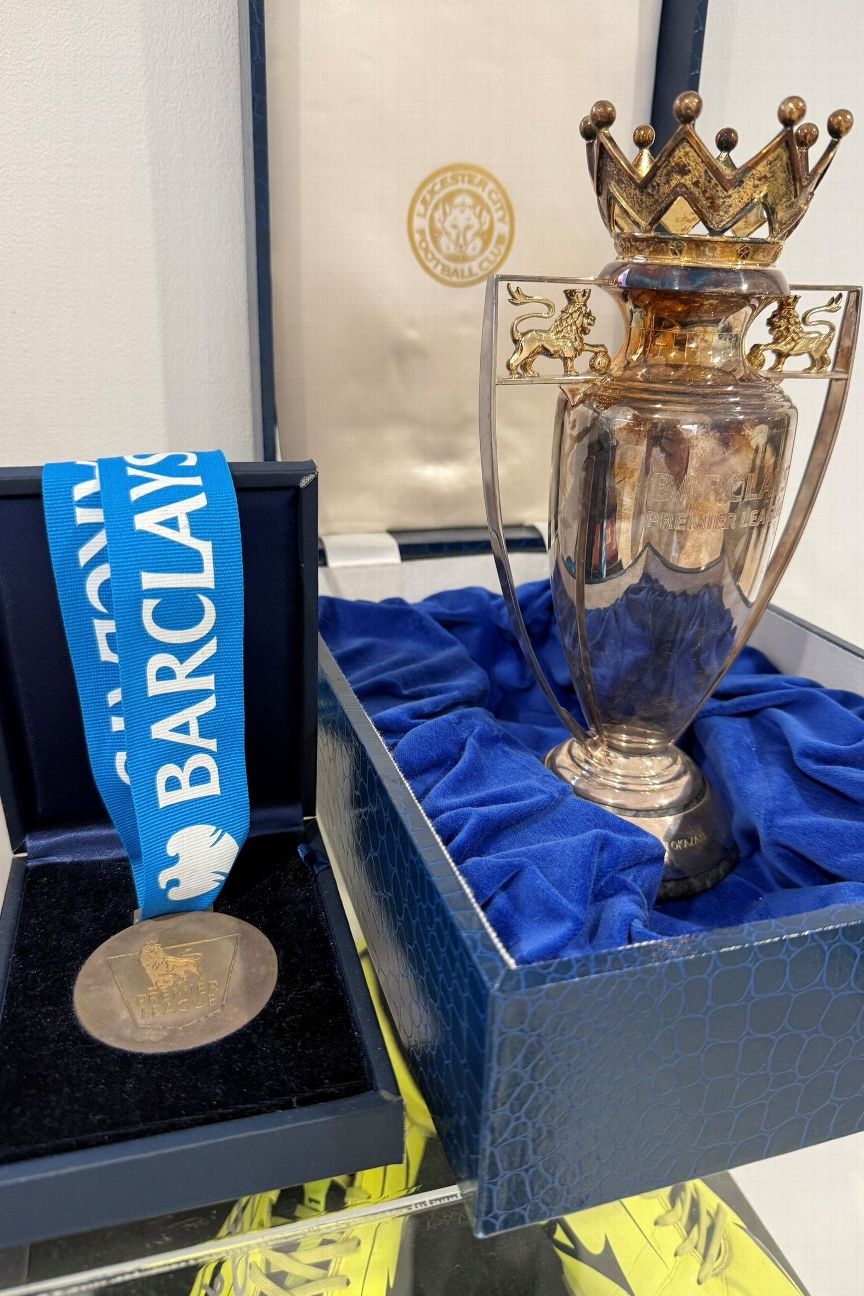
Shinji Okazaki’s Premier League winner’s medal and replica trophy in his office at Basara Mainz. Photo credit: Basara Mainz
Fuchs’ medal hangs by his dining table, along with a replica of the FA Cup he won in 2021. “I told my kids we need to add a couple [of medals] there,” Fuchs says. And for Simpson, both trophy and medal get regular outings. They’re reminders of the graft it took to achieve his dreams back in 2016. “My trophy’s on display, and my medals are in the safe,” Simpson says. “But sometimes when I get home from a few drinks, I put the medal on just to remind myself what it felt like.
“I felt like I had proved something to people, maybe even to myself, that I could achieve something. I wish I could go back to it and relive it again.”

How Leicester won the Premier League — and could it ever happen again?
If you’re hoping to see another club “pull a Leicester” anytime soon, I have some good and bad news for you. The bad news is, it’s terribly unlikely because Leicester pulling a Leicester was so unlikely; so many things had to go just right. The good news, however, is that there was nothing terribly unique about the recipe Leicester followed — underdogs try it every year. And hey, if it worked once, there’s nothing saying it can’t work again in our lifetimes, right?
At its heart, Leicester’s run came down to three things: lineup stability, perfect counterattacking personnel and some close-game magic (or, more specifically, a lack thereof from title rivals). Teams benefit from any of these items every year, but Leicester landed the trifecta.
Lineup stability
The thing about depth is, you never know you have it until it’s tested. Had it been tested, we may have found out that Leicester’s depth was rock solid in 2015-16. Young attacker Andrej Kramaric had a lovely career at Hoffenheim, but he couldn’t find a spot in Leicester’s 2015-16 lineup. Key substitute Jeffrey Schlupp would go on to make nearly 250 Premier League appearances with Crystal Palace. Teenage fullback Ben Chilwell would start 19 times for the English national team, and another teenager, winger and midseason acquisition Demarai Gray, would put up decent numbers for Everton a few years later. Plus, after narrowly surviving their first season back in the Premier League thanks to a late charge, Leicester had attempted to shell out some money for extra veterans such as forward Okazaki, midfielder Gokhan Inler and center back Yohan Benalouane that summer.
Only Okazaki would play much in 2015-16, because once new manager Ranieri locked in his starting lineup, he barely had to change it all season.
Goalkeeper Schmeichel and center back Morgan started all 38 league games, while Morgan’s batterymate Huth started 35. Vardy and Mahrez each started 36 games while combining for 41 goals and 17 assists. Midfielders Drinkwater (35 starts) and Kante (33) were mainstays. Even Okazaki (28) and fullbacks Fuchs (30) and Simpson (30) were rarely out of the lineup. When they were, deputies such as Leonardo Ulloa up front and Ritchie De Laet at fullback slotted in nicely. Injuries never really forced Ranieri to stray far from his preferred lineup, so he didn’t.
A genuinely awesome attack
Leicester’s decision to hire Ranieri was a bit of a left turn. As authors Simon Kuper and Stefan Szymanski wrote in “Soccernomics”: “In 2015, fresh from a disastrous spell with Greece that ended with defeat at home to the miniscule Faroe Islands, [Ranieri] joined Leicester City. At that point he had been a manager for twenty-nine years without any outstanding successes. ‘He was the perfect loser, with a capital L,’ says the Italian soccer writer Tommaso Pellizzari. ‘Everyone in Italy thought he was very nice, polite, kind, but please never call him to my team.'”
As much as anything, it almost seemed Ranieri was hired because he was the temperamental opposite of Pearson. Pep Guardiola’s possession-heavy ball and Jurgen Klopp’s gegenpressing were the emerging styles of the day, but Ranieri deployed an old-school, defense-first 4-4-2 formation with loads of counterattacking. Soccer was becoming more horizontal with its buildup play, but Ranieri only knew verticality. And instead of counter-pressing with vigor, Klopp-style, Leicester picked their spots.
Leicester’s ensuing success proved that when you have the right personnel — and that personnel never changes — you can make just about any playing style work whether it’s trendy or not. The Foxes were the most active and direct team in the Premier League, leading the league in ball recoveries, defensive interventions, counterattacking shots and xG, and a StatsPerform measure called direct speed, which measures how many meters per second the ball is pushed up the pitch when a team is in possession. They pressed selectively but effectively, forcing 11.1 high turnovers per game (second in the league), and when they bunkered in, they threw their collective bodies in front of shots, blocking 31.6% of opponents’ attempts (third). Goalkeeper Kasper Schmeichel helped in this regard, too: While his save percentage was merely above-average, he was maybe the most active keeper in the league when it came to claiming the ball in the box.
Leicester attempted the most duels in the league (127.1 per game), and Mahrez and Vardy both ranked in the top five for duel attempts in the box. Mahrez was either going to draw contact or find Vardy running full speed. Mahrez led the league with 267 ground duels won and 45 fouls suffered in the attacking third (no one else had more than 32), and Vardy was first in xG (23.1) and second in goals (24, one behind Spurs’ Harry Kane).
The Foxes were active but extremely organized — a Ranieri dream. When they regained possession, the formula was pretty simple: Get the ball to Drinkwater or Kante (who were probably the ones to win the ball in the first place), then pivot it to Mahrez, who will feed Vardy. It’s obviously too simple to say this was the only path for Leicester to score, but Mahrez and Vardy scored 61% of Leicester’s goals, while Mahrez, Vardy and Drinkwater had 53% of their assists and Drinkwater and Kante were second and third in the league, respectively, in ball recoveries. The ball moved very fast, and while the attack didn’t create a high volume of shots, anything it produced was pristine.
Leicester led the league in xG per shot (0.18), and only Arsenal was anywhere close. And despite the low overall shot volume, they attempted 91 shots worth at least 0.2 xG; Arsenal were the only other team that topped 77 such attempts.
Leicester had the second-worst pass completion rate in the Premier League (70.5%) but scored the third-most goals (68) while always keeping loads of bodies behind the ball. There was nothing unique about their attack, but you couldn’t have asked for better personnel for what Ranieri wanted to do.
Everyone else blew it
The Premier League was in an odd place in 2015-16. Liverpool fell apart under Brendan Rodgers (they would hire Jurgen Klopp in October while mired in 10th place), and Chelsea really fell apart under Jose Mourinho (the defending league champs were in 16th when he was fired in December). Manchester City were riding it out for one more season with Manuel Pellegrini before hiring Pep Guardiola (who was still with Bayern Munich), Manchester United were stagnant under Louis van Gaal, and any hope either club had of sneaking away with a title was done in by lineup instability.
This was therefore a good year for a usurper to rise, but Arsene Wenger’s Arsenal and Mauricio Pochettino’s young Tottenham Hotspur team were still in excellent positions. They couldn’t close the deal.
Granted, it only felt like every Leicester match was a 1-0 win — only seven of their 23 wins came with that scoreline — but it will surprise no one to learn that in matches decided by zero or one goals, Leicester were comfortably the best team in the league.
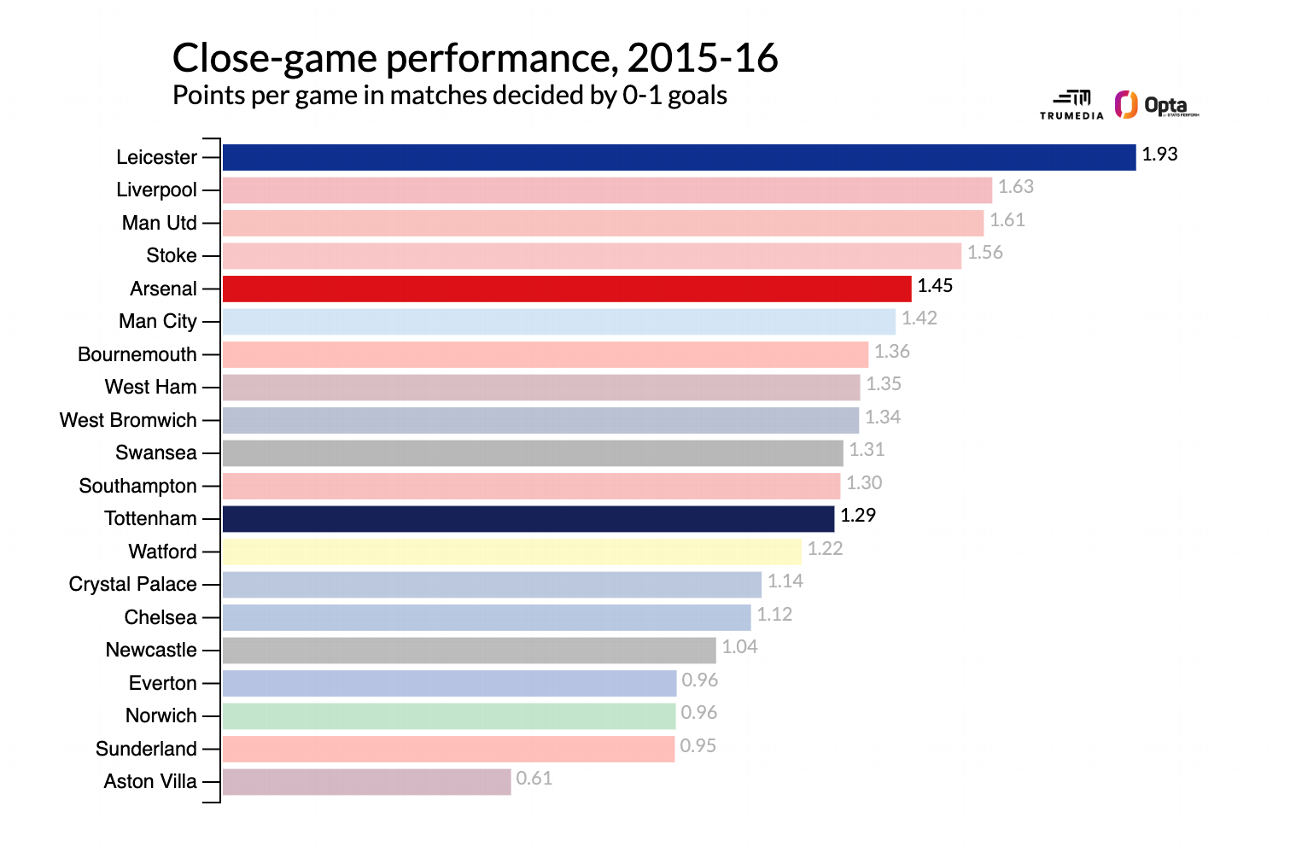
They weren’t really an outlier in this regard. In fact, for a league champion, they were below average. Their 12 draws were the second most for a champ in the Premier League era (behind Manchester United’s 13 in 1998-99), and of all the champions since 2015-16, only Manchester City’s close-game averages in 2020-21 (1.88 PPG) and 2022-23 (1.53) were worse than Leicester’s 1.93 that season.
It wasn’t that Leicester were abnormally good in tight games — it’s that the other contenders were abnormally bad. Arsenal led the league with a plus-19 goal differential after 40 minutes but were only plus-10 for the last 50 minutes and won only 20 of 27 games in which they led. Spurs won only 19 of 28 such games and averaged a dreadful 1.29 points per close game.
Leicester won 23 of 29 such games and took the title with 81 points, the sixth-lowest point total for a champion in the Premier League era. It wasn’t their fault that it only took 81 points to get it done, just as it wasn’t their fault that they didn’t suffer many injuries, or that no one could stop their seemingly rudimentary attack, or that no one else realized what kind of burgeoning talent Kante (added for €9 million in 2015), Mahrez (€500,000 in 2014) or Vardy (€1.2 million in 2012) possessed. Their title was a product of not only good fortune but also great talent identification and execution.
It might have been a once-in-a-lifetime run, but nothing they did was unreplicable. Teams like Atletico Madrid and RB Leipzig have enjoyed success with vertical attacks in the 2020s. And with the most direct attack in the league, Nottingham Forest was within shouting distance of first place into the spring just last season. The components were familiar, even if no one has conjured quite the same magic in the decade since this miraculous run.
It is an issue that is dividing football, a classic example of one generation questioning the choices of another, but the sight of a former Tottenham and Germany player rolling on the pitch in agony with a severely gashed leg earlier this month might end up changing opinions about the ever-decreasing size of shin guards.
Until recently, shin guards covered the entire shin — sometimes up to 9 inches long — and they were made of foam or rubber with a hard plastic shell. But in recent years, some players have abandoned the protective element completely, wearing only tiny pieces of foam under their socks, and it seems only a matter of time before a serious injury leads to a rethink in what players are wearing.
Lewis Holtby‘s injury, sustained while playing for Dutch team NAC Breda against Fortuna Sittard in the Eredivisie on April 12, looks to have ended the 35-year-old’s season due to the depth of the wound on his left shin following a challenge with an opposition defender. It also led to a blame game centered on Holtby’s shin guards.
“I think it’s ridiculous that the referee [Jeroen Manschot] says something about it,” Breda coach Carl Hoefkens said after the game. “In the tunnel, it was said [by Manschot] that Holtby should just wear shin guards, or better shin guards. The officials also check the shin guards before the match, so it’s their responsibility as well.”
La aparatosa lesión de Lewis Holtby este fin de semana. 😬
Vía ESPNnl/X pic.twitter.com/WgHl4PL5xo
— ESPN Deportes (@ESPNDeportes) April 14, 2026
Breda defender Denis Odoi spoke about Holtby’s “small shin guards” and said “You’re never too old to learn,” when asked about players wearing “normal” shin guards again, while ESPN NL analyst, former Ajax and PSV Eindhoven winger Kenneth Perez, was more critical.
“They [players] are now wearing those tiny things, or basically toilet paper, just to have something there,” Perez said. “I have absolutely no sympathy for injuries that result from that.
“As a club, you can simply say: We require our players to wear proper shin guards.”
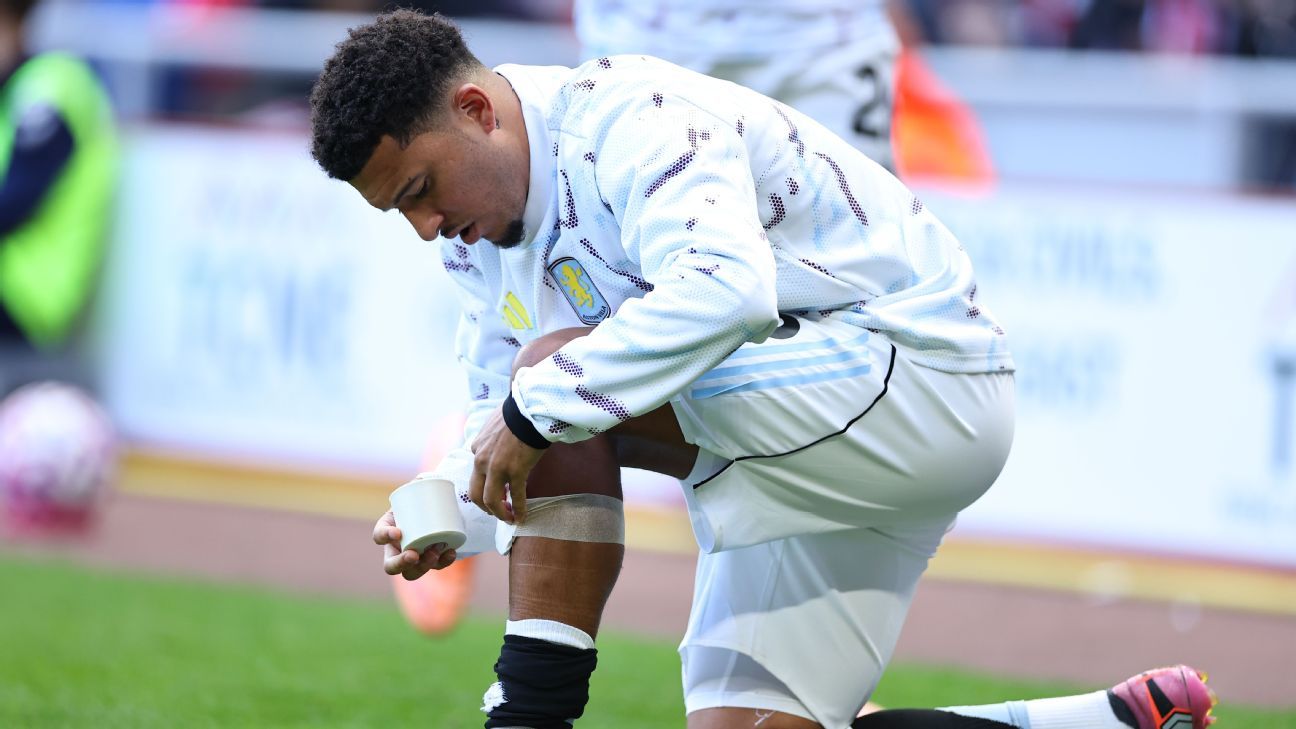
Watch any top-level fixture this season and you’re likely to see players with socks rolled down almost to their ankles — Everton‘s Jack Grealish and Tyler Dibling wear them low, covering tiny shin guards. Others have their socks just below the knee, but still sport shin guards half the size of a cellphone, as shown by Burnley midfielder Marcus Edwards during a game against West Ham in February. Arsenal forward Bukayo Saka has spoken this season about his preference for tiny shin guards — “I’m a fan of them; I don’t like big shin pads” — though Liverpool defender Virgil van Dijk harbors a more cautious approach to protecting his lower leg.
“If you get kicked on your shin and your shin pad is that size of an AirPod, then obviously that’s a big problem,” Van Dijk said.
Brighton forward Danny Welbeck has said that his younger teammates ridicule his old-school shin guards — “They say to me ‘Your shinnies are massive,’ but you need a bit more safety, you know?” — but just like Saka, Fulham winger Alex Iwobi prefers the small, lightweight guards because “I just don’t like having something heavy on my shin.”
Former England and Liverpool forward Peter Crouch regularly raises the shin guard issue on his podcast, That “Peter Crouch Podcast,” under the light-hearted “Make Shin Pads Great Again” banner, with Fulham midfielder Harry Wilson saying this season that some of his teammates “cut up the sponge you get from the physio and use that.”
If a high-profile player sustains this type of injury thanks to tiny shin guards, the kind of injury that forces them to miss the World Cup or that happens on the biggest stage this summer — the debate about the shrinking move towards smaller pads will likely increase in volume.
The trend toward smaller shin guards — and away from larger models that would also include ankle protectors — is rooted in many things, including the game becoming less physical with fewer tackles and players wanting to feel as light as possible to boost their sprinting speed. But it is also a result of a change in the Laws of the Game in July 2024 when IFAB (the International Football Association Board) amended the rule covering shin guards (Law 4) to place the responsibility on the player rather than the match officials to ensure sufficient shin protection was worn.
Prior to the change, the responsibility was on referees to police the rule, but many were being ignored by players and clubs and then criticized — or even sometimes challenged in court — for failing to impose the rules if a player was subsequently injured. But the Law remains vague and open to interpretation. There is no minimum size required, only that the shin guards are “covered entirely by the socks, are made of suitable material (rubber, plastic or similar substances) and provide a reasonable degree of protection.”
“The reason we changed the Law was because it is impossible to legislate and say a shin pad must be a certain size,” David Elleray, IFAB technical director and former Premier League referee told ESPN. “So two years ago, we put the responsibility on the players that they should wear something which they believe protects them.
“The challenge we had was partly legal. If we left the responsibility with the referees and the referees said, “Okay, that shin guard is okay,” then the player got injured, the player might decide to take action. So we put that very firmly in the court of the players and the coaches, and for young players, the parents.”
The change of the Law has led to players placing speed and aesthetics — many dislike the bulk of larger shin pads — above safety, however, and Elleray admits it has not led to a sensible approach by players and clubs.
“We [IFAB] had hoped, or expected, that they would take a responsible attitude to it, but there was one recently [Marcus Edwards] that was almost like a sticking plaster,” Elleray said. “The pressure needs to go on the individual players, the coaches and the clubs to make sure their players are protected because it’s impossible to legislate for.”
Former leading referee Pierluigi Collina, now the Chair of the FIFA referees’ committee, has urged players to be more mindful of their well-being when choosing their shin guards. “At the end of the day, the shin pad rule is for their own safety,” Collina told ESPN. “So they should care of what is really safe for them.”
But as shocking as Holtby’s injury was, it perhaps generated such attention because of the rarity of such incidents. Broken legs and deep cuts and gashes seem less prevalent despite the reduction in shin pad sizes, with muscle tears and ligament injuries to ankle and knee more likely to sideline a player.
The argument put forward by those who favor small shin guards is that players no longer suffer serious impact injuries, and that might be a valid point. In a recent example of a bad impact injury, Liverpool’s Alexander Isak was wearing small — but not tiny — shin guards when he suffered a fractured leg in a challenge with Tottenham’s Micky van de Ven last December, but it would be difficult to argue that larger shin pads would have diminished the severity of Isak’s injury.
Sources at the Professional Footballers’ Association (PFA) have told ESPN that “primary decisions around safety are taken by players in consultation with their club and medical teams” and that players ultimately “feel comfortable with different shapes and sizes of shin pads.” There is certainly no drive within the game to force players to re-think the protection being offered by their shin pads.
Football trends have changed since larger and heavier shin pads were the go-to model for top players. The Umbro Armadillo, which was manufactured during the early-2000s, was a large plastic guard with ankle protectors and was worn by Michael Owen and Alan Shearer, while Brazil forward Ronaldo wore Nike’s T90 model. Both designs were significantly larger, heavier and stronger than the pads now being preferred.
Today’s younger players prefer small, lightweight pads and the shifting trend led two brothers — Kaizer Chiefs midfielder Ethan Chislett and Zack, who plays for UAE-based Palm City — to develop their brand of Joga shinpads, which are tiny, much lighter and softer than traditional shin guards. The Joga Shinpad Sleeve, worn by Chelsea‘s João Pedro, is a cellphone-sized soft pad within a fabric sleeve that’s worn to cover the shin. Everton midfielder Grealish wears Joga’s Breathe pads that measure just 6 centimeters x 10 centimeters (2 inches x 4 inches).
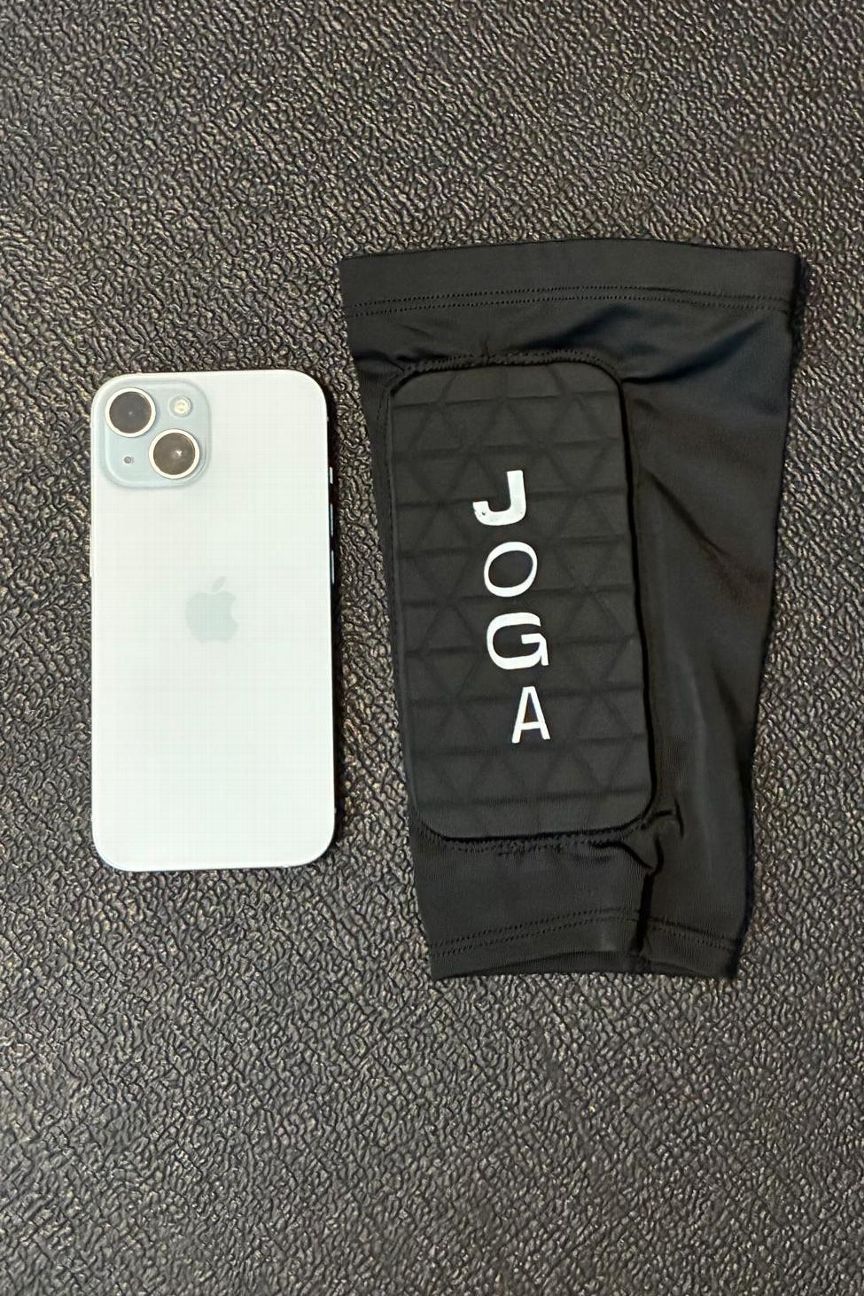
“We were the first ones to make a mini shin pad that you could buy,” Zack Chislett told ESPN. “I was playing nonleague at the time, my brother Ethan was playing for AFC Wimbledon, and we noticed that pads were getting smaller and smaller, but there was no-one giving players an option to buy them. They were just using anything they could find in the physio’s bag, so the demand was obviously there.”
But why do young players want their shin guards to be so small and lacking in protection?
“When you’re training the whole week without shin pads and you then put the big pad on, sometimes with ankle pads, on a Saturday, it doesn’t feel natural like when you’re training,” Zack said. “Some players will feel better with the big shin pad, but a lot of the younger, more attacking players don’t feel that way and they don’t want to feel as restricted when they go on the pitch.
“And the game has changed, 100%. The tackles aren’t coming in like they used to, it isn’t as aggressive or as physical. I’m 23, and players of my generation just don’t want to wear big shin pads — it would be like wearing old, heavy leather boots. It just isn’t going to happen.”
The likes of Welbeck and Van Dijk are being usurped by players such as Saka, Iwobi, Grealish and Joao Pedro when it comes to the size and protective elements of their shin pads.
Perhaps Holtby’s injury will prompt some players to think about the risks of playing without suitable protection and a high-profile injury at this summer’s World Cup could also lead to FIFA imposing stricter guidelines on what can, and can’t, be worn by players. But right now, footballers are putting risk to one side in favour of speed and freedom of movement, so shin pads could get smaller and smaller.
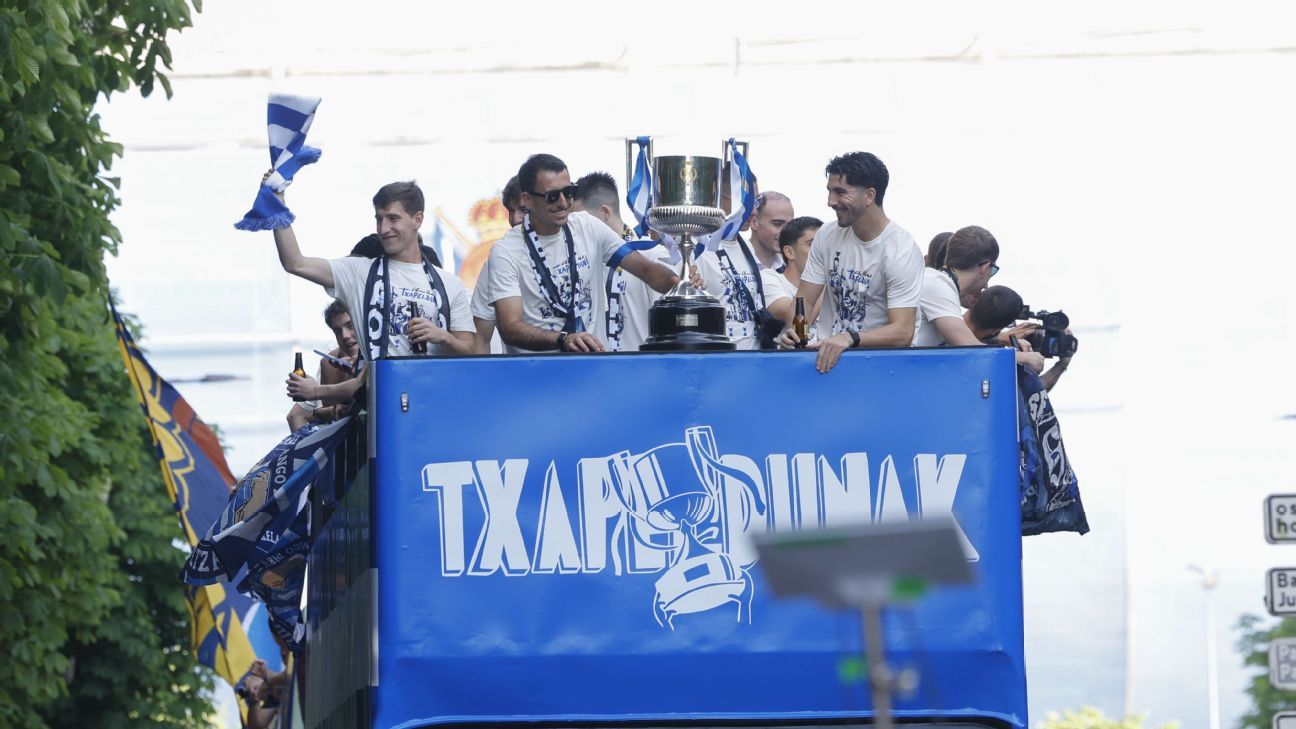
More than 100,000 fans gathered in the streets of San Sebastian, Spain, on Monday to celebrate Real Sociedad‘s Copa del Rey win over the weekend — a first major trophy for the Basque team since 2021.
Real Sociedad defeated Atlético Madrid on penalties Saturday to secure the title, marking a historic milestone for American coach Pellegrino Matarazzo, who earned his first trophy just four months after taking over the squad. In doing so, he became the first U.S.-born manager to win a major European tournament.
Matarazzo received one of the loudest ovations of the day. He further endeared himself to the local supporters by attempting a speech in Euskera, the Basque regional language.
“We are champions! I will try to do this in Basque, so I apologize for any mistakes I may make,” Matarazzo said from the balcony of San Sebastian’s town hall. “What a wonderful start on this path we are taking together. I feel that this is just the beginning! With your help, these players can achieve many great things.”
The “Blue and White” crowd chanted “Rino, Rino, Rino Matarazzo,” to which the New Jersey native responded that no one lifted the trophy as “high as I have,” due to his 6’6″ height and the proudness he feels.
Another moment of peak euphoria occurred when club captain Mikel Oyarzabal raised the trophy. The Spain striker thanked the fans for their unwavering support, while being frequently interrupted by the crowd chanting “Ballon d’Or” in his honor.
“Firstly, thank you very much for being here with us. It’s great to see how happy you look,” Oyarzabal said. “Here we are again, saying we are the champions of the Copa del Rey.”
Matarazzo — who previously coached Stuttgart and Hoffenheim in Germany — took charge of Real Sociedad as they struggled last December and has lifted them to seventh in LaLiga, and now a major trophy.
Information from The Associated Press was used in this report.
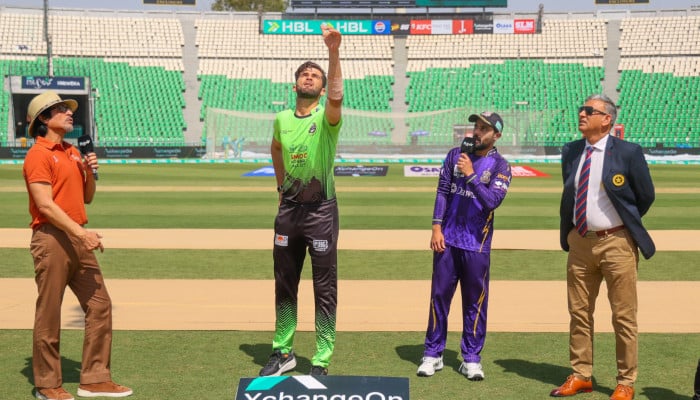
Lahore Qalandars opted to bat first after winning the toss against Quetta Gladiators in the 30th match of the Pakistan Super League (PSL) 11 at Gaddafi Stadium in Lahore on Tuesday.
The two sides have a closely contested head-to-head record, having faced each other 22 times. Lahore Qalandars hold a slight edge with 11 wins, while Quetta Gladiators have 10 victories; one match ended with no result.
Playing XIs
Lahore Qalandars: Mohammad Farooq, Fakhar Zaman, Abdullah Shafique, Charith Asalanka, Haseeb Ullah (wk), Sikandar Raza, Daniel Sams, Shaheen Afridi, Usama Mir, Ubaid Shah and Haris Rauf.
Quetta Gladiators: Shamyl Hussain, Saud Shakeel (c), Rilee Rossouw, Hassan Nawaz, Brett Hampton, Bevon Jacobs, Khawaja Nafay (wk), Khalil Ahmed, Alzarri Joseph, Abrar Ahmed and Usman Tariq.
This is a developing story and is being updated with further details.


Soccer’s incredible shrinking shin guards could be a big problem

Matarazzo celebrates Real Sociedad Copa title: ‘Just the beginning’

Germany firms raise investment plans, uncertainty persists: ifo

-

 Fashion5 days ago
France’s LVMH Q1 revenue falls 6%, shows resilience amid Iran war
-

 Sports1 week ago
The case for Man United’s Fernandes as Premier League’s best
-

 Entertainment1 week ago
Palace left in shock as Prince William cancels grand ceremony
-
 Business1 week ago
UK could adopt EU single market rules under new legislation
-

 Entertainment6 days ago
Is Claude down? Here’s why users are seeing errors
-

 Fashion1 week ago
Energy emerges as biggest cost driver in textile margins
-
 Business1 week ago
Delta Air Lines unveils first new Delta One suite in premium cabin arms race
-

 Fashion1 week ago
Asia claims largest share of markets on Kearney FDI Confidence Index