

Business
LG Electronics India’s stellar 50% premium listing: $13 billion giant more valuable than South Korean parent! Top 5 takeaways – The Times of India


LG Electronics India on Tuesday had a stellar listing on the stock exchanges NSE and BSE, debuting at a whopping premium of 50% above its share price issue. Trading commenced at Rs 1,715 on BSE and Rs 1,710.10 on NSE, considerably above the Rs 1,140 per share issue price, resulting in day-one returns exceeding 50% for investors.The Rs 11,607-crore public offering consisted solely of shares divested by LG Electronics Inc. The issue garnered overwhelming interest, securing 54-fold oversubscription. The qualified institutional buyers’ segment witnessed 166 times subscription, whilst retail investors’ portion achieved 3.5 times subscription.Before the official listing, the shares attracted strong demand in the grey market, trading at a 31% premium, reflecting strong investor confidence.The debut takes place in India’s second-busiest IPO quarter, though recent major listings, including WeWork India and Tata Capital, experienced relatively modest market debuts.So why is the LG Electronics India listing important and what does it mean for the IPO market in India?
LG Electronics’ Stellar listing
The IPO performance stands as the most impressive among Indian offerings exceeding one billion dollars since 2021, placing the organisation ahead of rivals such as Whirlpool, Voltas and Havells.The rise pushed the organisation’s market valuation beyond other listed Indian consumer durables firms, including Whirlpool of India ($1.7 billion), Voltas ($5.8 billion) and Havells India ($10.4 billion).
LG Electronics India more valuable than South Korean parent company!
Interestingly, LG’s market capitalisation reached Rs 1.16 lakh crore (approximately $13.13 billion), surpassing its South Korean parent LG Electronics Inc’s value of $8-9 billion on the Seoul exchange!According to experts, the company’s success stems from its sensible valuations, market leadership position and clear earnings prospects. LG holds a dominant position in India’s consumer durables sector with its diverse range of home appliances, TVs and ACs, consistently outperforming competitors in profitability and expansion, according to an ET report.Ambit Capital assigned a Buy rating with a 12-month target of Rs 1,820, noting several positive factors supporting the company’s outlook, including localisation, premium product focus, increased exports and GST-driven market recovery.“LG’s under-penetration across categories leaves ample room for growth. The Six City plant will double capacity and boost exports by 4 percentage points by FY28E,” the brokerage said. Their forecast indicates 11% revenue and 13% EBITDA CAGR through FY25-28.The IPO pricing proved appealing to investors. At 35x FY25 earnings, LG presented better value compared to listed competitors trading at 45-60x multiples. Additional factors strengthening investor trust included its debt-free status, consistent ROE exceeding 30%, and stable EBITDA margins above 10%.
LG Stands Tall In Rs 10,000 crore IPO Club
The listing proved exceptionally rewarding for investors and set a new benchmark among India’s Rs 10,000-crore-plus IPOs, where such issues typically struggle to maintain momentum post-listing. LG India recorded the highest day-one premium of 50.4% amongst IPOs exceeding Rs 10,000 crore.Historical data of significant Indian listings reveals diverse outcomes. Coal India’s public offering in 2010, which raised Rs 15,199 crore, remains amongst the successful ventures, beginning 40% higher.
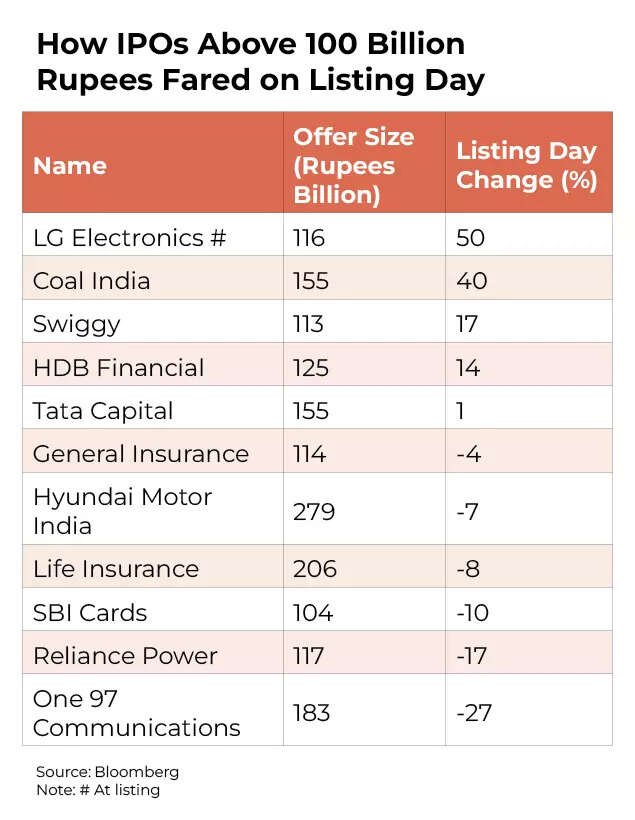
How above Rs 100 billion IPOs fares on listing
In contrast, Reliance Power’s 2008 issue started 17% lower, while Paytm’s Rs 18,300-crore offering in 2021 fell 27% at listing. State-backed enterprises encountered difficulties too, with LIC’s Rs 20,557-crore issue opening 7.8% lower and GIC Re’s Rs 11,257-crore offering starting with a 4.6% decline.Considering these precedents, LG India’s market debut stands out amongst substantial Indian IPOs, reflecting both scale and strong investor confidence.
More IPOs loading – what LG’s stellar listing means
The impressive first-day performance serves as a positive indicator for upcoming Indian corporate listings, particularly following Tata Capital Ltd.’s modest 1.4% increase during its debut in the nation’s largest initial public offering this year.Over the past two years, India has emerged as one of the world’s most active markets for public listings, attracting international investors keen to participate in its rapidly expanding consumer market.October is poised to set a record for Indian IPOs, with anticipated proceeds exceeding $5 billion. The market has closely monitored both LG and Tata’s offerings as indicators of stability in one of the world’s most vibrant IPO markets.
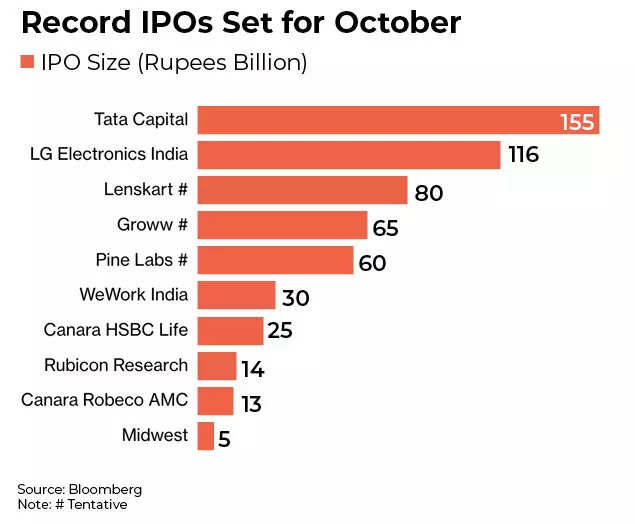
Record IPOs Set for October
According to Bloomberg data, these recent offerings have pushed the total IPO proceeds in India beyond $15 billion this year. The surge in significant offerings has generated confidence that the total could exceed last year’s milestone of nearly $21 billion. Jefferies Financial Group previously indicated that India’s primary market is positioned for substantial growth following a quiet start, projecting fundraising of up to $18 billion in the latter half of the year.
IPOs a Hit Even As Nifty, Sensex Still Below Highs
Amidst international market fluctuations, India maintains its status as the second-largest IPO market globally, following the United States. This position is supported by sound economic fundamentals, improved regulatory framework, and increased participation from retail investors.Although foreign investors have been consistently selling in the secondary market, they maintain substantial confidence in India’s leading growth narrative by participating as committed anchor investors in companies’ initial public offerings.The Indian IPO sector demonstrates exceptional vitality, generating approximately 1% of the nation’s GDP, R. Venkataraman, Managing Director of IIFL Capital told ET recently.The prevailing robust valuations and conducive market environment are allowing business owners to secure capital for expansion whilst partially realising their investments.Experts are of the view that companies at their listing stage are typically in their early growth phase, potentially offering higher returns compared to established listed entities, according to Shah. Additional advantages of IPOs include minimal price impact from bulk purchases and opportunities to invest in unique business models at competitive valuations.(Disclaimer: Recommendations and views on the stock market and other asset classes given by experts are their own. These opinions do not represent the views of The Times of India)


While hackers used to sneak into computer systems, intimidation of staff is now more common.
Source link
Business
Noel Tata part of 3-1 vote against Srinivasan, Singh at Tata edu trust – The Times of India

MUMBAI: Noel Tata has voted against the reappointment of Venu Srinivasan and Vijay Singh as trustees of Tata Education and Development Trust (TEDT), the largest corpus trust within Tata Trusts, in a move that widens fault lines within one of India’s most powerful philanthropic structures. It marks the first time Noel has made his opposition to the duo unequivocal.The vote, the last of four cast on the matter, added to a verdict that had already been sealed when Mehli Mistry became the first to oppose the duo’s extension, shortly after the trusteeship renewal circular was issued.Under TEDT’s governance rules, reappointments require unanimous consent among trustees – a threshold that had already been foreclosed by Mehli’s vote. Jehangir Mistry subsequently voted against both men as well. Srinivasan and Singh had each voted for the other. The tally stood at 3-1 against each of them.
Noel’s vote signals widening of Tata Trusts rift since ’25
Their tenures in an influential Tata trust that supports projects in India and abroad, formally expired on Sunday, May 10. Noel Tata voting against Srinivasan and Singh significantly curtails influence of both men within wider Tata Trusts ecosystem, even as they remain vice-chairmen of the Sir Dorabji Tata Trust (SDTT) and Sir Ratan Tata Trust (SRTT) — the two apex trusts that together hold controlling stake in Tata Sons.The rift between Noel and the duo deepened after Srinivasan and Singh publicly backed a listing of Tata Sons, a move Noel opposed. In an email to Tata Trusts CEO, Mehli said “My affidavit in response to the board composition change report for SDTT explains the reasons why I chose to take such a decision.” According to the affidavit, Noel, Srinivasan and Singh had wrongly voted against him at SDTT. He also said that Srinivasan had taken part in the vote even though his term had already ended at SDTT. TEDT, with a corpus of Rs 5,600 crore, has been among the most prominent Indian donors to Ivy League institutions, including Harvard Business School and Cornell University, and owns and operates two cancer hospitals in India while supporting 17 others through grants.Following the board changes, Noel remains chairman and perpetual trustee of TEDT. Mehli continues in his role as perpetual trustee, while Jehangir holds a fixed-term trusteeship. With Srinivasan and Singh’s departure, TEDT now sits at the minimum threshold of three trustees permitted under its deed. An email sent to Noel did not elicit a response. The vote is the latest and most visible expression of a fracture within Tata Trusts that has been widening since late 2025. Established by former Tata Trusts chairman Ratan Tata in 2008, TEDT is perhaps the only trust within Tata Trusts that can support social projects in India and abroad.

NEW DELHI: The Competition Commission has ordered a detailed probe against French spirits major Pernod Ricard and seven other entities for alleged cartelisation in the Indian-made foreign liquor market.The seven entities that have come under the watchdog’s lens are Indo Spirits, Pathway HR Solutions, Universal Distributors, Khao Gali, Bubbly Beverages, Shiv Associates and Organomix Ecosystems.Ordering the investigation, the regulator said it is of prima-facie view that Pernord Ricard’s restrictive conduct with its retailers/wholesalers, purportedly, to induce brand pushing and achieve higher market share in IMFL market in Delhi, falls within the purview of ‘exclusive dealing agreement’ under the Competition Act. Such conduct violates the Act, according to a 26-page order, dated May 5, by the Competition Commission of India (CCI). The complaint was filed before the CCI in 2024.CCI’s Director General (DG) will carry out the investigation that will also look into the role of the persons/officers who were responsible for the conduct of the activities of such entities as well as individuals whose consent or connivance was involved during the time of the contraventions.

Cyber-crime increasingly coming with threats of physical violence

Martin Short praises ex-girlfriend Gilda Radner: ‘Alive’
Noel Tata part of 3-1 vote against Srinivasan, Singh at Tata edu trust – The Times of India

-

 Politics1 week ago
Iran weighs US reply delivered via Pakistan as Trump signals opposition to deal terms
-

 Fashion1 week ago
AAFA pushes for swift US House passage of key anti-counterfeiting law
-

 Fashion1 week ago
US’ J.Jill, Inc. appoints Kimberly Wallengren as CMO
-

 Fashion1 week ago
US cotton export sales show strong recovery, Upland rise 36%
-

 Sports1 week ago
Sajid Ali Sadpara summits world’s fifth-highest peak
-

 Tech6 days ago
DHS Demanded Google Surrender Data on Canadian’s Activity, Location Over Anti-ICE Posts
-

 Fashion1 week ago
ICE cotton witnesses sharp rise on weaker dollar, strong exports
-
 Business1 week ago
Heineken to invest £44.5m in hundreds of pubs creating 850 jobs