

Politics
Maduro in New York jail; Trump ‘designating people’ to be in charge of Venezuela



- US to run Venezuela until ‘safe, proper, judicious transition’: Trump
- Venezuela’s top court orders VP Rodriguez to assume presidency.
- US general says over 150 aircraft used in mission to capture Maduro.
Venezuelan President Nicolas Maduro was in a New York jail Saturday, hours after American special forces seized and flew him out of his country, which President Donald Trump said would come under effective US control.
The US president’s announcement followed a lightning pre-dawn attack in which commandos grabbed Maduro and his wife while air strikes pounded sites in and around Caracas.
A US government plane carrying Maduro landed at a military base shortly after nightfall, and he was transported by helicopter to New York City, where the couple were to be arraigned on drug trafficking and weapons charges.
The White House posted a video on X of Maduro, handcuffed and in sandals, escorted by federal agents through a US Drug Enforcement Administration facility in New York.
“Good night, happy new year,” the 63-year-old leftist is heard saying in English.
Despite the success of the risky raid, what happens next is highly uncertain.
Trump said he was “designating people” from his cabinet to be in charge in Venezuela, but gave no further details.
In another surprise, Trump indicated US troops could be deployed, saying Washington is “not afraid of boots on the ground.”
But he appeared to reject the possibility of the country’s opposition taking power and said he could work instead with Maduro’s Vice President, Delcy Rodriguez.
One aspect that became clearer was Trump’s interest in Venezuela’s vast oil reserves.
“We’re going to have our very large United States oil companies… go in, spend billions of dollars, fix the badly broken infrastructure,” he said.
“We’ll be selling large amounts of oil.”
Trump dismisses opposition leader
US-backed opposition leader Maria Corina Machado, who won last year’s Nobel Peace Prize, posted on social media that “the hour of freedom has arrived.”
She called for the opposition’s 2024 election candidate, Edmundo Gonzalez Urrutia, to “immediately” assume the presidency.
But Trump was surprisingly cold about expectations that Machado could become Venezuela’s new leader, saying she doesn’t have “support or respect” there.
Instead, he touted Rodriguez, saying “she’s essentially willing to do what we think is necessary to make Venezuela great again.”
Rodriguez poured cold water on that, demanding Maduro’s release and vowing to “defend” the country.
Late Saturday, Venezuela’s Supreme Court ordered Rodriguez to assume presidential powers “in an acting capacity.”
Reflecting the confusion, Trump indicated US involvement is likely for the long haul.
“We’re going to stay until such time as the proper transition can take place,” he said.
Venezuela’s ally China said it “strongly condemns” the US operation, while France warned a solution cannot “be imposed from outside.”
United Nations Secretary-General Antonio Guterres said he was “deeply concerned that the rules of international law have not been respected.”
At Venezuela’s request, the UN Security Council will meet on Monday to discuss the crisis, the Somali presidency of the Council told AFP.
Blackout and bombing
Venezuelans had been bracing for attacks as US forces spent months massing off the coast.
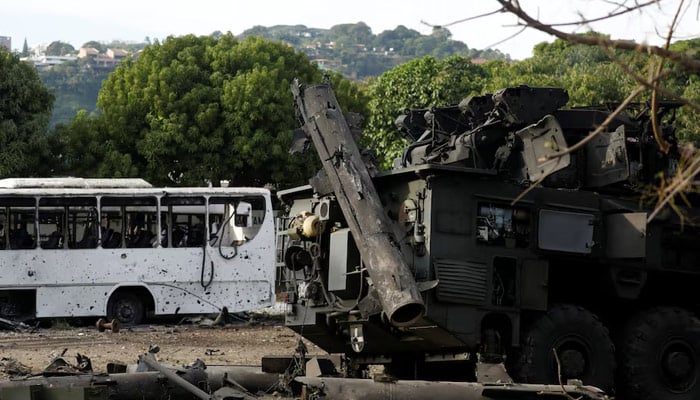
Caracas residents woke to explosions and the whir of military helicopters around 2:00am (0600 GMT). Air strikes hit a major military base and an airbase, among other sites, for nearly an hour.
The top US military officer, General Dan Caine, said 150 aircraft took part in the operation, supporting troops who choppered in to seize Maduro with the help of months of intelligence into his daily habits — down to “what he ate” and what pets he kept.
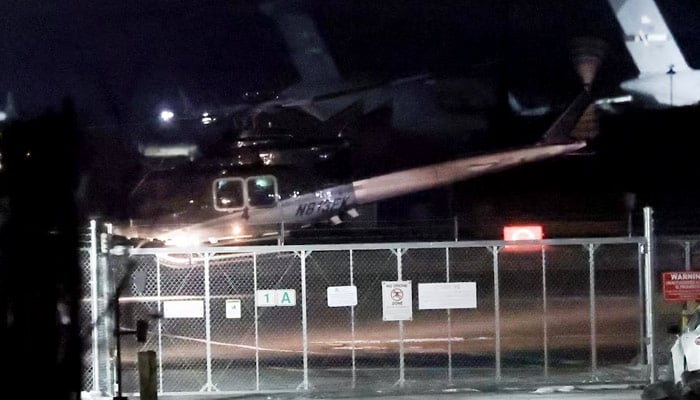
Maduro and his wife “gave up” without a struggle and there was “no loss of US life,” he said.
Venezuelan authorities have yet to release casualty figures. But Trump told the New York Post that “many” Cubans in Maduro’s security detail were killed.
Within hours of the operation, Caracas had fallen eerily quiet, with police stationed outside public buildings and the smell of smoke drifting through the streets.
Shifting justifications
The US and numerous European governments did not recognise Maduro’s legitimacy, saying he stole elections in 2018 and 2024.
Maduro — in power since 2013 after taking over from leftist mentor Hugo Chavez — long accused Trump of seeking regime change in order to control Venezuela´s oil reserves.
Trump has offered several justifications for the aggressive policy toward Venezuela, at times stressing illegal migration, narcotics trafficking and oil.
But he had previously avoided openly calling for regime change.
Several members of Congress quickly questioned the legality of the operation. But Trump´s key ally, Mike Johnson, the top Republican in the House of Representatives, said it was “justified.”
- Pentagon chief warns Iran miscalculating US ability to sustain the war.
- Says US campaign targets Iranian missiles, missile production and navy.
- Says Iran making ‘bad calculation’ believing US can’t sustain war.
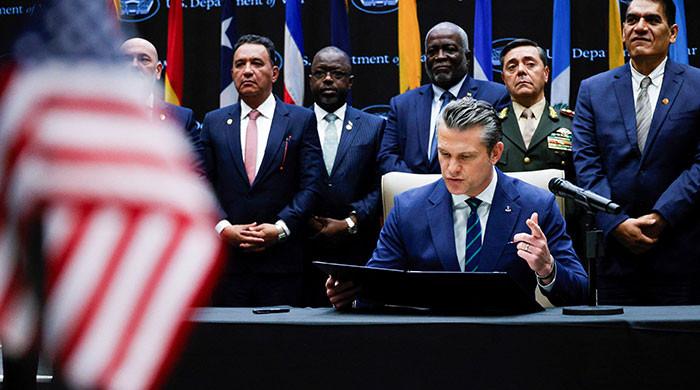
TAMPA: TAMPA: US Defence Secretary Pete Hegseth warned on Thursday that Iran was making a serious miscalculation if it believed the United States could not sustain the ongoing war, stressing that Washington had the resources and resolve to continue the military campaign for as long as necessary.
The Pentagon earlier this week said the military campaign, known as Operation Epic Fury, is focused on destroying Iran’s offensive missiles, missile production and navy, while not allowing Tehran to have a nuclear weapon.
“There’s no expansion in our objectives. We know exactly what we’re trying to achieve,” Hegseth said.
He added that Trump was “having a heck of a say in who runs Iran given the ongoing operation.”
In a telephone interview with Reuters on Thursday, Trump said the United States would have to help pick the next person to lead the country.
The US and Israeli military campaign that started on Saturday has hit targets across the country and triggered Iranian retaliatory strikes in the region as Tehran seeks to impose a high cost on the United States, Israel and their allies.
Iran has attacked countries including Israel, the United Arab Emirates and Qatar. Fire crews in Bahrain extinguished a blaze at a refinery following a missile strike.
Azerbaijan became the latest country drawn in, as it accused Iran of firing drones at its territory and ordered its southern airspace closed for 12 hours.
Hegseth said by striking countries in the region, Iran would only bring them closer to the United States.
“It’s actually firming up the unity of the resistance in order to focus exactly where we need to,” Hegseth said.
Next phase of operations
The United States has hit more than 2,000 targets in Iran, including Iranian warships.
Admiral Brad Cooper, the head of US Central Command, said US forces had destroyed 30 Iranian warships, including an Iranian drone carrier ship earlier on Thursday.
Cooper said the United States was hitting Iran’s ability to rebuild.
“As we transition to the next phase of this operation, we will systematically dismantle Iran’s missile production capability for the future, and that’s absolutely in progress,” Cooper said, adding that it would take some time.
The US military has identified the six US Army Reserve soldiers killed when a drone slammed into a US military facility in Port Shuaiba, Kuwait.
Trump and other senior officials have warned the Iran conflict will result in more US military deaths.
Hegseth, during the press conference, said Iran was making a mistake if it believed that the United States could not sustain the ongoing war, adding that Washington had just begun to fight.
“Iran is hoping that we cannot sustain this, which is a really bad miscalculation,” Hegseth said. “We set the timeline.”
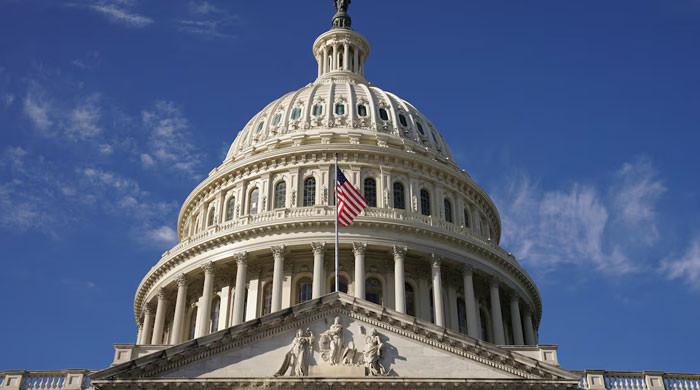
WASHINGTON: The US House of Representatives rejected an effort on Thursday to stop President Donald Trump’s air war on Iran and require that any hostilities against Iran be authorised by Congress, backing the Republican president’s military campaign on the sixth day of the expanding conflict.
The vote was 219 to 212, largely along party lines, in the House, where Trump’s fellow Republicans control a narrow majority of seats. Two Republicans voted in favour of the resolution and four Democrats voted against it.
Opponents accused Democrats of taking the issue to a vote only because they oppose Trump, putting Americans at increased risk.
“We all know that we wouldn’t be here today if the president’s name wasn’t Donald Trump,” Representative Rick Crawford of Arizona, the Republican chairman of the House Intelligence Committee, said during debate on Wednesday.
Sponsors of the resolution described it as a bid to take back Congress’ responsibility to authorise war, as spelled out in the US Constitution.
The US and Israel launched attacks on Iran on Saturday, a conflict that has killed more than 1,000 people, including at least six US service members, and caused damage and instability throughout the Middle East.
Supporters said the resolution, by requiring Trump to come to Congress for a war authorisation, would force him to explain to Americans why the US is fighting and how it might end.
“This is a war of choice, launched by this administration without authorisation, without clearly stated objectives or a defined endgame, and without explaining how they intend to keep Americans safe,” said Representative Gregory Meeks of New York, the top Democrat on the Foreign Affairs Committee.
Approval would not have stopped Iran air war
Just before the resolution vote, House members from both parties overwhelmingly passed a measure “Reaffirming Iran remains the largest state sponsor of terrorism.”
The vote would not have stopped the conflict even if the House had voted yes.
To go into effect, the resolution would also have had to pass the Senate and garner the two-thirds majorities needed to override Trump’s expected veto.
The Senate, also narrowly controlled by Trump’s party, backed his military campaign against Iran in a vote on Wednesday, voting to block a bipartisan resolution similar to the measure passed by the House. The votes this week are not the end of the matter. The War Powers Resolution of 1973, which provides for votes on the resolutions, says a president can only involve the military in an armed conflict when Congress has declared war or provided specific authority or in response to an attack.
Trump and his Republicans have argued that Iran posed an “imminent threat” so that his actions were legal under that law.
However, the War Powers measure also requires unauthorised military actions to be terminated within 60 days, giving the Trump administration a deadline at the end of April to seek Congress’ approval.
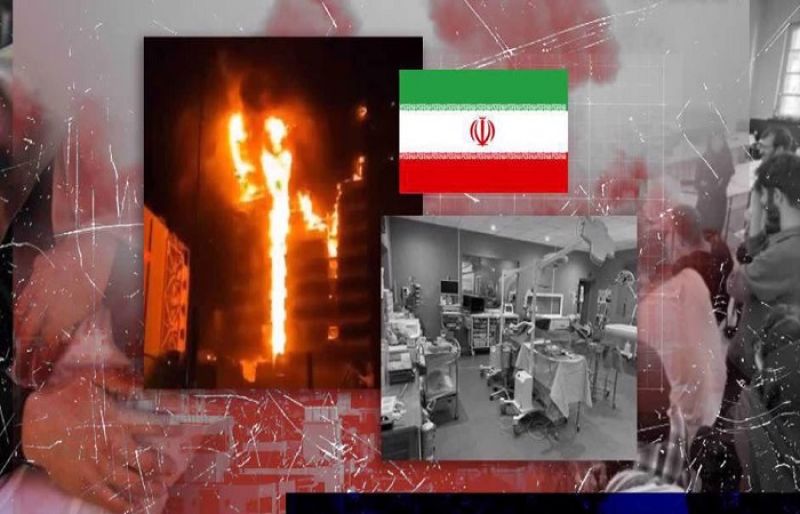

The air at the bombed-out Tehran hospital room hung thick with dust and the metallic tang of recent destruction carried out by the United States and the Israeli regime.
Against a backdrop of shattered concrete, two newborns clung precariously to life. Their breaths were being measured by the rhythmic beep of monitors connected by vital wires.
Amid the dust-choked room following the dastardly US-Israeli aggression, Iranian Red Crescent personnel worked to sever the fragile connection to the damaged infrastructure, to take the infants out of the wreckage.
The Gandhi Hospital in central Tehran, along with a nearby residential building, sustained catastrophic damage from strikes carried out by the United States and Israel late Sunday night, a day after the aggression was launched without provocation.
Immediately following the attack, harrowing footage depicted medical personnel urgently transferring the tiny newborns from their compromised incubators to ambulances.
Hope for new life, IVF centre targeted
The tragedy deepened with confirmation from hospital authorities later about the massive damage incurred by a specialized IVF center there, which lay in ruins.
The IVF centre was a sanctuary where hundreds of hopeful couples had invested their futures, their deepest desires for parenthood.
The US-Israeli aggression destroyed their dreams for future generations that had been painstakingly planned.
“The ledger of violated human rights in this war will be written in blood and shame,” Hossein Kermanpour, Health Ministry spokesman, wrote in a post on his X account.
“For the first time in my life, I am witnessing something I never even saw during the Iran-Iraq War. Patients being carried in their caregivers’ arms, fleeing into smoke-filled streets after missiles exploded beside their hospital,” Kermanpour added.
The assault was not limited to Gandhi Hospital. Reports confirmed that Khatam al-Anbiya Hospital and Motahari Hospital were also directly targeted in Tehran.
Furthermore, several missiles struck near Abuzar Hospital in the southern city of Ahvaz, forcing the immediate evacuation of 21 patients, including those in intensive care, requiring 30 ambulances to reroute them to other centers.
Images from Ahvaz captured the evacuation under dire circumstances. Emergency personnel were moving the sick through the thick plumes of smoke while the terrifying sounds of aerial bombardment still echoed overhead.
The American and Israeli regimes also targeted three emergency medical bases in Sarab, Chabahar, and Hamedan following the Abuzar attack.
A member of the Iranian Parliament said five hospitals and medical centers have been damaged or destroyed during the US-Israeli terrorist attacks on the Islamic Republic.
“Unfortunately, this illegal act of aggression resulted not only in the destruction of the buildings of hospitals and medical centers but also the injury of a number of students and local residents,” Fatemeh Mohammad Beigi, a member of the Parliament’s Health and Treatment Commission, said in a statement on Monday.
She added that a number of these medical centers have been evacuated in fear of more attacks.
Assault on life itself
Iranian President Masoud Pezeshkian denounced the US-Israeli strikes on civilian infrastructure, stating that the attacks on medical facilities “affect life itself and assaults on educational centers jeopardize the future of a nation.”
He made this reference following a US-Israeli strike on an elementary school in the southern Hormozgan Province that killed 171 girls.
He added that “targeting patients and children blatantly violates humanitarian principles.”
The Iranian president called upon the international community to censure the atrocities.
The Director-General of the World Health Organization (WHO), Tedros Adhanom Ghebreyesus, expressed extreme concern over the damage to Gandhi Hospital in Tehran.
Following the bombing, he posted on X, stating, “Reports of Tehran’s Gandhi Hospital being damaged during today’s bombardment of the Iranian capital are extremely worrying.”
Ghebreyesus reiterated that “all efforts must be taken to prevent health facilities from being caught up in the ongoing conflict,” emphasizing that “Health facilities are protected under international humanitarian law” with the hashtag “#healthisnotatarget.”
Strike on hospitals, a pattern
However, this event is part of a disturbing pattern. This is not the first time Israel has attacked medical facilities in the Islamic Republic. During the 12-day military aggression in June, nearly a dozen hospitals were targeted in clear violation of international conventions.
The Geneva Conventions, long considered the bedrock of humanitarian protection in wartime, have been repeatedly flouted by both the US and Israel.
In Gaza, an entire health system has been systematically crippled, and doctors have been killed while on duty since the genocidal war was launched in October 2023.
According to chilling WHO figures, 94 percent of hospitals in Gaza were destroyed by Israel during its two-year-long genocide.


Maisie Peters surprises fans in Australia with Ed Sheeran

Trump pays tribute to Lou Holtz after legendary football coach’s death

Hegseth warns Iran miscalculating US ability to sustain war

What are Iran’s ballistic missile capabilities?

India Us Trade Deal: Fresh look at India-US trade deal? May be ‘rebalanced’ if circumstances change, says Piyush Goyal – The Times of India

Attock Cement’s acquisition approved | The Express Tribune

-
 Politics1 week ago
What are Iran’s ballistic missile capabilities?
-
Business7 days ago
India Us Trade Deal: Fresh look at India-US trade deal? May be ‘rebalanced’ if circumstances change, says Piyush Goyal – The Times of India
-
Business1 week ago
Attock Cement’s acquisition approved | The Express Tribune
-
 Politics1 week ago
US arrests ex-Air Force pilot for ‘training’ Chinese military
-

 Fashion1 week ago
Policy easing drives Argentina’s garment import surge in 2025
-
 Business6 days ago
Greggs to reveal trading amid pressure from cost of living and weight loss drugs
-

 Fashion7 days ago
Texwin Spinning showcasing premium cotton yarn range at VIATT 2026
-

 Sports1 week ago
Sri Lanka’s Shanaka says constant criticism has affected players’ mental health