

Politics
Mexico City lawmakers pull hair, trade blows during debate

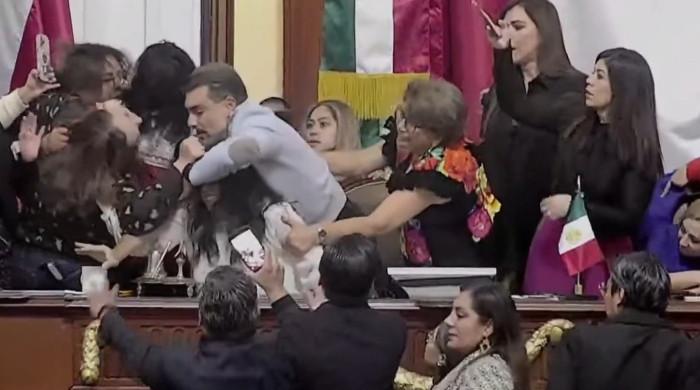
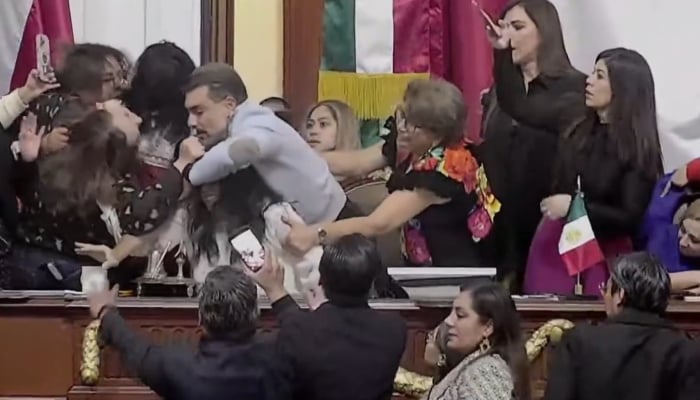
MEXICO CITY: A group of women legislators in the Congress of Mexico City got into a physical fight Monday, with cameras broadcasting the brawl live as they pulled each other’s hair and traded blows.
The fight broke out after a group of women from the right-wing National Action Party (PAN) approached the legislature’s main podium in protest of a rule allegedly broken by the leftist Morena party, which has a majority in the legislature.
The debate involved reforming the city government’s transparency oversight agency, according to local media reports.
Video from the incident shows at least five lawmakers from both parties arguing intensely, with members elbowing, slapping, and pulling each other’s hair in an attempt by Morena lawmakers to physically remove the PAN members from the podium, despite their refusal to move.
“We took the podium peacefully, without touching anyone, and the decision made by the majority legislative group and its allies was to try and regain control of the board through violence,” Andres Atayde, an aide for the PAN representatives, told a press conference after the incident.
Daniela Alvarez, one of the PAN lawmakers who approached the podium, told reporters: “Not only is it vulgar, not only is it aggressive, but it is lamentable that this is the majority governing party for this city.”
After the fight, the PAN lawmakers left the chamber and the Morena majority resumed the debate without the opposition party present, according to reports posted to the Congress of Mexico City’s social media.
“What worries us a lot is how the opposition is systematically resorting to violence instead of arguments, in the absence of being able to debate,” Morena spokesman Paulo Garcia later told broadcaster Milenio.
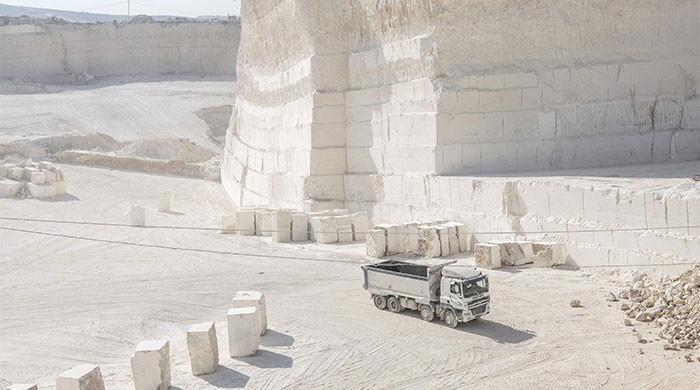
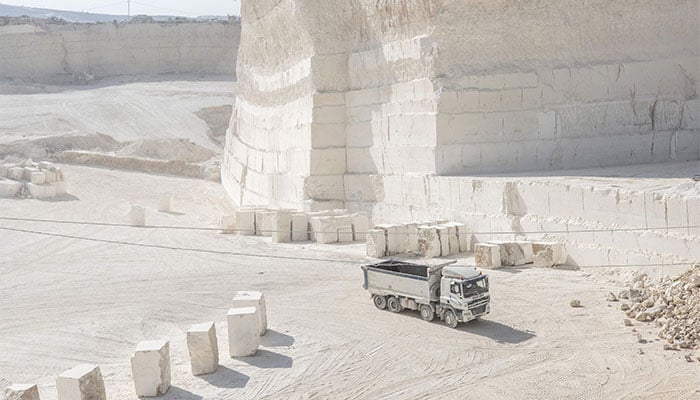
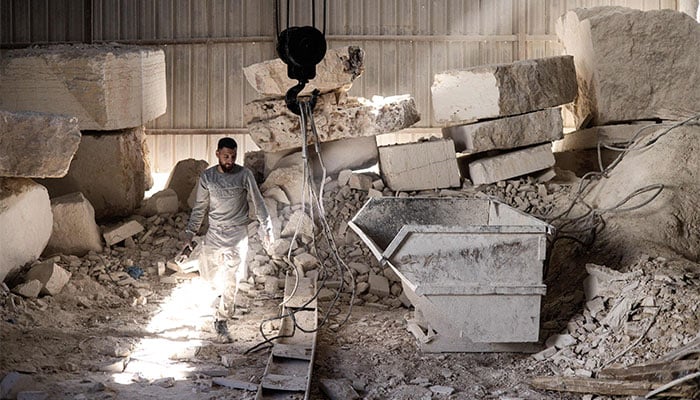
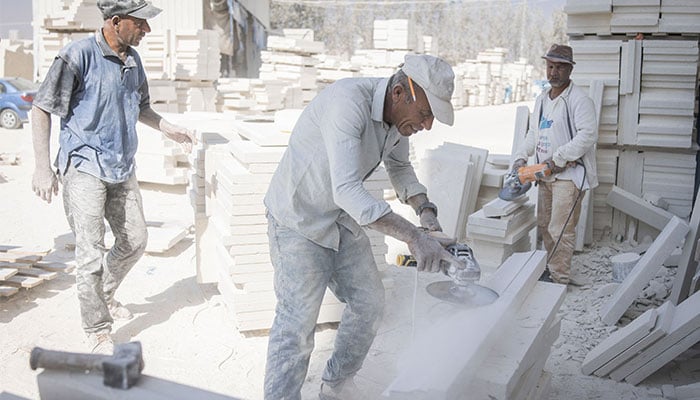
Despite the catastrophic state of the Palestinian economy, Faraj al-Atrash, operator of a quarry in the occupied West Bank, proudly points to an armada of machines busy eating away at sheer walls of dusty white rock that stretch into the distance.
“This here is considered the main source of revenue for the entire region”, Atrash said at the site near the town of Beit Fajjar, close to the city of Hebron.
The quarry is a source of Jerusalem stone, the famed pale rock used throughout the Holy Land and beyond for millennia and which gives much of the region its distinctive architectural look.
But Atrash, in his fifties, said “our livelihood is constantly under threat”.
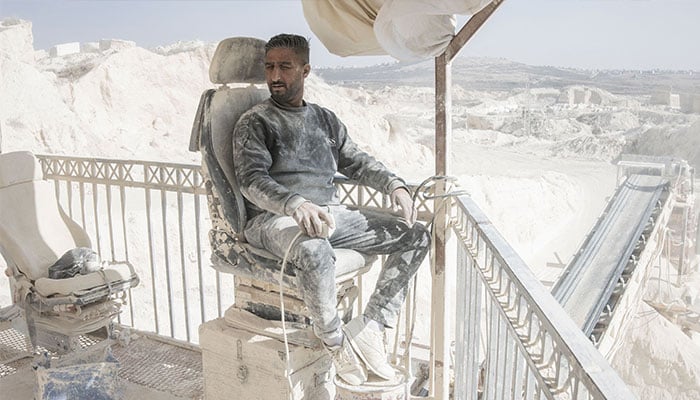
“Lately, I feel like the occupation (Israel) has begun to fight us on the economic front,” he said.
Atrash fears the confiscation of the quarry’s industrial equipment, the expansion of Israeli settlements and the Palestinian financial crisis.
The war in Gaza, triggered by Hamas’s October 2023 attack on Israel, dealt a severe blow to a Palestinian economy that was already in poor shape.
The Palestinian territories are “currently going through the most severe economic crisis ever recorded,” according to a report by the United Nations Conference on Trade and Development presented in late November.
Israel, which has occupied the West Bank since 1967, has recently set up hundreds of new checkpoints across the territory, paralysing commercial transport.
Beyond restrictions on freedom of movement, a halt in permits for West Bank Palestinians seeking work inside Israel has also had a severe impact.
Soaring costs
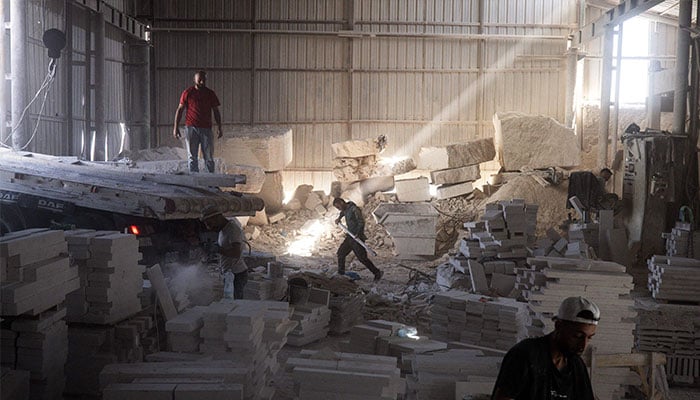
“There are problems with exports and market access because we used to export most of the stone to Israel, and after October 7, we ran into difficulties,” explained Ibrahim Jaradat, whose family has owned a quarry for more than 40 years near Sair, also near Hebron.
The Palestinian Authority, which exercises partial civilian control over some of the West Bank, is on the brink of bankruptcy.
Public services are functioning worse than ever, Atrash said, adding that fixed costs such as water and electricity had soared.
Quarries account for 4.5% of Palestinian GDP and employ nearly 20,000 workers, according to the Hebron Chamber of Commerce.
Around 65% of exports are destined for the Israeli market, where some municipalities mandate the use of Jerusalem stone.
“The people who buy the stones from us to resell them to construction sites are mostly Israelis,” said Abu Walid Riyad Gaith, a 65-year-old quarry operator.
He lamented what he said was a lack of solidarity from Arab countries, which he said do not buy enough of the rock.
‘Afraid to build’
Other threats hang over the industry.
Most of the roughly 300 quarries in the West Bank are located in Area C, land which falls under full Israeli authority and covers the vast majority of its settlements.
“Many (Israeli) settlers pass through here, and if Israel annexes Palestine, it will start with these areas,” said one operator, speaking on condition of anonymity.
Some members of Israel’s government, one of the most right-wing in the country’s history, openly discuss plans to annex parts or all of the West Bank.
Israeli settlements in the West Bank are illegal under international law.
They are expanding at the fastest rate since at least 2017, when the United Nations began tracking such data, according to a recent report by the UN chief.
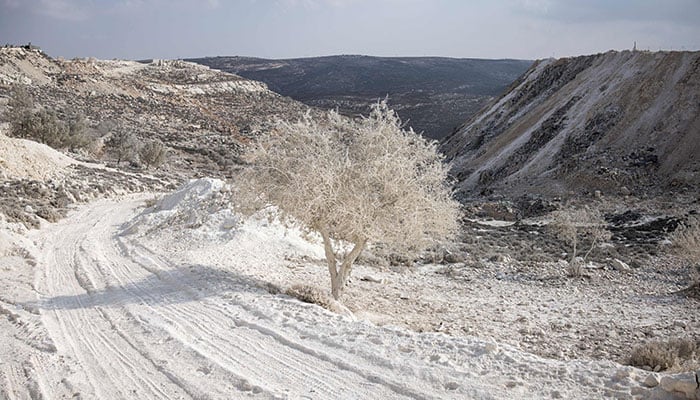
The physical demands of working in a quarry are intense, but for many Palestinians there are few other options as the West Bank’s economy wilts.
“We are working ourselves to death,” Atrash said, pointing to his ten labourers moving back and forth in monumental pits where clouds of dust coat them in a white film.
In the neighbouring quarry, blinking and coughing as he struggled with the intense work was a former geography teacher.
With the Palestinian Authority’s budget crisis meaning he was no longer receiving his salary, he had looked for work in the only local place still hiring.
All the labourers AFP spoke to said they suffered from back, eye and throat problems.
“We call it white gold,” said Laith Derriyeh, employed by a stonemason, “because it normally brings in substantial amounts of money”.
“But today everything is complicated; it’s very difficult to think about the future.”
“People have no money, and those who do are afraid to build,” he added.

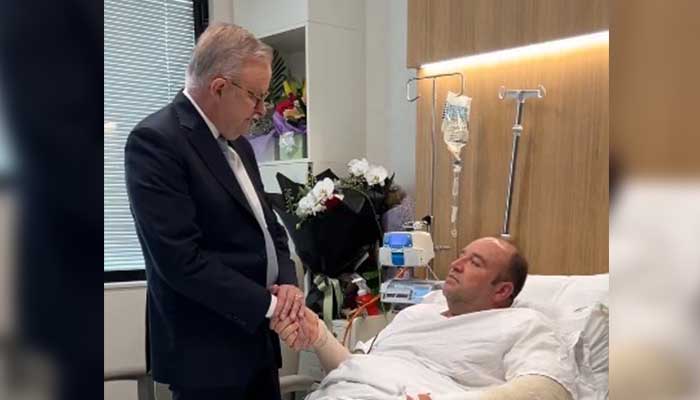
SYDNEY: Australia’s prime minister visited Bondi Beach shooting hero Ahmed al Ahmed in hospital on Tuesday, lauding his efforts to help stop the nation’s deadliest gun attack in decades.
A father and son killed 15 people at Bondi Beach on Sunday, targeting a Jewish festival that marked the start of Hanukkah.
Footage showed the fruit seller ducking between parked cars as the shooting unfolded and then wresting a gun from one of the assailant’s hands.
“He was trying to get a cup of coffee and found himself at a moment where people were being shot in front of him,” Prime Minister Anthony Albanese said after a bedside visit with heavily bandaged Ahmed.
“He decided to take action and his bravery is an inspiration for all Australians,” Albanese added.
Ahmed was shot several times in the shoulder after tussling with one of the gunmen.
Albanese said he would “undergo further surgery” on Wednesday.
“At a moment where we have seen evil perpetrated, he shines out as an example of the strength of humanity,” the prime minister said, adding: “We are a brave country. Ahmed al Ahmed represents the best of our country”.
Bedbound and with tubes in his nose, Ahmed briefly thanked wellwishers in Arabic in a video circulating on social media on Tuesday morning.
“I appreciate the efforts of everyone,” he said, according to an English translation provided by Turkish public broadcaster TRT World.
“May Allah reward you and grant you wellbeing,” he said. “God willing, we will return to you with joy. Thank you for your efforts.”
The father-of-two came to Australia from Syria almost 10 years ago, local media reported.
His mother told Australian broadcaster ABC on Monday that she kept “beating myself up and crying” when she received the call that her son had been shot in “an accident”.
“He saw they were dying, and people were losing their lives, and when that guy ran out of ammo, he took it from him, but he was hit,” she said. “We pray that God saves him.”
There has been a global outpouring of support for Ahmed, including from US President Donald Trump who praised his incredible courage.
An online fundraiser has received more than AU$1.9 million ($1.2 million) in donations for Ahmed’s medical fees.

- Immigration says shooters listed Davao as final destination on trip.
- Australia says suspects returned to Sydney on Nov 28 before attack.
- Police, military still confirming duo’s presence in Philippines.
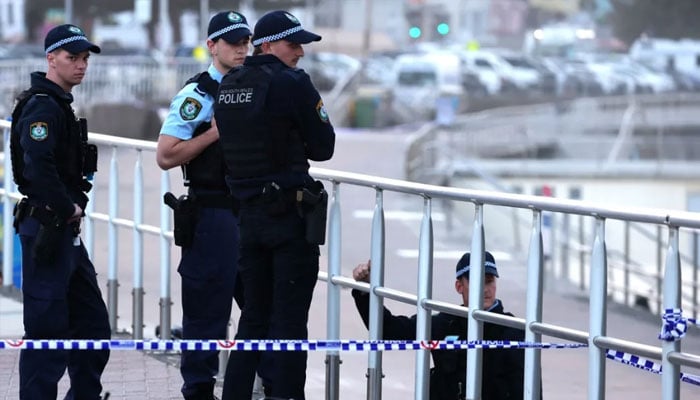
The father and son allegedly behind one of Australia’s deadliest mass shootings spent nearly the entire month of November in the Philippines, authorities in Manila confirmed Tuesday, with the father entering as an “Indian national”.
Sajid Akram and his son Naveed, who allegedly killed 15 people and wounded dozens of others at a Hanukkah celebration on Sydney’s Bondi Beach, entered the country on November 1 with the southern province of Davao listed as their final destination.
“Sajid Akram, 50, Indian national, and Naveed Akram, 24, Australian national, arrived in the Philippines together last November 1, 2025 from Sydney, Australia,” immigration spokeswoman Dana Sandoval told AFP.
“Both reported Davao as their final destination. They left the country on November 28, 2025 on a connecting flight from Davao to Manila, with Sydney as their final destination.”
Police and military sources had earlier told reporters they were still in the process of confirming the duo’s presence in the country.
“Early indications point to a terrorist attack inspired by Islamic State, allegedly committed by a father and son,” Australian Federal Police Commissioner Krissy Barrett said at a news conference.
“These are the alleged actions of those who have aligned themselves with a terrorist organisation, not a religion.”
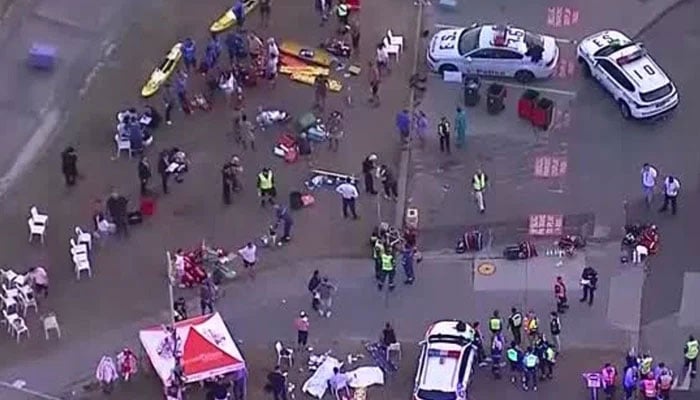
Police also said the vehicle which is registered to the younger male contained improvised explosive devices and two homemade flags associated with ISIS, or Daesh, a militant group designated by Australia and many other countries as a terrorist organisation.
Videos have emerged of the younger shooter preaching religion outside train stations in suburban Sydney. Authorities are still trying to piece together how he went down the path of violence.
The attack on Sunday was Australia’s worst mass shooting in nearly 30 years, and is being investigated as an act of terrorism targeting the Jewish community.
The death toll stands at 16 including Sajid, who was shot by police on spot. The man’s 24-year-old son and alleged accomplice Naveed, was in critical condition in hospital after also being shot.
The 15 victims ranged from a rabbi who was a father of five, to a Holocaust survivor, to a 10-year-old girl named Matilda Britvan, according to interviews, officials and media reports. Two police officers remained in critical but stable condition in hospital, New South Wales police said.
Australian Prime Minister Anthony Albanese said Tuesday that the two men had likely been radicalised by “Daesh ideology”.
Davao is a large urban center located on the eastern side of Mindanao, the Philippines’ largest southern island. Armed groups are known to be active in economically disadvantaged areas of central and southwestern Mindanao.
The Philippine military, however, said it was unable to promptly verify claims that the two individuals had received “military-style training” during their time in the country, despite earlier reports suggesting otherwise.
Mindanao also has a long history of insurgencies against central government rule.
Pro-Daesh Maute and Abu Sayyaf militants — including foreign and local fighters — held Mindanao’s Marawi under siege in 2017.
The Philippine military wrested back the ruined city after a five-month battle that claimed more than 1,000 lives and displaced hundreds of thousands of people.
While insurgent activity in Mindanao has significantly abated in the years since, the Philippine army continues to hunt leaders of groups deemed to be “terrorists”.
Memorial of flowers
Some 25 survivors are receiving care in several Sydney hospitals, officials said.
Israeli Ambassador Amir Maimon visited Bondi on Tuesday and urged the Australian government to take all required steps to secure the lives of Jews in Australia.
“Only Australians of Jewish faith are forced to worship their gods behind closed doors, CCTV, guards,” Maimon told reporters in Bondi, after laying flowers at the temporary memorial and paying his respects to the victims.
“My heart is torn apart … it is insane.”
A string of antisemitic incidents in Australia has unfolded in the past 16 months, prompting the head of the nation’s main intelligence agency to declare that antisemitism was his top priority in terms of threat to life.
At Bondi, the beach was open on Tuesday but was largely empty under overcast skies, as a growing memorial of flowers was established at the Bondi Pavilion, metres from the location of the shootings.
Bondi is Sydney’s best-known beach, located about 8.2 km (5 miles) from the city centre, and draws hundreds of thousands of international tourists each year.
Olivia Robertson, 25, visited the memorial before work.
“This is the country that our grandparents have come to for us to feel safe and to have opportunity,” she said.
“And now this has happened right here in our backyard. It’s pretty shocking.”
Ahmed al Ahmed, the 43-year-old Muslim father-of-two who charged at one of the gunmen and seized his rifle, remains in a Sydney hospital with gunshot wounds. He has been hailed as a hero around the world, including by US President Donald Trump.
A GoFundMe campaign set up for Ahmed has raised more than A$1.9 million ($1.26 million).


IHC orders to re-record witnesses’ statements in Imaan Mazari controversial tweets case

Kering and Ardian finalise New York property deal

Women’s Champions League permutations: Who has qualified? What’s left?

-
 Politics1 week ago
Thailand launches air strikes against Cambodian military: army
-
 Politics1 week ago
Zelenskiy says Ukraine’s peace talks with US constructive but not easy
-
 Politics5 days ago
Trump launches gold card programme for expedited visas with a $1m price tag
-
 Fashion1 week ago
Germany’s LuxExperience appoints Francis Belin as new CEO of Mytheresa
-

 Tech7 days ago
Jennifer Lewis ScD ’91: “Can we make tissues that are made from you, for you?”
-
 Business6 days ago
Rivian turns to AI, autonomy to woo investors as EV sales stall
-
 Entertainment1 week ago
Too big to fail? IndiGo crisis exposes risks in Indian aviation
-

 Sports5 days ago
Police detain Michigan head football coach Sherrone Moore after firing, salacious details emerge: report