

Tech
Nanoengineered electrode material boosts cycling and efficiency in Li-metal batteries

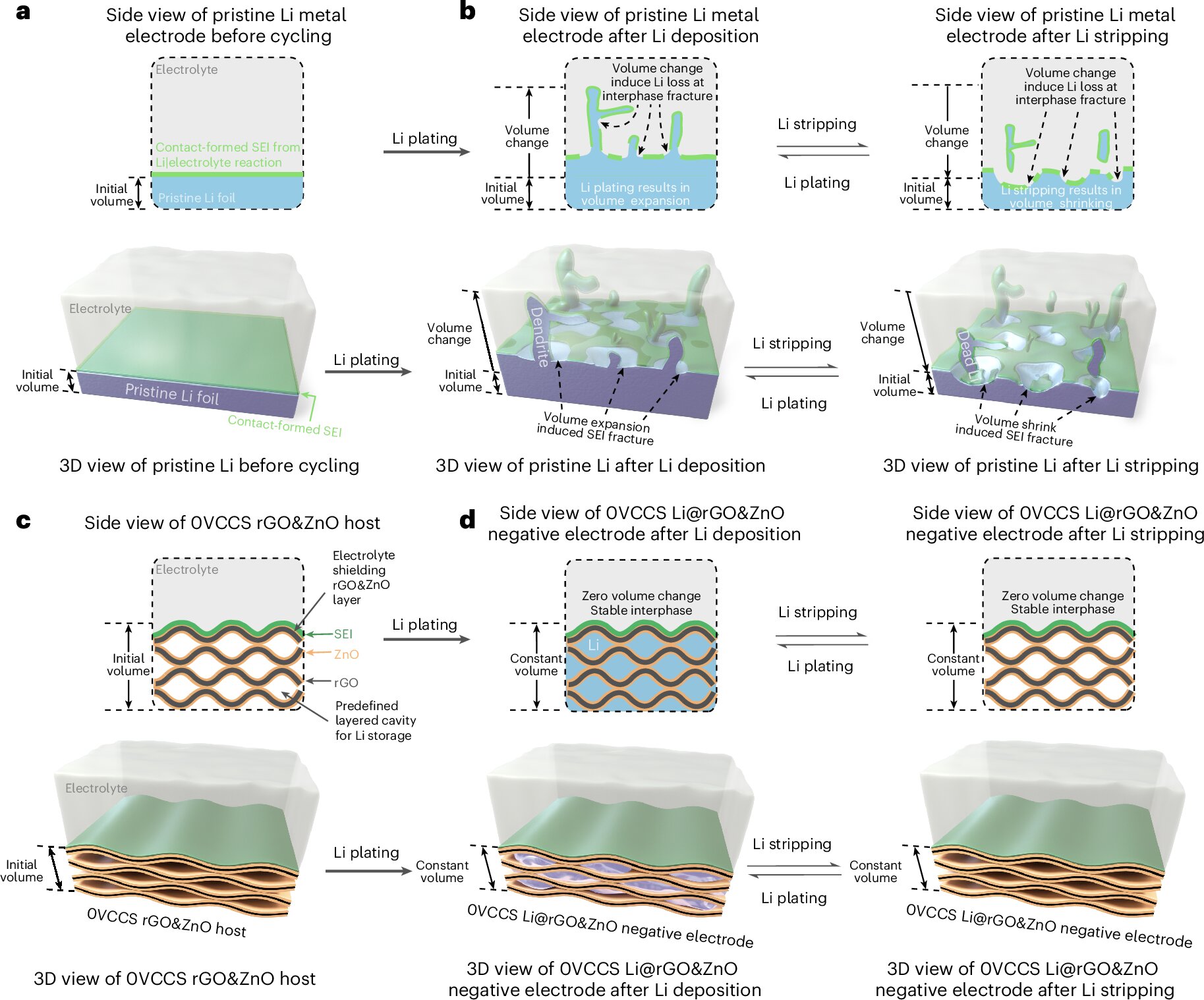
Lithium metal (Li-metal) batteries are among the most promising alternatives to widely employed rechargeable lithium-ion (Li-ion) batteries, as they could store more energy and thus extend the battery life of many electronic devices. Despite their potential, existing Li-metal batteries have been found to be less stable than Li-ion batteries, while also exhibiting lower coulombic efficiencies (CE) and degrading faster over time.
In addition, the Li-metal electrodes integrated in these batteries tend to expand and contract when a battery is charging and discharging. These changes in volume can result in cracks and a loss of electrical contact, further hindering the batteries’ performance.
Researchers at Shandong University, Zhejiang University and other institutes recently introduced a new nanoengineered material that could be used as an electrode in Li-metal batteries, which does not expand or shrink during charging and discharging. The new material, presented in a paper published in Nature Nanotechnology, is comprised of reduced graphene oxide (rGO), a thin material that conducts electricity, and zinc oxide, a stable and electrochemically active ceramic.
“Our recent work stemmed from decades of frustration in the lithium metal battery field, namely that the highest capacity anode material consistently failed due to its infinite volume changes during cycling,” Hao Chen, co-senior author of the paper, told Tech Xplore. “These volume fluctuations rupture solid electrolyte interfaces and trigger irreversible corrosion, preventing the >99.9% coulombic efficiency (CE) essential for practical batteries.”
The main goal of this recent study by Chen and his colleagues was thus to realize an electrode material that does not change in volume and that entirely isolates lithium from the corrosive electrolytes inside a battery. The composite material they realized, based on rGO and ZnO, was found to prompt the formation of a durable solid-electrolyte interphase (SEI), the protective layer separating electrodes from electrolytes in battery cells.
“We designed a two-dimensional, continuous layered-cavity zero-volume-change complete-sealing rGO&ZnO host,” explained Chen. “Its architecture has two key features. First, Li plating/stripping occurs entirely within rigid cavities, eliminating destructive volume expansion. Second, a continuous host structure acts like corrosion-proof armor, entirely preventing electrolyte penetration and contact with Li.”
The material nanoengineered by Chen and his colleagues was found to successfully overcome the limitations of electrodes that are widely employed in Li-metal batteries. In initial tests, it was found to exhibit no changes in volume during charging and discharging, which is highly desirable and proved difficult to achieve so far.
“Our host enabled unprecedented Li cycling,” said Chen. “We attained a record efficiency of 99.99–99.9999% and a coulombic efficiency of almost 2,000 cycles—surpassing the critical >99.9% threshold for viable Li-metal batteries. We solved the core challenge of volume-change-driven Li degradation, demonstrating for the first time that near-perfect Li reversibility is achievable.”
The composite electrode material engineered by this team of researchers could soon be deployed in Li-metal batteries with varying compositions to further assess its potential and performance. In the future, it could contribute to the development of Li-metal batteries with high energy densities and ultra-long lifespans.
“Looking ahead, we are scaling this host design for commercial pouch cells while refining manufacturing processes,” added Chen. “We’re also adapting its zero-volume-change sealing concept to other battery chemistries (e.g., sodium-metal anodes) and exploring integrations with solid-state electrolytes to further enhance safety and energy density—aiming to accelerate real-world deployment through industry partnerships in the next 3–5 years.”
Written for you by our author Ingrid Fadelli,
edited by Lisa Lock, and fact-checked and reviewed by Robert Egan—this article is the result of careful human work. We rely on readers like you to keep independent science journalism alive.
If this reporting matters to you,
please consider a donation (especially monthly).
You’ll get an ad-free account as a thank-you.
More information:
Lequan Deng et al, A nanoengineered lithium-hosting carbon/zinc oxide composite electrode material for efficient non-aqueous lithium metal batteries, Nature Nanotechnology (2025). DOI: 10.1038/s41565-025-01983-4
© 2025 Science X Network
Citation:
Nanoengineered electrode material boosts cycling and efficiency in Li-metal batteries (2025, August 15)
retrieved 15 August 2025
from https://techxplore.com/news/2025-08-nanoengineered-electrode-material-boosts-efficiency.html
This document is subject to copyright. Apart from any fair dealing for the purpose of private study or research, no
part may be reproduced without the written permission. The content is provided for information purposes only.












Mick Mulvaney wants to be clear: He really likes gambling. “You’re talking to the only former member of Congress who’s won a poker tournament in Las Vegas,” he tells WIRED. When he was representing South Carolina in the US House of Representatives, he pushed for the state to allow sports betting.
Because of his background, Mulvaney, a former Trump administration official, says he can tell when something is gambling—and that the sports contracts on prediction markets fit the bill. “You know the old saying, if it walks like a duck and quacks like a duck, it’s a duck?” he asks. “If it looks like a sports bet, if it sounds like a sports bet, if it pays off like a sports bet, if it’s on a sporting event—it’s a sports bet.”
Mulvaney, who was President Trump’s acting White House chief of staff from 2019 to 2020, is now leading a new advocacy coalition called Gambling Is Not Investing, which will lobby for prediction markets to be regulated by state gambling laws. He joins a number of other prominent Republicans calling for similar rules. Earlier this month, former New Jersey Governor Chris Christie and current Utah Governor Spencer Cox both spoke out against the current federal approach to regulating prediction markets. (Christie also used the “quack like a duck” line.)
These developments are part of a fierce political battle over how prediction markets are regulated. On the federal level, the Commodity Futures Trading Commission (CFTC) oversees these platforms, which are currently classified as derivatives markets. While a traditional sportsbook will offer customers a chance to place a bet on which team will win or lose a game, a prediction market will offer an “event contract” on the outcome. Critics view the difference as little more than a loophole, and state authorities from across the country are currently pursuing lawsuits against prediction market companies like Kalshi, alleging that they violate state gambling laws. (While these markets offer event contracts on a wide variety of topics, sporting events are their most popular offerings.) “I love the CFTC, but they’re not set up to do this,” says Mulvaney.
Recently, a group of 23 Democratic Senators sent the CFTC a letter urging it to allow these court cases to play out. It did not appear to go over well; CFTC head Michael Selig insists that prediction markets are correctly classified, and that his agency has jurisdiction over the industry. After Selig released a video promising to see those who “challenge our authority” in court, the CFTC even took the unprecedented step of filing a brief in support of the cryptocurrency platform Crypto.com, which faces a lawsuit from Nevada regulators over its prediction market offering.
During the Biden Administration, the CFTC took a notably different approach to prediction markets, even fining Polymarket $1.4 million for failing to register as a derivatives market and temporarily blocking it from operating in the US.
Now, though, the agency’s friendlier approach appears to dovetail with the White House’s interest in the industry. The Trumps have numerous ties to the prediction market world. Truth Social, the social media platform majority-owned by President Trump and his family, is planning its own prediction market offering, reportedly called Truth Predict. Donald Trump Jr is an advisor to both Kalshi and Polymarket, and his venture capital firm has invested in the latter.
But the launch of Gambling Not Investing demonstrates that there is a growing wing of the Republican party that feels the prediction markets need more guardrails. Its founding member organizations include a number of conservative consumer advocacy groups, including Moms for America, Consumer Action for a Strong Economy, and Frontiers of Freedom.
Mulvaney is hopeful that he can make his case to the current White House. “Their default position is going to be to regulate less, not more. And I respect that,” he says. “But I also know that in the first Trump administration, when there were common sense reasons to do some regulation, that we did that.”

Alaqad says that because traditional media outlets pick and choose what to show their audiences, losing on-the-ground journalists means losing parts of the truth. “When the people are being silenced and censored, and they don’t have a space for them to talk or a platform to express what’s happening, and for us to see what’s happening through their eyes, there will always be limitations [on] how much we know,” she says.
In every crisis, when communication breaks down, accountability is lost and injustice becomes easier to ignore. “Injustice is super loud,” Alaqad says. “Justice needs to be louder.”
Targeted
Journalists are also silenced permanently. Reporters Without Borders (RSF) wrote in December 2025 that 67 media professionals were killed that year, 43 percent of whom were killed in Gaza by Israeli armed forces. The total number of journalists killed in Gaza since October 7, 2023 has risen to over 220, according to the RSF. The UN estimate sits at more than 260.
“When we look at it within the framework of imposing a ban on the foreign press entering Gaza now, more than two years into that war, when they are restricting the free movement of journalists within Gaza and into Gaza, when we are talking about an unprecedented massacre of journalists, the targeting of media offices and the targeting of communication infrastructure just becomes another piece of that puzzle, which aims at imposing a media blackout,” Dagher says. Israel has repeatedly denied claims that it targets journalists or media infrastructure.
“Killing journalists means killing and silencing the truth,” Alaqad says. In her experience, this strategy works on multiple levels—killing journalists means fewer people reporting on the ground, but equally, it turns journalists into a threat to the people. “This is also sending a message to the people that all journalists are a threat, don’t talk to journalists, stay away from journalists,” she explains.
She recalls her mother begging her not to wear her press vest and helmet. Meant to signify neutrality and protect journalists in the field, instead, it made her feel like a target. “It’s supposed to protect, but on the contrary, it actually puts risk on your life and even on your beloved ones and the ones around you,” she explains.
Alaqad says it was not always this way. Early on, people would greet journalists, offer them food, and thank them for their work. “After a couple of months, when they’d seen journalists getting targeted, Palestinians started treating journalists differently,” she says.
To report in Gaza was to work inside a landscape where time itself was unstable and not guaranteed. Plans rarely extended beyond daylight. Conversations ended abruptly. Addresses became memorials overnight. “The only certainty in Gaza is uncertainty,” Alaqad says.
She recalls interviewing families and planning to return the next day, only to find that the people she spoke with had been killed in airstrikes.
She has since left Gaza, and is pursuing a master’s degree in media studies at the American University of Beirut. She received the Shireen Abu Akleh Memorial Endowed Scholarship, named for the Palestinian journalist killed by Israeli forces in May 2022.
Digital Truths
Going viral on social media helped her reach people, but it also put her at risk. “It showed millions of people around the world what’s happening in Gaza, but at what cost? Being in Gaza could cost you your life, especially as a journalist,” she says.
Despite the reach of digital reporting, she does not trust its permanence. Accounts disappear, posts are removed and videos are lost. What is available today may be gone tomorrow.

After two years of intensive development and close collaboration with leading global brands, together with its customers, the company is unveiling its complete footwear solution at ITMA Asia + CITME Singapore 2025, marking a turning point for digital production in footwear. For the first time, Kornit technology has crossed the milestone of more than one million pairs of sports shoes sold globally under leading brands, proving that digital footwear manufacturing has moved beyond concept and is now a fully scaled commercial reality.
Kornit Digital has launched its revolutionary digital footwear solution at ITMA Asia + CITME Singapore 2025, marking a major step in sustainable, on-demand footwear production.
The solution allows direct digital printing on technical fabrics, combining design flexibility, precision, and durability.
The company is exhibiting at Hall 6 Stand C204 at the event.
A Massive Market Opportunity for Digital Transformation, and Kornit is Just Getting Started
The addressable market Kornit is targeting represents roughly one billion decorated shoe uppers each year across the global sports and athleisure footwear industry. This is a massive and fast-growing segment shaped by consumer demand for variety, innovation, and personalization. Kornit’s technology directly addresses the key challenges of this market, including design limitations, long development cycles, and overproduction, by replacing complex analog decoration with a single-step digital workflow that delivers durability, flexibility, and limitless design freedom. Kornit’s patented technology enables high-quality, durable prints directly on technical fabrics used in footwear, combining precision, sustainability, and performance in one streamlined process. This innovation redefines how footwear is designed and produced, shifting from traditional mass-production methods to agile, efficient, and creative digital workflows that allow brands to create on demand.
Following successful deployments with two leading footwear manufacturers in China, Kornit is expanding globally with additional customers in Vietnam and in Germany, setting a new standard for agility, creativity, and sustainability across the world’s leading footwear hubs. Ronen Samuel, Chief Executive Officer at Kornit Digital said:
“The footwear industry is undergoing a profound transformation. Through close collaboration with visionary partners and relentless innovation, we have developed a fully digital solution that redefines how shoes are designed, produced, and delivered. What started as a concept is now being adopted at scale, with leading global brands. Kornit has always been about pushing boundaries, and this milestone marks a new era for digital manufacturing and sustainable growth.”
Customer feedback highlights that Kornit’s digital solution has dramatically accelerated footwear development and unlocked creative freedom. What took months now happens in days, enabling brands to respond faster to trends and deliver distinctive, high-performance products with consistency and efficiency.
Kornit’s footwear solution also sets new standards for sustainability. The process requires no water, uses minimal energy, and enables local, near-shore production—reducing waste, inventory, and carbon footprint while allowing brands to produce only what is sold.
Looking ahead, Kornit’s next-generation patented footwear technology will be introduced at Techtextil 2026 in Frankfurt, showcasing new specialized polymers and expanded material compatibility that will further enhance performance and scalability.
Visit Kornit at ITMA Asia + CITME Singapore 2025, Hall 6 Stand C204, to experience how creativity is replacing complexity and digital is replacing analog, empowering the footwear industry to move at the speed of imagination, with Kornit leading the way.
Note: The headline, insights, and image of this press release may have been refined by the Fibre2Fashion staff; the rest of the content remains unchanged.
Fibre2Fashion News Desk (KD)


Will petrol and diesel prices go up now?

Bangladesh’s CPD calls for reforms in biz & tax climate, trade deals

Iran says has ‘no choice’ but to fight back, holds no enmity toward American people

Pakistan carries out precision strikes on seven militant hideouts in Afghanistan

Eye-popping rise in one year: Betting on just gold and silver for long-term wealth creation? Think again! – The Times of India

These Cheap Noise-Cancelling Sony Headphones Are Even Cheaper Right Now

-
 Politics1 week ago
Pakistan carries out precision strikes on seven militant hideouts in Afghanistan
-
Business1 week ago
Eye-popping rise in one year: Betting on just gold and silver for long-term wealth creation? Think again! – The Times of India
-
 Tech1 week ago
These Cheap Noise-Cancelling Sony Headphones Are Even Cheaper Right Now
-

 Entertainment1 week ago
Viral monkey Punch makes IKEA toy global sensation: Here’s what it costs
-

 Sports1 week ago
Kansas’ Darryn Peterson misses most of 2nd half with cramping
-

 Sports1 week ago
How James Milner broke Premier League’s appearances record
-
Sports1 week ago
Mike Eruzione and the ‘Miracle on Ice’ team are looking for some company
-

 Entertainment1 week ago
Saturday Sessions: Say She She performs "Under the Sun"