

Business
Our son can’t come home for Christmas after insulation mould took over


Zoe ConwayNews Correspondent
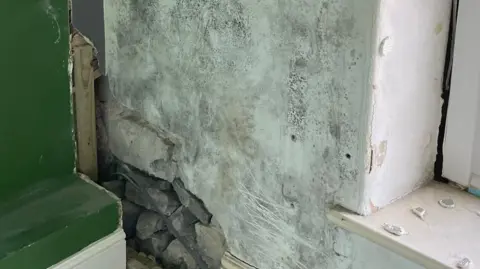
Tony and Becs Wadley say they can’t spend Christmas at home after insulation installed under a government scheme has caused black mould in several rooms, and their asthmatic son can’t be inside the property.
Mr Wadley says the situation is tearing the family apart: ”It’s awful. Elliott can’t come into our house, it’s as if he’s been ostracised from his own home.”
The couple are among more than 300 people who have contacted the BBC in recent weeks to tell us about insulation that has gone wrong in their homes.
The Department of Energy Security and Net Zero (DESNZ) said it was taking action to ensure consumers are no longer let down by poor installations.
 Becs Wadley
Mr and Mrs Wadley got a government grant to have energy efficiency measures fitted in their Gower Peninsula house because they hoped a warmer home would help Elliott’s asthma. The grant covered the cost of insulating his bedroom walls.
But months after the work was completed, the Wadleys discovered black mould was growing behind the insulation boards. It was removed by the installer and replaced with a new insulation system. But this also had to be removed along with all the plaster after it became damp. Elliott, 19, hasn’t entered the house since April, instead staying with his grandmother during university breaks.
”I miss him like you wouldn’t believe’,” says Mrs Wadley.
The family are going to stay with Mr Wadley’s sister for Christmas so they can all be together.
Billions of pounds of public money has been spent on insulating homes over the last 15 years.
The Wadleys’ home was insulated under a government scheme known as ECO4. In October, the National Audit Office (NAO) spending watchdog found that 98% of homes fitted with external wall insulation under ECO4 and the Great British Insulation Scheme since 2022 had major issues that needed to be repaired.
It added that 29% of homes that had internal wall insulation fitted under the schemes had major issues.
The report also said there had been “weak” government oversight and regulatory ”failure”.
DESNZ said it had “inherited a flawed system of oversight and regulation”. A spokesman for the department said it was “committed to introducing comprehensive reforms through the Warm Homes Plan to ensure that consumers get the quality installations they deserve and failures like these are not repeated”.
The spokesman added: “People should not be expected to navigate a complex web of organisations when they want to improve their homes – and with this government, they won’t.”

 Becs Wadley
In the downstairs rooms of the Wadleys’ home the insulation has also failed and has had to be removed. There is black mould on the walls while electric sockets hang loose with the wires exposed. The family says it has been in this condition for months.
The installer, Stellar Energy, says it has ”no record of any immediate safety hazards being flagged.” It says the descriptions of the exposed wires and sockets was “highly inconsistent” with their standard operating procedures, which required all such work to be made safe.
Building surveyor, David Walter, says the insulation wasn’t fitted correctly and says the installer ”didn’t understand what they were doing and what they were doing to the building which is why we’ve got these problems.”
Stellar Energy told the BBC the design was ”technically correct for a stone house and was installed…in strict accordance with the mandatory technical specifications of ECO4.”
Mr Wadley says he wouldn’t have signed up for the grant if he’d known what would happen. ”You wouldn’t put your family through this. Nobody would. Somebody needs to take responsibility.”
Stellar Energy says it ”sincerely regrets any distress this situation has caused the family” and says its priority is ”providing a final resolution to ensure the home meets the high standards” it strives for.

Scott Proudman contacted the BBC about the botched external wall insulation fitted to his Bristol home in 2021.
His family had been eligible for a government grant because of his eight-year-old daughter’s disabilities. Born 24 weeks premature, she has cerebral palsy, a partial visual impairment and was recently diagnosed with autism.
”I feel like a failure every time I come home because this was meant to be something to look after my family, to make life easier, and it hasn’t,” he says.
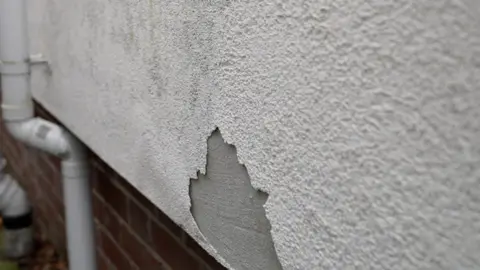
When the work was done, insulation boards were fixed to the outside of the house and render was applied to make it waterproof. But the render has been falling off for years.
 Scott Proudman
Building surveyor Mr Walter, says poor design and poor workmanship has caused the render to disintegrate. He says rainwater will very likely get under the cracked render and behind the insulation and will likely cause dampness inside.
”It’s like a timebomb. It’s going to get worse and worse, affecting the inside of the property,” he says.
Mr Walter says all of the render and insulation will have to come off and will cost tens of thousands of pounds to put right.
Right now the family is stuck with the repair bill because the installer, SPMS Wales, is being liquidated and Mr Proudman says they weren’t given the required guarantee for the work. Trustmark, the organisation responsible for overseeing quality, told Mr Proudman it couldn’t help because the company is no longer accredited.
Mr Proudman says he chose the company ”because it was on a government website and was Trustmark registered. I can’t believe how few rights consumers have.”
Brett Langdon, a director at SPMS Wales says he is ”very sorry the Proudmans have ended up in this situation” and says all works ”were done to the manufactures specification.” He says he gave a guarantee to the Proudmans but has told the BBC he can’t remember who the guarantee is with. He says the delamination of the render was “due to a failure of the system”.
In a statement TrustMark said it was ”very sorry to hear about what’s happened to Mr and Mrs Proudman and Mr and Mrs Wadley and the conditions both families’ homes have been left in. It is totally unacceptable and we are in discussions with the relevant Scheme Providers and guarantee providers to help resolve these situations.”
And it said it underlined ”the need for reform to the current system”.

The equity market rose on Tuesday as hopes of easing Middle East tensions lifted sentiment, while reports that Pakistan may be playing a mediating role between the United States and Iran added support.
The Pakistan Stock Exchange’s (PSX) benchmark KSE-100 Index closed at 152,207.89 points, up 1,225.99 points, or 0.8%, versus the previous close of 152,740.37. During the session, the index traded between a high of 157,442.68, up 4,702.31 points, or 3.08%, and a low of 153,382, up 641.63 points, or 0.42%.
“The market opened on a positive note, driven by investor optimism surrounding the potential easing of geopolitical tensions and further supported by Pakistan’s perceived geopolitical relevance following media reports suggesting the country may be mediating between the United States and Iran,” said Huzaifa Riaz, Director, Mayari Securities (Pvt) Limited.
US President Donald Trump said on Monday he had ordered a five-day postponement of any military strikes against Iranian power plants, citing what he described as “very good and productive” conversations over the past two days about a “complete and total resolution of hostilities in the Middle East”.
Iran’s Fars news agency later reported there had been no direct communication with the United States or through intermediaries, citing an unnamed source, while also quoting Deputy Speaker Ali Nikzad as saying there would be no talks and that the Strait of Hormuz would remain effectively closed.
Asian equities rose on the headlines as hopes of de-escalation briefly strengthened, with Tokyo, Hong Kong, Shanghai, Sydney, Seoul, Taipei and Manila higher, though gains pared as trading progressed. Oil prices, after plunging on Monday, edged up again as the outlook remained uncertain.
Analysts said market direction would remain tied to Middle East developments, with investors also watching post-Ramadan participation and upcoming inflation data.
AKD Research said any de-escalation could trigger a sharper rebound as valuations had turned more attractive, with forward price-to-earnings at 6.6 times. Arif Habib Limited Research put the market at a price-to-earnings ratio of 7.5 times and a dividend yield of around 6.8%.
Business
After Trump’s sanction waiver, Reliance Industries procures 5 million barrels of Iran crude oil: Report – The Times of India

With the US waiving sanctions on Iran oil, Reliance Industries has reportedly bought 5 million barrels of Iranian crude. Reliance runs the world’s largest refining complex. The effective closure of the Strait of Hormuz has led to global crude oil prices shooting up. In recent years, Iranian crude has largely been purchased by independent refiners in China and is often rebranded as originating from other countries.Last Friday, the Donald Trump administration granted a 30-day waiver on sanctions for Iranian oil already in transit. The exemption covers cargo loaded on or before March 20, including shipments on sanctioned vessels, provided it is discharged by April 19.
Reliance buys Iran crude oil
Two sources told Reuters that the cargo was sourced from the National Iranian Oil Company. One of them noted that the crude was priced at a premium of about $7 per barrel over ICE Brent futures. The delivery schedule is not yet known.The transaction marks India’s first import of Iranian oil since May 2019, when the country, the world’s third-largest importer and consumer of crude, stopped purchases following the reimposition of US sanctions on Tehran.The move follows large-scale buying of Russian crude by Indian refiners, who secured more than 40 million barrels to deal with supply crunch from the Middle East.Other Asian refiners, including Indian state-run firms, are evaluating whether to buy Iranian oil, sources said.
State refiners hesitant?
At the same time, a Bloomberg report indicates that state-run refiners are reluctant to procure Iranian crude, as apprehensions around operational, financial and regulatory hurdles could outweigh any short-term benefits.Despite the sanctions waiver granted by the administration of Donald Trump, these refiners have remained cautious. Persistent uncertainties linked to shipping, insurance and payment mechanisms have so far prevented deals from being finalised.The brief duration of the waiver is a major concern. Refiners worry that any delays in execution could push shipments beyond the allowed timeframe, potentially exposing them to the risk of sanctions.
Business
Property Play: Home flippers see smallest profits since the Great Recession, real estate data firm says

Vesnaandjic | E+ | Getty Images
A version of this article first appeared in the CNBC Property Play newsletter with Diana Olick. Property Play covers new and evolving opportunities for the real estate investor, from individuals to venture capitalists, private equity funds, family offices, institutional investors and large public companies. Sign up to receive future editions, straight to your inbox.
Higher mortgage rates, high home prices and tight supply are all conspiring to squeeze investors in the home flipping play.
In all of 2025, roughly 297,000 single-family homes and condos were flipped nationwide, according to ATTOM, a real estate data provider, which defines a flip as a home purchased and sold in the same 12-month period. That was a decrease of 3.9% from 2024 and the lowest number of flips in any year since 2020. Investor flips accounted for 7.4% of all 2025 home sales, down from 7.6% in 2024.
Flips are falling because profits are making it less and less worth it.
With the backdrop of the highest median home prices on record, the typical home flip netted investors just $65,981 in gross profit, or a 25.5% return on investment, according to ATTOM. That is down from 32% the prior year and the lowest rate since the Great Recession in 2008.
“Competition for homes remains strong in many markets due to constrained supply,” Rob Barber, CEO of ATTOM, said in a release. “With prices staying elevated, investors are finding it harder to secure deals that deliver strong returns.”
For comparison, in the boom decade following the financial crisis, profit margins were higher than 50%, peaking at 61% in 2012, which is around the time home prices bottomed.
Net profits, or investor returns that factor in the cost of fixing up the property, can vary widely depending on local labor, material and financing costs. Across the U.S., however, the cost of fixing properties before flipping remains elevated due to ongoing supply chain pressures and tariff-related increases in material prices, which continue to compress investor margins, according to ATTOM.
There are signs, however, that the flipping market could improve this year, as home prices are expected to moderate further and mortgage rates remain below year-ago levels.
“After nearly 4 years of declining flipped home transaction volume, our survey is picking up signs of positive momentum in the fix-and-flip space,” Alex Thomas, research manager at John Burns Research and Consulting, wrote in a recent report.
The firm partners with Kiavi on a Fix and Flip Housing Market Index, which looks at investor sentiment in the market. In the fourth quarter of 2025, it recorded the largest quarter-over-quarter gain in three years and a reversal of six consecutive quarters of declines.
In addition, 71% of investors surveyed said they expect to purchase more homes this year, compared with 66% last year and 49% in 2024, according to the JBRC/Kiavi survey. That is the highest share in its four-year history.
Fewer flippers are also reporting disappointing results from their investments. Nationally, 17% of flippers in the fourth quarter reported selling “mostly below” expected after-repair volume, or ARV, down from 21% in the prior quarter, per the survey.
“Because flippers tend to cut prices faster than typical home sellers during slowdowns (to avoid costly holding periods), this improvement is an early signal that the pricing environment is firming,” Thomas wrote.
He also said several provisions in last summer’s “big beautiful bill” could boost fix-and-flip profitability, including enhanced depreciation, a permanent 20% qualified business income deduction and deductible interest expenses on fix-and-flip loans.
Other measures of real estate flipper sentiment, including the RCN Capital Investor Sentiment Survey, a quarterly report prepared by CJ Patrick Company, also cite optimism.
“It’s those improving market conditions — more inventory, moderating home prices, and slightly better financing costs — coupled with pent-up demand from buyers and increased numbers of distressed properties for sale that I think should give flippers more opportunities as the year goes on,” said Rick Sharga, CEO of CJ Patrick.
The wild card will be mortgage rates. More investors are using financing, at 37.7% in 2025 compared with 36.9% in 2024, according to ATTOM. Rates were expected to be lower this year, but the Iran war and the resulting rise in oil prices have upended those forecasts.
“Flippers are having to get more creative to maintain profitability,” Barber said. “That could include taking on older homes, as the median flipped property in 2025 was built in 1978, the oldest since we began tracking, along with tighter cost control and more disciplined renovation strategies.”


Ole Miss to launch center devoted to risks, effects of gambling

War economy fuels $252 bn technical textile boom amid cost surges

Op. True Promise 4: Iranian missiles rain down on Israel’s intelligence hubs in new wave

-

 Entertainment1 week ago
Strategic oil stocks to be released ‘immediately’ in Asia and Oceania: IEA
-

 Tech7 days ago
Justice Department Says Anthropic Can’t Be Trusted With Warfighting Systems
-
 Business1 week ago
Stocks To Watch: Tata Motors, IndiGo, Jindal Stainless, GMR Airports, Hindalco, And Others
-

 Sports1 week ago
Men’s March Madness 2026 bracket: Get to know all 68 teams
-
 Business1 week ago
Gas supply crunch a worry for AC makers ahead of peak season – The Times of India
-

 Tech1 week ago
Early Deals From the Amazon Spring Sale That Passed Our BS Test
-

 Sports6 days ago
March Madness 2026 – How to watch in SA, start time, schedule, TV channel for NCAA championship basketball tournament
-

 Fashion1 week ago
Trump signs order to combat fraudulent ‘Made in America’ labels