

Business
Why the US is buying icebreakers from Finland

Adrienne MurrayBusiness reporter, Helsinki
 Aker Arctic Technology
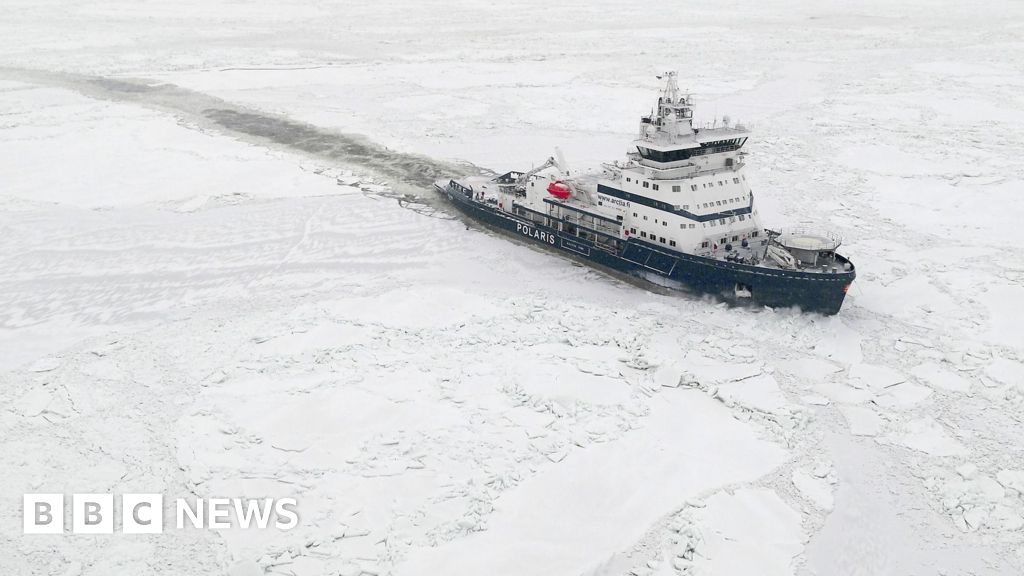
As President Donald Trump continues to insist that the US needs to own Greenland, his wider focus on the Arctic region has seen Washington order new icebreakers.
For these ships, which can sail through seas covered in solid ice, the US has gone to the world expert – Finland.
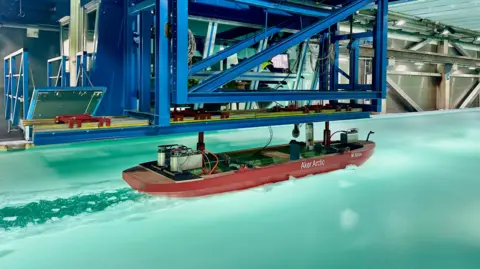
Temperatures are sub-zero inside Aker Arctic Technology’s ice laboratory, as the scale model of an icebreaker cruises down a 70m-long simulation tank.
It ploughs a neat channel through the frozen surface of the water.
Undergoing testing at a facility in Helsinki, Finland’s capital, this is a design for the next generation of the country’s icebreakers.
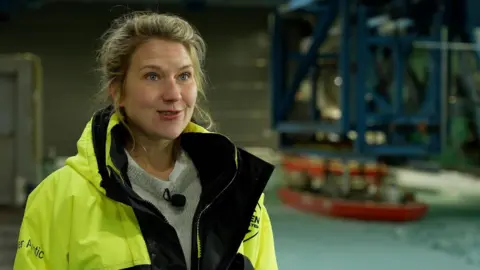
“It’s crucial that it has sufficient structural strength and engine power,” says ice performance engineer, Riikka Matala.
Mika Hovilainen, the firm’s chief executive, adds that the shape of the vessel is also crucial. “You have to have a hull form that breaks ice by bending it downwards,” he says. “It’s not cutting, it’s not slicing.”
Finland is the undisputed world leader when it comes to icebreakers. Finnish companies have designed 80% of all those currently in operation, and 60% were built at shipyards in Finland.
The country leads the way out of necessity, explains Maunu Visuri, president and chief executive of Finnish state-owned company Arctia, which operates a fleet of eight icebreakers.
“Finland is the only country in the world where all the harbours may freeze during wintertime,” he says, adding that 97% of all goods to the country are imported by sea.
During the coldest months, icebreakers keep Finland’s ports open, and work as pathfinders for big cargo ships. “It’s really a necessity for Finland. We say that Finland is an island.”
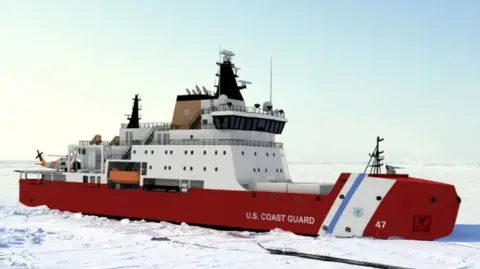
It was this expertise that saw Trump announce in October that the US planned to order four icebreakers from Finland for the US Coast Guard.
A further seven of the vessels, which the US is calling “Arctic Security Cutters”, are to be built in the US, using Finnish designs and expertise.
“We’re buying the finest icebreakers in the world, and Finland is known for making them,” said Trump.

 Adrienne Murray
Under US law, the country’s naval and coastguard ships must be domestically-built, but in this case the president waived that requirement on national security grounds. He cited “aggressive military posturing, and economic encroachment by foreign adversaries”, by which he means Russia and China.
This US concern comes as climate change continues to make the Arctic Ocean more navigable for cargo ships, at least if icebreakers lead the way by cutting a path. This opens up commercial trade routes from Asia to Europe, either above Russia, or north of Alaska and Canada’s mainland, and down past Greenland.
Reduced ice levels also mean that oil and gas fields beneath the Arctic are more accessible.
“There’s simply a lot more traffic in that part of the world now,” notes Peter Rybski, a retired US Navy officer and Helsinki-based, Arctic expert.
“You have an active oil and gas exploration and extraction industry in Russia, as well as a newly-emerging trans-shipment route from Europe to Asia.”
 Rauma Marine Constructions
Following Trump’s outline announcement last autumn, the first contracts were awarded on 29 December.
Finland’s Rauma Marine Constructions is to build two icebreakers for the US Coast Guard at its shipyard in the Finnish port of Rauma. The first ship is due to be delivered in 2028.
A further four will be constructed in Louisiana, with all six using an Aker Arctic Technology diesel-electric powered design.
The US orders are part of an effort to catch up with the number of Russian icebreakers. Currently Russia has around 40, including eight that are nuclear powered.
By contrast, the US presently only has three in operation.
Meanwhile China operates around five polar-capable vessels. “None of them are technically icebreakers,” says Rybski, pointing to their design not meeting the strict criteria. “But they are increasing their fleet.”
He adds that China has increasingly been sending these “research” ships into Arctic waters between Alaska and the far east of Russia, including areas that the US considers its “exclusive economic zone”.
“With limited means to respond this becomes a problem [for the US].”
Trump’s desire to enlarge its icebreaker fleet goes beyond the practicalities of operating in ice-clad Arctic seas, assesses Lin Mortensgaard, a researcher at the Danish Institute of International Studies. She says it is also about projecting power.
“No matter how many aircraft carriers you have and how much you use them to threaten states with, you cannot sail your aircraft carrier into the central Arctic Ocean,” she says.
“Icebreakers are really the only kind of naval vessel to signal that you are an Arctic state, with Arctic capabilities. And I think this is what much of the US discourse is about.”
 James Brooks
Back in Finland, Helsinki Shipyard occupies a dock on the capital’s waterfront. It is where half of the world’s icebreakers have been made. Today owned by Canadian firm Davie, it also hopes to win new contracts from the US Coast Guard.
“The geopolitical situation has changed definitely,” says the shipyard’s managing director, Kim Salmi.
“We have our eastern neighbour here [Russia]. They are building their own [new] fleet. And the Chinese are building their fleet.”
He adds: “The US, Canada and the western allies in general, are looking for the power balance.”
Inside a cavernous shipbuilding hangar, workers cut and weld steel for the yard’s latest icebreaker, a heavy-duty Arctic vessel, called Polarmax that’s destined for the Canadian coastguard.
The Finns can build these complex vessels remarkably swiftly – it takes between two-and-a-half and three years – thanks to a streamlined production method, and decades of experience.
“Over 100 years, we have practised this,” says Arctia’s Visuri. “You’ve got this cycle of designers, operators, builders. That’s why Finland is the superpower of icebreakers.”

It is unusual for a senior figure at the Bank to be so forthright on market movements.
Source link

Consumer confidence has fallen for the third consecutive month amid household “jitters” over rapid price rises, figures show.
GfK’s long-running consumer confidence index fell four points to minus 25 in April, following falls of two points and three points in March and February respectively.
The deepening concern was driven by perceptions of the UK economy, with a six-point slide in confidence for the next 12 months to minus 43, its lowest level since February 2023.
Confidence in personal finances over the coming year fell five points to minus four – one point lower than this time last year.
The major purchase index – an indicator of confidence in buying big ticket items – held steady, albeit at minus 18 but one point better than last April.
The only measure to improve was the savings index – often an indication that households are concerned about their finances and looking to build contingency funds – which is up five points to 32.
Neil Bellamy, consumer insights director at GfK, said: “Consumers really do have the jitters now.
“It is a year since we last saw a monthly drop of this size, and we have to go back to October 2023 to find the last time consumer confidence was lower.
“Everyone is grappling with rapid price rises, especially at the fuel pumps, which are taking a dent out of household budgets, and people know further price hikes are coming.
“Consumer confidence is deteriorating sharply, with fuel prices and threats of more energy price increases acting as constant reminders of inflation.
“While the Gulf crisis is intensifying pressures, much of the current strain reflects earlier domestic cost increases.
“How long can all this disruption and pain continue?”

People walk past a Nike store in New York City, on April 2, 2025.
Kylie Cooper | Reuters
Nike announced a new round of layoffs Thursday affecting approximately 1,400 employees across the organization, mostly concentrated in its technology department.
In a note from COO Venkatesh Alagirisamy, the company said the layoffs were part of Nike’s broader “Win Now” turnaround strategy aiming to reshape its technology team, modernize its Air manufacturing, move some of its Converse Footwear operations and integrate its materials supply chain work into its footwear and apparel supply chain teams.
“Collectively, these changes will result in a reduction of approximately 1,400 roles in global operations, with the majority in technology,” Alagirisamy wrote. “These reductions are very hard for the teammates directly affected and for the teams around them, too.”
A Nike spokesperson said the layoffs are about better positioning the organization for the current pace of sports and accelerating its growth. The layoffs affect employees across North America, Asia and Europe and represent less than 2% of the company’s total global head count.
“This is not a new direction,” Alagirisamy wrote. “It is the next phase of the work already underway.”
Affected employees will be notified beginning Thursday, Nike added.
CEO Elliott Hill has been working to turn Nike around after years of slumping sales. While Hill has made some initial progress, it’s come with some bumps in the road.
Nike announced 775 job cuts in January, primarily at its U.S.-based distribution centers, due to the company’s work in accelerating its use of automation. At the time, the company said the cuts are part of Nike’s goal to return to “long-term, profitable growth.”
Those layoffs came on top of a round of cuts last summer that affected less than 1% of Nike’s corporate staff as part of the company’s efforts to realign the business.
In its third fiscal quarter earnings report last month, the retailer warned that sales will continue to fall for the rest of the year, primarily led by an anticipated 20% decline in China during the current quarter.
— CNBC’s Jessica Golden contributed to this report.


Rams make surprise first-round move, take Alabama QB Ty Simpson

Luke Grimes shares what disappoints ‘Yellowstone’ fans the most

US Special Forces Soldier Arrested for Polymarket Bets on Maduro Raid

-

 Fashion1 week ago
France’s LVMH Q1 revenue falls 6%, shows resilience amid Iran war
-

 Entertainment1 week ago
Is Claude down? Here’s why users are seeing errors
-

 Sports1 week ago
PSL 11: Peshawar Zalmi win toss, opt to field first against Quetta Gladiators
-

 Tech1 week ago
The Deepfake Nudes Crisis in Schools Is Much Worse Than You Thought
-
 Business1 week ago
Standard Life buys rival in £2b deal to create savings giant
-

 Tech1 week ago
CYBERUK ’26: UK lagging on legal protections for cyber pros | Computer Weekly
-

 Fashion1 week ago
Raymond unveils luxury Chairman’s Collection Store in Mumbai
-
 Business1 week ago
PepsiCo earnings beat estimates as North American food business improves