

Business
Pakistan’s crisis differs from world | The Express Tribune

1729471601-0/image-(8)1729471601-0-640x480.webp "Pakistan’s crisis differs from world | The Express Tribune")
Multiple elite clusters capture system as each extracts benefits in different ways
Pakistan’s ruling elite reinforces a blind nationalism, promoting the belief that the country does not need to learn from developed or emerging economies, as this serves their interests. PHOTO: FILE
KARACHI:
Elite capture is hardly a unique Pakistani phenomenon. Across developing economies – from Latin America to Sub-Saharan Africa and parts of South Asia – political and economic systems are often influenced, shaped, or quietly commandeered by narrow interest groups.
However, the latest IMF analysis of Pakistan’s political economy highlights a deeper, more entrenched strain of elite capture; one that is broader in composition, more durable in structure, and more corrosive in its fiscal consequences than what is commonly observed elsewhere. This difference matters because it shapes why repeated reform cycles have failed, why tax bases remain narrow, and why the state repeatedly slips back into crisis despite bailouts, stabilisation efforts, and policy resets.
Globally, elite capture typically operates through predictable channels: regulatory manipulation, favourable credit allocation, public-sector appointments, or preferential access to state contracts. In most emerging economies, these practices tend to be dominated by one or two elite blocs; often oligarchic business families or entrenched political networks.
In contrast, Pakistan’s system is not captured by a single group but by multiple competing elite clusters – military, political dynasties, large landholders, protected industrial lobbies, and urban commercial networks; each extracting benefits in different forms. Instead of acting as a unified oligarchic class, these groups engage in a form of competitive extraction, amplifying inefficiencies and leaving the state structurally weak.
The IMF’s identification of this fragmentation is crucial. Unlike countries where the dominant elite at least maintains a degree of policy coherence, such as Vietnam’s party-led model or Turkiye’s centralised political-business nexus, Pakistan’s fragmentation results in incoherent, stop-start economic governance, with every reform initiative caught in the crossfire of competing privileges.
For example, tax exemptions continue to favour both agricultural landholders and protected sectors despite broad consensus on the inefficiencies they generate. Meanwhile, state-owned enterprises continue to drain the budget due to overlapping political and bureaucratic interests that resist restructuring. These dynamics create a fiscal environment where adjustment becomes politically costly and therefore systematically delayed.
Another distinguishing characteristic is the fiscal footprint of elite capture in Pakistan. While elite influence is global, its measurable impact on Pakistan’s budget is unusually pronounced. Regressive tax structures, preferential energy tariffs, subsidised credit lines for favoured industries, and the persistent shielding of large informal commercial segments combine to erode the state’s revenue base.
The result is dependency on external financing and an inability to build buffers. Where other developing economies have expanded domestic taxation after crises, like Indonesia after the Asian financial crisis, Pakistan’s tax-to-GDP ratio has stagnated or deteriorated, repeatedly offset by politically negotiated exemptions.
Moreover, unlike countries where elite capture operates primarily through economic levers, Pakistan’s structure is intensely politico-establishment in design. This tri-layer configuration creates an institutional rigidity that is difficult to unwind. The civil-military imbalance limits parliamentary oversight of fiscal decisions, political fragmentation obstructs legislative reform, and bureaucratic inertia prevents implementation, even when policies are designed effectively.
In many ways, Pakistan’s challenge is not just elite capture; it is elite entanglement, where power is diffused, yet collectively resistant to change. Given these distinctions, the solutions cannot simply mimic generic reform templates applied in other developing economies. Pakistan requires a sequenced, politically aware reform agenda that aligns incentives rather than assuming an unrealistic national consensus.
First, broadening the tax base must be anchored in institutional credibility rather than coercion. The state has historically attempted forced compliance but has not invested in digitalisation, transparent tax administration, and trusted grievance mechanisms. Countries like Rwanda and Georgia demonstrate that tax reforms succeed only when the system is depersonalised and automated. Pakistan’s current reforms must similarly prioritise structural modernisation over episodic revenue drives.
Second, rationalising subsidies and preferential tariffs requires a political bargain that recognises the diversity of elite interests. Phasing out energy subsidies for specific sectors should be accompanied by productivity-linked support, time-bound transition windows, and export-competitiveness incentives. This shifts the debate from entitlement to performance, making reform politically feasible.
Third, Pakistan must reduce its SOE burden through a dual-track programme: commercial restructuring where feasible and privatisation or liquidation where not. Many countries, including Brazil and Malaysia, have stabilised finances by ring-fencing SOE losses. Pakistan needs a professional, autonomous holding company structure like Singapore’s Temasek to depoliticise SOE governance.
Fourth, politico-establishment reform is essential but must be approached through institutional incentives rather than confrontation. The creation of unified economic decision-making forums with transparent minutes, parliamentary reporting, and performance audits can gradually rebalance power. The goal is not confrontation, but alignment of national economic priorities with institutional roles.
Finally, political stability is the foundational prerequisite. Long-term reform cannot coexist with cyclical political resets. Countries that broke elite capture, such as South Korea in the 1960s or Indonesia in the 2000s, did so through sustained, multi-year policy continuity.
What differentiates Pakistan is not the existence of elite capture but its multi-polar, deeply institutionalised, fiscally destructive form. Yet this does not make reform impossible. It simply means the solutions must reflect the structural specificity of Pakistan’s governance. Undoing entrenched capture requires neither revolutionary rhetoric nor unrealistic expectations but a deliberate recalibration of incentives, institutions, and political alignments. Only through such a pragmatic approach can Pakistan shift from chronic crisis management to genuine economic renewal.
The writer is a financial market enthusiast and is associated with Pakistan’s stocks, commodities and emerging technology




Business
IIP sees 4.8% YoY growth in January; manufacturing & electricity support rise – The Times of India
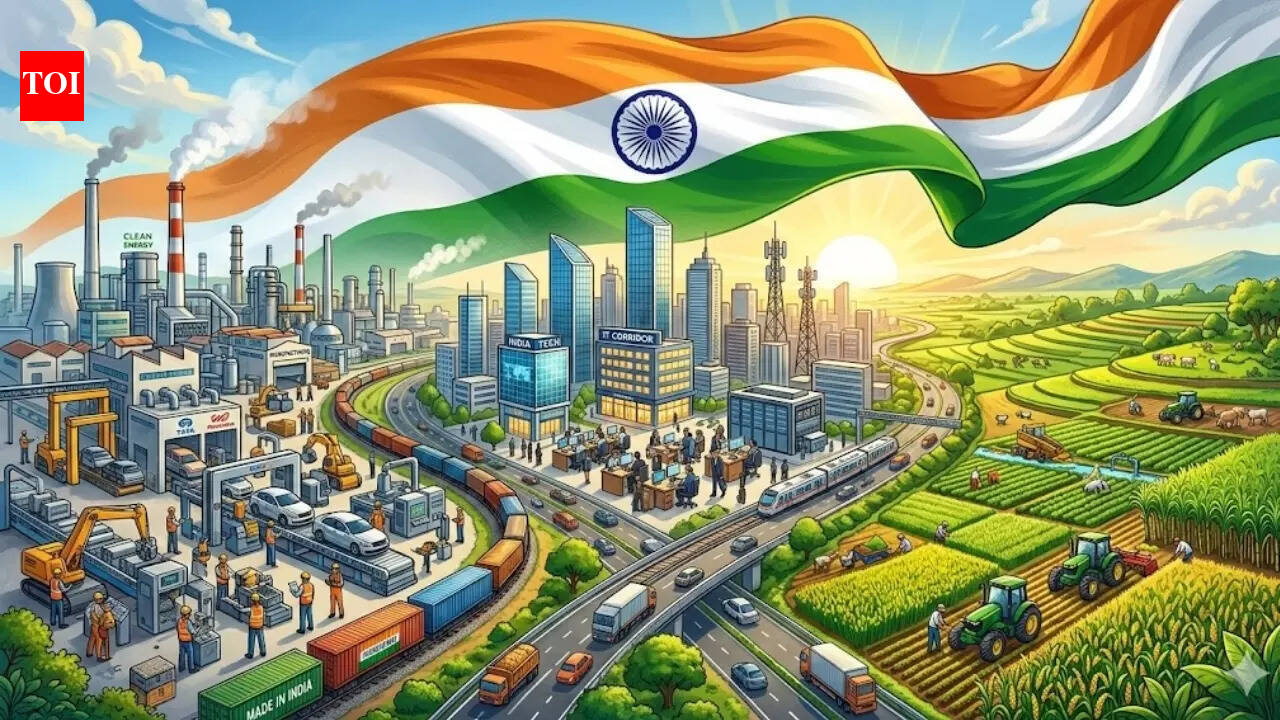
India’s Index of Industrial Production saw a 4.8% increase year-on-year in January 2026, according to the Ministry of Statistics & Programme Implementation. The rise in industrial output was largely driven by a 4.8 per cent expansion in manufacturing and a 5.1 per cent improvement in electricity generation. Mining activity also supported overall growth, registering a 4.3 per cent uptick during the month.Estimates placed IIP at 169.4 for January 2026, compared with 161.6 in January 2025. This follows a stronger reading in December 2025, when industrial production had grown by 7.8 per cent. For January 2026, the sector-specific indices stood at 157.2 for mining, 167.2 for manufacturing and 212.1 for electricity.Within manufacturing, 14 of the 23 industry groups at the NIC two-digit level posted year-on-year gains in January. The strongest contributors were manufacture of basic metals, which rose 13.2 per cent; manufacture of motor vehicles, trailers and semi-trailers, up 10.9 per cent; and manufacture of other non-metallic mineral products, which increased 9.9 per cent. Growth in basic metals was supported by items such as flat products of alloy steel, MS slabs, and hot-rolled coils and sheets of mild steel.The automobile category advanced on the back of higher output of auto components and spare parts, commercial vehicles, and bus and minibus bodies or chassis. In the non-metallic mineral products segment, cement of all types, cement clinkers and stone chips were key contributors.According to use-based classification, output of primary goods grew 3.1 per cent, capital goods rose 4.3 per cent and intermediate goods increased 6 per cent compared with January 2025. Infrastructure and construction goods recorded the sharpest rise at 13.7 per cent, while consumer durables expanded 6.3 per cent. In contrast, consumer non-durables declined by 2.7 per cent. The ministry identified infrastructure and construction goods, intermediate goods and primary goods as the leading drivers of growth under this classification.

There might also be a more direct impact on food. “Some elements of crude oil are used in fertiliser, and so there could be a cost implication in terms of food prices,” Benjamin Goodwin, partner at banking advisory firm PRISM Strategic Intelligence told the BBC.

Gold prices in Pakistan surged sharply on Monday, with the price of 24-karat gold rising by Rs13,300 per tola, according to the All Pakistan Sarafa Gems and Jewellers Association.
The new price of 24-karat gold per tola stands at Rs563,862, up from Rs550,562.
Updated Gold Rates
24K gold (per 10 grams):
Increased by Rs11,402 to Rs483,420
22K gold (per 10 grams):
Rose by Rs10,453 to Rs443,151
Silver Prices Also Rise
Silver (per tola):
Up Rs188 to Rs10,050
Silver (per 10 grams):
Increased by Rs161 to Rs8,616
International Market Impact
The surge in domestic prices follows gains in the international market, where gold climbed by $133 to $5,411 per ounce, while silver rose by $1.88 to $95.66 per ounce.
Analysts attribute the rally to global economic uncertainty and heightened geopolitical tensions, which typically drive investors toward safe-haven assets like gold.


Brad Falchuk describes impactful conversation with Eric Dane for “Famous Last Words”

Apple’s Price-Friendly iPhone 17e Gets a MagSafe Upgrade
IIP sees 4.8% YoY growth in January; manufacturing & electricity support rise – The Times of India

-
 Politics1 week ago
Pakistan carries out precision strikes on seven militant hideouts in Afghanistan
-

 Tech1 week ago
These Cheap Noise-Cancelling Sony Headphones Are Even Cheaper Right Now
-

 Entertainment1 week ago
Viral monkey Punch makes IKEA toy global sensation: Here’s what it costs
-

 Sports1 week ago
Kansas’ Darryn Peterson misses most of 2nd half with cramping
-
Sports1 week ago
Mike Eruzione and the ‘Miracle on Ice’ team are looking for some company
-
 Business6 days ago
Households set for lower energy bills amid price cap shake-up
-
 Politics1 week ago
Trump says he will raise US global tariff rate from 10% to 15%, following court ruling
-
 Entertainment1 week ago
Talking minerals and megawatts