

Business
Paraguay – the Silicon Valley of South America?


Jane ChambersBusiness reporter, Asunción, Paraguay
 Gabriela Cibils
Gabriela Cibils is on a mission – to help turn Paraguay into the Silicon Valley of South America.
When she was growing up in the landlocked country, nestled between Brazil and Argentina, she says the nation “wasn’t super tech focused”.
But it was different for Ms Cibils, as her parents worked in the technology sector. And she was inspired to study in the US, where she got a degree in computing and neuroscience from the University of California, Berkeley.
After graduating she spent eight years working in Silicon Valley, near San Francisco, with roles at various American start-ups.
But rather than staying permanently in the US, a few years ago she decided to return home to Paraguay. She’s now helping to lead efforts to build a large and successful tech sector that puts the country of seven million people on the world map – and attract some of the globe’s tech giants.

 AFP via Getty Images
“I saw first hand the impact that technology can have on your life,” says Ms Cibils. “After being exposed to such a different world [in Silicon Valley], it’s my responsibility to bring that mindset back and combine it with the talent I see in Paraguay.”
She is now a partner at global technology and investment firm Cibersons, whose headquarters is in Paraguay’s capital Asunción.
While most countries would love to build a world-class tech sector, Paraguay has a distinct advantage in one regard – an abundance of cheap, green electricity.
This is thanks to 100% of its generation now coming from hydroelectric power.
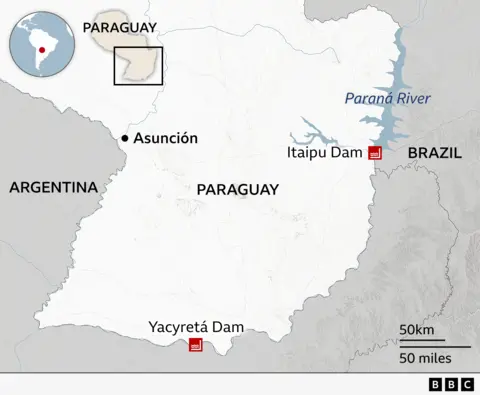
This is centred on the giant Itaipu Dam on the Paraná River, which forms part of the border between Paraguay and Brazil. This huge hydroelectric power station, the largest in the world outside of China, supplies 90% of Paraguay’s electricity needs, and 10% of Brazil’s.
In fact, such is Paraguay’s surplus of electricity that its electricity prices are the lowest in South America.
And it is the world’s largest exporter of clean energy.
The Paraguayan government hopes that the country’s abundance of cheap, green electricity will attract global tech firms increasingly focused on the massive energy demands of AI computing.
“If you want to install any technology investment like AI data centres, keep in mind hydroelectric power is both renewable and steady,” says Paraguayan software development entrepreneur Sebastian Ortiz-Chamorro.
“Compared to other renewable energy sources like wind or solar, that have their ups and downs, it’s much more attractive for creating data centres or any other electro intensive activity that requires a steady electricity source.”
He adds that in addition to Itaipu, and Paraguay’s other large state-owned hydroelectric plant, the Yacyretá Dam, private companies can easily build their own smaller facilities.
On a visit to California last year Paraguay’s President Santiago Peña spoke with companies like Google and OpenAI to encourage them to invest in Paraguay. It remains to be seen if such industry giants open large operations in the country.
Minister of Technology and Communication Gustavo Villate is working closely with the president on the continuing efforts.
“We have the youngest population. We have a lot of renewable green energy. We have low taxes and economic stability,” he says proudly.
I’m taken on a tour with the minister of a planned new digital park near Asunción’s main airport. It’s currently green fields and some army barracks.
Mr Villate unfurls plans to show off the lakes, a childcare centre and other buildings which he says should be ready in under two years.
“The government are going to invest around $20m (£15m) for the first stage, but the idea is for private companies to invest the rest,” he says.
Even though the park isn’t ready yet, Mr Villate says the collaboration already happening between the public, private and university sectors is key to building an ecosystem to attract foreign investors.
The government thinks the country’s young population will be a key attraction, and able to provide a large tech workforce. The average age in Paraguay is 27.
 Vanessa Cañete
But more young people will need to be trained. The technology minister says the new digital park will also be home to The University of Technology, which is a joint venture between Taiwan and Paraguay.
Meanwhile, there are other initiatives to train young people in the country. “We are working really hard to create a mass of software engineers, programmers and everything you need to provide software services,” says Vanessa Cañete, president of trade group Paraguayan Chamber of the Software Industry.
Ms Cañete says she is also passionate about encouraging more women to study computer engineering. In 2017 she set up Girls Code, a non-profit association which aims to close the tech gender gap.
It organises programming and robotics workshops for teenagers and young women, with more than 1,000 receiving some sort of training to date.
Ms Cañete adds that software developers are also given English lessons for up to four years to improve their communication with overseas firms.
The people I met are brimming with positivity about what Paraguay has to offer the tech world, but they are also pragmatic.
Ms Cibils says there are still “growing pains” for foreign investors, with issues like bureaucracy, which can hold things up adapting local contracts to standardised international ones.
But she is adamant that “if you put innovation at its core and leverage all the benefits that the country has I think Paraguay can be a superpower”.
Business
Top stocks to buy today: Stock recommendations for April 24, 2026 – check list – The Times of India

Stock market recommendations: Bharat Electronics, and Colgate-Palmolive (India) have been recommended as the top stocks to buy today (April 24, 2026) by Bajaj Broking Research. Take a look at the target prices and expected returns:Bharat ElectronicsBuy in the range of ₹ 440.00-450.00
The stock is in structural up trend forming higher high and higher low in all time frame signaling strength and continuation of the uptrend. The entire up move of the last 8 months is in a rising channel as can be seen in the chart highlighting sustained demand at an elevated level.On the smaller time frame, the stock is at the cusp of generating a breakout above the bullish Flag like formation as post a sharp up move in the first 3 weeks of April the stock went into a consolidation phase in the last four sessions. It is seen resuming up move and is at the cusp of generating a breakout above the bullish Flag formation highlighting continuation of the up move and offers fresh entry opportunity.We expect the stock to extend the up move and head towards 495 levels in the coming months being the confluence of the 123.6% external retracement of the previous decline 473 – 400 and the upper band of the rising channel of the last 8 months.Colgate-Palmolive (India)Buy in the range of 2120-2160
The share price of Colgate-Palmolive has generated a breakout above bullish Flag pattern signaling continuation of the up move and offers fresh entry opportunity.We expect the stock to head higher towards 2330 levels in the coming months being the measuring implication of the bullish flag breakout.The daily 14 periods RSI is in buy mode thus supports the positive bias in the stock.(Disclaimer: Recommendations and views on the stock market, other asset classes or personal finance management tips given by experts are their own. These opinions do not represent the views of The Times of India)

It is unusual for a senior figure at the Bank to be so forthright on market movements.
Source link

Consumer confidence has fallen for the third consecutive month amid household “jitters” over rapid price rises, figures show.
GfK’s long-running consumer confidence index fell four points to minus 25 in April, following falls of two points and three points in March and February respectively.
The deepening concern was driven by perceptions of the UK economy, with a six-point slide in confidence for the next 12 months to minus 43, its lowest level since February 2023.
Confidence in personal finances over the coming year fell five points to minus four – one point lower than this time last year.
The major purchase index – an indicator of confidence in buying big ticket items – held steady, albeit at minus 18 but one point better than last April.
The only measure to improve was the savings index – often an indication that households are concerned about their finances and looking to build contingency funds – which is up five points to 32.
Neil Bellamy, consumer insights director at GfK, said: “Consumers really do have the jitters now.
“It is a year since we last saw a monthly drop of this size, and we have to go back to October 2023 to find the last time consumer confidence was lower.
“Everyone is grappling with rapid price rises, especially at the fuel pumps, which are taking a dent out of household budgets, and people know further price hikes are coming.
“Consumer confidence is deteriorating sharply, with fuel prices and threats of more energy price increases acting as constant reminders of inflation.
“While the Gulf crisis is intensifying pressures, much of the current strain reflects earlier domestic cost increases.
“How long can all this disruption and pain continue?”


UK’s clothing exports down 7.6% to $293 mn in Jan-Feb
Top stocks to buy today: Stock recommendations for April 24, 2026 – check list – The Times of India

Mariska Hargitay expresses love for Christopher Meloni’s ‘Law & Order’ series

-

 Fashion1 week ago
France’s LVMH Q1 revenue falls 6%, shows resilience amid Iran war
-

 Entertainment1 week ago
Is Claude down? Here’s why users are seeing errors
-

 Tech1 week ago
The Deepfake Nudes Crisis in Schools Is Much Worse Than You Thought
-

 Sports1 week ago
PSL 11: Peshawar Zalmi win toss, opt to field first against Quetta Gladiators
-
 Business1 week ago
Standard Life buys rival in £2b deal to create savings giant
-

 Tech1 week ago
CYBERUK ’26: UK lagging on legal protections for cyber pros | Computer Weekly
-

 Fashion1 week ago
Raymond unveils luxury Chairman’s Collection Store in Mumbai
-
 Business1 week ago
PepsiCo earnings beat estimates as North American food business improves