

Business
Pound climbs as miners help FTSE 100 nudge higher

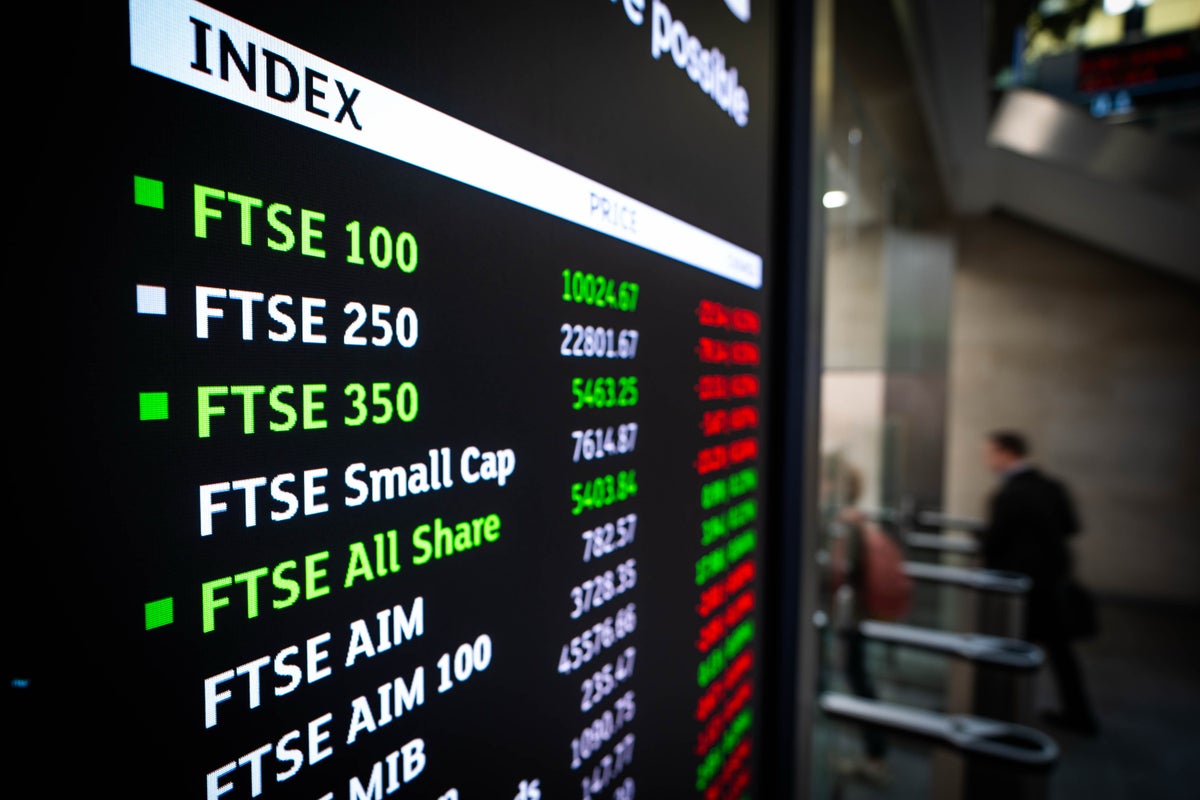
The FTSE 100 made modest headway on Monday, supported by fresh gains in mining stocks as gold and silver prices hit new highs.
The FTSE 100 index closed up 5.41 points, 0.1%, at 10,148.85.
The FTSE 250 ended 34.13 points higher, 0.2%, at 23,351.66, and the Aim All-Share closed up 5.74 points, 0.7%, at 828.49.
Miners Fresnillo, Antofagasta and Endeavour led blue-chip risers, up 6.7%, 5.3% and 4.0%, amid strength in metals prices.
Gold was quoted at 5,095.11 dollars an ounce on Monday, after hitting another record high, and up from 4,984.07 dollars on Friday.
Meanwhile, the price of silver leapt 10%, pushing well above the 100 dollar an ounce landmark it hit late on Friday.
Russ Mould at AJ Bell noted: “In less than 18 months bullion has more than doubled in value – buoyed by central bank demand, global turmoil, dollar weakness, and the diminished appeal of other popular defensive assets.”
Tom Stevenson, investment director at Fidelity International, said the yellow metal is the “ultimate risk-off safe haven – and investors have found plenty to worry about so far this year.”
“With government bonds – the traditional safe haven – falling out of favour as concerns mount about the high levels of borrowing around the world… gold has become the go-to for risk averse investors,” he pointed out.
The latest moves came amid increased uncertainty in the US with Mr Mould noting the odds of another US government shutdown have increased as Democrats say they will block the federal spending package over the fallout from the Trump administration’s immigration crackdown.
Wells Fargo said the odds of a government shutdown starting on January 31 have risen sharply.
“Polymarket traders price the odds of a shutdown starting this Saturday at roughly 80%… which strikes us as reasonable based on what we know now,” the broker said.
“Should another extended shutdown occur, it would leave the FOMC in a tricky spot.
“The lack of visibility that arises from receiving limited economic data could thrust an already divided FOMC into a period of stasis.
“Fed officials lamented the lack of clarity on inflation during the last shutdown. We expect they would again use this argument to delay additional cuts.”
The political uncertainty plus speculation of intervention to support the yen sparked further dollar weakness.
ING noted widespread discussion late on Friday that the Federal Reserve started asking banks in New York about their position sizes in USD/JPY, akin to a “rate check”, where a central bank might be preparing the market for physical intervention.
“That the Fed was allegedly doing this and not making clear that this activity was purely on behalf of Japanese authorities”, has led to “understandable suggestions that the US might be on the verge of joint intervention with Japan,” ING said.
The pound was quoted higher at 1.3704 dollars at the time of the London equities close on Friday, compared to 1.3567 dollars on Thursday.
The euro stood at 1.1884 dollars, higher against 1.1758 dollars. Against the yen, the dollar was trading at 153.99 yen, lower from 157.99 yen.
Kathleen Brooks at XTB said in the short term, a stronger yen means a weaker dollar, which is inflationary for the US.
“This is a good way to inflate away some of the US’s debt pile, however, it may cause a big headache for the Federal Reserve.
“The central bank will meet this week, and we expect yen intervention to be a major topic up for discussion, along with the future of Fed independence.”
The Federal Reserve is widely expected to leave interest rates unchanged on Wednesday after three successive cuts.
“The January FOMC meeting is likely to be uneventful, with no change to the fed funds rate, only minor changes to the statement, and few hints about the future policy path,” analysts at Goldman Sachs said.
Goldman thinks the next cut will be in June, with one more in September.
In European equities on Monday, the Cac 40 in Paris closed down 0.2%, while the Dax 40 in Frankfurt ended up 0.1%.
In New York, financial markets were higher at the time of the London equity market close.
The Dow Jones Industrial Average was up 0.4%, the S&P 500 was 0.5% higher, as was the Nasdaq Composite.
The yield on the US 10-year Treasury was quoted at 4.22%, trimmed from 4.25% on Friday.
The yield on the US 30-year Treasury was quoted at 4.81%, narrowed from 4.84%.
Back in London, a report showed short-term inflation expectations increased in January.
According to the latest Citi/YouGov inflation expectation survey year-ahead expectations increased to 3.8% from 3.6% on a single-month basis.
This reverses the last two months of prospective disinflation in the series and brings it to the highest level since October 2025.
On a three-month rolling basis, however, year-ahead expectations fell to 3.7% from 3.8% thanks to the 4.2% reading in October falling out of comparison.
“This move is explicable, given recent data, but it will continue to keep the inflation expectation argument alive for monetary policy despite recent moderation in these series,” analysts at Citi said.
On the FTSE 100, 3i fell 4.9% as RBC Capital Markets downgraded to “underperform” from “sector perform”.
The broker thinks the private equity and venture capital firm’s key investment, discount retailer Action, is “at risk of moving into a period of diminishing returns” because of macro-economic pressures on its customers and increased maturity and competition in its major markets.
On the FTSE 250, Spire Healthcare rose 18% after confirming it is in early-stage discussions for a potential buyout.
The London-based private healthcare company named Bridgepoint Advisers and Triton Investment Advisers as two suitors with whom it had communicated so far.
The Takeover Code gives Bridgepoint and Triton until February 21 – unless an extension is granted – to declare a firm intention to make an offer.
Ninety One soared 8.4% as Bank of America raised to “buy” from “underperform”, while Costain climbed 7.0% after striking a new agreement with the trustees of its defined-benefit pension scheme.
Costain said the deal clears the way for increased shareholder returns, including a £20 million share buyback this year.
The Maidenhead-based construction and engineering firm also intends to almost double its cash dividend payments in 2026 from 2025, starting with the final dividend for 2025.
Brent oil traded lower at 65.43 dollars a barrel on Monday, down from 65.76 dollars late on Friday.
The biggest risers on the FTSE 100 were Fresnillo, up 280.00p at 4,448.00p, Antofagasta, up 191.00p at 3,775.00p, Endeavour Mining, up 176.00p at 4,542.00p, Segro, up 22.40p at 752.00p and Pershing Square Holdings, up 96.00p at 4,646.00p.
The biggest fallers on the FTSE 100 were 3i, down 160.0p at 3,129.0p, Autotrader, down 19.4p at 549.0p, Experian, down 97.0p at 2,932.0p, BT Group, down 5.45p at 182.8p and BAE Systems, down 54.0p at 1,973.0p.
Tuesday’s global economic calendar sees the start of the two-day Federal Open Market Committee meeting and US house price data.
Tuesday’s UK corporate calendar has trading statements from accountancy software provider Sage, boot maker Dr Martens and betting operator Evoke.
– Contributed by Alliance News

Two ads promoting British beef and milk have been banned after television presenter and environmental campaigner Chris Packham complained that they misled consumers about the products’ carbon footprints.
Both ads for the Agriculture and Horticulture Development Board’s (AHDB) Let’s Eat Balanced campaign used the carbon footprint of British beef and milk to promote the products, firstly stating: “British beef not only tastes great, but has a carbon footprint that’s half the global average*.”
The asterisk linked to text that stated: “Full lifecycle emissions of CO2 eq (carbon dioxide equivalent) per kg of beef.”
The ad for milk stated: “British milk not only tastes good, but is also produced to world-class standards, and has a carbon footprint a third lower than the global average.”
Packham complained to the Advertising Standards Authority (ASA) that the ads, and specifically the carbon footprint claims, were misleading as they did not reflect the full environmental impact of British meat and dairy.
The AHDB said the ads’ mention of carbon emissions would be understood in relation to the environmental impact of beef and milk that occurred between the “cradle-to-retail” stages.
But the ASA said the average consumer “being reasonably well-informed, observant and circumspect” would understand the claims to apply beyond the retail stage and include actions such as cooking and wastage.
The ASA said: “While we acknowledged the potential difficulties in producing post-retail emissions data, the claims in the ads suggested those emissions were included and we therefore expected the evidence provided to also include them.
“We therefore concluded that the evidence presented was insufficient to support the full life-cycle claims in the ads, which was how the average consumer was likely to interpret them.
“We reminded AHDB that environmental claims should be based on the full life cycle unless the ad stated otherwise.”
AHDB’s director of communications and market development, Will Jackson, said: “Let’s Eat Balanced is doing what it was designed to do, providing clear, factual, evidence-led information about British food, nutrition and farming standards.
“Since the investigation began, we have conducted independent consumer research which found that the majority of respondents interpreted these adverts as relating to the production phase only, from farm to retail.
“This research provides important insight into consumer understanding and supports our belief that consumers were not misled by the information we shared in these two specific adverts.”

BENGALURU: India’s Gen Z workforce is embracing what experts describe as “portfolio careers” – balancing multiple professional identities and income streams simultaneously. New research from LinkedIn shows that 75% of Gen Z entrepreneurs in India now manage multiple income streams, significantly higher than the 62% among Gen X entrepreneurs. The findings point to a growing preference among younger professionals for flexibility, autonomy and diversified sources of income. “We’re also seeing the rise of the ‘portfolio era’, with more professionals creating multiple income streams and redefining what a career can look like. This shift is making entrepreneurship more accessible than ever before,” said LinkedIn India country manager Kumaresh Pattabiraman.Rather than depending on a single full-time role, many professionals are simultaneously building businesses, freelancing, consulting, creating online content and monetising specialised skills through digital platforms. The trend comes amid a broader rise in entrepreneurial activity in India. LinkedIn recorded a 104% year-on-year increase in members adding “Founder” to their profiles – the highest growth among all global markets.AI is also emerging as a major enabler of this shift. The report found that 85% of Gen Z entrepreneurs consider AI and digital tools important to their business operations.

Sam Altman said Elon Musk tried many times for total control of OpenAI, which he’s now suing.
Source link


Will LeBron James retire after current season?

South Korea reviews phased support for Strait of Hormuz security efforts

New Jersey Gov. Mikie Sherrill announces another NJ Transit World Cup ticket cut days after first reduction

-

 Tech1 week ago
DHS Demanded Google Surrender Data on Canadian’s Activity, Location Over Anti-ICE Posts
-
 Business1 week ago
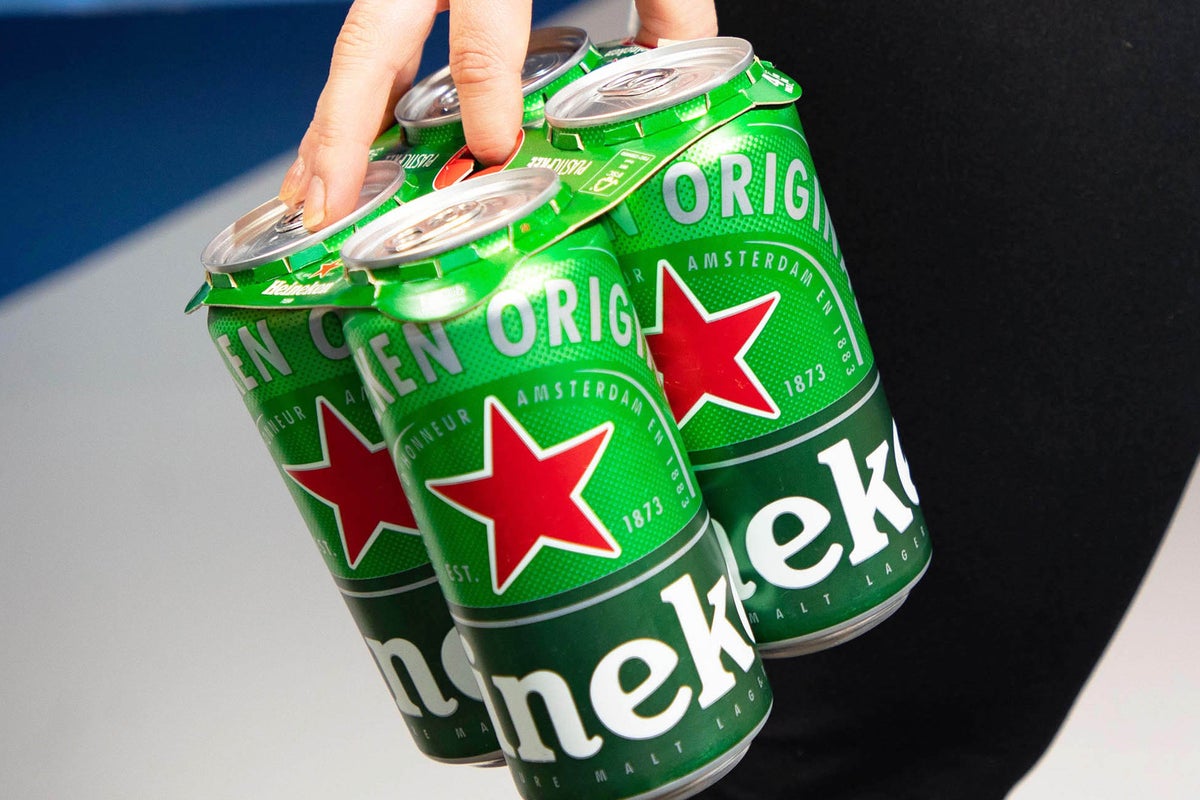
Heineken plans huge investment in hundreds of UK pubs ahead of World Cup
-

 Tech5 days ago
A new frontier: Identity stack evolves for agentic systems | Computer Weekly
-

 Tech4 days ago
‘Orbs,’ ‘Saucers,’ and ‘Flashes’ on the Moon: Pentagon Drops New UFO Files
-

 Sports5 days ago
Shaheen Afridi achieves landmark feat during opening Test against Bangladesh
-
 Business1 week ago
India among most resilient large EMs, better placed for future global shocks; policy reforms & strong buffers help: Moody’s – The Times of India
-

 Tech5 days ago
What Microsoft Executives Really Thought About OpenAI in 2018
-
 Fashion5 days ago
New orders in German manufacturing up 5% MoM in Mar 2026: Destatis