

Tech
Prague’s City Center Sparkles, Buzzes, and Burns at the Signal Festival


And thanks to a mention in Dan Brown’s new novel, The Secret of Secrets, the festival has gained even more global recognition. Just a few weeks after the release of Brown’s new bestseller set in contemporary Prague, viewers were able to see for themselves what drew the popular writer to the festival, which is the largest Czech and Central European showcase of digital art. In one passage, the Signal Festival has a cameo appearance when the novel’s protagonist recalls attending an event at the 2024 edition.
“We’re happy about it,” festival director Martin Pošta says about the mention. “It’s a kind of recognition.” Not that the event needed promotion, even in one of the most anticipated novels of recent years. The organizers have yet to share the number of visitors to the festival this year, but the four-day event typically attracts half a million visitors.
On the final day, there was a long queue in front of the monumental installation Tristan’s Ascension by American video art pioneer Bill Viola before it opened for the evening, even though it was a ticketed event. In the Church of St. Salvator in the Convent of St. Agnes, visitors could watch a Christ-like figure rise upwards, streams of water defying gravity along with him, all projected on a huge screen.
The festival premiere took place on the Vltava River near the Dvořák Embankment. Taiwan’s Peppercorns Interactive Media Art presented a projection on a cloud of mist called Tzolk’in Light. While creators of other light installations have to deal with the challenges of buildings—their irregular surfaces, decorative details, and awkward cornices—projecting onto water droplets is a challenge of a different kind with artists having to give up control over the resulting image. The shape and depth of the Peppercorns’ work depended on the wind at any given moment, which determined how much of the scene was revealed to viewers and how much simply blown away. The reward, however, was an extraordinary 3D spectacle reminiscent of a hologram—something that can’t be achieved with video projections on static and flat buildings.
Another premiere event was a projection on the tower of the Old Town Hall, created for the festival by the Italian studio mammasONica. It transformed the 230-foot structure into a kaleidoscope of blue, green, red, and white surfaces. A short distance away, on Republic Square, Peppercorns had another installation. On a circular LED installation, they projected a work entitled Between Mountains and Seas, which recounted the history of Taiwan.












L.L. Bean is infamous for its outdoorsy appeal, ranging from outerwear and supplies to withstand the elements to laid-back lifestyle products. The company was established in 1912 by Leon Leonwood Bean in Maine. It remains headquartered there today, continually rolling out revered classics and updated essentials for today’s nature lovers. Take the Bean Boots: what started as L.L. Bean’s premier product ultimately helped shape the brand into what it is today. This definitive shoe, which can be worn on hiking trails and rain-slicked city streets alike, has remained true to the original version. If you’ve ever wanted to capture the essence of being a rugged Mainer or recreate a cozy cabin at home, here are plenty of L.L. Bean promo code options at your fingertips.
Get 10% Off Your First Order With an L.L.Bean Promo Code
You may bemoan email updates, but in terms of sales, this L.L. Bean coupon is a pretty low lift. Sign up for email updates from the company, and you get 10% off your first order. This offer is valid only once per email address, so choose your purchase wisely.
Take Up to 75% Off Outdoor Gear in the L.L.Bean Sale Section
Sales mean stocking up, especially on outdoor equipment and camping supplies ahead of your next adventure. Whether you’re about to take up fishing and need supplies, or have Noah Kahan concert tickets in sight and want extras from his L.L. Bean collaboration collection for the event, all of that is available to you. You can save 75% off these L.L. Bean sale items, no promo code needed.
This is a different sort of two-for-one special: twice a day, L.L. Bean posts new sales at 6 AM and 2 PM sharp, Eastern time. While the two-a-day daily markdown is not super expansive in terms of inventory up for grabs, what is posted for sale usually comes at a heavily discounted price akin to deals you’d see on Black Friday.
This L.L. Bean sale is like an online treasure hunt. The daily markdown sale involves a new deal posted daily from 6 AM to midnight Eastern time. Inventory leans toward gear, such as backpacks, blankets, and shoes.
Score Free Shipping on Orders Over $75
We’ve all abandoned our online shopping carts at one point or another once we saw how much shipping was going to cost. Shipping usually costs $8 for a standard L.L. Bean order—that is, if you are under $75. If you hit that threshold or more, you immediately score free shipping on your order.
Military, First Responders, Medical Workers, and Students Can Save an Additional 10%
Being in the medical field or a first responder can often be a tough, thankless job. But, there’s a special L.L. Bean sale for medical workers and first responders so that you can stock up on supplies for when you rest and recharge in your down time. Use the L.L. Bean first responder discount for 10% off—be sure to verify your license status through SheerID.
L.L. Bean military discount offers 10% for military personnel, current or former. This discount also applies to family members—if you or a family member would like to partake, verify your status via SheerID.
Teachers deserve their (wild)flowers. To make sure you have what you need for your next outdoor adventure and say thanks, you can get 10% off with the special L.L. Bean teacher discount. College students, there’s also the L.L. Bean student discount where you 10% off, too. To redeem either of these discounts, make sure to verify your teaching or student (or both!) status via SheerID.
Earn 20% Off With the L.L.Bean Mastercard
If you’re hunting for a potential credit card candidate, and already are an avid L.L. Bean fan, this is the opportunity for you. You can earn 20% off once approved for an L.L. Bean Mastercard, along with free shipping on all orders when you use it—no minimum purchase necessary.

Joe Gebbia, cofounder of Airbnb and the US Chief Design Officer appointed by Trump, was spotted in San Francisco today using a mysterious metallic device. In a social media post on X viewed over 500,000 times, a man who looks like Gebbia sits with an espresso at a coffee shop. He’s wearing metallic buds that bisect his ears, with a matching clamshell-shaped disc in front of him on the counter.
After the video was posted Monday morning, social media users were quick to suggest that this could be some kind of prototype from OpenAI’s upcoming line of hardware devices designed in partnership with famed Apple designer Jony Ive. An OpenAI spokesperson declined to comment on the potential Gebbia video after WIRED reached out. Gebbia also did not respond to a request for comment.
The device Gebbia appears to be wearing looks quite similar to the hardware seen in a fake OpenAI ad that was widely circulated on Reddit and social media in February. That video from last month seemingly showed Pillion actor Alexander Skarsgård interacting with an AI device that had a similar-looking pair of earbuds and a circular disc. At the time, OpenAI denounced the widely seen video as not real. “Fake news,” wrote OpenAI President Greg Brockman at the time, responding to a social media post.
The earbuds seen in the video of Gebbia also look quite similar in shape to the Huawei FreeClip 2, a pair of open earbuds released earlier this year. However, the clamshell seen on the coffee counter next to Gebbia is different from Huawei’s most recent headphone case. It would also be quite surprising if a government official were seen using Huawei tech, considering the Chinese company is effectively banned from selling its phones in the US due to security concerns.
WIRED’s audio experts say he’s most likely wearing open earbuds, as Gebbia’s pair share some similarities with Soundcore’s AeroClips or Sony’s LinkBuds Clip, though the cases for those buds don’t match what’s on the table in front of Gebbia. WIRED also ran the photo and video through software that attempts to identify AI-generated outputs and other deepfakes. The detection software, from a company called Hive, says the odds are low that this imagery of Gebbia was generated by AI. Still, AI detectors are not always reliable and can include false outputs. It’s possible that the entire post could be a synthetic hoax.
Could this be some kind of soft launch teaser for OpenAI’s hardware? The timing of this trickle out would make sense, since the company may ship devices to consumers sometime early in 2027. Still, OpenAI denied any involvement with the previous pseudo-ad for the metallic AI hardware, with its shiny earbuds and matching disc.
“There are Chinese components as well—we are totally open about it—but the key is that as we compile the software ourselves and install it in Finland, we protect the integrity of the product,” Pienimäki says.
What makes Sailfish OS unique over competitors like GrapheneOS or e/OS is that it’s not based on the Android Open Source Project, but Linux. That means it has no ties to Google—no need for the company to “deGoogle” the software; meaning there’s a greater sense of sovereignty over the software (and now the hardware). Still, it’s able to run Android apps, though the implementation isn’t perfect. Another common criticism is that it’s not as secure as options like GrapheneOS, where every app is sandboxed.
There’s a good chance some Android apps on Sailfish OS will run into issues, which is why in the startup wizard, the phone will ask if you want to install services like MicroG—open source software that can run Google services on devices that don’t have the Google Play Store, making it an easier on-ramp for folks coming from traditional smartphones without a technical background. You don’t even need to create a Sailfish OS account to use the Jolla Phone.
Jolla’s effort is hardly the first to push the anti-Big Tech narrative. A wave of other hardware and software companies offer a “deGoogled” experience, whether that’s Murena from France and its e/OS privacy-friendly operating system, or the Canadian GrapheneOS, which just announced a partnership with Motorola. At CES earlier this year, the Swiss company Punkt also teamed up with ApostrophyOS to deploy its software on the new MC03 smartphone. Jolla is following a broader European trend of reducing reliance on US companies, like how French officials ditched Zoom for French-made video conference software earlier this year.
The Phone
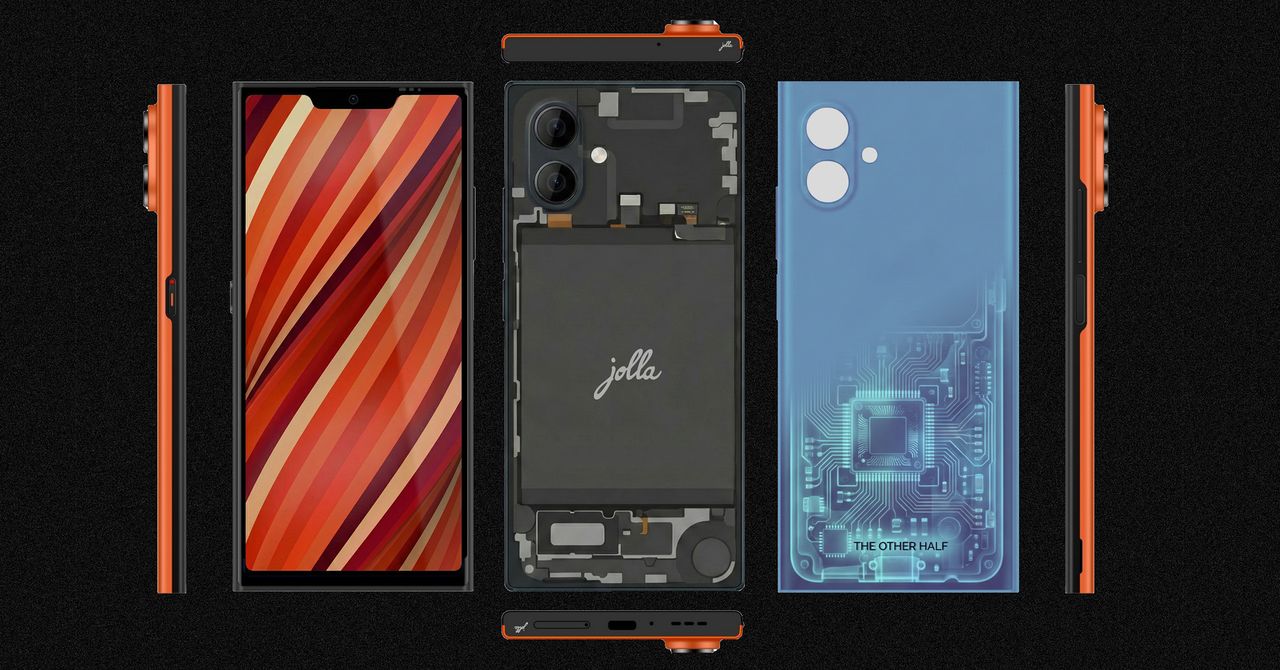
A common problem with these niche smartphones is that they inevitably end up costing a lot of money for the specs. Take the Light Phone III, for example, a fairly low-tech anti-smartphone that doesn’t enjoy the benefits of economies of scale, resulting in an outlandish $699 price. The Jolla Phone is in a similar boat, though the specs-to-value ratio is a little more respectable.
It’s powered by a midrange MediaTek Dimensity 7100 5G chip with 8 GB of RAM, 256 GB of storage, plus a microSD card slot and dual-SIM tray. There’s a 6.36-inch 1080p AMOLED screen, the two main cameras, and a 32-megapixel selfie shooter. The 5,500-mAh battery cell is fairly large considering the phone’s size, though the phone’s connectivity is a little dated, stuck with Wi-Fi 6 and Bluetooth 5.4.
Uniquely, the Jolla Phone brings back “The Other Half” functional rear covers from the original. These swappable back covers have pogo pins that interface with the phone, allowing people to create unique accessories like a second display on the back of the phone or even a keyboard attachment. There’s an Innovation Program where the community can cocreate functional covers together and 3D print them. And yes, a removable rear cover means the Jolla Phone’s battery is user-replaceable.


US’ Gap Inc. president & CEO Richard Dickson to be honoured by FIT

Thailand’s Indorama Ventures’ revenue, profit decline in 2025

L.L.Bean Promo Codes and Coupons: Up to 75% Off

-

 Politics5 days ago
What are Iran’s ballistic missile capabilities?
-
 Business6 days ago
Households set for lower energy bills amid price cap shake-up
-

 Sports5 days ago
Sri Lanka’s Shanaka says constant criticism has affected players’ mental health
-
 Business6 days ago
Lucid widely misses earnings expectations, forecasts continued EV growth in 2026
-
 Business1 week ago
Haryana Govt bars IDFC First Bank, AU Small Finance Bank over alleged Rs 590 crore fraud
-

 Sports1 week ago
Top 50 USMNT players of 2026, ranked by club form: USMNT Player Performance Index returns
-
 Business5 days ago
Attock Cement’s acquisition approved | The Express Tribune
-

 Tech6 days ago
Here’s What a Google Subpoena Response Looks Like, Courtesy of the Epstein Files