

Sports
Premier League midseason awards: Ranking picks for best player, manager and more

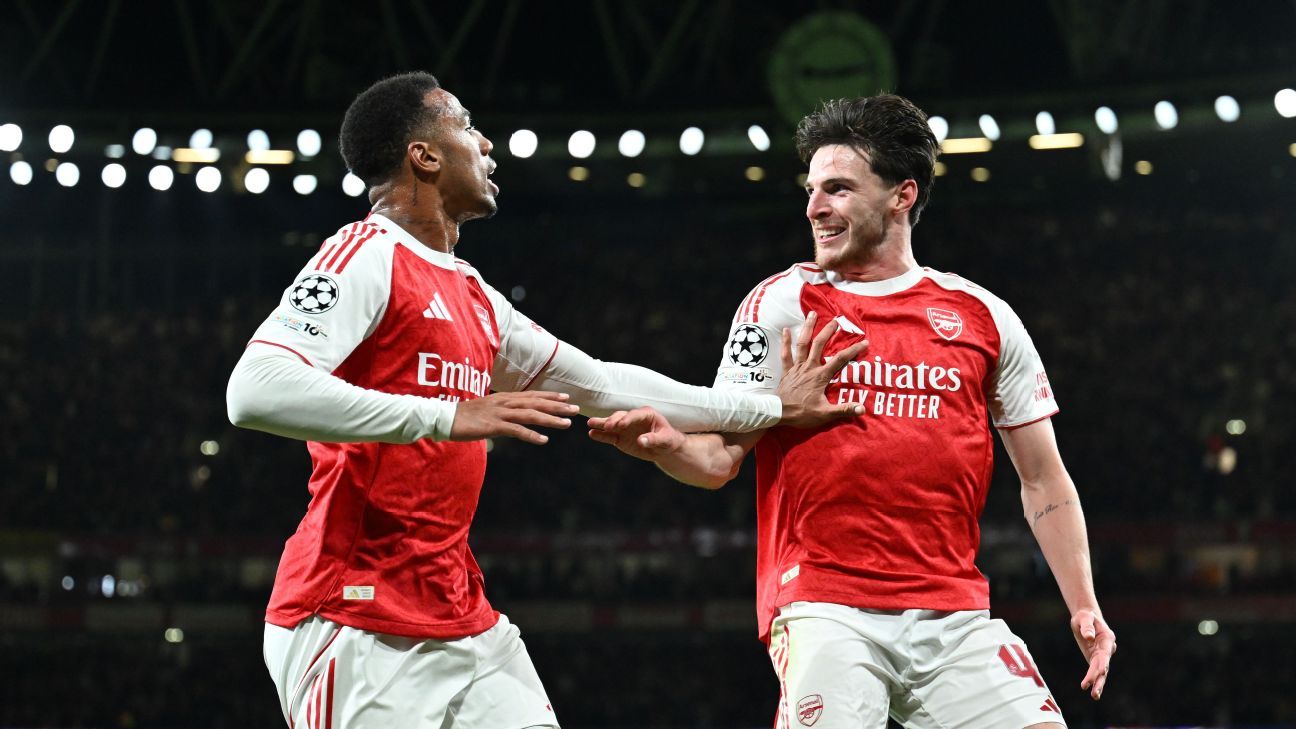
We’re halfway done-ish!
The Premier League is now 21 games in — just a bit past the exact halfway of the 38-game season — and we’ve reached a point where the league is taking a week off and every team has played every other team at least once. So, that means it’s time to check in on the various award races.
Most of the Premier League’s awards are determined by statistics: Golden Boot (most goals), Playmaker of the Year (most assists), Golden Glove (most saves), and, yes, they also have something called “The Premier League Most Powerful Goal,” which is given to the player who kicks the ball the hardest before it crosses the goal line.
But there are four other “major” awards that are fun to think about: goal of the season, young player of the season, manager of the season and player of the season. Here is who deserves each award to if the season ended today, plus the next two runners-up.
Goal of the Season
If it feels like there haven’t been as many great goals this season, it’s because, well, there haven’t been that many open-play goals.
A goal from a throw-in or a corner kick has such a high bar to clear for it to deserve a place on this list. Sure, we’d throw a bone to one of those clipped diagonal balls to a guy at the top of the box who then volleys it into the upper corner, but teams are getting smarter about set pieces, so they’re not trying that anymore. And, unfortunately, the beauty of most great coals comes from the inefficiency in which they arise.
At the same time, it does seem like we’ve seen a minor reemergence of players just smacking the ball as hard as they can and hoping it stays under the crossbar. Maybe because defenses are more organized and harder to break down than ever before, there’s more space in the area extending out from the top of the box and a little more freedom or frustration leading to some more goals from long range?
Anyway, enough with the theorizing, and on to my top three picks for Goal of the Season.
3. Dominik Szoboszlai vs. Arsenal, Aug. 31
I love the headline on the Premier League’s website for this one: “Szoboszlai makes history with Guinness Goal of the Month award.” What kind of history did he make for this wonderful free kick? Was it the hardest-hit dead ball of the decade? Can they measure spin now, and so did that thing have less spin than any shot ever recorded? Is this the latest winning direct free-kick goal in a match between the previous season’s top two teams?
No, the history Szoboszlai apparently made was that he became the first player from Hungary to win a Premier League-trademarked award. What an important day for Hungarian soccer.
At the time, this seemed like it might be the most important goal of the season. It marked three straight wins for Liverpool, and after two more consecutive victories, they’d already built up a six-point lead on Arsenal. Fast forward to today and Arsenal are comfortably in first place, 14 points ahead of fourth-placed Liverpool.
2. Harrison Reed vs. Liverpool, Jan. 4
When it’s not your year, sometimes it’s really not your year.
Reed hadn’t scored a Premier League goal since April 15, 2023. He’d scored three Premier League goals in his entire career. He turns 31 at the end of this month. He’d only played eight Premier League minutes in 2025-26 prior to this match, and the only reason he was subbed on in the 89th minute against Liverpool was because Fulham have multiple players away at the Africa Cup of Nations.
I hope he doesn’t take another shot this season because if he doesn’t, then he might win the Premier League’s Goal of the Season award with his only attempt.
1. Zian Flemming vs. Wolves, Oct. 26
This is my favorite kind of goal: technically perfect, aesthetically simple, and intellectually brilliant.
It looks so easy: one guy kicks it straight, and then another guy kicks it straight, and it ends up in the back of the net. But this goal never happens without a perfect 45-yard diagonal ball under pressure, and the pass never happens if Flemming doesn’t recognize it, peel off the defender’s shoulder, and signal that he’s an option for a ball over the top.
But what I love most is how the goal uses the complexity of the sport as a decoy. The Wolves defenders are so worried about all of the different potential passing combinations underneath that they give the passer too much time to look up and leave just another space for the attacker to run into.
Then, once the pass is played, everyone on the field starts running toward the ball — watch the video: both teams drift in the same direction the ball is heading, especially Sam Johnstone, the Wolves goalkeeper. And that’s what allows Flemming to tap the ball into the net: the flight of the ball makes it so the side-footed shot spins the ball in the opposite direction you’d expect, and the momentum of the play pulls Johnstone just far enough away that he can’t dive quickly enough, back from where he came.
The best goal of the season came from a game between the two worst teams in the Premier League.
– Is Premier League parity a sign of quality — or these teams stink?
– Ranking transfer needs for top clubs in January
– The inside story of why Man United sacked Ruben Amorim
Young Player of the Season
What happens when the Premier League realizes that players peak earlier than everyone once thought at the same time that the Premier League’s financial advantage over the rest of the world reached escape velocity? You get a league with a ton of fantastic young players.
I’ve only selected three, but there are probably at least 10 others worthy of this award, which goes to the best players aged 23 or younger at the start of the season.
Jérémy Doku has made the leap this year. Elliot Anderson will probably start for England at the World Cup. Ryan Gravenberch won it last year and is still eligible. Michael Kayode‘s throw-ins are more valuable than maybe any other specific skill from any other player. Moisés Caicedo, Florian Wirtz, Josko Gvardiol, Riccardo Calafiori, Rayan Cherki, Cole Palmer, Alejandro Garnacho? All eligible for this award. And Bukayo Saka will probably — and rightfully — actually win it if he stays healthy for the rest of the season.
However, we’re giving this out purely based on the player’s performance from the first half of the season. So, here’s the top three.
3. Adam Wharton, midfielder, Crystal Palace
For the unfamiliar, Opta’s expected possession value (xPV) is just a way to determine how much everything a player does with the ball increases or decreases their team’s chances of scoring.
For example, Liverpool’s Milos Kerkez is eligible for this award. He will not be winning this award because, among other things, he’s contributed minus-0.4 xPV to Liverpool this season. Typically, the only players who contribute negative values are forwards because the metric doesn’t award players for shooting, and forwards often will either lose possession when the ball is in a high-value area or they’ll pass the ball backward, out of a high value area. For Kerkez, his xPV matches what you’ve seen if you’ve watched; he is not helping Liverpool win soccer games.
Wharton, though, is doing the opposite for Crystal Palace. He’s the only player in the league who ranks in the top 10 for expected possession value added via defensive actions and in the top 10 for open-play passing. He’s 21 years old, and he’s already one of the best midfielders in the world.
2. Hugo Ekitike, forward, Liverpool
One simple way to calculate the “value” a player has provided to a team is to take their xPV, add it to the number of non-penalty goals they have scored, and see what comes up.
The promise of Ekitike, when Liverpool signed him, is that he was the rare center forward who could do both: score goals but also create all kinds of other value in buildup play, with his ability to win headers, beat players off the dribble, and create dangerous opportunities for his teammates. And despite playing in a mostly dysfunctional team for most of the season, Ekitike has already shown that, at age 23, in the most competitive league in the world.
Only two 23-and-under players have generated more than eight non-penalty goals and xPV combined, and Ekitike is one of them.
1. Morgan Rogers, attacking midfielder, Aston Villa
There’s one main reason why Villa are 11 points clear of sixth place, more than halfway through the season: Rogers has gone nuclear. Here’s his shot map so far this season:
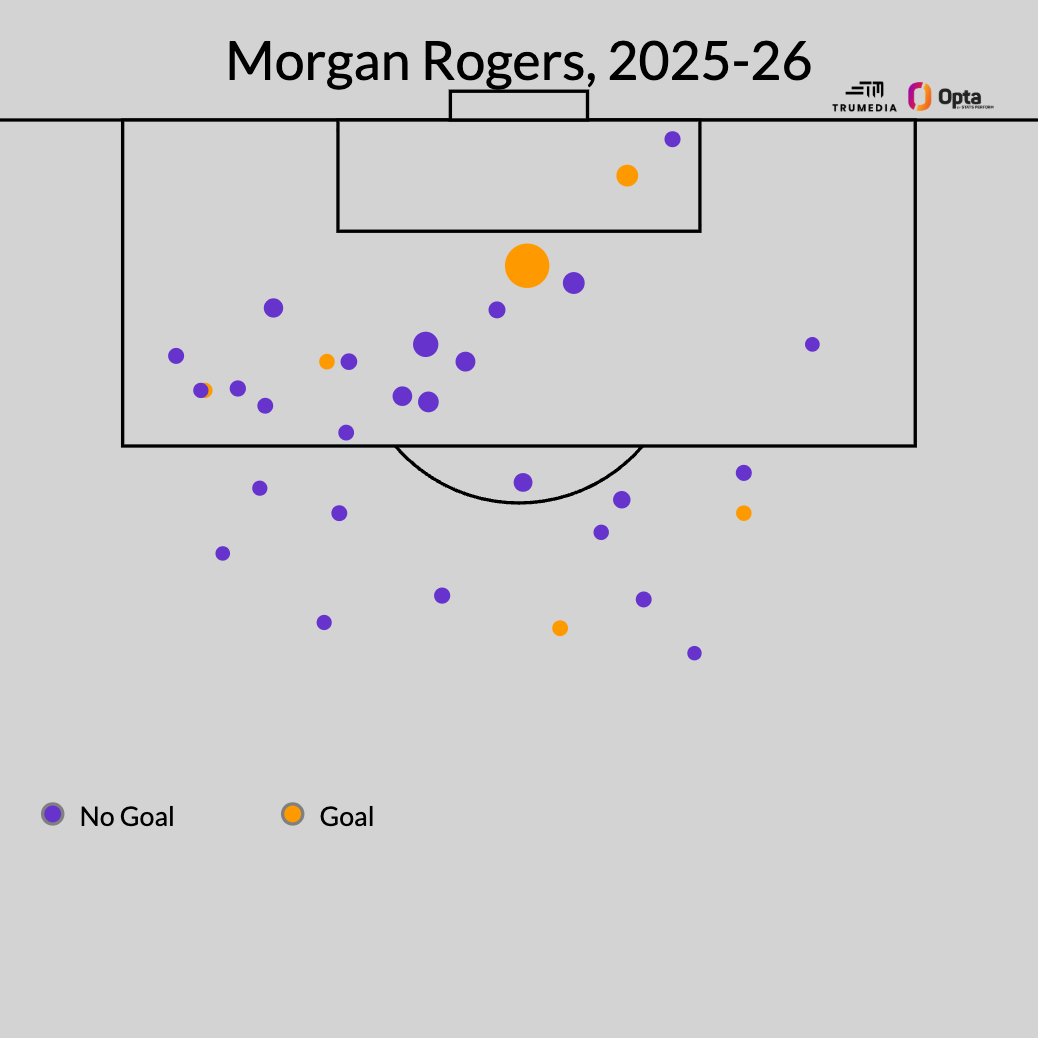
That’s six goals from just around 2.5 expected goals, or xG. And while I absolutely would not expect that to continue, Rogers has won so many extra points for his team by scoring so many low-probability opportunities.
Add that to the fact that he’s one of the best half-space players in the league — he’s second in the league in through balls completed; he’s the one who takes Villa’s patient possession and turns it into actual danger — and Rogers has provided more value to his team than any other young player in the league.
Manager of the Season
Before we get into the choices, I’d just like to point out the past six winners of manager of the month. Last March, it was Nuno Espirito Santo … with Nottingham Forest. In April, it was Vitor Pereira with Wolves. In August, it was Liverpool’s Arne Slot. In September, Crystal Palace’s Oliver Glasner. And then the last two winners were Ruben Amorim (Manchester United) and Enzo Maresca (Chelsea).
So, four of those six guys have been fired, one of them is somehow on the hot seat despite winning the Premier League in his first season in England (Slot), and the other one is currently coaching a team that emerged from the holiday period with one point from five matches (Glasner) — all of which were against teams in the bottom half of the table at the time.
What does that mean? It reminds me of a piece from FiveThirtyEight a couple years ago that looked at how almost everyone that won Executive of the Year in the NFL was fired soon after. One potential reason why: the award went to teams who outperformed expectations, and teams often outperform expectations because they get lucky or do something unsustainable. The award then raises the team’s expectations, and then they fire the executive when they regress back to the mean.
This warrants further research in the Premier League, but I think the reasoning here is quite similar. Maybe not quite for Amorim and Maresca, but they both lost their jobs after a downturn in results and a public falling-out with the front office.
So, how can we identify three managers who aren’t inevitably going to come crashing back to Earth?
3. Daniel Farke, Leeds United
I am aware that approximately zero people who read this column will agree with me. But hear me out: all that a manager really has control over is the chances their team create and concede. Whether the goalkeeper makes a save or the forward converts the header, that’s mostly divorced from whatever tactics and patterns and player interactions led to the shot in the first place.
And yes, Leeds are currently in 16th place. But through 21 games, they have a roughly even xG differential — good enough for 11th-best in the league. And unlike Burnley and Sunderland, Leeds really didn’t spend big this past summer. Wage estimates have them as a bottom-three payroll team, and Transfermarkt estimates them as the second-least valuable squad in the league.
Despite their performance in the Championship last season, Leeds have relegation-level talent, and they’re performing like a borderline top-half-of-the-table team. Sunderland and Burnley, meanwhile, are 20th and 19th in xGD.
Not only that, Farke actively made a tactical change midway through the season that directly coincided with an uptick in his team’s play. Despite their place in the table, Leeds are outperforming their resources in a very real way, and their manager made a very real change that had a very real effect on their performances. Come the end of the season, I don’t think this choice is going to look as strange as it does right now.
2. Mikel Arteta, Arsenal
Arsenal are the best team in the world right now. They just are — they never give up goals and they seemingly go three deep at every position. They spent €63.5 million on a center forward who has been a total flop (Viktor Gyökeres), and it hasn’t mattered at all. All of their star players have been out for significant periods of time due to injury and, again, it hasn’t mattered at all.
It’s no guarantee that they win the league — even if they maintain their current performance level. But they’re also the favorites to win the Premier League and the Champions League. You can’t ask for more than that.
While this was a smartly and patiently and expensively built team that is peaking as all of its core players enter their peak years, Arteta deserves a ton of credit for the unique model of play he’s landed on. He’s helped create one of the better defensive teams we’ve ever seen through an approach that limits goals both by dominating possession and by being equally comfortable defending in their own penalty area. That’s a rare combination, and it’s deadly when combined with a level of set-piece execution we’ve rarely, if ever, seen before.
It all just makes so much sense together: there’s enough offensive skill to chase games when need be, but the dominant defense makes the set piece goals especially valuable since Arsenal don’t need to score as much. And those burly physical defenders who are so hard to score against? They double as dominant set-piece threats.
Set pieces have been the sport’s most undervalued tactical resource, and Arteta’s Arsenal are showing us what happens when one of the richest and most talented teams in the world takes full advantage.
1. Keith Andrews, Brentford
If this were any club other than Brentford, Andrews would be No. 1 with a bullet. This team lost their two best strikers this summer, and they lost the coach who seemingly guided them out of the Championship and into Premier League stability when Thomas Frank went to Tottenham. You’ll never believe what happened next: There are 17 games remaining, and if the season ended today, Brentford would qualify for the Champions League this season.
The reason I’m a little uncertain of the choice here is that we know Brentford are one of the most data-driven clubs in the world, and their manager might have less influence on proceedings than any other in the league does. But I think that says more about what the modern role of the manager is than anything about Andrews himself. The modern manager (or head coach, as teams are increasingly opting for as the title) needs to work with an ever-churning collection of players, figure out the best way to arrange them on the field, and be OK with constant communication and direction from people who aren’t actually soccer coaches. Hasn’t Andrews done all of that?
It’s not just that Brentford are in fifth, either. Per FBref’s estimates, they have the smallest wage bill in the league, and they have a plus-0.2 xG differential per game — currently eighth best in the league and competitive with the three teams above them. It’s really incredible how Brentford continue to lose their best attackers, year after year, and never get worse. Andrews is my choice for manager of the season because this year, they got better.
Player of the Season
With the decline of open-play scoring in the Premier League this season, we’ve also seen a decline in individual attacking performance. There’s been a grand total of one world-class attacker in the Premier League this year, which is bizarre but also kind of fun, as it opens things up in the POTY conversation for defenders, midfielders, and maybe even goalkeepers?
But the longer I looked at this, I started to realize that there are only two players who really seem to warrant the POTY designation through the first half of the season. And so, I’m still selecting a top three, but consider No. 3 to be more of a symbolic choice.
3. Gabriel Magalhães, center back, Arsenal
I’m a little less high on this pick than I used to be because I view center backs like the NFL views offensive linemen. The penalty for making a mistake is so massive that it’s really hard to overcome the negative value you create by getting called for holding or, say, falling down and letting Newcastle’s Nick Woltemade have a free header from three yards our or, I don’t know, passing the ball to Bournemouth’s Evanilson while you’re under no pressure and he’s standing directly in front of an empty goal and also playing for the other team.
Gabriel did both of those things, but then he also went on and scored goals for himself in both of those games. Now, he’s only scored three goals this season, but he has two more assists and is probably the single most important figure in Arsenal’s single most important strength: their set piece goal-scoring. On top of that, he’s one of the starting center backs in one of the most dominant defenses of the modern era. Arsenal have allowed 14 goals this season and half of them came in the handful of matches Gabriel has missed.
2. Declan Rice, midfielder Arsenal
You don’t need stats to understand how good Rice is — just watch a game. He’s the most physically dominant English midfielder since … no, yeah, I’m just gonna stop it there. He’s the most physically dominant English midfielder ever. He covers a ton of space, his ball striking shrinks the field, his ball carrying makes it seem like Baltimore Ravens Running Back Derrick Henry wandered onto a soccer field, and c’mon. He just looks freaking huge out there.
It’s funny. According to FBref, the most similar player to him is PSG’s João Neves. Neves was the starting defensive midfielder for the best team in the world last season. He’s fantastic, and Rice does everything he does while also being much bigger than him.
But here are some stats just to confirm what you see every weekend. The company Gradient Spots grades every action by every player in the Premier League each weekend, across a number of categories, and then they normalize the grades on a 0-100 scale. The six major ones, to my mind, are passing, shooting, crossing, carrying, defending carries, and making challenges. And there is only one player in the league who grades out at a 75 or better in all six categories:
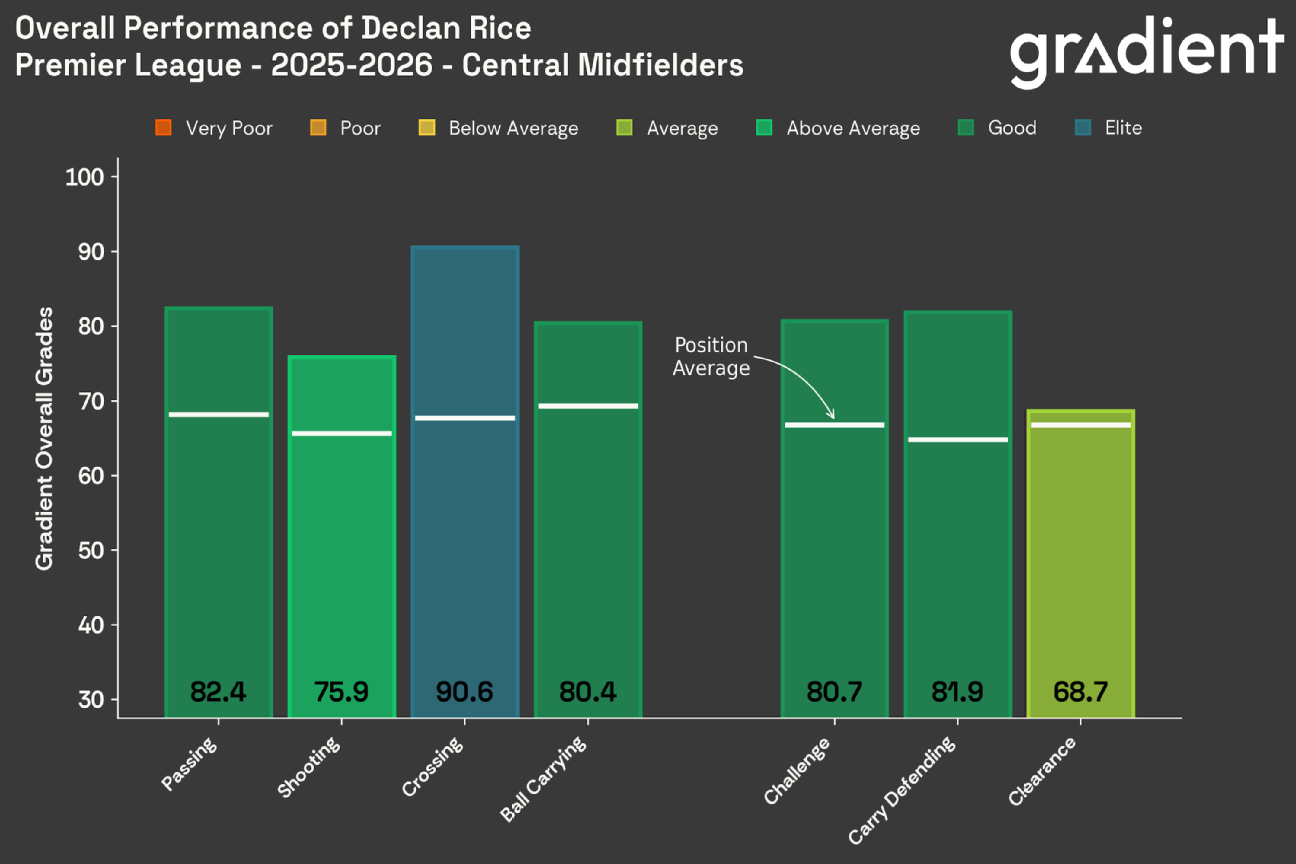
Rice is the best all-around midfielder in the world, and I don’t think there’s really even an argument for anybody else.
1. Erling Haaland, center forward, Manchester City
Goals win soccer games, and Golden Boot-leader Haaland has twice as many goals as all but one other player in the Premier League. Not only that, Haaland also has nearly twice as many expected goals as any player in the Premier League.
I frequently find myself leaving Haaland’s entries brief in exercises like this, but I think that’s sort of the point: He doesn’t do much else, but he does the most important thing in soccer twice as well as almost anyone else in England. What more do you need me to say?
NEWYou can now listen to Fox News articles!
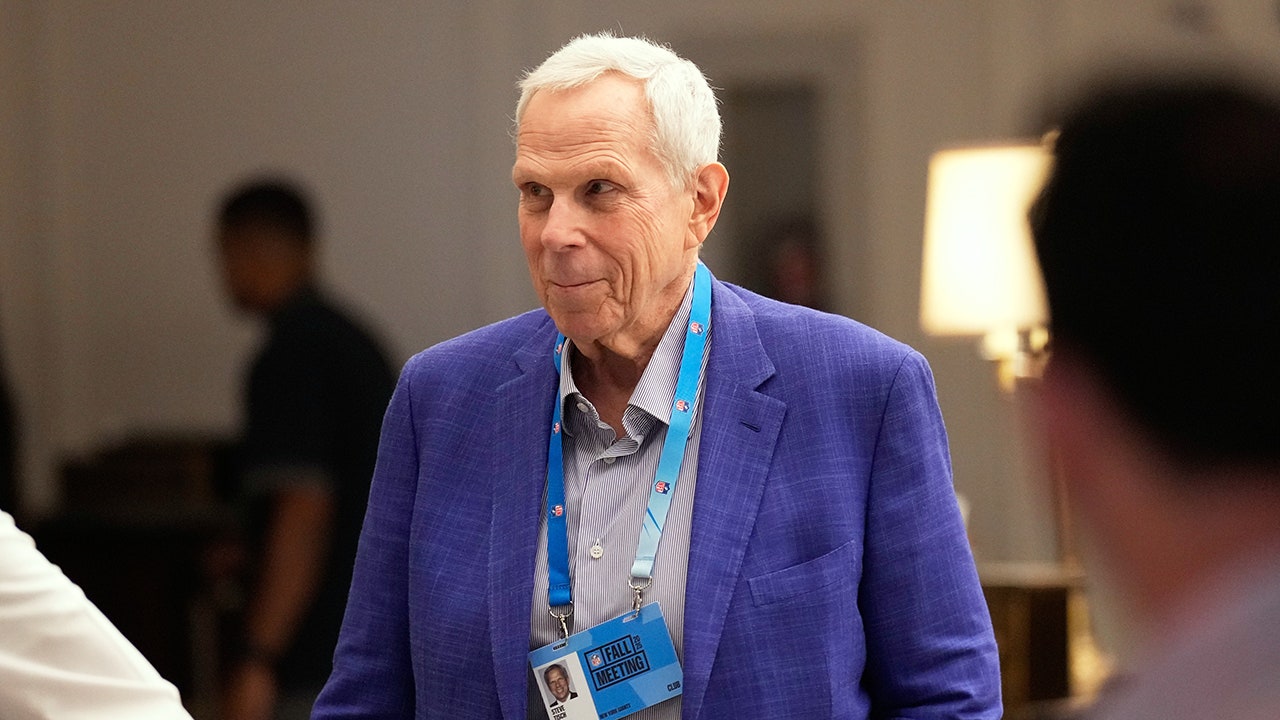
Cameras showed former New York Giants co-owner Steve Tisch in the team’s draft room Thursday night during the first round.
At one point, Tisch was seen standing near Giants head coach John Harbaugh. Despite no longer holding a majority stake in the NFL franchise, Tisch remains the Giants’ chairman of the board.
ESPN obtained an NFL memo last month detailing plans by Steve Tisch and his siblings to transfer their stake in the Giants to trusts for their children.
CLICK HERE FOR MORE SPORTS COVERAGE ON FOXNEWS.COM
New York Giants co-owner Steve Tisch warms up before the NFL game between the Washington Redskins and New York Giants at Met Life Stadium in East Rutherford, N.J., on Oct. 28, 2018. (Rich Graessle/Icon Sportswire)
“Prior transfers to these Trusts were completed pursuant to 2023 and 2024 Finance Committee approvals,” the memo stated. “The Sellers now propose to transfer their entire remaining interests, totaling 23.1% of the Club, to the Trusts. … Following the transactions, the Sellers will no longer own any interest in the Club.”
It was not clear if the transfer requests were in any way related to Tisch’s name appearing in the Epstein files released by the U.S. Justice Department in January. Tisch’s name came up more than 400 times in the files. Tisch at the time said he knew Epstein but denied visiting Epstein’s island.
As for draft night, the Giants made what some viewed as an unconventional pick at No. 10, selecting offensive lineman Francis Mauigoa.
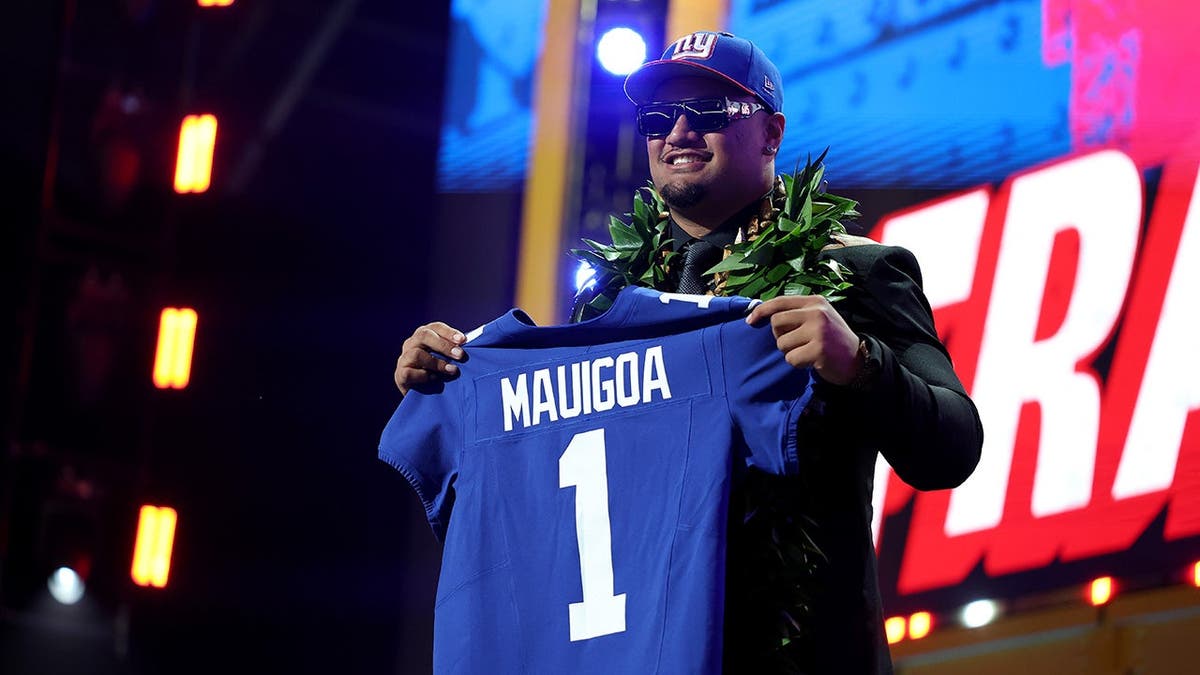
Francis Mauigoa of Miami celebrates after being selected as the tenth overall pick by the New York Giants during the first round of the 2026 NFL Draft at Acrisure Stadium in Pittsburgh, Pa., on April 23, 2026. (Emilee Chinn/Getty Images)
Before that, the Giants added another piece to their pass rush, selecting hybrid edge/off-ball linebacker Arvell Reese at No. 5.
Reese earned All-American honors at Ohio State and finished his first season as a full-time starter with 6.5 sacks.
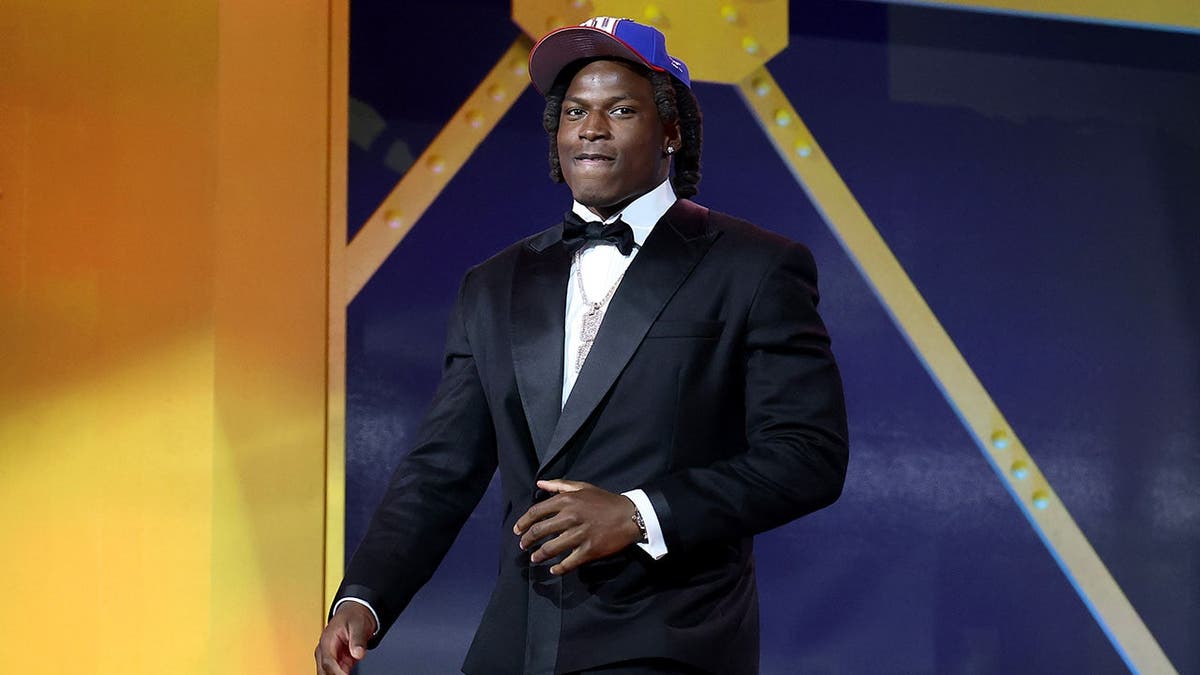
Arvell Reese of Ohio State celebrates after being selected as the fifth overall pick by the New York Giants during the first round of the 2026 NFL Draft at Acrisure Stadium in Pittsburgh, Pa., on April 23, 2026. (Emilee Chinn/Getty Images)
CLICK HERE TO DOWNLOAD THE FOX NEWS APP
Reese is set to join a pass rush that includes Brian Burns, Abdul Carter and, likely, Kayvon Thibodeaux.
Follow Fox News Digital’s sports coverage on X, and subscribe to the Fox News Sports Huddle newsletter.
NEWYou can now listen to Fox News articles!
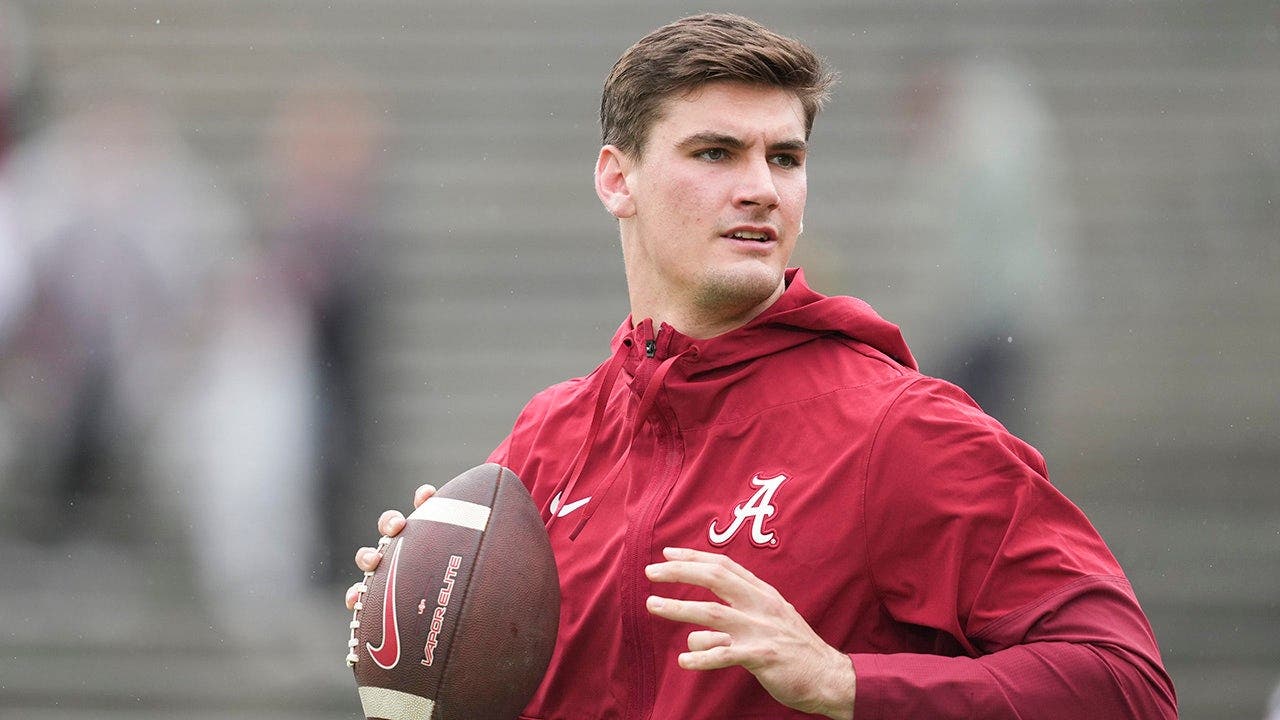
One of the most intriguing stories entering the first round of the NFL Draft was where Alabama quarterback Ty Simpson might land. Well, fans got their answer sooner than they expected.
The Los Angeles Rams surprisingly selected Simpson with the No. 13 pick in the 2026 NFL Draft.
The selection isn’t completely out of left field and is arguably the best-case scenario for Simpson. The Rams have Matthew Stafford as their starter for 2026, but Stafford has flirted with the idea of retirement each of the past two offseasons. It’s clear the clock is ticking on his NFL career.
CLICK HERE TO DOWNLOAD THE FOX NEWS APP
The Los Angeles Rams pulled a stunner and drafted Alababam QB Ty Simpson with the No. 13 pick in the NFL Draft. (CFP/Getty Images)
Now, Simpson gets to sit behind one of the NFL’s best veteran quarterbacks, learn the position while adapting to life in the NFL, and not face immediate pressure to succeed. Additionally, the Rams are one of the most well-run franchises in the league right now. Sean McVay is an elite head coach who led the team to a Super Bowl victory to cap the 2021 season and just had the team within one win of another Super Bowl berth before falling to the Seattle Seahawks in the NFC Championship.
ZERO BS. JUST DAKICH. TAKE THE DON’T @ ME PODCAST ON THE ROAD. DOWNLOAD NOW!
The most surprising aspect is the Rams looking toward the future, quite frankly. This is a team that has had no problem trading away first-round picks to make its team the best it can be each season. It seemed most likely the team would use the No. 13 pick to improve its team for next season, which could be Stafford’s last. Instead, the team decided to put itself in position for Stafford’s retirement without skipping a beat.
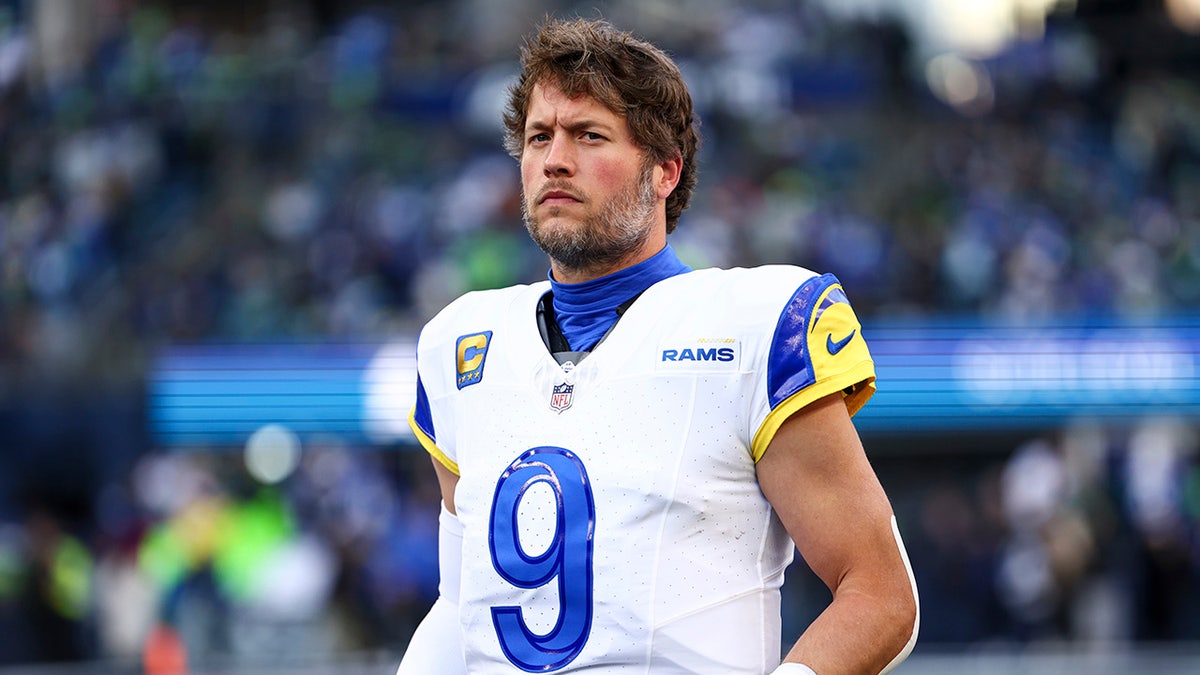
Los Angeles Rams QB Matthew Stafford, now 38-years-old, has flirted with retirement after each of the past two seasons. (Kevin Sabitus/Getty Images)
There were several surprises in the first 13 picks of the 2026 NFL Draft: the Cardinals taking Notre Dame running back Jeremiyah Love at No. 3, the Titans selecting Ohio State wide receiver Carnell Tate at No. 4, the Kansas City Chiefs trading up to take LSU cornerback Mansoor Delane at No. 6 and even the Cowboys trading up one spot to make sure they drafted Ohio State safety Caleb Downs at No. 11.
CLICK HERE FOR MORE SPORTS COVERAGE ON FOXNEWS.COM
But the Rams completely abandoning their recent strategy (usually trading away first-round picks and loading up for now) to select Stafford’s heir apparent is easily the biggest early shock of the 2026 NFL Draft.
Sports
Yankees owner Hal Steinbrenner considering factors before debuting new alternate uniforms: report
NEWYou can now listen to Fox News articles!
The choice for the New York Yankees to wear their new alternate uniform is ultimately up to owner Hal Steinbrenner, who has shown a knack for change in recent years.
And according to The Athletic, Steinbrenner and others in the front office will decide when the time is right based on some factors.
The outlet noted that economic impact, how often they’ll be worn, and how fans feel about the jerseys will all be key considerations in deciding if, and perhaps when, the jerseys will be worn.
CLICK HERE FOR MORE SPORTS COVERAGE ON FOXNEWS.COM
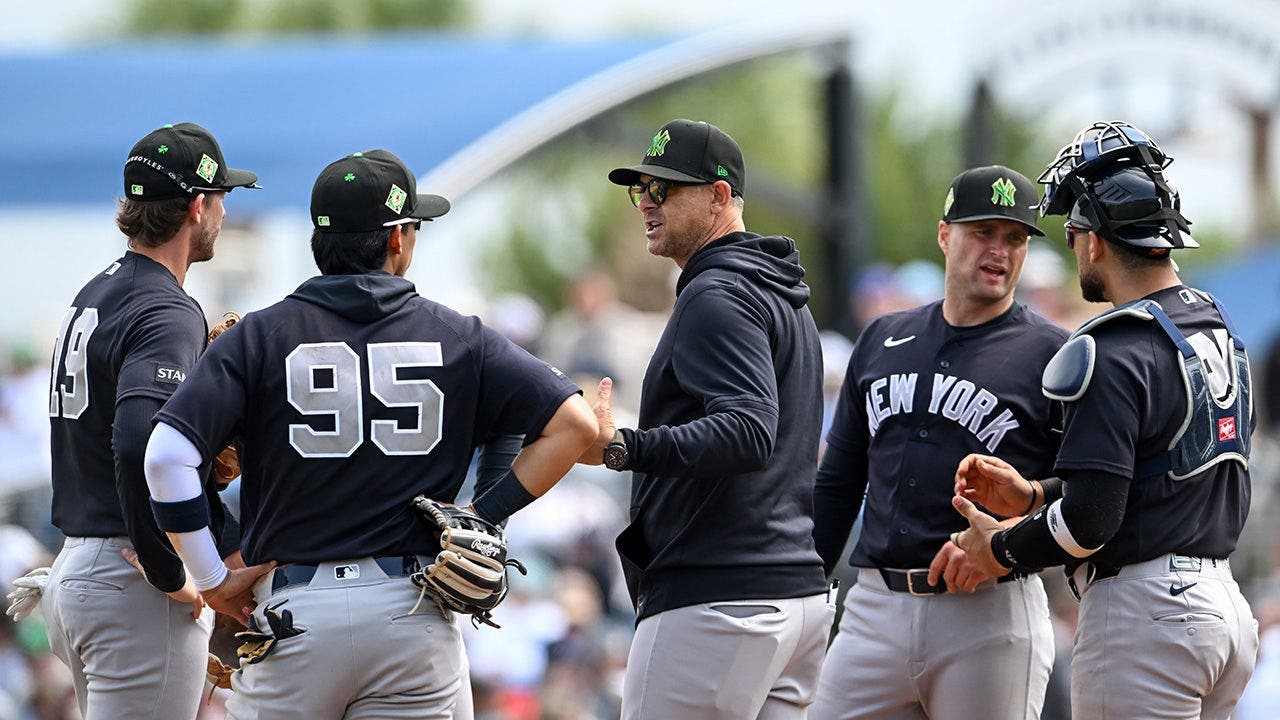
Manager Aaron Boone of the New York Yankees makes a pitching change during the fifth inning of a spring training game against the Tampa Bay Rays at Charlotte Sports Park in Port Charlotte, Florida, on March 17, 2026. (Nick Cammett/Diamond Images)
Hours after The Athletic reported that players had gone to higher-ups about the idea, it was revealed that an alternate jersey had in fact been approved prior.
The Yankees’ navy blue batting practice tops, similar to their road spring training uniforms, were the ones that were approved to be worn in games.
The Yankees have taken part in wearing different jerseys in the past, including Players’ Weekend from 2017 through 2019, a nod to the 1912 team while playing in Boston on the 100th anniversary of Fenway Park’s opening, and jerseys commemorating the Black Yankees in 1996. The Yankees also wore replicas of their 1921 road uniforms for the first Field of Dreams game in 2021.
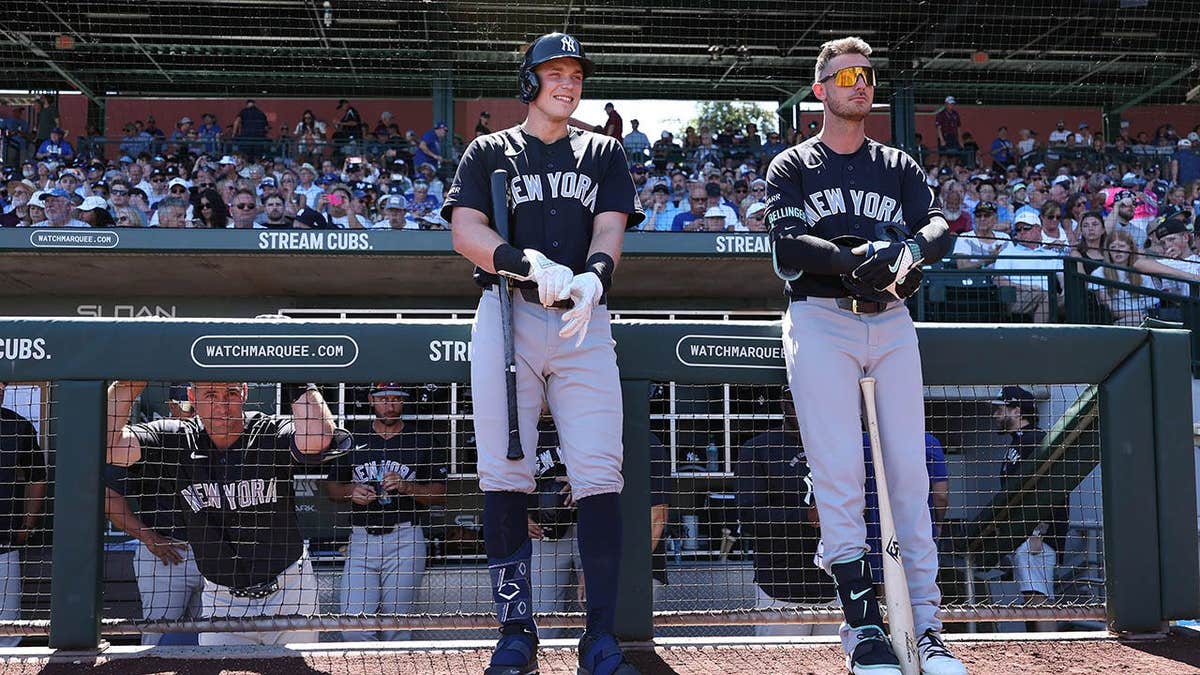
Paul Goldschmidt, Ben Rice and Cody Bellinger of the New York Yankees wait for the start of a spring training game against the Chicago Cubs at Sloan Park in Mesa, Arizona, on March 24, 2026. (Chris Coduto/Getty Images)
YANKEES ANNOUNCER SAYS TEAM SHOULD WIN A WORLD SERIES BEFORE BREAKING LONGSTANDING JERSEY TRADITION
However, none of those jerseys were ever officially put into the rotation, leaving them with just a home and road uniform from day one.
The Yankees also remain the only team to have no last names on the back of their jerseys, home or away, and they are also one of two teams, including the Athletics, without a City Connect jersey.
The Yankees added an advertisement patch on their jerseys in 2023, and beginning last year, “well-groomed” facial hair below the lip was reintroduced after a 50-year ban by Steinbrenner’s father, George.
Yankees players reportedly said they want the home pinstripes untouched and would wear the alternates on the road.
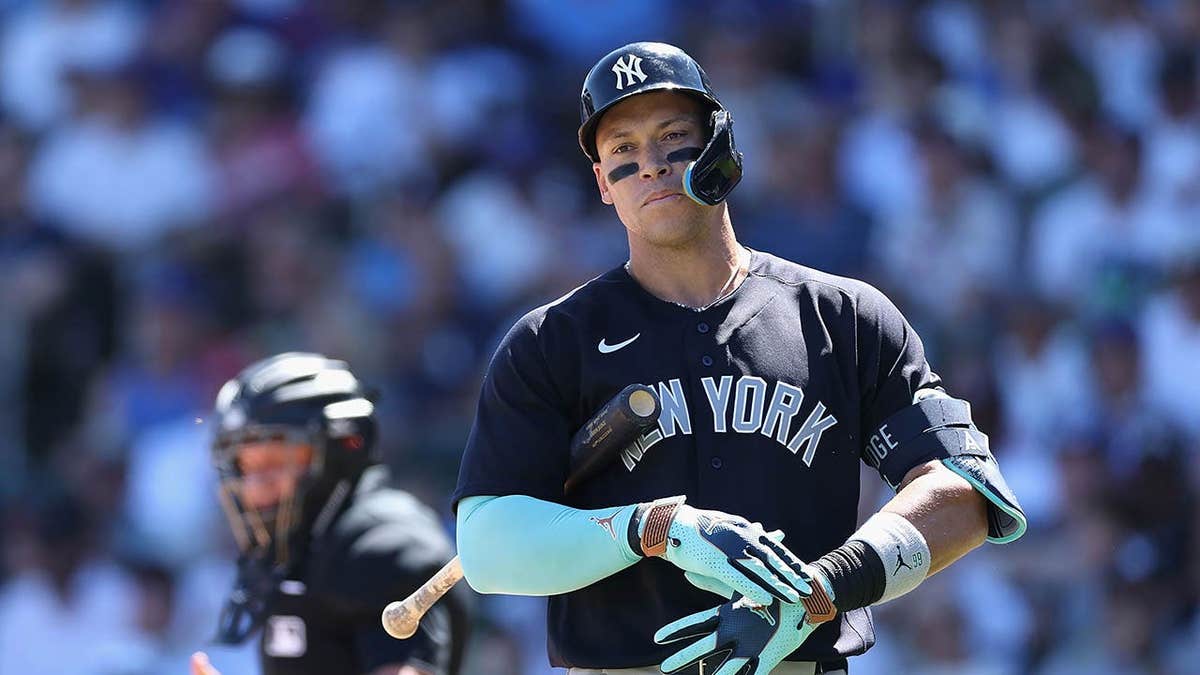
Aaron Judge of the New York Yankees bats against the Chicago Cubs during the first inning of a spring training game at Sloan Park in Mesa, Arizona, on March 23, 2026. (Christian Petersen/Getty Images)
CLICK HERE TO DOWNLOAD THE FOX NEWS APP
The Yankees sell navy blue “shirseys” that mimic the tone of their spring training uniforms, but the pinstripes have been even more prevalent in home spring games in Florida.
Follow Fox News Digital’s sports coverage on X, and subscribe to the Fox News Sports Huddle newsletter.


Former Giants co-owner Steve Tisch seen in team’s draft room

UK’s clothing exports down 7.6% to $293 mn in Jan-Feb

Top stocks to buy today: Stock recommendations for April 24, 2026 – check list – The Times of India

-

 Fashion1 week ago
France’s LVMH Q1 revenue falls 6%, shows resilience amid Iran war
-

 Entertainment1 week ago
Is Claude down? Here’s why users are seeing errors
-

 Sports1 week ago
PSL 11: Peshawar Zalmi win toss, opt to field first against Quetta Gladiators
-

 Tech1 week ago
The Deepfake Nudes Crisis in Schools Is Much Worse Than You Thought
-
 Business1 week ago
Standard Life buys rival in £2b deal to create savings giant
-

 Tech1 week ago
CYBERUK ’26: UK lagging on legal protections for cyber pros | Computer Weekly
-

 Fashion1 week ago
Raymond unveils luxury Chairman’s Collection Store in Mumbai
-

 Sports4 days ago
NCAA men’s gymnastics championship: All-time winners list