

Entertainment
Prince Harry’s cousin Amelia Windsor tries to be his replacement in royal family


King Charles has one big royal seat empty since Meghan Markle has left for America with her family.
Trying to be the fit for this role, Prince Harry’s cousin Lady Amelia Windsor has stepped out to catch attention in black.
The 30 year old was at the premiere of Agatha Christie’s Seven Dials, wearing a gown by Percy Langley that was as elegant as it was intentional.
Fashion followers were quick to spot that this wasn’t the dress’s first outing.
Known for championing sustainable style long before it became a buzzword, Lady Amelia has worn the gown on multiple occasions, reinforcing her belief that true luxury lies in rewearing.
Whispers are now swirling that she could be stepping into a whole new chapter of her life .
Although neither she nor her rumored partner have confirmed anything yet but according to insider she may soon be engaged to her long-term boyfriend, property developer Ollie Lewis.
Amelia is currently 44th in line to the throne and has been linked with Lewis for several years, and fans of the couple have enjoyed watching their relationship grow from festival flings to public appearances on major social stages.
Their story first attracted attention at Glastonbury 2023, where the pair were photographed hugging and kissing amid the crowds even alongside her sister Lady Marina and her now-fiancé, Nico Macauley.

Kirsten Storms is facing new legal challenges after her ex-husband, actor Brandon Barash, was granted a restraining order citing concerns about her mental health and their 12-year-old daughter’s safety.
As per TMZ, Barash filed for an emergency order earlier this month, with a judge approving the request after he alleged Storms has exhibited troubling behavior.
The pair were married from 2013 to 2016 and share daughter Harper.
In court filings obtained by TMZ, Barash detailed incidents that raised alarms, including Storms’ eviction proceedings in Tennessee, financial instability, and alleged substance abuse.
He claimed he loaned her $5,000 to prevent her car from being repossessed, but said broader issues left him “greatly” concerned about her ability to care for their child.
Barash also recounted a May 2025 episode when Storms reportedly experienced delusions and hallucinations, leading his current wife, Isabella Devoto, to take her to a hospital where she was placed on a psychiatric hold.
Later that year, the General Hospital star allegedly called him with claims that intruders were tampering with her belongings.
According to Barash, friends have suggested Storms may be misusing Adderall and other substances.
He alleged she has suffered repeated breakdowns, hearing voices and experiencing paranoia.
Storms, who has portrayed Maxie Jones on General Hospital since 2005, previously announced in July 2025 that she was taking a leave of absence to undergo brain surgery.
She later revealed doctors had discovered a cyst and aneurysm, prompting her move from Los Angeles to Tennessee for health and family reasons.
Storms currently has supervised visitation with Harper.
A judge is expected to review the status of restraining order this week.
Entertainment
Trumps call for Jimmy Kimmel to be fired over jokes made prior to correspondents’ dinner attack

Watch CBS News
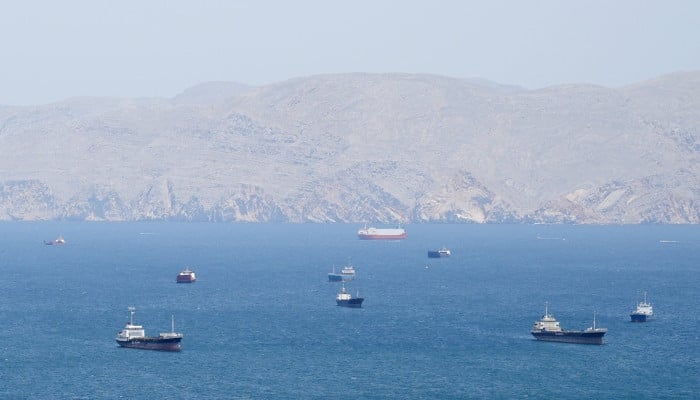
Iran warned last week that submarine cables in the Strait of Hormuz were a vulnerable point for the region’s digital economy, raising concerns about potential attacks on critical infrastructure.
The narrow waterway, already a chokepoint for global oil shipments, is equally vital for the digital world. Several fibre-optic cables snake across the seabed of the strait, connecting countries from India and Southeast Asia to Europe via the Gulf states and Egypt.
What makes undersea cables important?
Subsea cables are fibre-optic or electrical cables laid on the sea floor to transmit data and power. They carry around 99% of the world’s internet traffic, according to the ITU, the United Nations specialised agency for digital technologies.
They also carry telecommunications and electricity between countries, and are essential for cloud services and online communications.
“Damaged cables mean the internet slowing down or outages, e-commerce disruptions, delayed financial transactions … and economic fallout from all of these disruptions,” said geopolitical and energy analyst Masha Kotkin.
Gulf countries, particularly the UAE and Saudi Arabia, have been investing billions of dollars in artificial intelligence and digital infrastructure to diversify their economies away from oil. Both nations have established national AI companies serving customers across the region — all reliant on undersea cables to move data at lightning speed.
Major cables through the Strait of Hormuz include the Asia-Africa-Europe 1 (AAE-1), connecting Southeast Asia to Europe via Egypt, with landing points in the UAE, Oman, Qatar, and Saudi Arabia; the FALCON network, connecting India and Sri Lanka to Gulf countries, Sudan, and Egypt; and the Gulf Bridge International Cable System, linking all Gulf countries including Iran.
Additional networks are under construction, including a system led by Qatar’s Ooredoo.
What area the risks?
While the total length of submarine cables has grown considerably between 2014 and 2025, faults have remained stable at around 150–200 incidents per year, according to the International Cable Protection Committee (ICPC).
State-sponsored sabotage remains a risk, but 70–80% of faults are caused by accidental human activities — primarily fishing and ship anchors, according to the ICPC and experts.
Other risks include undersea currents, earthquakes, subsea volcanoes, and typhoons, said Alan Mauldin, research director at telecom research firm TeleGeography. The industry addresses these by burying cables, armouring them, and selecting safe routes, he said.
The US-Israel war on Iran, nearing the two-month mark, has brought unprecedented disruption to global energy supply and regional infrastructure, including hits to Amazon Web Services data centres in Bahrain and the UAE. Subsea cables have been spared so far.
However, an indirect risk exists from damaged vessels inadvertently hitting cables by dragging anchors.
“In a situation of active military operations, the risk of unintentional damage increases, and the longer this conflict lasts, the higher the likelihood of unintentional damage,” Kotkin said. A similar incident occurred in 2024, when a commercial vessel attacked by Iran-aligned Houthis drifted in the Red Sea and severed cables with its anchor.
The degree to which damage to the cables might impact connectivity in Gulf countries depends largely on how much individual network operators rely on them and what alternatives they have, according to TeleGeography.
No easy fix
Repairing damaged cables in conflict zones poses a separate challenge to securing them. While the physical repair itself is not overly complicated, decisions by repair vessel owners and insurers may also be impacted by the risk of damage from fighting or the presence of mines, experts say.
Permits to access territorial waters add another layer of difficulty. “Often one of the biggest problems with doing repairs is you have to get permits into the waters where the damage is. That can take a long time sometimes and can be the biggest source (of problems),” Mauldin said.
Once the conflict ends, industry players will also face the challenge of re-surveying the sea floor to determine safe cable positions and avoid ships or objects that may have sunk during hostilities, he said.
What alternatives are there if subsea cables falter?
While potential damage to subsea cables would not cause a complete connectivity loss — due to land-based links — experts agree that satellite systems are not a feasible replacement, as they cannot handle the same volume of traffic and are more expensive.
“It’s not as though you could just switch to satellite. That’s not an alternative,” Mauldin said, noting that satellites rely on connections to land-based networks and are better suited for things in motion, like airplanes and ships.
Low-Earth-orbit networks such as Starlink are “a boutique solution, which is not scalable to millions of users, at this time,” Kotkin added.


Iran, US allowed Russian superyacht to cross Strait of Hormuz, says source

BCC warns UK govt on economic risks after global shocks

UAE To Exit OPEC After Nearly 60 Years

-

 Sports1 week ago
NCAA men’s gymnastics championship: All-time winners list
-

 Sports1 week ago
WWE WrestleMania 42 Night 2: Live match results and analysis
-

 Politics1 week ago
UK’s Starmer seeks to deflect blame over Mandelson appointment
-

 Fashion1 week ago
UK’s Sosandar returns to profitability amid robust FY26 performance
-
 Business1 week ago
How Trump’s psychedelics executive order could unlock stalled cannabis reform
-

 Entertainment1 week ago
Lee Anderson, Zarah Sultana kicked out of UK Parliament for calling PM ‘liar’
-
 Business7 days ago
Us-India Trade Talks: US–India trade deal: Where do talks stand & what to expect – explained – The Times of India
-
 Business1 week ago
Exercise to test response to offshore energy threat involving vessels and drones