

Tech
Private LTE/5G networks reached 6,500 deployments in 2025 | Computer Weekly


Driven by the increasing availability of dedicated spectrum, evolving device ecosystem and a growing number of latency-sensitive enterprise use cases, the private cellular network market is undergoing a transformation. According to research from IoT analyst firm Berg Insight, the market value for private LTE/5G network solutions reached an estimated US$2.4bn in 2025.
The private LTE/5G network market report offered an overview of the private LTE/5G ecosystem, with an analysis of market trends and key developments including an investigation of spectrum availability for private LTE/5G network deployments. It was based on profiles of 43 key private LTE/5G solution providers leading to market forecasts on private LTE/5G network deployments.
Berg said the private LTE/5G network market can be divided into two main segments: enterprise and wide-area networks (WAN). Enterprise networks were seen as being smaller, typically covering areas ranging from single buildings to mid-sized cities. WANs extend across much larger areas, sometimes entire countries, and are typically owned by government organisations or utilities and used for critical communications.
The research calculated that there were a total of 6,500 private LTE/5G networks deployed across the world at the end of 2025, excluding proof-of-concept (PoC) projects. Out of the total market value of US$2.4bn, the enterprise and WAN segments were said to have accounted for US$1.1bn and US$1.3bn.
Berg Insight believes that the market value for private LTE/5G network solutions will grow at a steady pace over the next five years, largely driven by new network deployments. “While the market historically has been mainly supply-driven, it is today increasingly driven by organic demand from end users,” said Melvin Sorum, IoT analyst at Berg Insight.
Said to be growing at a CAGR of 38%, the total market value for private LTE/5G network solutions is forecasted to reach US$12bn in 2030. The analyst added that revenue growth will also be driven by upgrades and expansions of existing networks, as enterprises add new applications and transition from LTE to 5G.
Technologically, Berg said the market was being shaped by trends such as the virtualisation of network functions, the implementation of O-RAN in radio products and the emergence of neutral host network solutions. Other key trends identified that could significantly impact private LTE/5G network adoption include new regulatory changes, major divestments, new product categories and emerging technologies such as Wi-Fi 7 and network slicing, which may serve as either complements or substitutes for private cellular networks depending on the use case.
Looking as to which companies are setting the market, the report cited the major RAN vendors of Ericsson, Nokia and Huawei as all playing significant roles as end-to-end solution providers and are challenged by a number of smaller RAN equipment providers. Berg Insight ranked Nokia as the largest private LTE/5G network solution vendor with around 960 customers and more than 2,000 private network deployments at the end of 2025.
However, the report also highlighted that Nokia announced in November 2025 that it is looking to divest its flagship Nokia DAC solution in favour of focusing more on its other larger segments.
A number of small cell and other RAN equipment providers were also seen as offering competitive LTE/5G radio products and in some cases complete private network offerings, including Airspan Networks, Askey, AW2S, Baicells, Benetel, BLiNQ Networks, Cablefree, Celona, Firecell, GXC, JMA Wireless, Mavenir, Microamp, Samsung Networks, Sercomm, Star Solutions, Telrad, XCOM RAN and ZTE.
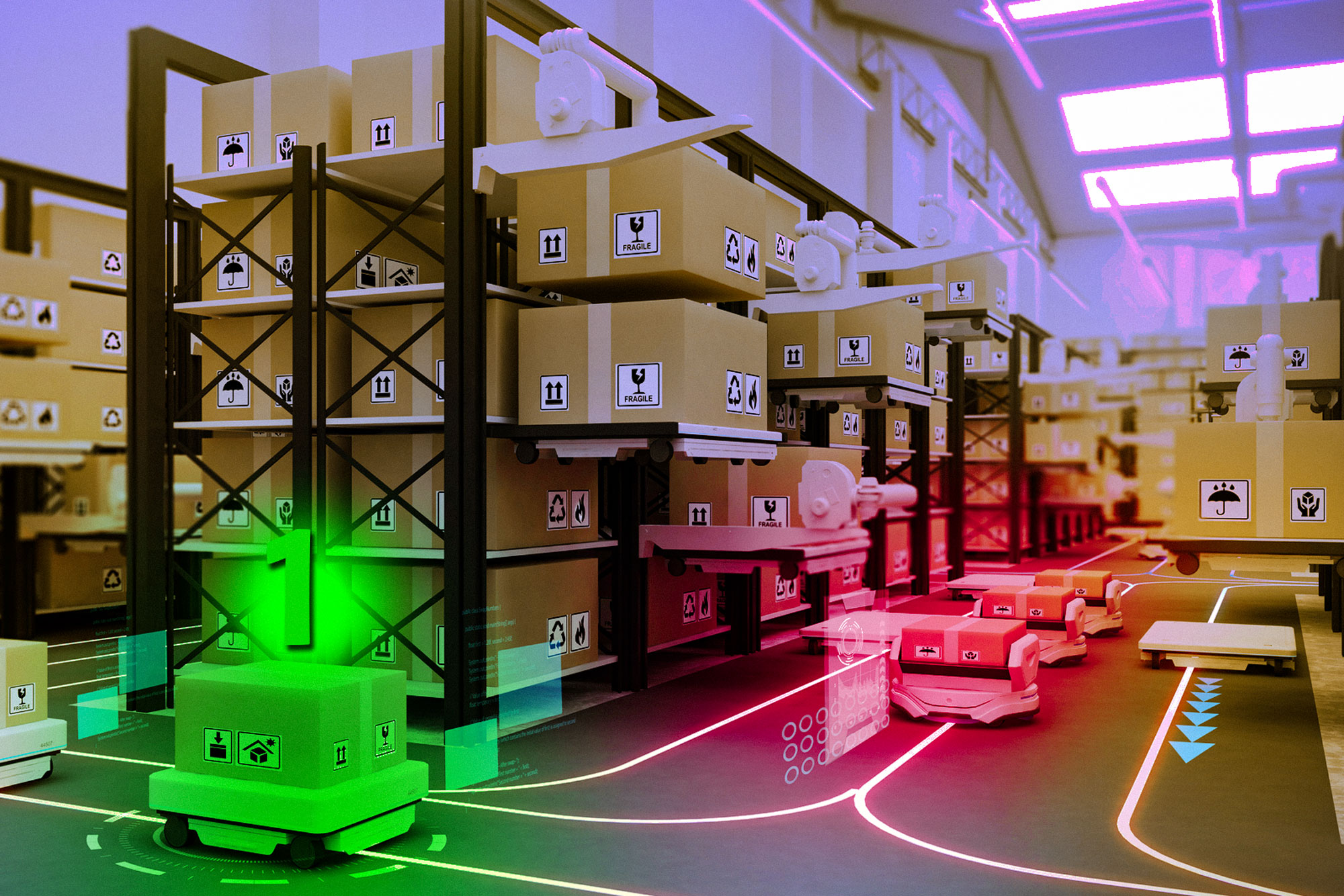
Inside a giant autonomous warehouse, hundreds of robots dart down aisles as they collect and distribute items to fulfill a steady stream of customer orders. In this busy environment, even small traffic jams or minor collisions can snowball into massive slowdowns.
To avoid such an avalanche of inefficiencies, researchers from MIT and the tech firm Symbotic developed a new method that automatically keeps a fleet of robots moving smoothly. Their method learns which robots should go first at each moment, based on how congestion is forming, and adapts to prioritize robots that are about to get stuck. In this way, the system can reroute robots in advance to avoid bottlenecks.
The hybrid system utilizes deep reinforcement learning, a powerful artificial intelligence method for solving complex problems, to figure out which robots should be prioritized. Then, a fast and reliable planning algorithm feeds instructions to the robots, enabling them to respond rapidly in constantly changing conditions.
In simulations inspired by actual e-commerce warehouse layouts, this new approach achieved about a 25 percent gain in throughput over other methods. Importantly, the system can quickly adapt to new environments with different quantities of robots or varied warehouse layouts.
“There are a lot of decision-making problems in manufacturing and logistics where companies rely on algorithms designed by human experts. But we have shown that, with the power of deep reinforcement learning, we can achieve super-human performance. This is a very promising approach, because in these giant warehouses even a 2 or 3 percent increase in throughput can have a huge impact,” says Han Zheng, a graduate student in the Laboratory for Information and Decision Systems (LIDS) at MIT and lead author of a paper on this new approach.
Zheng is joined on the paper by Yining Ma, a LIDS postdoc; Brandon Araki and Jingkai Chen of Symbotic; and senior author Cathy Wu, the Class of 1954 Career Development Associate Professor in Civil and Environmental Engineering (CEE) and the Institute for Data, Systems, and Society (IDSS) at MIT, and a member of LIDS. The research appears today in the Journal of Artificial Intelligence Research.
Rerouting robots
Coordinating hundreds of robots in an e-commerce warehouse simultaneously is no easy task.
The problem is especially complicated because the warehouse is a dynamic environment, and robots continually receive new tasks after reaching their goals. They need to be rapidly redirected as they leave and enter the warehouse floor.
Companies often leverage algorithms written by human experts to determine where and when robots should move to maximize the number of packages they can handle.
But if there is congestion or a collision, a firm may have no choice but to shut down the entire warehouse for hours to manually sort the problem out.
“In this setting, we don’t have an exact prediction of the future. We only know what the future might hold, in terms of the packages that come in or the distribution of future orders. The planning system needs to be adaptive to these changes as the warehouse operations go on,” Zheng says.
The MIT researchers achieved this adaptability using machine learning. They began by designing a neural network model to take observations of the warehouse environment and decide how to prioritize the robots. They train this model using deep reinforcement learning, a trial-and-error method in which the model learns to control robots in simulations that mimic actual warehouses. The model is rewarded for making decisions that increase overall throughput while avoiding conflicts.
Over time, the neural network learns to coordinate many robots efficiently.
“By interacting with simulations inspired by real warehouse layouts, our system receives feedback that we use to make its decision-making more intelligent. The trained neural network can then adapt to warehouses with different layouts,” Zheng explains.
It is designed to capture the long-term constraints and obstacles in each robot’s path, while also considering dynamic interactions between robots as they move through the warehouse.
By predicting current and future robot interactions, the model plans to avoid congestion before it happens.
After the neural network decides which robots should receive priority, the system employs a tried-and-true planning algorithm to tell each robot how to move from one point to another. This efficient algorithm helps the robots react quickly in the changing warehouse environment.
This combination of methods is key.
“This hybrid approach builds on my group’s work on how to achieve the best of both worlds between machine learning and classical optimization methods. Pure machine-learning methods still struggle to solve complex optimization problems, and yet it is extremely time- and labor-intensive for human experts to design effective methods. But together, using expert-designed methods the right way can tremendously simplify the machine learning task,” says Wu.
Overcoming complexity
Once the researchers trained the neural network, they tested the system in simulated warehouses that were different than those it had seen during training. Since industrial simulations were too inefficient for this complex problem, the researchers designed their own environments to mimic what happens in actual warehouses.
On average, their hybrid learning-based approach achieved 25 percent greater throughput than traditional algorithms as well as a random search method, in terms of number of packages delivered per robot. Their approach could also generate feasible robot path plans that overcame congestion caused by traditional methods.
“Especially when the density of robots in the warehouse goes up, the complexity scales exponentially, and these traditional methods quickly start to break down. In these environments, our method is much more efficient,” Zheng says.
While their system is still far away from real-world deployment, these demonstrations highlight the feasibility and benefits of using a machine learning-guided approach in warehouse automation.
In the future, the researchers want to include task assignments in the problem formulation, since determining which robot will complete each task impacts congestion. They also plan to scale up their system to larger warehouses with thousands of robots.
This research was funded by Symbotic.

I was a late convert to air fryers, in part because I worried about versatility: Just how many wings and nuggets and fries does anyone need? (Don’t answer. The answer will incriminate you.)
The Typhur Dome 2 is the air fryer that obliterated this worry, by adding pizza, browned meats, grilled asparagus, and toasted bread to this list—not to mention perfect crispy bacon. It’s an innovative device that takes over most of the functions of a classic auxiliary oven, but with far more powerful convection.
After testing more than 30 air fryers over the past year, the Dome 2 is the one I far and away recommend as the most powerful, versatile, accurate, and fast air fryer I know. I’ve evangelized for this thing ever since I first tried it last year. But the one big caveat is always the price: It’s listed at $500 and rarely dips much below $400.
So imagine my surprise when I saw the Dome 2 dip to $340 for Amazon’s Spring Sale, the lowest I’ve seen it since Black Friday. If you’ve been hunting for an upgrade to your old basket air fryer, this is probably a good time. The sale lasts until March 31.
-
-
Photograph: Matthew Korfhage
-
Photograph: Matthew Korfhage
-
Photograph: Matthew Korfhage


Fast, Versatile, App-Controlled Cooks
So why’s the Dome 2 my favorite air fryer? Typhur, a tech-forward company based in San Francisco but with engineering and manufacturing ties to China, reimagined the shape and function of the classic basket fryer by creating a broader and shallower basket, with individually controllable dual heating elements.
This means the Dome 2 has room for a freezer pizza, and can apply direct heat from the bottom to add actual char-speckle and crispness to the crust, kind of like a combination grill-oven. The Dome’s shallow basket also lets you spread out ingredients in a single layer for excellent airflow, while heating from both sides. I can crisp two dozen wings in just 14 minutes (or 17 minutes if I fry hard). The Dome also toasts bread evenly, and crisps bacon without smelling up the house—in part because it has a helpful self-clean function.
Temp accuracy is within 5 or 10 degrees of target, and the fan can adjust its speed depending on the cooking mode. And the smart app is actually useful, with about 50 recipes ranging from asparagus to eclair to a flank steak London broil that can be synced with a button-press. But note that some functions, such as baking, need the app to work, and the device is more of a counter hog than taller basket fryers.
Typhur’s Probe-Assisted Oven Also on Sale
The Dome 2’s basket is a bit shallow for a whole bird or a large roast, however. If you want a convection device for larger meats, I often recommend the Breville Smart Oven Air Fryer Pro, which is among my favorite convection toaster ovens. This is a (very) smart oven and air fryer that doesn’t crisp up wings and fries quite as well as basket fryers, but is more versatile for roasting big proteins like a whole chicken. The Breville is also on a nice sale right now, dropping by 20 percent.

Breville
the Smart Oven Air Fryer Pro

“I’ve spent a lot of time looking at the comment sections on these videos actually, and it does not seem like bots. I clicked on people’s profiles; these are real profiles, thousands of followers, no signs of inorganic activity,” Maddox says. “People just like it.”
But even if the views and engagement are real, that doesn’t mean this content is profitable—yet. Maddox noted that because the accounts are so new, most likely aren’t yet enrolled in TikTok’s Creator Fund or other forms of social media ad revenue-sharing, because those usually require accounts to apply and have a certain number of views. But, Maddox says, the earning potential is huge, with the ability to earn thousands of dollars per video if they get millions of views.
AI fruit content started getting posted earlier in March, before Fruit Love Island, but many of the recently created pages clearly take inspiration from its success. There’s The Summer I Turned Fruity, based on the popular teen drama The Summer I Turned Pretty; The Fruitpire Diaries, based on the CW series The Vampire Diaries; and Food Is Blind, based on Netflix’s Love Is Blind.
Predecessors of this AI fruit content include the Italian brainrot characters like Ballerina Cappuccina and Bombardino Crocodilo and the Elsagate controversy. But with these AI fruit miniseries that attempt to follow a narrative across multiple segments or episodes, the clearest parallel actually feels like microdramas, vertical short-form scripted series that American big tech companies are starting to invest more in. Like the AI fruits, these are minutes-long episodic shows intended to perform well on social media, eventually directing viewers to paywalled sequels.
Ben L. Cohen, an actor in Los Angeles who is credited in around 15 of these vertical microdramas, sees at least one common thread between the AI fruit dramas and the shows he has worked on: They both feature “lots of violence toward women.” They also try to cram as much drama as possible into these short clips and have attention-grabbing titles in the style of “Alpha Werewolf Daddy Impregnated Me,” Cohen says.
“It draws people in, I think, seeing that jarring, absurd, cartoonish vibe. It’s cartoonish abuse, but it’s still abuse.”
Vertical microdrama acting work still exists in LA, which can’t be said for all acting gigs right now. Cohen has had conversations with other people working in the industry about how AI is already being integrated more into the videos, potentially posing a threat to the existence of human actors in clickbait content. After all, it’s much cheaper and faster to churn out AI fruit episodes than actual productions. It also raises the question—are some people going to prefer the AI series over the ones they’re inspired by? Already, the answer is yes.
“How is Love Island gonna outdo AI Fruit Love Island?” asked a TikToker with more than 70,000 followers, arguing that the AI fruit version was more engaging than the actual reality show. She deleted the video after it started getting backlash, but other people agreed with her.
“I think TikTok was definitely a big part of that,” Cohen says about the audience’s shortening attention span and desire for compressed, sometimes AI-generated drama. “It makes sense that people are intrigued by a one-minute clip, and then they’ll be like ‘Oh, I’ll watch another one-minute clip.’ You’re not committing to a full, heaven forbid, 20-minute episode. Or 40 minutes. Or an hour. You can just watch one minute.”


PSX slips as doubts grow over Middle East peace

Iran says ‘No talks with US’, and wants end to war on its terms

Jaouadi sets record as Florida, Indiana co-lead NCAA swim

-

 Fashion1 week ago
Sales at US apparel, clothing accessories stores up 4% YoY in Jan 2026
-

 Tech1 week ago
Justice Department Says Anthropic Can’t Be Trusted With Warfighting Systems
-

 Entertainment1 week ago
Val Kilmer revived 1 year after death through AI
-
 Business1 week ago
Stocks and pound rise as US rate call approaches
-

 Sports1 week ago
March Madness 2026 – How to watch in SA, start time, schedule, TV channel for NCAA championship basketball tournament
-

 Politics1 week ago
Iran strikes Tel Aviv with cluster-warhead missiles in retaliation of Larijani’s martyrdom
-
 Business1 week ago
Brits cashing in jewellery as gold price hits record high
-

 Tech1 week ago
Meta Is Shutting Down Horizon Worlds on Meta Quest