

Business
PSX jumps 1.3% on institutional support | The Express Tribune

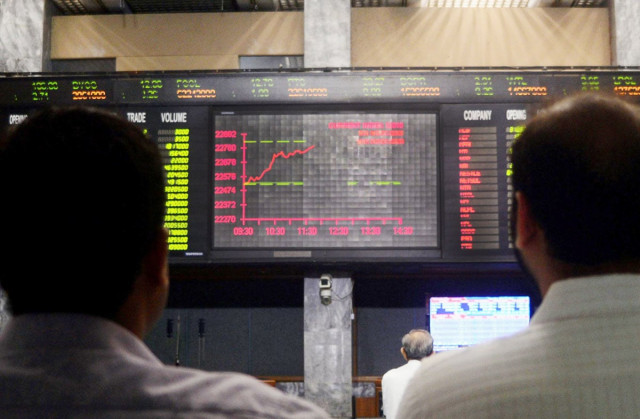
Foreign institutional investors were net buyers of Rs37.6 million worth of shares during the trading session. PHOTO: AFP
KARACHI:
The Pakistan Stock Exchange (PSX) witnessed a strong momentum on Thursday as the benchmark KSE-100 index surged nearly 2,200 points, powered by robust institutional buying and renewed interest in blue-chip shares.
The rally, which pushed the index to the intra-day high of over 2,400 points, marked a sharp shift from the sluggish pace in recent days and reflected improving sentiment despite lingering geopolitical and macroeconomic concerns.
At the close of trading, the KSE-100 index posted gains of 2,184.78 points, or 1.34%, and settled at 165,373.31.
“Upward momentum was built as local institutions led the charge,” commented Topline Securities. The local bourse moved higher once again, supported by steady buying from local institutions that kept sentiment positive, it said. The benchmark index touched the intra-day high of 2,422 points, showing solid interest throughout the session. By the close, the market settled at 165,373, gaining 2,185 points. The banking sector stole the spotlight, where Meezan Bank, HBL, UBL and MCB Bank closed higher, aided by healthy volumes.
In the exploration & production sector, OGDC and PPL were not far behind as both stocks attracted investor interest and closed firmly in the green. Index heavyweights – Meezan Bank, Lucky Cement, PPL, OGDC and Engro – contributed around 942 points to the overall gains, Topline added.
Arif Habib Limited (AHL) said that the KSE-100 index finally breached the 164,000 mark, gaining 1.34% day-on-day as market sentiment strengthened, with 75 stocks advancing and 21 declining. Major contributors to the rally were Meezan Bank (+4.42%), Lucky Cement (+3.41%) and PPL (+3.47%), while Pioneer Cement (-0.52%) and PTCL (-0.65%) emerged as key drags on the index.
On the macro front, headline inflation for November 2025 is expected to reach 6.2% year-on-year, with average inflation for 5MFY26 projected at 5%, significantly lower than the 7.9% reading in the same period of last year, AHL said.
In positive developments, Pakistan and its partners were on track to achieve financial close within the next two weeks for the Reko Diq copper and gold project by securing $3.5 billion in funding. Additionally, the Sindh government approved a strategic partnership with China’s ADM Group to establish more than 600 electric vehicle charging stations across the province.
As the market heads into the final session of the week, the benchmark index was up 2.02% week-on-week, with the 164,000 level now expected to act as an important support for a potential move back towards October highs, AHL concluded.
Muhammad Hasan Ather of JS Global wrote that buying momentum strengthened as the KSE-100 index rose 1.3% on robust volumes and broad institutional interest across key sectors. If positive macro sentiment and liquidity persists, the rally could be extended, supported by reforms, external inflows and strong earnings. However, renewed external or policy pressures could reintroduce volatility, warranting close investor attention, he said.
Overall trading volumes were recorded at 498.4 million shares compared with the previous session’s tally of 636.4 million. The value of shares traded during the day was Rs30.6 billion.
Shares of 484 companies were traded. Of these, 289 stocks closed higher, 152 fell and 43 remained unchanged.
Dost Steels was the volume leader with trading in 48.4 million shares, gaining Rs0.57 to close at Rs8.49. It was followed by WorldCall Telecom with 36.7 million shares, gaining Rs0.04 to close at Rs1.86 and Beco Steel with 25.1 million shares, losing Rs0.12 to close at Rs6.58.
Foreign investors sold shares worth Rs1.8 billion, the National Clearing Company reported.






Business
Top stocks to buy today: Stock recommendations for April 24, 2026 – check list – The Times of India

Stock market recommendations: Bharat Electronics, and Colgate-Palmolive (India) have been recommended as the top stocks to buy today (April 24, 2026) by Bajaj Broking Research. Take a look at the target prices and expected returns:Bharat ElectronicsBuy in the range of ₹ 440.00-450.00
The stock is in structural up trend forming higher high and higher low in all time frame signaling strength and continuation of the uptrend. The entire up move of the last 8 months is in a rising channel as can be seen in the chart highlighting sustained demand at an elevated level.On the smaller time frame, the stock is at the cusp of generating a breakout above the bullish Flag like formation as post a sharp up move in the first 3 weeks of April the stock went into a consolidation phase in the last four sessions. It is seen resuming up move and is at the cusp of generating a breakout above the bullish Flag formation highlighting continuation of the up move and offers fresh entry opportunity.We expect the stock to extend the up move and head towards 495 levels in the coming months being the confluence of the 123.6% external retracement of the previous decline 473 – 400 and the upper band of the rising channel of the last 8 months.Colgate-Palmolive (India)Buy in the range of 2120-2160
The share price of Colgate-Palmolive has generated a breakout above bullish Flag pattern signaling continuation of the up move and offers fresh entry opportunity.We expect the stock to head higher towards 2330 levels in the coming months being the measuring implication of the bullish flag breakout.The daily 14 periods RSI is in buy mode thus supports the positive bias in the stock.(Disclaimer: Recommendations and views on the stock market, other asset classes or personal finance management tips given by experts are their own. These opinions do not represent the views of The Times of India)
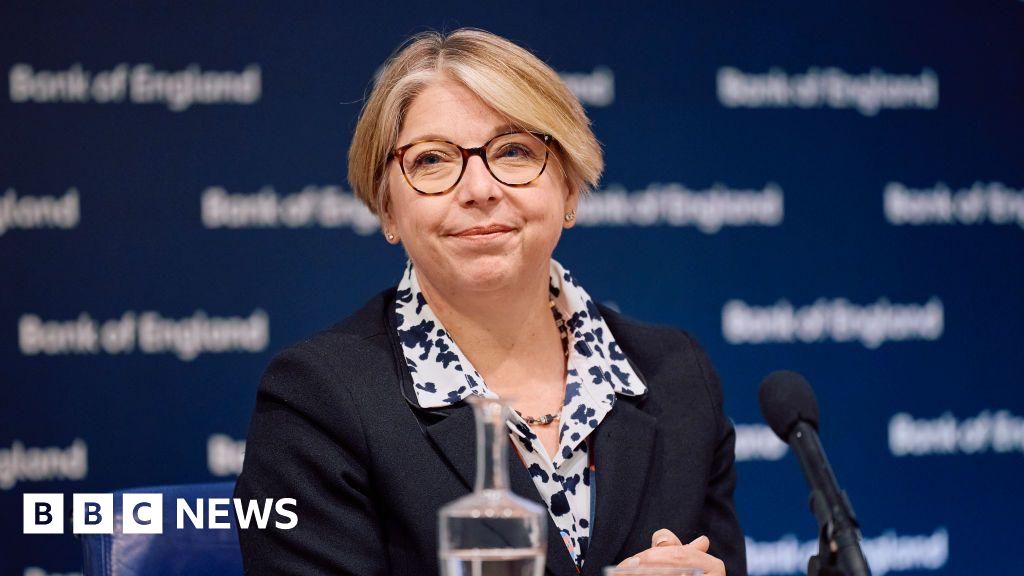
It is unusual for a senior figure at the Bank to be so forthright on market movements.
Source link

Consumer confidence has fallen for the third consecutive month amid household “jitters” over rapid price rises, figures show.
GfK’s long-running consumer confidence index fell four points to minus 25 in April, following falls of two points and three points in March and February respectively.
The deepening concern was driven by perceptions of the UK economy, with a six-point slide in confidence for the next 12 months to minus 43, its lowest level since February 2023.
Confidence in personal finances over the coming year fell five points to minus four – one point lower than this time last year.
The major purchase index – an indicator of confidence in buying big ticket items – held steady, albeit at minus 18 but one point better than last April.
The only measure to improve was the savings index – often an indication that households are concerned about their finances and looking to build contingency funds – which is up five points to 32.
Neil Bellamy, consumer insights director at GfK, said: “Consumers really do have the jitters now.
“It is a year since we last saw a monthly drop of this size, and we have to go back to October 2023 to find the last time consumer confidence was lower.
“Everyone is grappling with rapid price rises, especially at the fuel pumps, which are taking a dent out of household budgets, and people know further price hikes are coming.
“Consumer confidence is deteriorating sharply, with fuel prices and threats of more energy price increases acting as constant reminders of inflation.
“While the Gulf crisis is intensifying pressures, much of the current strain reflects earlier domestic cost increases.
“How long can all this disruption and pain continue?”


Former Giants co-owner Steve Tisch seen in team’s draft room

UK’s clothing exports down 7.6% to $293 mn in Jan-Feb
Top stocks to buy today: Stock recommendations for April 24, 2026 – check list – The Times of India

-

 Fashion1 week ago
France’s LVMH Q1 revenue falls 6%, shows resilience amid Iran war
-

 Entertainment1 week ago
Is Claude down? Here’s why users are seeing errors
-

 Sports1 week ago
PSL 11: Peshawar Zalmi win toss, opt to field first against Quetta Gladiators
-

 Tech1 week ago
The Deepfake Nudes Crisis in Schools Is Much Worse Than You Thought
-
 Business1 week ago
Standard Life buys rival in £2b deal to create savings giant
-

 Tech1 week ago
CYBERUK ’26: UK lagging on legal protections for cyber pros | Computer Weekly
-

 Fashion1 week ago
Raymond unveils luxury Chairman’s Collection Store in Mumbai
-
 Business1 week ago
PepsiCo earnings beat estimates as North American food business improves