

Business
Renewables generated record share of UK electricity in 2025, data shows

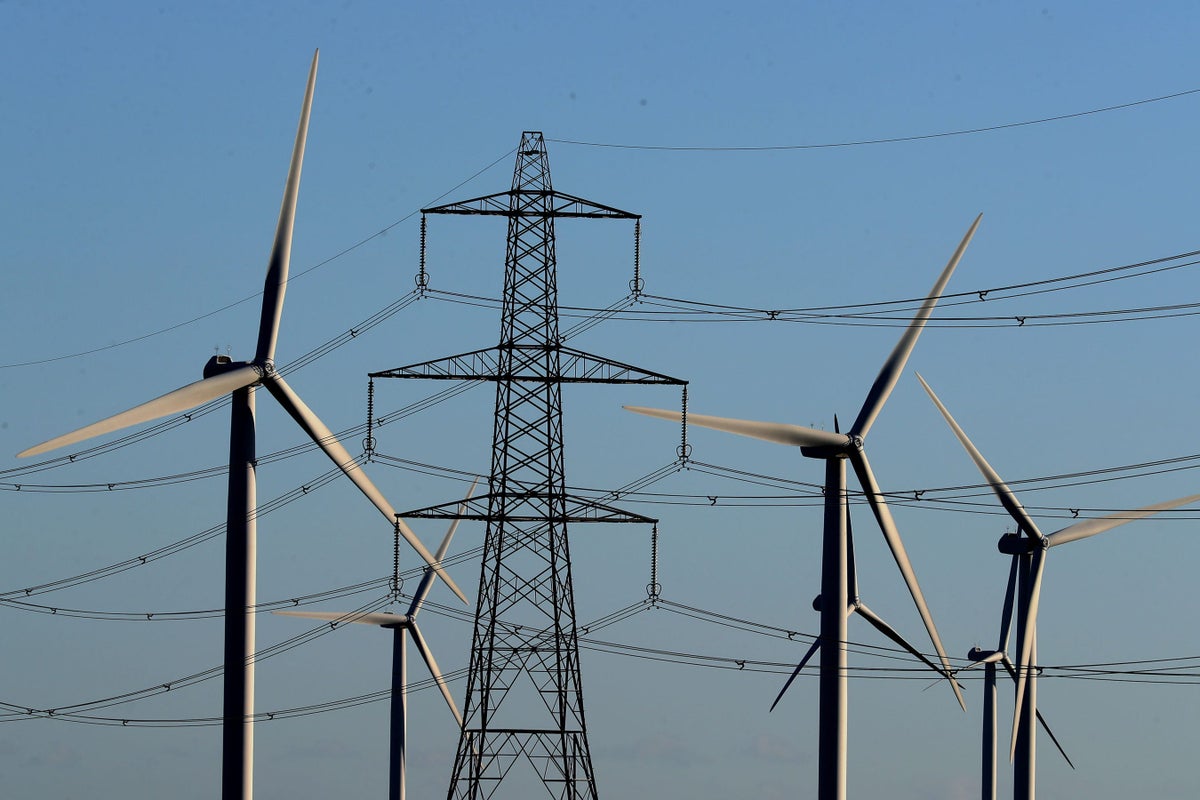
Renewables generated a record share of the UK’s electricity in 2025, according to provisional figures from the Energy Department (Desnz).
The data, released on Thursday, shows that output from renewable technologies such as wind and solar accounted for 52.5% of electricity generation last year.
Together they generated 152.5 terrawatt-hours (TWh) of electricity – an increase of 5.7% compared to 2024.
Desnz said the rise was driven by more renewables being rolled out across the UK, coupled with more favourable weather conditions.
The UK added 3.8 gigawatts (GW) of renewable capacity to the grid, bringing the total to 65.1 GW, up from 61.3 GW in 2024 and 9.3 GW in 2010, the figures show.
It comes after Labour came to power nearly two years ago with a promise to remove almost all fossil fuels from the UK’s electricity grid by 2030, arguing that would reduce bills, generate economic growth, boost energy security and help the UK meet its commitments to tackle climate change.
Energy minister Michael Shanks said last year marked “a major step towards greater control over our energy, our bills and our future”.
“Britain didn’t just break records in 2025 – we blew them away,” he said.
With the Iran conflict currently driving up oil and gas prices, Mr Shanks said: “Four years on from Russia’s invasion of Ukraine we are again seeing what it means to be in the grip of volatile fossil fuel markets we do not control.
“While we continue to fight for people’s corner, with action taken at the budget cutting bills by £117 this week, we are also going further and faster on clean, homegrown energy such as solar and wind.
“This is how we get bills down for good and protect everyone from fossil fuel price shocks.”
Last year, wind generation broke previous records with a share of 30.0% after increasing by 4.1% and contributing 87.1 TWh.
And electricity generated by solar power soared by 36.6% in 2025 compared to 2024, hitting a new record of 20 TWh and generating a 6.9% share of the UK’s energy.
However, last year also saw nuclear power hit a record low, which nearly offset the growth in renewables, Desnz said.
The share of generation from low carbon sources therefore dropped slightly from 65.0% in 2024 to 64.8% last year.
Meanwhile, fossil fuel generation increased by 2.0% compared to last year’s record low following reduced electricity imports.
Tara Singh, chief executive of RenewableUK, said the figures show renewables are now “the backbone of Britain’s power system, supplying most of our electricity for the second year running, with wind doing the heavy lifting”.
She added: “That matters for bills, because low cost renewables reduce our reliance on gas, which still sets electricity prices most of the time and is vulnerable to spikes.”
Overall UK energy production in 2025, which covers heating and transport as well as electricity, dropped by 1.0% to a record low, breaking the record lows seen in 2023 and 2024.
This was partly driven by the fall in fossil fuel production as output from the UK’s older fields decline.
It follows the Government’s ban on new exploration licences for oil and gas fields in the North Sea.
Elsewhere, household energy consumption in 2025 was found to be at similar to 2024.
But officials said it remains significantly down on pre-pandemic averages because of factors such as higher energy prices and record warm temperatures in recent years.
Figures also released on Tuesday showed the UK’s greenhouse gas emissions for those produced within the country’s borders decreased by 1.8% last year compared to 2024, and were down by 53.6% on 1990 levels.
Last year, 30.8% of these emissions were from domestic transport, 21.9% were from the buildings and product uses sector, 12.5% from agriculture, 11.2% from industry, 10.2% from electricity supply and 7.4% from fuel supply.
Desnz said the largest emissions reductions were driven by the fall in blast furnace use in the industrial sector and a fall in coal use in the electricity supply sector.
This came after the UK stopped burning coal to generate electricity in September 2024 following the closure of the last coal-fired power station at Ratcliffe-on-Soar.
But while industry and electricity supply emissions fell, domestic transport sector emissions increased by 2.2%, largely because of an increase in the use of petrol and diesel in road transport.
Fuel supply sector emissions decreased by 5.2% in 2025, driven by less being generated by oil and gas supply compared to 2024.
And a decrease in buildings using heating meant emissions from the buildings and product use sector decreased by 1.7%.

MUMBAI: Some friction, long viewed as a flaw in digital payments, is now being seen as a feature. An RBI discussion paper proposes to introduce a short delay, or “lag”, for high-value transfers above Rs 10,000. This gives customers time to rethink a transaction and cancel it if they suspect fraud. Customers may also be allowed to whitelist trusted payees so that genuine payments are not delayed.Another proposal is to provide stronger protection to vulnerable users such as senior citizens by requiring an additional confirmation from a “trusted person” for large transactions above Rs 50,000. The paper also suggests a “kill switch” to instantly block all digital transactions in case of suspected fraud.Banks are expected to identify suspicious transactions in real time and seek reconfirmation from customers before processing them. They will need to build systems to implement delays, allow cancellations, and generate risk alerts. Banks are also expected to tighten due diligence by linking the level of activity in an account to the customer’s profile. For instance, accounts with low verified income may face limits on how much money they can receive unless additional checks are completed. A key finding is that most frauds now are the result of human vulnerability. The growth of digital payments has amplified this risk.

The project was part of a package of tech investment promising the UK could become an AI superpower.
Source link

People gather at the Magic Kingdom theme park before the “Festival of Fantasy” parade at Walt Disney World in Orlando, Florida, U.S. July 30, 2022.
Octavio Jones | Reuters
Disney is planning to begin its next phase of cost cutting, which will include as many as 1,000 layoffs, according to a person familiar with the matter.
The cost-cutting initiative comes shortly after Josh D’Amaro took the helm as CEO in mid-March.
The layoffs are expected to mostly affect Disney’s marketing department, according to the person, who requested to speak anonymously because the moves had not yet been made public. That department was recently consolidated under Asad Ayaz, who was named chief marketing and brand officer in January.
Ayaz, who reports directly to D’Amaro and Dana Walden, Disney’s president and chief creative officer, oversees marketing for all of Disney’s divisions — entertainment, experiences and sports — in the newly created role. It’s the first time that Disney brought all of its units under one marketing chief.
Disney’s stock was slightly down in afternoon trading on Thursday. The layoffs were first reported by The Wall Street Journal.
The changes to the marketing department structure occurred in January, when Bob Iger was still CEO of the company. Disney announced shortly after that that D’Amaro would take take over the top job — a long-awaited decision for the company.
D’Amaro, who previously was chairman of Disney Experiences, succeeded Iger after a period of uncertainty for the media and theme park giant — which had included a succession race and recent reorganization and turnaround of the business.
Iger reclaimed the Disney CEO role in late 2022, about two years after his initial departure. He was immediately tasked with a turnaround of the business as its stock price had fallen and earnings began to miss expectations.
By February 2023, Disney had announced sweeping plans that reorganized the structure of the company, cut $5.5 billion in costs and eliminated 7,000 jobs from its workforce.
On D’Amaro’s first official day as CEO in March, he noted the work Iger had done to get the company past one of its most difficult periods.
“When Bob returned to the company a few years ago, his goal was to fortify our business and lay the groundwork for long-term growth, by reigniting creativity and improving performance at our studios, building a robust and profitable streaming business, transforming ESPN for a digital future, and turbocharging our parks and experiences,” D’Amaro said on stage at the company’s investor day.
“We’ve accomplished all of those things, and we’re operating from a place of strength, with ample opportunity for growth.”

[CinePlex360] Please moderate: “Lindsey Vonn cr

Diddy fights against ‘unfair’ trial with twisted arguments
[CinePlex360] Please moderate: “US fleet is mov

-
 Business1 week ago
Jaguar Land Rover sees sales recover after cyber attack
-
Uncategorized1 week ago
[CinePlex360] Please moderate: “Trump signals p
-

 Entertainment6 days ago
Joe Jonas shares candid glimpse into parenthood with Sophie Turner
-

 Tech6 days ago
Our Favorite iPad Is $50 Off
-

 Sports6 days ago
UConn Final Four run could trigger a $50M furniture giveaway for Massachusetts-based Jordan’s Furniture
-

 Entertainment6 days ago
Blake Lively reacts to harassment claims dismissal against Justin Baldoni
-

 Fashion1 week ago
China’s Anta Sports posts record $11.62 bn revenue in 2025
-
 Business6 days ago
Video: Why Is the Labor Market Stuck?