

Tech
Robots that spare warehouse workers the heavy lifting

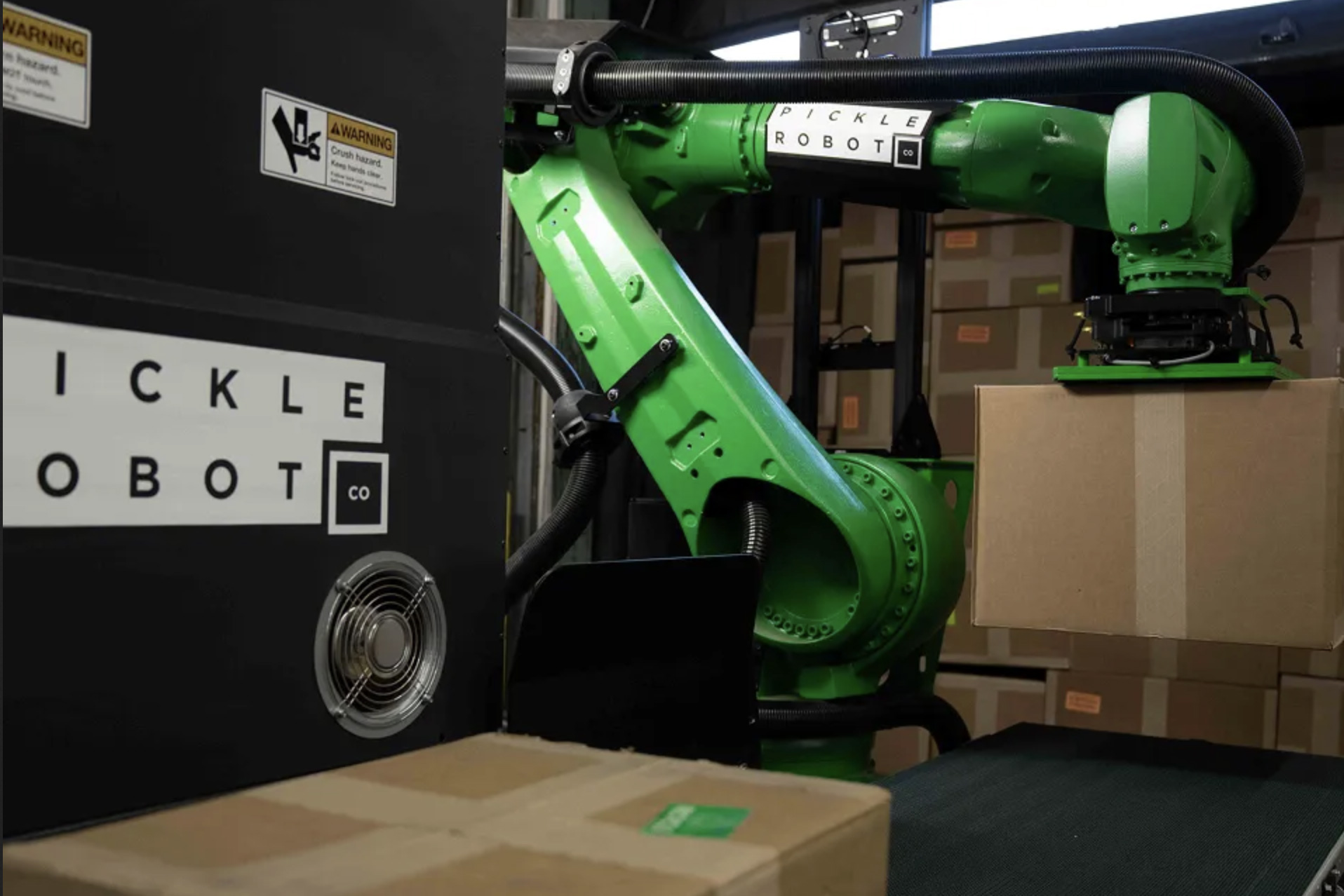
There are some jobs human bodies just weren’t meant to do. Unloading trucks and shipping containers is a repetitive, grueling task — and a big reason warehouse injury rates are more than twice the national average.
The Pickle Robot Company wants its machines to do the heavy lifting. The company’s one-armed robots autonomously unload trailers, picking up boxes weighing up to 50 pounds and placing them onto onboard conveyor belts for warehouses of all types.
The company name, an homage to The Apple Computer Company, hints at the ambitions of founders AJ Meyer ’09, Ariana Eisenstein ’15, SM ’16, and Dan Paluska ’97, SM ’00. The founders want to make the company the technology leader for supply chain automation.
The company’s unloading robots combine generative AI and machine-learning algorithms with sensors, cameras, and machine-vision software to navigate new environments on day one and improve performance over time. Much of the company’s hardware is adapted from industrial partners. You may recognize the arm, for instance, from car manufacturing lines — though you may not have seen it in bright pickle-green.
The company is already working with customers like UPS, Ryobi Tools, and Yusen Logistics to take a load off warehouse workers, freeing them to solve other supply chain bottlenecks in the process.
“Humans are really good edge-case problem solvers, and robots are not,” Paluska says. “How can the robot, which is really good at the brute force, repetitive tasks, interact with humans to solve more problems? Human bodies and minds are so adaptable, the way we sense and respond to the environment is so adaptable, and robots aren’t going to replace that anytime soon. But there’s so much drudgery we can get rid of.”
Finding problems for robots
Meyer and Eisenstein majored in computer science and electrical engineering at MIT, but they didn’t work together until after graduation, when Meyer started the technology consultancy Leaf Labs, which specializes in building embedded computer systems for things like robots, cars, and satellites.
“A bunch of friends from MIT ran that shop,” Meyer recalls, noting it’s still running today. “Ari worked there, Dan consulted there, and we worked on some big projects. We were the primary software and digital design team behind Project Ara, a smartphone for Google, and we worked on a bunch of interesting government projects. It was really a lifestyle company for MIT kids. But 10 years go by, and we thought, ‘We didn’t get into this to do consulting. We got into this to do robots.’”
When Meyer graduated in 2009, problems like robot dexterity seemed insurmountable. By 2018, the rise of algorithmic approaches like neural networks had brought huge advances to robotic manipulation and navigation.
To figure out what problem to solve with robots, the founders talked to people in industries as diverse as agriculture, food prep, and hospitality. At some point, they started visiting logistics warehouses, bringing a stopwatch to see how long it took workers to complete different tasks.
“In 2018, we went to a UPS warehouse and watched 15 guys unloading trucks during a winter night shift,” Meyer recalls. “We spoke to everyone, and not a single person had worked there for more than 90 days. We asked, ‘Why not?’ They laughed at us. They said, ‘Have you tried to do this job before?’”
It turns out warehouse turnover is one of the industry’s biggest problems, limiting productivity as managers constantly grapple with hiring, onboarding, and training.
The founders raised a seed funding round and built robots that could sort boxes because it was an easier problem that allowed them to work with technology like grippers and barcode scanners. Their robots eventually worked, but the company wasn’t growing fast enough to be profitable. Worse yet, the founders were having trouble raising money.
“We were desperately low on funds,” Meyer recalls. “So we thought, ‘Why spend our last dollar on a warm-up task?’”
With money dwindling, the founders built a proof-of-concept robot that could unload trucks reliably for about 20 seconds at a time and posted a video of it on YouTube. Hundreds of potential customers reached out. The interest was enough to get investors back on board to keep the company alive.
The company piloted its first unloading system for a year with a customer in the desert of California, sparing human workers from unloading shipping containers that can reach temperatures up to 130 degrees in the summer. It has since scaled deployments with multiple customers and gained traction among third-party logistics centers across the U.S.
The company’s robotic arm is made by the German industrial robotics giant KUKA. The robots are mounted on a custom mobile base with an onboard computing systems so they can navigate to docks and adjust their positions inside trailers autonomously while lifting. The end of each arm features a suction gripper that clings to packages and moves them to the onboard conveyor belt.
The company’s robots can pick up boxes ranging in size from 5-inch cubes to 24-by-30 inch boxes. The robots can unload anywhere from 400 to 1,500 cases per hour depending on size and weight. The company fine tunes pre-trained generative AI models and uses a number of smaller models to ensure the robot runs smoothly in every setting.
The company is also developing a software platform it can integrate with third-party hardware, from humanoid robots to autonomous forklifts.
“Our immediate product roadmap is load and unload,” Meyer says. “But we’re also hoping to connect these third-party platforms. Other companies are also trying to connect robots. What does it mean for the robot unloading a truck to talk to the robot palletizing, or for the forklift to talk to the inventory drone? Can they do the job faster? I think there’s a big network coming in which we need to orchestrate the robots and the automation across the entire supply chain, from the mines to the factories to your front door.”
“Why not us?”
The Pickle Robot Company employs about 130 people in its office in Charlestown, Massachusetts, where a standard — if green — office gives way to a warehouse where its robots can be seen loading boxes onto conveyor belts alongside human workers and manufacturing lines.
This summer, Pickle will be ramping up production of a new version of its system, with further plans to begin designing a two-armed robot sometime after that.
“My supervisor at Leaf Labs once told me ‘No one knows what they’re doing, so why not us?’” Eisenstein says. “I carry that with me all the time. I’ve been very lucky to be able to work with so many talented, experienced people in my career. They all bring their own skill sets and understanding. That’s a massive opportunity — and it’s the only way something as hard as what we’re doing is going to work.”
Moving forward, the company sees many other robot-shaped problems for its machines.
“We didn’t start out by saying, ‘Let’s load and unload a truck,’” Meyers says. “We said, ‘What does it take to make a great robot business?’ Unloading trucks is the first chapter. Now we’ve built a platform to make the next robot that helps with more jobs, starting in logistics but then ultimately in manufacturing, retail, and hopefully the entire supply chain.”

The latest brain-computer interface could help people recover from severe depression. Motif Neurotech announced Monday that the US Food and Drug Administration has approved a human study to trial the company’s blueberry-sized brain implant that sits in the skull and delivers electrical stimulation to treat depression.
The Houston-based startup, founded in 2022, is part of a budding industry pursuing technology to read and interpret brain signals. While other companies exploring similar technology, like Elon Musk’s Neuralink, Paradromics, and Synchron, are developing devices to enable paralyzed people to communicate and use computers, Motif is aiming to ease depression in people who have not benefited from medication.
The company’s device is implanted in the skull just above the dura, the brain’s protective membrane. It targets the central executive network, a part of the brain that is responsible for high-level cognitive functions and is underactive in major depressive disorder. The implant emits specific patterns of stimulation to turn “on” this network.
Motif’s device would allow patients to receive therapeutic brain stimulation at home. “Through frequent electrical stimulation, we think we can drive that neuroplasticity that creates stronger connectivity within the central executive network for patients with depression, so that they can get out of bed in the morning, call their friends, go to the gym,” says Jacob Robinson, Motif’s cofounder and CEO.
Courtesy of Motif
Electrical stimulation has been used for decades to treat depression, and Motif’s approach is just the latest iteration. Electroconvulsive or “shock” therapy began in the 1930s and is still used today in cases where patients don’t benefit from antidepressants. Deep brain stimulation, which involves surgically implanting electrodes into the brain, is occasionally used experimentally but is not FDA approved. A much milder form of stimulation known as transcranial magnetic stimulation, or TMS, was approved in 2008. While it can be highly effective, it typically requires a lengthy treatment regimen of five treatments a week for six weeks.
A study from 2021 found that during a 12-month period in the United States, nearly 9 million adults were undergoing treatment for major depressive disorder, and of those, almost 3 million were considered to have treatment-resistant depression, when symptoms do not improve after at least two, and often more, antidepressant medications.
Motif’s device can be implanted in a 20-minute outpatient procedure without the need for brain surgery. It’s powered by wireless magnetoelectric technology that Robinson developed while at Rice University and is charged with a baseball cap that patients will wear when receiving the stimulation.

David Silver gave the world its very first glimpse of superintelligence.
In 2016, an AI program he developed at Google DeepMind, AlphaGo, taught itself to play the famously difficult game of Go with a kind of mastery that went far beyond mimicry.
Silver has since founded his own company, Ineffable Intelligence, that aims to build more general forms of AI superintelligence. The company will do this, Silver says, by focusing on reinforcement learning, which involves AI models learning new capabilities through trial and error. The vision is to create “superlearners” that go beyond human intelligence in many domains.
This approach stands in contrast to how most AI companies plan to build superintelligence, by exploiting the coding and research capabilities of large-language models.
Silver, speaking to WIRED from his office in London, says he thinks this approach will fail. As amazing as LLMs are, they learn from human intelligence—rather than building their own.
“Human data is like a kind of fossil fuel that has provided an amazing shortcut,” Silver says. “You can think of systems that learn for themselves as a renewable fuel—something that can just learn and learn and learn forever, without limit,” he says.
I’ve met Silver a few times and—despite this proclamation—he’s always struck me as one of the more humble people in AI. Sometimes, when talking about ideas he considers silly, he flashes a puckish grin. Right now, though, he’s deadly serious.
“I think of our mission as making first contact with superintelligence,” he says. “By superintelligence I really mean something incredible. It should discover new forms of science or technology or government or economics for itself.”
Five years ago, such a mission might have seemed ridiculous. But tech CEOs now routinely talk about machines outpacing human intelligence and replacing entire categories of workers. The idea that some new technical twist might unlock superhuman AI capabilities has recently spawned a raft of billion-dollar startups.
Ineffable Intelligence has so far raised $1.1 billion in seed funding at a valuation of $5.1 billion—an enormous sum by European AI standards. Silver has also recruited top AI researchers from Google DeepMind and other frontier labs to join his endeavor.
Silver says he will give all of the money he makes from equity in Effable Intelligence—a sum that could amount to billions if he is successful—away to charity.
“It’s a huge responsibility to build a company focusing on superintelligence,” he tells me. “I think this is something that has to be done for the benefit of humanity, and any money that I make from Ineffable will will go to high-impact charities that save as many lives as possible.”
Total Focus
Silver met Demis Hassabis, the CEO of Google DeepMind, at a chess tournament when they were kids, and the pair later became lifelong friends and collaborators.
They remained close after Silver left Google DeepMind, which he did only because he wanted to chart a completely new path. “I feel it’s really important that there is an elite AI lab that actually focuses a hundred percent on this approach,” he says. “That it’s not just a corner of another place dedicated to LLMs.”
The limits of the LLM-based approach can be seen, Silver says, with a simple thought experiment. Imagine going back in time and releasing a large language model in a world that believed the world was flat. Without being able to interact with the real world, the system, he says, would remain an avid flat-earther, even if it continued to improve its own code.
An AI system that can learn about the world for itself, however, could make its own scientific discoveries.
The best iPhone charger depends on several factors. Are you topping off your battery on the go? Do you want to charge your iPhone as quickly as possible? Are you charging it overnight on your nightstand? The best gear recommendation is going to change with the situation. Luckily, the WIRED Reviews team tests iPhone chargers in the field all year long. There’s not a day that goes by that at least one of us is not assessing at least one iPhone charger. I’ve gathered up our favorite picks for every scenario.
Be sure to check out our related buying guides, like the Best Power Banks, the Best 3-in-1 Chargers, and the Best Wireless Chargers.
Table of Contents
The Best iPhone Chargers
Best Wall Charger for iPhone
This Anker charger is slick and has folding prongs so it’s easy to travel with, but the best part is that it can charge your phone at 40 watts (average is 20 to 27 watts). That means you can get up to 50 percent battery life in only 20 minutes. Not all iPhone models support charging this fast—it’s limited to iPhone 17, iPhone 17 Pro, and iPhone 17 Pro Max—but you may as well future-proof your gear if you’re shopping for a wall charger, even if your phone can’t take full advantage of those speeds yet.
Best Power Bank for iPhone
-Portable-Charger-Reviewer-Photo-(no-border)-SOURCE-Simon-Hill.jpg)
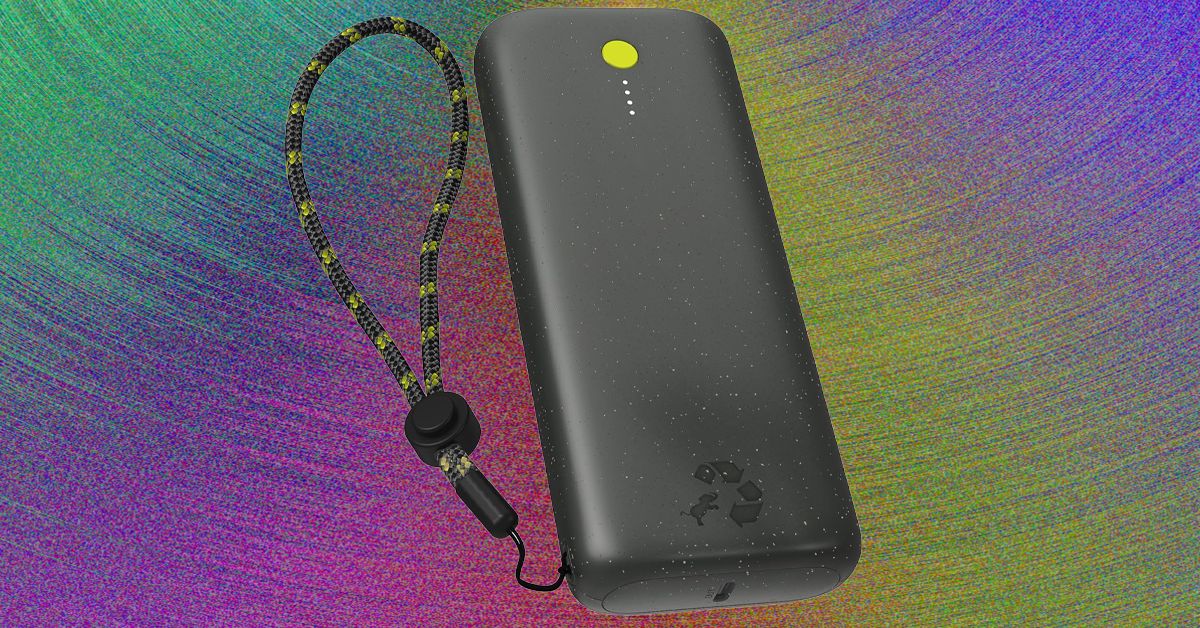
We do recommend the Anker Laptop Power Bank as our top-pick power bank, but if you’re only trying to top off your iPhone, this is a very reliable and neat-looking power bank. It’s svelte, smaller than a deck of cards, and can deliver 20 watts to two devices at once. Nimble also makes a slightly larger version, which has a larger capacity and can charge at up to 65 watts. Aside from the cool design featuring speckled colors and a lanyard loop, Nimble also uses bioplastics, recycled materials, and minimal packaging. A USB-C charger is included in the box.
Best MagSafe Portable Charger for iPhone
.jpg)
Anker
MagGo Power Bank (10K) (Qi2)
This 10,000-mAh power bank can charge your device at up to 15 watts, but it’ll also charge older devices at a slower rate. It has a built-in kickstand and an LED display that lets you know how much power is left at a glance. It works in portrait or landscape modes. Be aware that it won’t be able to charge most phones fully more than once, but it’s hard to beat if you’re seeking wireless charging on the go. If you want a bigger capacity or faster charging, you don’t want MagSafe.
Best 3-in-1 Charger for iPhone

Belkin
3-in-1 Qi2 Charging Stand
The Belkin 3-in-1 can charge your compatible iPhone at 15 watts, plus your AirPods and your Apple Watch at the same time. The charging pad can be tilted to your preferred angle, including in landscape orientation if you want to watch a video or put your phone in StandBy mode. The USB-C cable is permanently attached, which you may or may not like. Check our best 3-in-1 chargers buying guide for additional picks.
Best 2-in-1 Charger for iPhone

Photograph: Louryn Strampe
Mophie
2-in-1 Wireless Charging Stand
I love a 3-in-1 charger as much as the next tech nerd, but sometimes they’re overkill. My Apple Watch battery usually lasts all day long, but I can chew through my older AirPods battery before my lunch break hits, and my iPhone battery might be depleted too, depending on whether or not I’m streaming Max Velocity off to the side. This 2-in-1 charger has been my steadfast desktop companion. Mophie makes another version that tops off your Apple Watch and iPhone instead of your headphones, which might be what you want if you’re rocking wired headphones or you’re making intense use of a walking pad throughout the day. There’s a 40-watt wall charger in the box—a rarity these days!—plus a USB-C cable that winds neatly into the base. It’s easy to adjust the angle of your iPhone as well, and I’ve found the base very sturdy. If you want to charge, but not necessarily all of the possible devices simultaneously, these might be what you seek.

Anker
Prime USB-C to USB-C Cable
This braided nylon USB-C cable has a durable exterior made from recycled plastic. The cable is rugged, with Anker promising that it can operate in temperatures ranging from negative 40 degrees to 176 degrees Fahrenheit. It’s backed by a lifetime warranty. It’s got a built-in cable management loop. It’s more than enough cable for your iPhone. Read our guide to the Best USB-C Cables for more picks.

Ugreen
USB-C to Lightning Cable
If your iPhone is still rocking the Lightning cable, this is gonna be way better than whatever shoddy cable Apple sent you. It’s durable and is Made for iPhone-certified, so you won’t have any problems getting it to work. It comes in 3-, 6-, or 10-foot lengths with a two-year warranty. Best of all, the exterior casing will stay intact, unlike what you’d probably get with Apple’s cables.


PCB shares ticket pricing details for PSL 11 Qualifier in Karachi – SUCH TV

Melania Trump says ABC should ‘take a stand’ on late-night host Kimmel

A Brain Implant for Depression Is About to Be Tested in Humans

-

 Sports1 week ago
NCAA men’s gymnastics championship: All-time winners list
-

 Sports1 week ago
WWE WrestleMania 42 Night 2: Live match results and analysis
-

 Politics6 days ago
UK’s Starmer seeks to deflect blame over Mandelson appointment
-

 Fashion1 week ago
UK’s Sosandar returns to profitability amid robust FY26 performance
-

 Entertainment7 days ago
Lee Anderson, Zarah Sultana kicked out of UK Parliament for calling PM ‘liar’
-
 Business7 days ago
How Trump’s psychedelics executive order could unlock stalled cannabis reform
-
 Business1 week ago
No fuel shortage: Govt assures 100% domestic LPG, PNG, CNG supply amid Hormuz energy crunch – The Times of India
-

 Sports1 week ago
Quetta Gladiators opt to bowl after winning toss against Peshawar Zalmi in PSL 11 clash