

Business
South Korea Aims To Cut Carbon Emissions At International Airports By 10 Per Cent By 2030

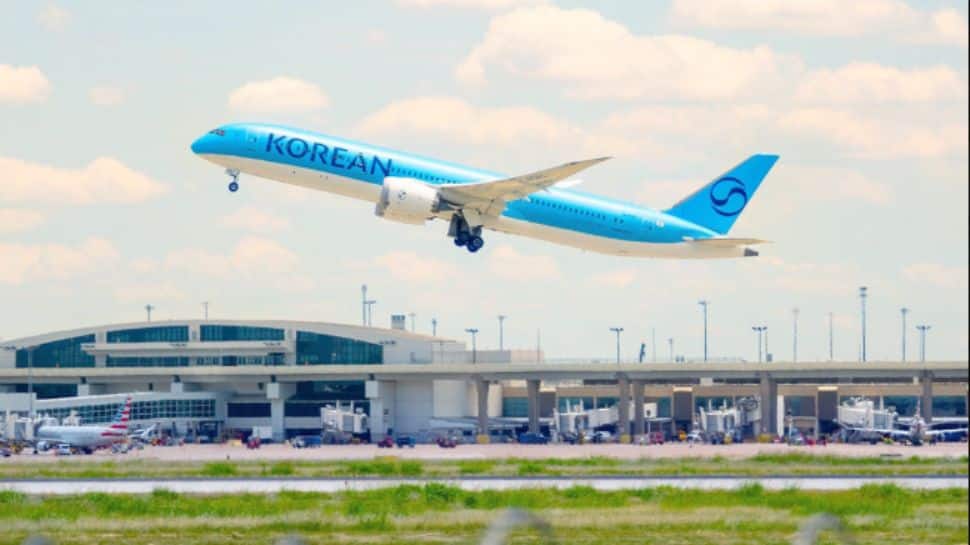
Seoul: South Korea aims to cut carbon emissions at its international airports by 10 percent by 2030 while expanding the use of sustainable aviation fuel (SAF), a government report showed on Sunday.
Under the blueprint for the 2026-2030 period, set by the transport, environment and industry ministries, carbon emissions at South Korea’s international airports are projected to reach 29.8 million tons in 2030, up 28 percent from 23.3 million tons recorded this year.
The government aims to reduce the projected amount by 10 percent, or 2.87 million tons, reports Yonhap news agency. The report said the reduction can be achieved by using SAF, shorter standby time during takeoff and landing, and improved efficiency in airport operations.
In line with the efforts, international aircraft taking off from South Korea will be required to use SAF for at least 1 percent of their fuel, and the share will be raised to between 3 percent and 5 percent after 2030.
South Korea will come up with measures to ease the financial burden on air carriers, considering that SAF prices are around three times higher than those of conventional jet fuel, including partially assisting with related costs.
Meanwhile, Korean Air build a next-generation aircraft maintenance hangar at Incheon International Airport, South Korea’s main gateway, under a 176 billion-won (US$119.2 million) joint investment deal with the airport operator, the airline said.
The new hangar will be located inside the airport’s High Tech Aviation Complex and will support airframe inspections, component checks, heavy maintenance and aircraft modification. The 69,299-square-meter site will accommodate two wide-body aircraft and one narrow-body aircraft at once. Construction is set to begin in 2027, with operations planned from late 2029.
Korean Air said the facility will strengthen its maintenance, repair and overhaul (MRO) capabilities ahead of the launch of the integrated carrier following the acquisition of rival carrier Asiana Airlines Inc.



BENGALURU: India’s Gen Z workforce is embracing what experts describe as “portfolio careers” – balancing multiple professional identities and income streams simultaneously. New research from LinkedIn shows that 75% of Gen Z entrepreneurs in India now manage multiple income streams, significantly higher than the 62% among Gen X entrepreneurs. The findings point to a growing preference among younger professionals for flexibility, autonomy and diversified sources of income. “We’re also seeing the rise of the ‘portfolio era’, with more professionals creating multiple income streams and redefining what a career can look like. This shift is making entrepreneurship more accessible than ever before,” said LinkedIn India country manager Kumaresh Pattabiraman.Rather than depending on a single full-time role, many professionals are simultaneously building businesses, freelancing, consulting, creating online content and monetising specialised skills through digital platforms. The trend comes amid a broader rise in entrepreneurial activity in India. LinkedIn recorded a 104% year-on-year increase in members adding “Founder” to their profiles – the highest growth among all global markets.AI is also emerging as a major enabler of this shift. The report found that 85% of Gen Z entrepreneurs consider AI and digital tools important to their business operations.

Sam Altman said Elon Musk tried many times for total control of OpenAI, which he’s now suing.
Source link

A United Airlines plane approaches the runway at Denver International Airport on March 23, 2026.
Al Drago | Getty Images
United Airlines flight attendants approved a new five-year labor contract with 31% average raises to base pay by August and other improvements, marking the last of the major carriers with unionized flight crews to reach a deal post-Covid.
The labor deal would give United’s roughly 30,000 flight attendants their first raises in close to six years. The company and the flight attendants’ union reached a preliminary deal in March. Crews had rejected a contract last year.
The union said the contract won 82% approval from the flight attendants, with close to 90% of them voting.
“The contract will immediately change the lives of United Flight Attendants, especially our thousands of new hires who have been hired since the pandemic,” said Ken Diaz, president of the United chapter of the Association of Flight Attendants.
The contract also includes boarding pay, or pay for when the aircraft’s door is open and travelers are getting on. Airlines had for years started flight attendants’ pay clock once the boarding door was closed.
The contract comes with a roughly 7% to 8% increase in compensation and $741 million in back pay, as well as quality-of-life improvements like restrictions on red-eye flights and “sit pay” during disruptions of more than 2½ hours.


South Korea reviews phased support for Strait of Hormuz security efforts

Kim Kardashian faces legal trouble by ‘innocent’ man

President to undergo medical examination amid serious concerns

-

 Tech1 week ago
DHS Demanded Google Surrender Data on Canadian’s Activity, Location Over Anti-ICE Posts
-
 Business1 week ago
Heineken plans huge investment in hundreds of UK pubs ahead of World Cup
-

 Tech5 days ago
A new frontier: Identity stack evolves for agentic systems | Computer Weekly
-

 Tech4 days ago
‘Orbs,’ ‘Saucers,’ and ‘Flashes’ on the Moon: Pentagon Drops New UFO Files
-
 Business1 week ago
India among most resilient large EMs, better placed for future global shocks; policy reforms & strong buffers help: Moody’s – The Times of India
-

 Fashion5 days ago
New orders in German manufacturing up 5% MoM in Mar 2026: Destatis
-

 Tech5 days ago
What Microsoft Executives Really Thought About OpenAI in 2018
-
 Business1 week ago
US denies Iranian report warship was struck by missiles