

Business
Stocks soar and oil sinks on fresh peace deal hope

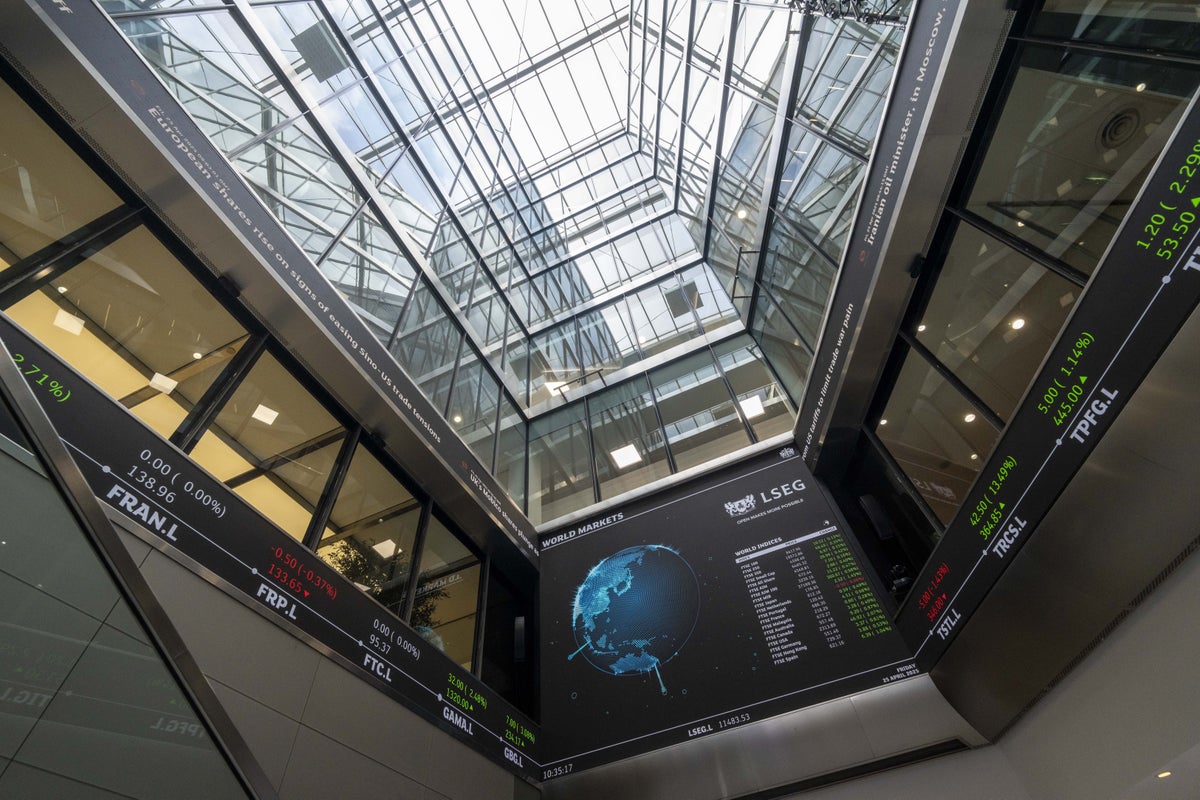
Stocks soared on Wednesday on renewed hopes a peace deal could be struck between the US and Iran to end the Middle East war.
The FTSE 100 closed up 219.55 points, 2.2%, at 10,438.66.
The FTSE 250 ended up 388.61 points, 1.7%, at 22,832.42, and the AIM All-Share rose 9.34 points, 1.2%, at 808.62.
Axios on Wednesday reported that the US believes it is getting close to an agreement with Iran on a one-page memorandum of understanding to end the Middle East war and set a framework for more detailed nuclear negotiations.
The one-page, 14-point memorandum of understanding is being negotiated between US President Donald Trump’s envoys Steve Witkoff and Jared Kushner and several Iranian officials, both directly and through mediators, the report said.
In its current form, the MOU would declare an end to the war in the region and the start of a 30-day period of negotiations on a detailed agreement to open the Strait of Hormuz, limit Iran’s nuclear programme and lift US sanctions, Axios said. Those negotiations could happen in Islamabad or Geneva.
AFP reported Iran Foreign Ministry spokesman Esmaeil Baqaei as saying that a US proposal to end the war is still “under review” by Tehran, citing local media.
Mr Trump himself issued an ultimatum for Iran to accept the deal to end the war or face intense renewed US bombing.
The report saw oil prices slide and equities soar.
Brent crude for July delivery was trading at 102.12 US dollars a barrel on Wednesday, down sharply compared with 110.70 dollars at the time of the equities close in London on Tuesday.
“No-one knows how this latest peace plan will pan out; however, the market is willing to trade on hope at this stage,” said Kathleen Brooks, research director at XTB.
But she cautioned: “We have been promised peace deals before, which have then failed to materialise, so while the market is willing to trade on the back of this de-escalation, it will take further concrete steps to end the war and reopen the Strait of Hormuz before the oil price can meaningfully fall below 100 dollars per barrel for Brent crude.”
In European equities on Wednesday, the CAC 40 in Paris ended up 2.9%, and the DAX 40 in Frankfurt jumped 2.1%.
In New York, markets were higher. The Dow Jones Industrial Average was up 1.2%, as was the S&P 500, while the Nasdaq Composite was up 1.5%.
Disney rose 6.4% as it reported better-than-expected second-quarter results, while Advanced Micro Devices soared 18% after its strong first-quarter earnings and upbeat guidance.
The yield on the US 10-year Treasury narrowed to 4.35% on Wednesday from 4.42% on Tuesday. The yield on the US 30-year Treasury was at 4.94% on Wednesday, down from 5.00%.
The pound firmed to 1.3602 dollars on Wednesday afternoon from 1.3569 dollars on Tuesday. Against the euro, sterling was lower at 1.1566 euros from 1.1586 euros on Tuesday.
The euro traded higher against the greenback, at 1.1756 dollars on Wednesday from 1.1707 dollars on Tuesday. Against the yen, the dollar was trading at 156.27 yen, lower than 157.66 yen.
London’s rally saw broad-based gains, with miners a strong feature.
Gold miner Fresnillo rose 11%, aerospace and defence manufacturer Rolls-Royce climbed 6.4%, British Airways owner IAG advanced 6.7%, lender Barclays added 5.5% and housebuilder Persimmon firmed 4.6%.
Retailer Next rose 4.4% as it nudged up full-year profit guidance after first-quarter sales grew more than it had forecast.
The Leicester-based clothing and homewares retailer said full price sales were up 6.2% in the 13 weeks to May on last year, and ahead of the group’s 4.0% forecast.
This reflected a strong start to the period, with sales in the first five weeks of the financial year up 11.8%.
The stronger sales came before the conflict in the Middle East started and last year’s UK sales strengthened as a result of unusually warm weather, the FTSE 100 listing explained.
JPMorgan analyst Georgina Johanan felt the “solid” statement was “somewhat reassuring” for the broader UK retail sector.
Diageo added 6.3% as it backed its annual outlook and reported better-than-expected third-quarter sales, despite spirits market weakness in the US.
The brewer and distiller, behind brands such as Guinness, Smirnoff and Tanqueray, said net sales rose 2.3% to 4.48 billion dollars in the financial third quarter ended March 31 from 4.38 billion dollars a year prior.
Diageo had been expected to report net sales of 4.27 billion dollars for the quarter, according to company-compiled market consensus. Organic net sales edged up 0.3%, however, beating expectations of a 2.3% decline.
Unsurprisingly, oil majors BP and Shell were prominent blue-chip fallers, down 3.7% and 3.1% respectively reflecting the lower oil price.
Smith & Nephew fell 3.6% as it reported in line first-quarter trading despite a drop in knee implant sales in the US.
On the FTSE 250, travel retailer WH Smith leapt 8.5% and airlines easyJet and Wizz Air soared 8.9% and 7.2% respectively.
But Telecom Plus plunged 11% as Deutsche Bank Research downgraded to “hold” from “buy” and slashed its share price target to 1,300 pence from 2,000p.
Elsewhere, Reach slid 9.9% as it reported “ongoing disruption in search and referral volumes” in its first quarter.
The publisher of the Daily Mirror, Daily Express and a raft of UK regional titles said revenue fell 6.9% on-year in the first quarter of 2026, with print down 6.6% and digital 8.1% lower.
On-platform referral volumes, mainly from Alphabet’s Google, were “materially lower” and reduced across the quarter, resulting in the 8.1% decline in digital revenue, it said.
Gold traded higher at 4,692.73 dollars an ounce on Wednesday, from 4,576.51 dollars on Tuesday.
The biggest risers on the FTSE 100 were Fresnillo, up 347p at 3,462p, Endeavour Mining, up 393p at 4,678p, Prudential, up 81.5p at 1,184p, Anglo American, up 263p at 3,827.5p and Antofagasta, up 257p at 3,818.5p.
The biggest fallers on the FTSE 100 were BP, down 21.3p at 551.3p, Smith & Nephew, down 41.5p at 1,117.5p, Shell, down 101p at 3,211.5p, London Stock Exchange, down 238p at 9,340p and Sage Group, down 22p at 886.6p.
Thursday’s global economic calendar has eurozone retail sales data, a slew of construction PMI readings and weekly initial jobless claims figures in the US.
Thursday’s local corporate calendar has full-year results from sports retailer JD Sports Fashion, first-quarter numbers from Holiday Inn owner InterContinental Hotels Group and oil major Shell plus a trading statement from insurer Hiscox.
Contributed by Alliance News
Business
Warner Bros. Discovery books $2.9 billion net loss tied to Paramount deal, restructuring costs

An American flag flies at Warner Bros. Studio in Burbank, California, on Sept. 12, 2025.
Mario Tama | Getty Images
Warner Bros. Discovery on Wednesday reported a staggering net loss for the first quarter, but it has an explanation.
The company booked a net loss of $2.9 billion, far larger than the net loss of $453 million it reported in the year-earlier quarter.
The figure included $1.3 billion of “pre-tax acquisition-related amortization of intangibles, content fair value step-up and restructuring expenses” as well as the $2.8 billion termination fee that Warner Bros. Discovery owed Netflix after their pending transaction fell through in February.
Netflix walked away from its proposed deal to buy WBD’s assets after Paramount Skydance came in with a higher offer. Paramount agreed to pay the termination fee as part of its agreement to buy the entirety of WBD, but the cost lives on WBD’s books until the close of that deal.
Since the amount is refundable to Paramount under certain circumstances, such as if it were to terminate the deal with Paramount for a higher offer, the obligation would be shifted to WBD.
Paramount’s proposed acquisition received approval from WBD shareholders in April and is currently in the midst of a regulatory review process. On Monday, Paramount said in its earnings release that it has “made significant progress” toward closing the deal, which it expects to be completed in the third quarter.
WBD on Wednesday also reported first-quarter revenue that was down 1% year over year to $8.89 billion. The company’s adjusted earnings before interest taxes, depreciation and amortization was up 5% to $2.2 billion. WBD had $33.4 billion in gross debt at the end of the quarter.
Streaming continued to be a highlight for the company.
Total streaming revenue was up 9% to about $2.89 billion as subscriber revenue increased due to the expansion of HBO Max — WBD’s flagship streaming platform — in international markets. Advertising revenue for the unit was up 20% due to an increase in customers subscribing to the ad-supported tier.
The company said in a shareholder letter it exceeded its guidance of more than 140 million global streaming customers at the end of the first quarter, and it remains on track to surpass 150 million global subscribers by the end of the year.
WBD’s portfolio of pay TV networks, which includes CNN, TBS and the Discovery Channel, continued to weigh on the company. The linear TV networks reported $4.38 billion in revenue, down 8% from the prior year. The company said linear advertising revenue was down 11%, which was primarily driven by the absence of NBA media rights from its portfolio.
Revenue for the film studio division, meanwhile, increased 35% to $3.13 billion year over year.

Virgin Media O2 recorded its highest-ever broadband traffic spike as millions across the UK tuned in to watch Arsenal‘s Uefa Champions League semi-final victory over Atletico Madrid.
Peak downstream traffic on the network surged by 17 per cent compared to an average Tuesday evening, marking an unprecedented event in Virgin Media’s broadband history.
This figure was 4.2 per cent higher than the previous record, established during Liverpool’s Champions League match against Real Madrid last November.
Jeanie York, chief technology officer at Virgin Media O2, commented on the phenomenon: “Live sport is one of the biggest drivers of broadband traffic in the UK and last night’s Champions League semi-final set a record on our network.
“As more people stream the biggest sporting moments from home, reliable, high-capacity connectivity has never been more important.”
Bukayo Saka delivered the decisive goal at the Emirates Stadium on Tuesday night as Arsenal secured a 2-1 aggregate triumph over Atletico Madrid to reach the Champions League final in Budapest on May 30 – their first on Europe’s grandest stage for 20 years.
And although Arsenal have received an official allocation of just 16,824 tickets from UEFA for the final at the 67,000-capacity Puskas Arena, Declan Rice wants the Hungarian capital to be a sea of red for the fixture against either Bayern Munich or Paris St Germain.
He said: “Bring it on, bring it on, I’ll be ready. I want every Arsenal fan out there, 200,000 of you, come out. Let’s try and do it because we’re going to need all the support, all the energy and let’s make it special.”
Mikel Arteta, meanwhile, hailed his “incredible” players for “making history” after securing the win.
Arteta said: “It was an incredible night. We made history again together and I cannot be happier and prouder for everybody that’s involved in this football club.
“The supporters were with us for every ball. They made it special and unique, and I have never felt it like that in this stadium.
“We knew how much it meant to everybody, we put everything on the line, the boys did an incredible job and after 20 years, and the second time in our history, we are back in the Champions League final.”
Business
Airlines spent 56.4% more on jet fuel in month after Iran war started, U.S. government says

A technician prepares to refuel a Delta Airlines aircraft at the Austin-Bergrstrom International Airport on April 10, 2026 in Austin, Texas.
Brandon Bell | Getty Images
U.S. airlines spent 56.4% more on jet fuel in March, the month after the U.S.-Israel strikes on Iran began, than they did in February, U.S. government data released Wednesday shows.
U.S. carriers spent $5.06 billion on fuel in March, up from $3.23 billion in February. It was 30% more than what they paid in March 2025, according to the Department of Transportation.
Airlines have lowered or scrapped their 2026 forecasts altogether because of the spike in fuel, their biggest expense after labor. Some carriers have scaled back growth plans to cut costs and avoid having too much expensive capacity in the markets.
The spike in jet fuel was even sharper and topped $4 a gallon in some markets in April as the war continued and the Strait of Hormuz was effectively closed.
Spirit Airlines collapsed over the weekend, and the carrier said the surge in jet fuel costs foiled its plans to emerge from bankruptcy midyear.
Other major carriers told Wall Street as they reported earnings last month that they expect customers to cover the higher jet fuel costs by early 2027, if not the end of this year.
So far, booking trends show consumers are still traveling, In March, travel agency ticket sales rose 12% from a year ago to $10.4 billion, with the number of domestic trips up 5% and international up 1%, according to the Airlines Reporting Corp.


Dave Chappelle clarifies his intentions with Trans jokes
Warner Bros. Discovery books $2.9 billion net loss tied to Paramount deal, restructuring costs

Jane Fonda breaks silence after ex-husband Ted Turner’s death

-

 Sports1 week ago
Pro wrestling star Steph De Lander reveals how colleague’s advice helped lead her to title triumph at ACW
-
 Business7 days ago
PSX plunges over 4,800 points | The Express Tribune
-

 Tech1 week ago
This Ambitious Laptop Doesn’t Leave Much Room for Your Hands
-

 Tech6 days ago
Almost half of UK businesses hit by cyber attacks | Computer Weekly
-

 Tech6 days ago
This Indigenous Language Survived Russian Occupation. Can It Survive YouTube?
-

 Tech6 days ago
Musk v. Altman Kicks Off, DOJ Guts Voting Rights Unit, and Is the AI Job Apocalypse Overhyped?
-

 Fashion1 week ago
Egypt’s SCZONE signs $8-mn Turkish textile project in Qantara West
-
 Business1 week ago
BP profits more than double as oil trading booms amid Iran war