

Tech
Sweat-powered sticker turns your drinking cup into a health sensor

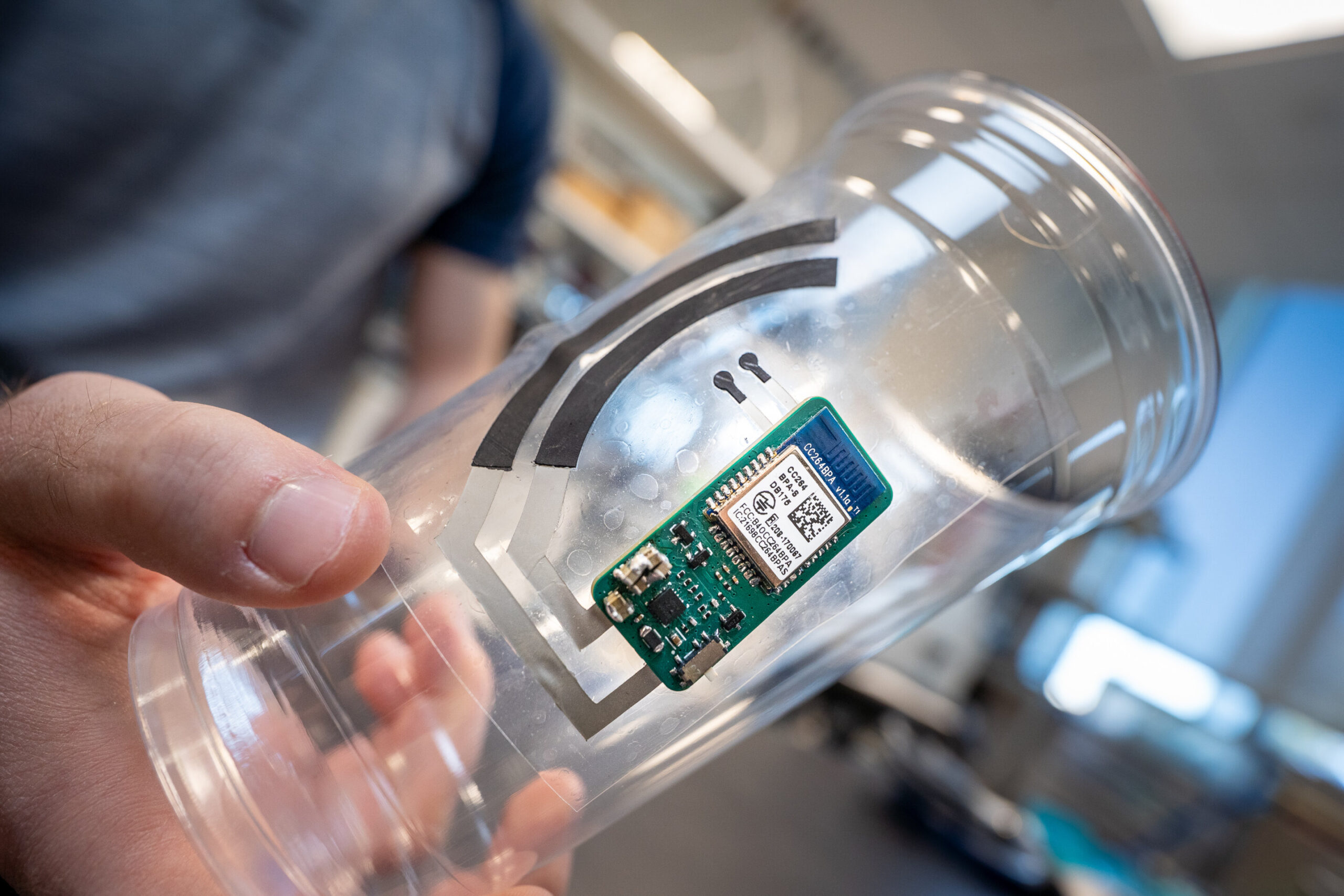
A team of engineers at the University of California San Diego has developed an electronic sticker that can monitor a person’s vitamin C levels using the sweat from their fingertips—no blood draws, lab visits or batteries required. The flexible sticker, which attaches to the outside of a drinking cup, collects trace amounts of sweat as a person grips the cup. Within minutes, the system harvests enough power from the sweat to analyze it for vitamin C and wirelessly sends the results to a nearby laptop.
Details about the device are published in Biosensors and Bioelectronics.
“By turning everyday objects like cups or bottles into smart sensors, people can gain real-time insights into their health and wellness without changing a thing about their daily routine,” said study co-senior author Patrick Mercier, a professor in the Department of Electrical and Computer Engineering at the UC San Diego Jacobs School of Engineering.
“We’re moving toward a future of ‘unawareables’—devices that are unobtrusive and essentially invisible so that you are unaware that you’re even using them. You just go about your day and your drinking cup can give you access to all this rich information.”
Malnutrition and micronutrient deficiencies continue to affect millions of people worldwide. While vitamin C plays a key role in immune function, tissue repair and iron absorption, testing for it currently requires blood draws, specialized laboratory equipment and costs around $50 per test in the U.S. These barriers make frequent monitoring impractical for many people.

The new sticker offers a simple, convenient and low-cost alternative. Built on a flexible, adhesive polymer sheet, the system integrates screen-printed electronic components. A porous hydrogel pad mounted on the sticker collects sweat from the fingertips. A built-in biofuel cell converts chemicals in the sweat into electricity, which powers a custom printed circuit board and the vitamin C sensor. The circuit board reads signals from the vitamin C sensor and wirelessly transmits the data via Bluetooth low energy.
“Most people only get a snapshot of their health once a year at the doctor. But our bodies change much more frequently than that,” Mercier said. “We want to make access to health data as frequent and effortless as holding your morning coffee cup or orange juice bottle.”
Another special feature of the sticker is that it generates power without requiring physical exertion from the user. Fingertips, despite their small size, are among the body’s most prolific sweat producers—each is packed with over a thousand sweat glands and can produce between 100 and 1,000 times more sweat than most other areas on the body. This steady trickle of natural perspiration provides a continuous energy source that allows the sticker to operate even when the user is at rest.
Because the system is battery-free, it can be manufactured at low cost—potentially for just a few cents per unit. Its affordability could also make future versions of the system disposable and widely accessible, particularly in low-resource areas.
-

Study co-first author Muhammad Inam Khan, a nano engineering Ph.D. student at the UC San Diego Jacobs School of Engineering, demonstrates fingertip placement on the sticker while gripping a boba drink. Three fingertips rest on the arched biofuel cell (left) while the tip of the middle finger rests on the vitamin C sensor (right). Credit: David Baillot/UC San Diego Jacobs School of Engineering
-

Study co-first author Ryan Burns, an electrical and computer engineering Ph.D. student at the UC San Diego Jacobs School of Engineering, uses the sticker on a cup filled with orange juice. Credit: David Baillot/UC San Diego Jacobs School of Engineering
The work is a collaboration between the labs of Mercier and Joseph Wang, a professor in the Aiiso Yufeng Li Family Department of Chemical and Nano Engineering at the UC San Diego Jacobs School of Engineering. It builds on wearable technologies that Wang’s lab has pioneered—including tattoo-like biochemical sensors and fingertip-power wearables—along with ultra-low power, battery-free wireless systems developed in Mercier’s lab.
In tests, the device was stuck onto a disposable drinking cup and accurately tracked changes in vitamin C levels after participants took a supplement or drank orange juice. The device powered itself for more than two hours using only sweat-derived energy.
“This is an elegant extension of our early fingertip sweat-based technology toward effortless, continuous monitoring of personal nutrition and health,” said Wang, one of the study’s co-senior authors. “By moving sensors from the skin to the surface of everyday objects like cups or bottles, we are expanding what wearable technology can be.”
The team plans to expand the technology to measure additional nutrients and biochemicals. Future versions could send readings directly to smartphones or smartwatches to provide more seamless, real-time tracking of personal health data throughout the day.
Co-authors of the study include Muhammad Inam Khan, Ryan Burns, Akshit Agarwal, Lu Yin, Jongmin Moon, Bumsik Choi, Shichao Ding and Tamoghna Saha, all at UC San Diego.
More information:
Muhammad Inam Khan et al, A smart cup for wireless, biofuel-powered, sweat-based vitamin C sensing, Biosensors and Bioelectronics (2026). DOI: 10.1016/j.bios.2025.118100
Citation:
Sweat-powered sticker turns your drinking cup into a health sensor (2025, November 10)
retrieved 10 November 2025
from https://techxplore.com/news/2025-11-powered-sticker-cup-health-sensor.html
This document is subject to copyright. Apart from any fair dealing for the purpose of private study or research, no
part may be reproduced without the written permission. The content is provided for information purposes only.











I’ve been trying to become fluent in Spanish for the last decade. After spending most of my adult life surrounded by multilinguals, I often feel like I’m playing an impossible game of catch-up. Like everyone else, I’ve tried to become regimented with practicing on an in-phone app like Duolingo, which attempts to ‘game-ify’ language learning, but mostly ends up with a sad and sick-looking green bird icon guilting me to practice every time I open up my phone.
Babbel aims to help people actually learn the language through practical conversation and grammar, using proven pedagogical methods and speech recognition technology. Each lesson is short, with 10 to 15 minute lessons developed by a team of over 150 linguists. Instead of learning the same simple phrases in ad-ridden games on an endless loop, take charge of your language learning this year and make that commitment a reality. No more excuses—we’ve got a Babbel promo code and a Babbel coupon to help you hit your goals. Maybe you’ll be fluent by your next vacation (or at least able to order a chopped cheese with confidence at the bodega).
Unlock Your Babbel Promo Code and Save Big in April 2026
Not only is Babbel a helpful interactive app to simplify language learning, but it also has holistic services to help introduce the language to every part of your life. These are things like Babbel videos, which do a deep dive into what makes a language so fascinating, Babbel podcasts, which are led by Babbel experts who take an inside look at local culture and break down language secrets, and Babbel magazine, which highlights stories from around the world so you can better understand the history, culture, and people from the language you’re learning (and maybe will inspire you to take a trip to practice that language IRL!).
Make sure you check back often to find the latest Babbel promo code for sitewide savings. There are often discounts on the subscription tiers, which range from three month plans to annual memberships. Plus, springtime is usually when there are significant Babbel discounts for new users. And, if you sign up for the Babbel newsletter, you can receive a link for a Babbel coupon in your inbox.
Save 60% on 6-Month Plans With the Healthcare Workers Discount
As stated, knowing another language is an invaluable life skill, and a skill that is immeasurably valuable to healthcare workers, who may be able to more easily give lifesaving care. Healthcare professionals and nurses get a Babbel discount of 60% off a six-month Babbel subscription. To claim the Babbel discount, users just need to verify their medical credentials via ID.me.
Claim Your 60% Military Discount on 6-Month Subscriptions
This Babbel discount also applies to active duty military, veterans, and their families, who are also eligible for 60% off six-month Babbel subscriptions. This Babbel military coupon is valid for National Guard, reserve members, and immediate family members of service personnel, and all you need to do is verify your status at ID.me.
Snag a 60% Teacher Discount on Your Next 6 Months
Babbel is also extending the 60% discount to the real unsung heroes, teachers. Knowing more than one language is an invaluable tool for educators to be able to talk more effectively to parents or guardians, as well as to more deeply understand their students’ cultural identities. Educators and teachers, like K-12 teachers, university professors, and other educational staff members, are eligible for 60% off a six-month Babbel subscription. And like the others, you just need to verify credentials through ID.me.
Grab Top Lifetime Subscription Deals and Save in April 2026
Everyone knows that learning a language is a lifetime process, and Babbel wants to make it even easier for you to commit to it. If you pay once, you’ll get access to all available Babbel languages forever with Lifetime deals. You’ll just need to look for the “Lifetime Subscription” Babbel promos that could potentially save you hundreds of dollars over several years. Be sure to check back often, as these rotating deals often pop up during major holiday sales. While the upfront cost is higher, you’ll get access to all 14 available languages with this Babbel promo code lifetime subscription deal.

An unknown technical problem caused a number of robotaxis owned by the Chinese tech giant Baidu to freeze on Tuesday in the middle of traffic, trapping some passengers in the vehicles for more than an hour.
In Wuhan, a city in central China where Baidu has deployed hundreds of its Apollo Go self-driving taxis, people on Chinese social media reported witnessing the cars suddenly malfunction and stop operating. Photos and videos shared online show the Baidu cars halted on busy highways, often in the fast lane.
A college student in Wuhan tells WIRED that she was stuck in a Baidu robotaxi with two friends for about 90 minutes on Tuesday. (She asked to be only identified with her last name, He, to protect her privacy.) The student says the car malfunctioned and stopped four or five times during the trip before it eventually parked in front of an intersection in eastern Wuhan. Luckily, it was not a busy road, and the group was not in immediate danger. The screen display in the car asked the passengers to remain in the car with seatbelt on and wait for a company representative to come “in five minutes,” according to a photo He shared with WIRED.
He says it took about 30 minutes to reach a Baidu customer representative on the phone. “They kept saying it would be reported to their superior. But they didn’t explain what caused [the outage] or let us know how long we needed to wait for the staff to come,” He says. But no one ever came, and after another hour of waiting, the three passengers decided to just get out and go home by themselves (the doors weren’t locked).
On Chinese social media, other passengers also complained about being unable to reach Baidu’s customer support. “I tried every way I could think of to call for help using the options the app showed, but the phone line wouldn’t go through, and when I pressed the SOS button it told me it was unavailable. So then what exactly is the SOS for?” wrote one person in a post on RedNote alongside a video showing the button not working. She said she had to force the door to open and get out of the car as traffic halted to a complete stop behind her robotaxi. “Apollo Go, you really owe me an apology,” she wrote.
Baidu didn’t immediately respond to a request for comment. Local police in Wuhan issued a statement around midnight in China that said the situation was “likely caused by a system malfunction,” but the incident is still under investigation. No one was injured and all passengers have exited the vehicles, the police added. It’s unclear how many of Baidu’s robotaxis may have been impacted.
One dash cam recording posted to RedNote shows a car passing 16 Apollo Go vehicles parked on the road in the span of 90 minutes. On several occasions, the video shows the driver narrowly avoiding hitting the robotaxis by braking or changing lanes at the last minute.
Others were apparently not as fortunate. In another RedNote post, a man claimed he crashed into one of the malfunctioning Baidu vehicles. The man wrote in the caption that he was driving over 40 mph on a highway when the car in front of him suddenly changed lanes to avoid the stopped robotaxi. He couldn’t react fast enough and ended up running into the self-driving car. Photos of the man’s orange SUV being towed away show that the car’s front-right fender was completely torn off, and other parts appeared to have sustained major damage.

Tired of the stale, fetid air looming over your apartment like a cloud? Check out the Coway Airmega Mighty, an already wallet-friendly home air purifier that’s even cheaper right now as part of the Amazon Big Spring Sale. It’s currently marked down to just $154, a $76 discount from its typical price, but you’ll want to move quickly if you’re interested, as the deal is only available for a limited time.
Despite its low price tag and squat stature, the Airmega Mighty is capable of cleaning a substantial amount of space. At full bore, it can handle a 361-square-foot space, although you’ll get the best performance, and save your ears, if you’re closer to a 200-square-foot room. If you don’t want it running constantly, there are built-in timers to automatically shut off after 1, 4, or 8 hours, or you can use Eco Mode, which will run until the Might doesn’t sense any dirty air for half an hour.
That’s right, the Airmega Mighty has a built-in air quality sensor, and it reflects the current state of the air quality using a colored light with three levels. It uses those readings to automatically adjust the fan speed and timing settings on the fly, as well as giving you a peak into how bad the air you’re breathing right now is for you. While it lacks integration with smart home setups like Google Home, it makes up for it by handling all of its own business without Wi-Fi or extra apps on your phone.
While the Coway Airmega Mighty is available in three colors, only the black and silver model is currently discounted, so you’ll have to pay full price if it doesn’t match your living room’s color scheme. We’ve put in the work testing every air purifier we could get our hands on, so make sure to check out the full guide if you’re trying to clean up your space. The Coway is discounted as part of Amazon’s Big Spring Sale, and we’ve got the best deals from products we’ve tested gathered in one place if you want to save some bucks.


Food prices to rise by almost 10% due to Iran war, warns key industry body

Should the USMNT be concerned about Pulisic’s goal drought?

Who was Jessie Jones? ‘Most-produced female American playwright’ dies at 75

-

 Politics1 week ago
Afghanistan announces release of detained US citizen
-

 Tech1 week ago
Can a Home Appliance Fix the Problem of Soft-Plastic Waste?
-

 Sports1 week ago
Broadcast industry CEO says consolidation is ‘essential’ to compete for NFL soaring media rights prices
-
 Business1 week ago
Property Play: Home flippers see smallest profits since the Great Recession, real estate data firm says
-

 Entertainment1 week ago
UN warns migratory freshwater fish numbers are spiralling
-
 Business1 week ago
Gold prices soar in Pakistan – SUCH TV
-

 Fashion1 week ago
ICE cotton slips on weaker crude, profit booking
-
 Business1 week ago
More women are entering wealth management, but few are in advisory roles, study finds