

Fashion
Swedish H&M’s & Other Stories unveils new spirit for Fall 2025


“The Fall campaign celebrates real clothes for everyday experiences, designed to inspire individuality. The new brand identity combines nostalgia with modernity and signifies an exciting new chapter for & Other Storied,” said Jonathan Saunders, Chief Creative Officer, & Other Stories.
H&M’s & Other Stories unveils a refreshed brand identity under new CCO Jonathan Saunders, marked by a new logo, tone, and creative direction.
Debuting with the Fall 2025 collection, the campaign blends nostalgia with modernity, featuring 60s–90s-inspired silhouettes, playful colours, textured fabrics, and bold accessories, styled with youthful layering and ease.
Modern nostalgia
Dynamic, energetic, and empowered, the Fall 2025 collection has been created for individuals who embrace self-expression. Rooted in modern sensibilities with a feel of nostalgia, the September collection re-imagines everyday pieces with an elevated edge. Drawing on references from the 60s, 70s, and 90s, updated for today, the collection explores progressive silhouettes, vintage-inspired lived-in textures, and a fluid attitude, juxtaposed with technical fabrics.
How it’s worn
Individuality comes through in the styling, where youthful energy is expressed through laid-back layering and unexpected pairings. There’s an ease in how pieces are combined — elevated bomber jackets paired with corduroy trousers, layered knitwear with circle or pencil skirts, tailored miniskirts with revived variations of the bow blouse, and slouchy wool coats layered over even slouchier denim.
Colour palette
Exploring playful and contrasting colour combinations, the palette features punctuating pops of pink, intense ultramarine blue, and lemon yellow — bright accents that break up the autumnal spectrum of earthy browns, charcoal grey, burgundy, and black.
Silhouette
Characterised by movement, insouciant, slouchy tailoring is balanced by sharp cuts and short hemlines, merging the elegance of the 60s and 70s with the ease of the 90s.
Fabrics
A juxtaposition of textures provides depth and contrast. Vintage-inspired fabrics, such as fuzzy mohair, croc-effect leather, jacquard and corduroy, evoke a sense of nostalgia. Whilst directional tailoring in Italian wool and outerwear in technical nylon adds a modern edge.
Accessories
Subtle nostalgic elements find new expressions with 70s-tinged eyewear, chunky gold-tone necklaces, and leather bags inspired by bowling styles. Belts become a focal point, purposefully worn over miniskirts with knitwear tucked in.
Loafers and Chelsea boots pay homage to 60s Mod style, whilst oversized teddy bags add a soft touch to tougher looks.
Creative team
The September chapter comes to life in a campaign photographed by Oliver Hadlee Pearch, featuring models Thea Almqvist, Xaria Carter and Sihana Shalaj. The campaign is styled by Isabelle Sayer, with art direction by JL Studio, and executive production by Sylvia Farago.
Note: The headline, insights, and image of this press release may have been refined by the Fibre2Fashion staff; the rest of the content remains unchanged.
Fibre2Fashion News Desk (HU)







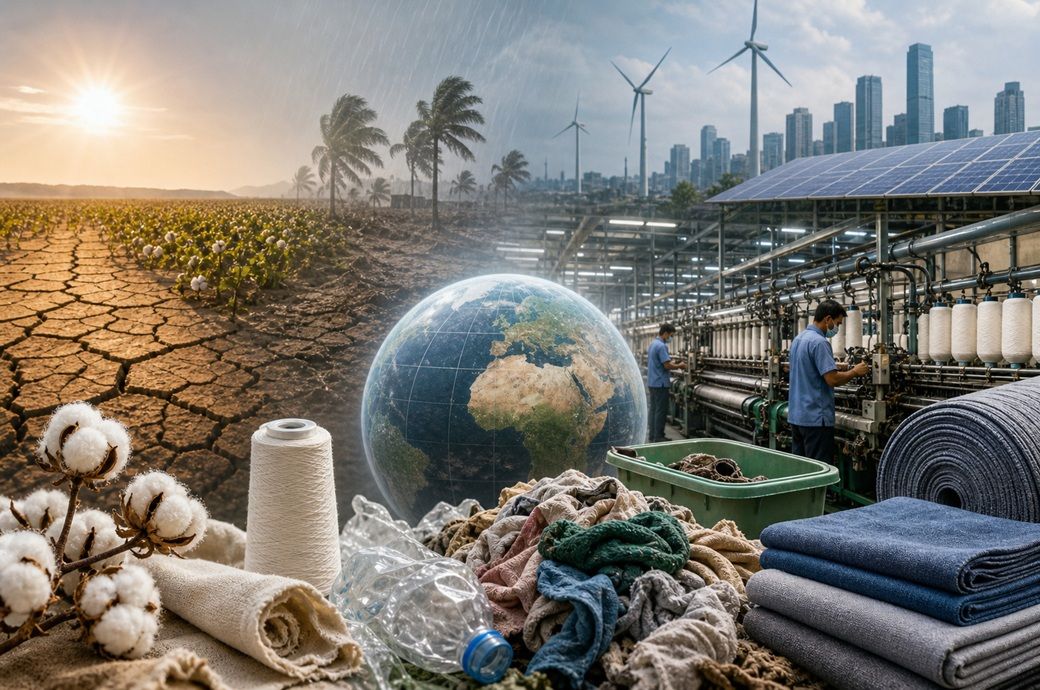
The apparel climate story has moved out of the ESG report and into the cost sheet. In ****–****, climate risk is showing up as cotton quality loss, import dependence, energy volatility, cooling capex, carbon-price exposure and mandatory textile-waste fees. For brands and suppliers, the question is no longer whether climate action is ‘responsible’. It is whether delay will make product margins uncompetitive.
The latest data makes the shift visible. Textile Exchange says global fibre production reached *** million tonnes in **** and could hit *** million tonnes by **** if business continues as usual. Polyester alone now makes up ** per cent of global fibre output, with ** per cent still fossil-based. That scale gives apparel a low-cost material engine, but it also ties the sector to fossil energy, petrochemical volatility and future carbon accounting.
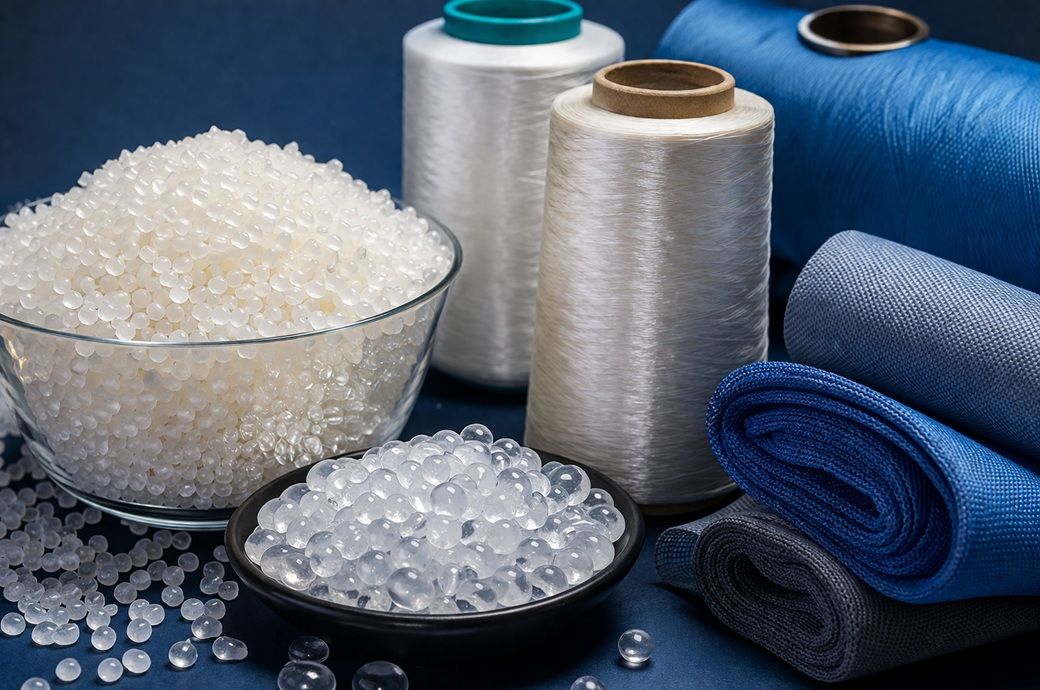
Caprolactam (CPL) prices initially held near $*.**–*.**/kg with minimal movement, while nylon chips saw uptick to ~$*.***/kg (+*.* per cent WoW) driven by short-term restocking. Nylon filament yarn (DTY **D/**F) prices remained stable at ~$*.**–*.**/kg, supported by existing inventory and steady downstream textile operations.
By the second week (April * to April **), benzene stabilised, but caprolactam began to weaken to ~$*.**–*.**/kg (−*.* per cent WoW), signalling the start of broader chain pressure. Nylon chips responded with a mild correction to ~$*.***/kg (−* per cent WoW), while filament yarn prices continued to hold steady due to inventory buffers and ongoing execution of prior textile orders. In the third week (Apr **–**), caprolactam stable to ~$*.*/kg, and chips followed to ~$*.***/kg (Stable WoW).
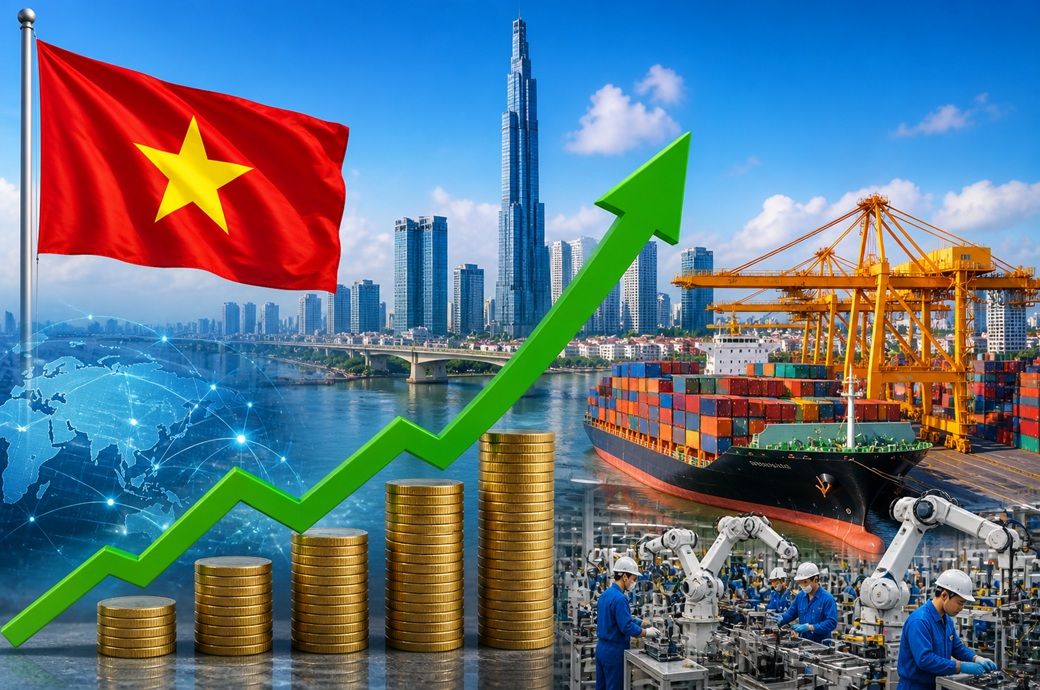
Total registered FDI, including newly registered and adjusted capital, along with foreign investors’ contributions and share purchases, reached $18.24 billion as of April 27, up 32 per cent year on year (YoY), according to the Ministry of Finance’s National Statistics Office (NSO).
Vietnam attracted $18.24 billion in FDI in January–April 2026, up 32 per cent, driven by manufacturing and processing.
Realised FDI hit a five-year high, signalling continued capacity expansion.
Trade surged to $344.17 billion, supported by strong US demand and rising imports from Asia, highlighting deeper global supply chain integration and export momentum.
A total of 1,249 new projects were licensed with combined registered capital of $12.15 billion, reflecting a 3.7 per cent annual increase in project numbers and a 2.2-fold rise in value. Manufacturing and processing dominated, attracting $8.12 billion, or 66.8 per cent of total newly registered capital.
Realised FDI in the January–April period was estimated at $7.40 billion, up 9.8 per cent YoY and marking the highest level for the period in the past five years. Of this, the manufacturing and processing sector disbursed $6.12 billion, accounting for 82.7 per cent. Meanwhile, 316 existing projects registered additional capital of $3.13 billion, representing a sharp 51 per cent decline compared to the same period last year. Combining newly registered and adjusted capital, total FDI into manufacturing and processing reached $10.49 billion, or 68.6 per cent of the total.
Foreign investors carried out 976 capital contribution and share purchase transactions worth $2.96 billion, up 61.9 per cent YoY. Among these, 325 deals increased enterprises’ charter capital by $445.13 million, while 651 share acquisitions without capital increases totalled $2.51 billion. Wholesale and retail trade led these investments, capturing $1.89 billion, or 63.9 per cent.
Among 53 countries and territories with newly licensed projects, Singapore was the largest investor with $6.05 billion, accounting for 49.8 per cent of the total. It was followed by the Republic of Korea with $4.08 billion (33.6 per cent), China with $524.1 million (4.3 per cent), Japan with $462 million (3.8 per cent), Hong Kong (China) with $329.2 million (2.7 per cent), and the Netherlands with $318.5 million (2.6 per cent).
On the trade front, Vietnam’s total trade with the rest of the world was estimated at $344.17 billion in the first four months of 2026, a significant increase from $277.21 billion in the same period last year, the NSO said. In April alone, trade volume reached an estimated $94.32 billion, rising 8 per cent from March and 26.7 per cent YoY.
The United States remained the largest importer of Vietnamese goods, with imports valued at $53.9 billion, while China continued as the top supplier with $69 billion. Imports from traditional markets also surged, with South Korea and ASEAN recording growth rates of 57.8 per cent and 44.3 per cent, respectively.
Fibre2Fashion News Desk (MS)


‘I Actually Thought He Was Going to Hit Me,’ OpenAI’s Greg Brockman Says of Elon Musk

Government needs to act on Middle East impact on retail, industry warns

WWE star Chelsea Green reveals she underwent ‘heart procedure’ to address SVT

-

 Tech1 week ago
A Brain Implant for Depression Is About to Be Tested in Humans
-

 Tech1 week ago
Almost 90% of women leave tech industry within 10 years | Computer Weekly
-

 Sports1 week ago
Pro wrestling star Steph De Lander reveals how colleague’s advice helped lead her to title triumph at ACW
-
 Business1 week ago
‘I had £20,000 stolen and had to fight a 13-month fraud reporting rule to get it back’
-

 Entertainment1 week ago
Norway joins Type 26 Frigate Programme to boost NATO naval power
-

 Tech1 week ago
Are tech leaders risking a cyber resourcing crisis? | Computer Weekly
-

 Entertainment1 week ago
Melania Trump says ABC should ‘take a stand’ on late-night host Kimmel
-
 Business6 days ago
PSX plunges over 4,800 points | The Express Tribune