

Business
Taxes hiked to ‘all-time high’ by Reeves as growth forecasts cut

- OBR apologises for publishing fiscal outlook early
- OBR: Tax thresholds freeze means more people will bay basic, higher and additional-rate taxes.
- New tax on £2m homes; mileage charge for electric vehicles; national insurance on salary sacrifice pension contributions above £2,000; changes to Isa rules
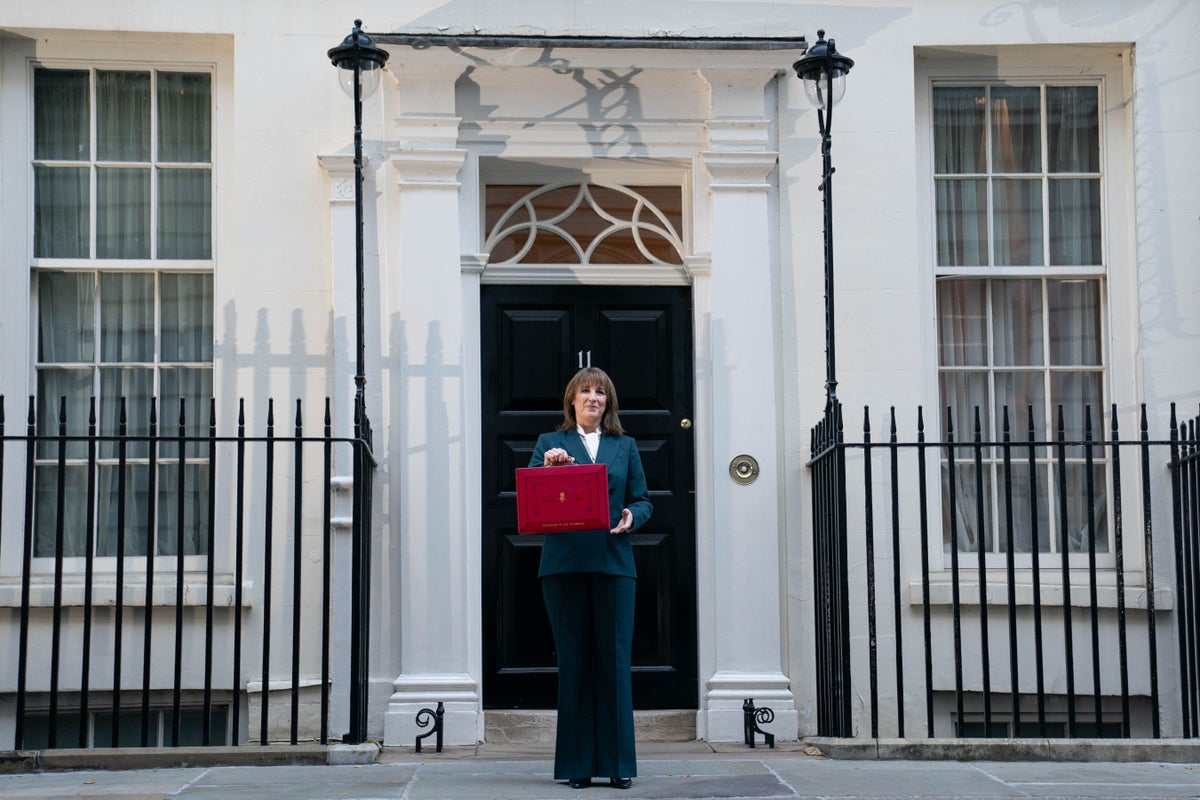
Rachel Reeves has announced tax rises amounting to £26 billion as she battles a downgrade in forecast economic growth.
More than 1.7 million people will face paying more income tax as she froze thresholds, meaning people will be dragged into paying the tax for the first time or shifted into higher bands as earnings increase.
The measures contribute to a tax burden that will rise to an “all-time high” in 2030/31.
The Office for Budget Responsibility (OBR) forecast gross domestic product would grow by 1.5% this year, an increase from its earlier 1% forecast.
But it downgraded growth in 2026 from 1.9% to 1.4%, in 2027 from 1.8% to 1.5%, in 2028 from 1.7% to 1.5% and in 2029 from 1.8% to 1.5%.
In an unprecedented blunder, full details of Ms Reeves’s plans were published by the OBR more than half an hour before she stood up in the Commons chamber.
The OBR confirmed Rachel Reeves’s Budget “raises taxes by amounts rising to £26 billion in 2029/30, through freezing personal tax thresholds and a host of smaller measures”.
The freeze in thresholds will result in 780,000 more basic-rate, 920,000 more higher-rate, and 4,000 more additional-rate income tax payers in 2029/30. Scotland has a separate income tax system.
The policy, which applies to income tax and national insurance contributions, will rake in £8.3 billion for the Exchequer in 2029/30 and the freeze will extend to 2030/31.
Other personal tax changes include £4.7 billion through charging national insurance on salary-sacrificed pension contributions, and £2.1 billion through increasing tax rates on dividends, property and savings income by two percentage points.
Ms Reeves acknowledged the freeze in tax thresholds would hit “working people” – the group Labour had promised to protect – but she was “asking everyone to make a contribution”.
“I can keep that contribution as low as possible because I will make further reforms to our tax system today to make it fairer and to ensure the wealthiest contribute the most,” she said.
The combination of measures means that tax as a share of the economy – the tax-to-GDP ratio – will “increase to an all-time high of 38.3%” in 2030/31.
The Chancellor insisted the downgraded growth forecasts were “the Tories’ legacy, not Britain’s destiny” after the OBR lowered its expectations for productivity growth by 0.3 percentage points.
Measures in the Budget include:
– Changes to green levies will save £150 on the average household energy bill from April next year.
– The amount of headroom the Government has against the Chancellor’s day-to-day spending rule will widen to £21.7 billion in 2029/30, almost £12 billion more than in March.
– The 5p cut in fuel duty will remain in place until September 2026, when it will be reversed through a staggered approach.
– Drivers of battery electric cars will be hit by a 3p per mile tax from April 2028, with the charge to rise annually with inflation.
– The two-child benefit cap is being removed at an estimated cost of £3 billion by 2029/30.
– A high-value council tax surcharge on properties worth more than £2 million will raise £0.4 billion in 2029/30.
– Debt will rise from 95% of GDP this year to 96.1% by the end of the decade.
– Consumer Prices Index inflation is forecast to be 3.5% this year, higher than the 3.2% forecast in March, and 2.5% next year, higher than the 2.1% previously forecast, before settling at 2%.
– Unemployment is also forecast to be higher than previously forecast until 2029, peaking at 1.8 million next year.
Tory leader Kemi Badenoch said the Budget was a “total humiliation” for Rachel Reeves and “if she had any decency she would resign”.
The OBR document is not meant to be released until after the Chancellor has delivered her Budget in the House of Commons.
But it was published on the Budget watchdog’s website early, the latest in a series of leaks and early disclosures in the run-up to Ms Reeves’s statement.
The OBR apologised, blaming a “technical error”.
Shadow chancellor Sir Mel Stride said it was an “utterly outrageous” leak of market-sensitive information, which could constitute a criminal act.
Ms Reeves said it was “deeply disappointing” and a “serious error on their part”.
Business
IMF says ‘too early’ to gauge West Asia conflict impact as energy prices, markets turn volatile – The Times of India
With tensions escalating in West Asia, the International Monetary Fund on Tuesday said it is closely tracking the situation but cautioned that it is “too early to assess the economic impact on the region and the global economy,” as disruptions to trade and energy markets intensify.In a statement, the IMF said it has “observed disruptions to trade and economic activity, surges in energy prices, and volatility in financial markets.”“The situation remains highly fluid and adds to an already uncertain global economic environment,” it said, reported ANI.“It is too early to assess the economic impact on the region and the global economy. That impact will depend on the extent and duration of the conflict,” the IMF added.The remarks come as governments evaluate the fallout of the widening hostilities in the region, particularly on oil supplies and global financial stability.In India, Petroleum and Natural Gas Minister Hardeep Singh Puri earlier said the country is “fully prepared amid evolving situation in the Middle East and energy supplies are robust.”He stated that “the country is well stocked with crude oil and inventories of key petroleum products including petrol, diesel and ATF to deal with short-term disruptions arising from the Middle East.”According to the minister, Indian energy companies have access to supplies that are not routed through the Strait of Hormuz, and such cargoes will remain available to mitigate any temporary disruptions affecting shipments passing through the strait.The Petroleum ministry has also set up a 24×7 Control Room to continuously monitor supply and stock positions of petroleum products across the country.The government is “reasonably comfortable in terms of stocks,” the minister said, adding that safeguarding the interests of Indian consumers remains the highest priority. Based on continuous monitoring, the government is cautiously optimistic that phased measures can be taken, if required, to further mitigate the situation.Government sources said India currently holds about eight weeks of crude oil and petroleum product inventories, including strategic reserves. They added that only about 40 per cent of India’s crude oil imports transit through the Strait of Hormuz, limiting exposure to regional disruptions.Sources maintained that the country remains in a comfortable position on energy security and is closely monitoring developments, while being prepared to manage potential supply-side challenges through adequate inventory levels and diversified sourcing.

The forecasts were made before the conflict in the Middle East broke out which could have a “very significant” impact, the OBR said.
Source link
Business
US stock market: Wall street crashes amid Iran tension; Dow jones slips over 900 points, Nasdaq dips by 2% – The Times of India

A fresh wave of global selling pressure hit Wall Street on Tuesday, as escalating tensions involving Iran deepened fears of prolonged economic disruption. The S&P 500 fell 1.8 per cent in early trade. The Dow Jones Industrial Average was down 907 points, or 1.9 per cent, as of 9:35 am Eastern time, while the Nasdaq Composite dropped 2.1 per cent. The renewed slide came just a day after US equities had erased steep early losses to close marginally higher — a rebound that had hinged on oil prices remaining contained. That relief faded as crude surged closer to levels that investors fear could reignite inflationary pressures. Brent crude, the global benchmark, jumped 8.2 per cent to $84.14 a barrel after trading near $70 less than a week ago. US benchmark crude rose 8 per cent to $76.92. Oil prices spiked after Iran struck the US Embassy in Saudi Arabia, broadening its list of targets to include areas central to global oil and natural gas production. Markets are particularly focused on the Strait of Hormuz, a strategic chokepoint off Iran’s coast through which roughly one-fifth of the world’s oil supply passes. Any disruption there could have outsized consequences for global energy markets. Uncertainty over the duration of the conflict is adding to volatility. US and Israeli strikes have already killed Iranian Supreme Leader Ayatollah Ali Khamenei, yet US President Donald Trump has indicated that hostilities could persist for weeks. In a late-night social media post on Monday, Trump said wars can be fought “forever” with the munitions available to the United States. The sharp rise in crude threatens to compound inflation, which remains elevated, by increasing fuel and transportation costs. According to data from motor club AAA, the average US gasoline price rose 11 cents overnight to about $3.11 per gallon.On Wall Street, airline stocks extended losses amid concerns over higher jet fuel costs and travel disruptions linked to the conflict. United Airlines fell 4.1 per cent, American Airlines declined 4 per cent and Delta Air Lines slipped 3 per cent. Bond markets also reflected rising inflation expectations. The yield on the 10-year US Treasury climbed to 4.10 per cent from 4.05 per cent late Monday and 3.97 per cent on Friday. Higher yields translate into more expensive borrowing costs for households and businesses, affecting everything from mortgages to corporate bond issuances.The impact in equity markets has been most pronounced in sectors and countries heavily reliant on energy imports. In South Korea — a major oil importer — the Kospi index plunged 7.2 per cent in its worst session in nearly two years as markets reopened after a holiday. Japan’s Nikkei 225 fell 3.1 per cent, despite analysts noting that Japan maintains strategic energy reserves estimated to last more than 200 days.


Polyester filament prices jump in India as crude spikes
IMF says ‘too early’ to gauge West Asia conflict impact as energy prices, markets turn volatile – The Times of India

Netanyahu’s political future at stake with Iran war: experts

-

 Politics5 days ago
What are Iran’s ballistic missile capabilities?
-

 Politics5 days ago
US arrests ex-Air Force pilot for ‘training’ Chinese military
-
 Business7 days ago
Households set for lower energy bills amid price cap shake-up
-

 Sports5 days ago
Sri Lanka’s Shanaka says constant criticism has affected players’ mental health
-

 Sports1 week ago
Top 50 USMNT players of 2026, ranked by club form: USMNT Player Performance Index returns
-
 Business7 days ago
Lucid widely misses earnings expectations, forecasts continued EV growth in 2026
-
 Fashion1 week ago
OECD GDP growth slows to 0.3% in Q4 amid mixed trends
-

 Fashion5 days ago
Policy easing drives Argentina’s garment import surge in 2025