

Business
Tech fails to break mandi monopoly | The Express Tribune

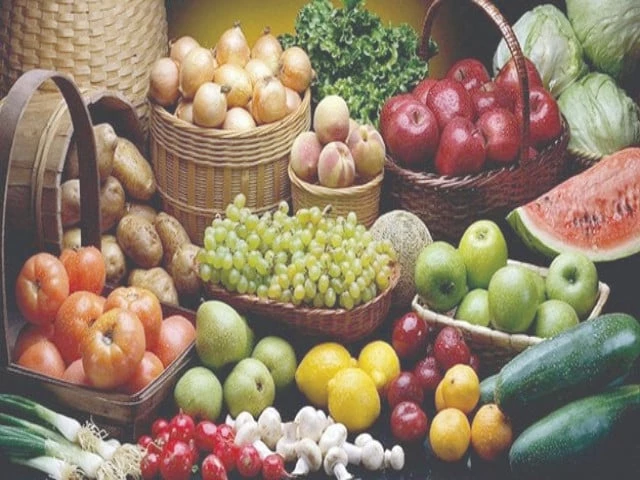
Digital platforms handle only 2-3% of fruit, vegetable trade as middlemen dominate supplies
Fruit and vegetable. Photo: file
KARACHI:
Technology companies that gave a positive connotation to the word “disruption” for radically transforming traditional markets globally have not been able to make a dent in Pakistan’s exploitative fruit and vegetable supply chains, which remain largely controlled by entrenched middlemen and constrained by restrictive government regulations.
Industry observers say that despite the rapid expansion of digital marketplaces and quick-commerce services in urban Pakistan, the country’s farm-to-fork system still revolves around traditional wholesale markets, where commission agents dominate trade flows and price formation. Growers’ representatives argue that online platforms have so far captured only a marginal share of the overall produce trade. Sindh Abadgar Board (SAB) President Mahmood Nawaz Shah recently said that digital platforms could handle no more than 2-3% of fruit and vegetable volumes, leaving the broader supply chain largely unchanged.
According to Shah, the structure of the market itself limits disruption. Wholesale trading of fruits and vegetables is governed by provincial legislation commonly referred to as the Market Produce Act, which requires buying and selling to take place within officially notified wholesale markets, commonly known as Sabzi Mandis. These markets operate under government-appointed market committees and effectively channel most large-scale trading through designated locations.
As a result, the system continues to revolve around commission agents, known locally as arthis, who provide credit to farmers and control access to trading space in wholesale markets. Growers often rely on advances from these intermediaries to finance production, which binds them to sell their harvest through the same dealers at predetermined prices. The structure, farmers say, creates a cycle of dependence that digital platforms have not yet been able to break.
Pakistan’s market infrastructure also remains limited relative to population size. Karachi, a city of more than 20 million people, operates essentially a single large wholesale fruit and vegetable market spread over roughly 100 acres, said Nawaz. Growers’ bodies argue that such limited infrastructure concentrates trading power and restricts competition.
In contrast, comparable international cities operate multiple wholesale produce markets with extensive storage and logistics facilities, enabling more efficient distribution and price discovery, he added.
Technology companies, however, say their platforms are gradually building alternatives that could improve efficiency in the long run. Digital marketplaces and quick-commerce operators argue that technology-driven procurement, cold-chain logistics and direct sourcing models can reduce waste, improve product quality and eventually provide better returns to farmers.
FoodPanda Pakistan’s Q-commerce Director Syed Taha Magrabi said the long-term sustainability of the farm-to-fork model depends heavily on reducing wastage within the supply chain.
“The sustainability of the farm-to-fork model rests on wastage management,” he said. While home delivery logistics may cost more than bulk transport to traditional wholesale markets, platforms can offset these costs by reducing spoilage and eliminating multiple layers of middlemen commissions.
By maintaining a controlled supply chain and cutting unnecessary intermediaries, he said, platforms can extend shelf life and reduce shrinkage. The resulting efficiencies allow companies to offer competitive retail prices while improving farm-gate returns. “When waste is reduced, the savings are shared between a higher farm-gate price, the net value a producer receives for their crops or livestock directly at the farm or nearest market, for the grower and a competitive retail price for the consumer,” he said.
Magrabi said investment in cold-chain infrastructure is central to this approach. According to him, each Pandamart facility is equipped with cold storage systems designed to maintain the quality of fresh produce and meat products.
“We utilise refrigerated trucks to transport sensitive products from the mandi to our dark stores,” he said. “This ensures that fresh vegetables and meat remain in a temperature-controlled environment from arrival until delivery.”
Such systems, he added, help prevent bacterial growth in meat and reduce wilting in vegetables, problems commonly associated with traditional open-air markets. Maintaining a continuous cold chain improves food safety and extends shelf life for consumers.
Despite these initiatives, Magrabi acknowledged that digital platforms still handle only a small portion of the country’s overall fruit and vegetable trade. “The transition from traditional mandis to digital platforms is currently in a high-growth phase rather than a mature state,” he said. While absolute volumes remain a fraction of national output, platforms are gradually gaining traction within the organised retail segment of major urban centres.
He noted that middle-income class consumers in cities increasingly value consistency in quality and price, which is driving the adoption of online grocery services.
Analysts say the gap between technology’s potential and its actual impact highlights deeper structural issues in Pakistan’s agricultural marketing system. Regulatory barriers, fragmented farm production, weak cold-chain networks and limited access to agricultural credit continue to reinforce the traditional mandi-based model. For digital platforms to scale significantly in fresh produce trading, experts say reforms may be required in market licensing, private-sector participation in wholesale markets and investment in logistics infrastructure.







The move comes weeks after the US Supreme Court struck down a key part of Trump’s tariffs policies.
Source link

Scottish surveyors reported falling homebuyer demand in February, the latest Royal Institution of Chartered Surveyors (Rics) Residential Market Survey has found.
But the group also suggested that surveyors expected sales and prices to continue rising.
A net balance of minus 8% of respondents in Scotland said that new buyer enquiries fell in February, down from the net balance of 18% that was seen in the previous month.
The February figure is the lowest recorded since mid-2024, Rics said.
Asked about supply, a net balance of 8% of respondents reported that instructions to sell rose last month – down from the 27% figure in January.
Meanwhile, a net balance of 7% of surveyors reported a rise in newly agreed sales last month, the survey found, representing the second consecutive month the balance has been positive.
A net balance of 39% of respondents also expected sales to rise over the next three months.
A net 28% of respondents in the survey said house prices had risen over the past three months, although the rate of the increase had slowed compared to January.
Many surveyors expected house prices to continue to rise, with a net balance of 24% of Scottish respondents anticipating they would increase over the next three months.
Marion Currie, a Rics-registered valuer at Galbraith in Dumfries and Galloway, said: “Activity has increased as February has unfolded.
“Agreed sales are starting to gain momentum and a good supply of fresh stock is in the pipeline.
“An encouraging outlook as we head towards a new financial year.”
Commenting on the UK-wide picture, Tarrant Parsons, head of market research and analytics at Rics, said: “February’s survey highlights renewed volatility in the market.
“While activity indicators at the start of the year suggested a tentative improvement, the deterioration in the geopolitical backdrop has clearly weighed on confidence.
“The recent rise in oil and energy prices has also increased the likelihood that mortgage rates will remain higher for longer. As a result, near-term expectations have softened.
“Although the 12-month outlook remains positive overall, maintaining that trajectory will depend on the recent spike in inflationary pressures easing in the months ahead.”
Business
Reliance to fund oil refinery in US; Donald Trump calls it ‘historic $300 billion deal’ – The Times of India

MUMBAI: Reliance Industries (RIL) will bankroll the first new oil refinery project in the US in 50 years, marking one of its biggest overseas bets and a return to the American energy market after four years.America First Refining (AFR), the startup developing the refinery at the Brownsville port in Texas, said it received a “nine-figure investment from a global supermajor at a 10-figure valuation” in Feb but did not name the investor. “For the first time in half a century, the US will build a new refinery designed specifically for American shale oil,” said AFR chairman & founder John Calce.US President Donald Trump, announcing the refinery project on his social media platform Truth Social, named RIL as the investor and called the investment by India’s largest privately held energy company “tremendous”.This announcement comes after RIL exited the upstream oil and shale gas business in the US in 2021.Construction of the 168,000-barrels-per-day shale oil refinery is expected to begin in the second quarter of this year.

‘Opportunity for Indian co to enter US refining ecosystem’AFR also said the “same global supermajor” had signed a 20-year agreement to purchase the refinery’s output.The project is also expected to help narrow India’s trade surplus with the US, an issue that has long been a point of concern for Trump. “This is a historic $300 billion deal, the biggest in US history,” read Trump’s post on Truth Social.According to AFR, the figure reflects the long-term offtake arrangement under which the global supermajor will purchase 1.2 billion barrels of shale oil valued at $125 billion and 50 billion gallons of refined petroleum products such as gasoline, diesel and jet fuel worth about $175 billion. Combined, the transactions are expected to improve the US trade balance by $300 billion, it said.Analysts noted that the actual equity investment in the refinery itself has been described as a “nine-figure” sum, implying several hundred million dollars, while the project valuation is in the “ten-figure” range, indicating that the capital commitment is likely to remain below $1 billion.The Texas refinery will mark RIL’s second greenfield investment outside India. In 2021, the company announced a partnership with Abu Dhabi National Oil Company (ADNOC) to build a $2 billion petrochemicals plant in the UAE.Industry experts say the project could deepen economic cooperation between India and the US. M S Banani, joint managing director of Axiom Gas Engineering, a fuel station developer, said Texas is one of the world’s most important energy hubs, hosting major companies such as ExxonMobil, Chevron, Shell and BP.“Establishing a refinery there provides direct access to crude supply and one of the largest fuel markets globally,” Banani said. “RIL has extensive experience in processing heavy and sour crude at its Jamnagar refinery complex, which gives it a strong technical advantage in refining diverse crude grades, including those available from regions such as Venezuela.”From a business perspective, the investment represents an opportunity for an Indian company to enter the American refining ecosystem and potentially expand into fuel distribution and retail in the future, Banani added.“It reflects both the growing global presence of Indian industry and the strengthening strategic partnership between India and the US.”The development coincides with volatility in global oil prices driven by the intensifying conflict in West Asia. However, the announcement had little impact on RIL’s shares. At close of trading, the stock was down 1.3% at Rs 1,391 on the BSE. RIL did not comment on the announcement.


Achilles tear ends Mexico GK Malagón’s World Cup dreams

Tech Traveler’s Guide to Dumbo: Where to Stay, Eat, and Recharge

Partridge sues Michigan over firing during Stalions scandal

-

 Politics5 days ago
India let Iran warship dock the day US sank another off Sri Lanka, say officials
-

 Sports5 days ago
Pakistan set for FIH Pro League debut | The Express Tribune
-
 Business5 days ago
Restaurant group changes name after bid to buys pubs across the UK
-

 Entertainment5 days ago
Harry Styles kicks off new era with ‘One Night Only’ comeback show
-
 Business5 days ago
Home heating oil: ‘Most of my pension has gone on home heating oil’
-

 Sports5 days ago
Winners and losers of the 2026 NHL trade deadline
-

 Tech1 week ago
Google’s Pixel 10a May Not Be Exciting, but It’s Still an Unbeatable Value
-

 Entertainment5 days ago
Kanye ‘Ye’ West trips during trial: ‘Is he asleep?’