

Business
Tesla says Musk should be paid $1tn – will shareholders agree?

Lily JamaliNorth America Technology Correspondent, San Francisco
 Getty Images
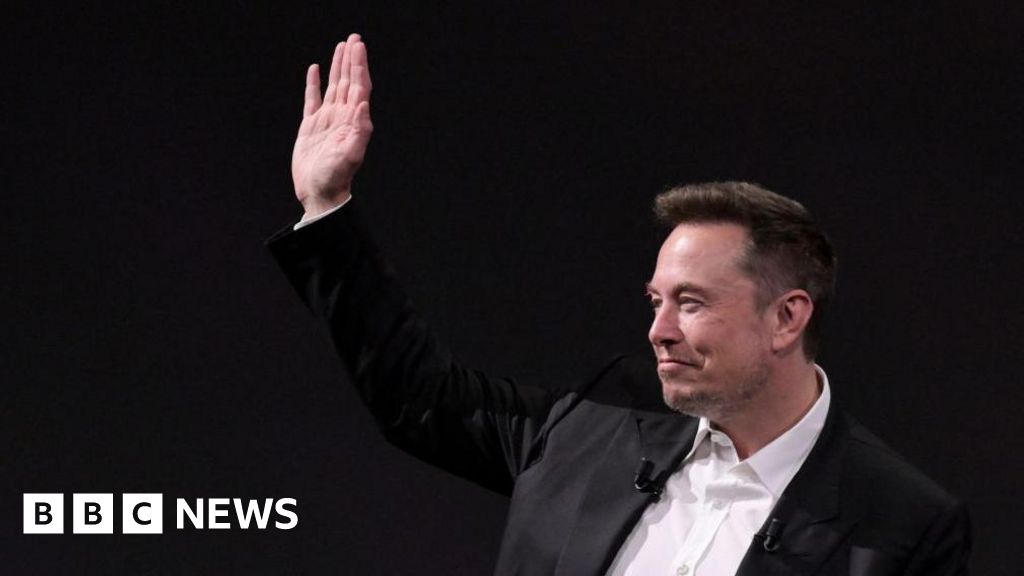
Ahead of Tesla’s annual general meeting (AGM) on Thursday there’s been one key message the electric car-maker has been hammering home to shareholders: the boss is worth $1tn.
It has taken out digital ads to make the case for Elon Musk’s proposed bumper pay package, while Votetesla.com features a video of board chair Robyn Denholm and director Kathleen Wilson-Thompson praising him, as triumphant music crescendos in the background.
It’s not clear that everyone is singing from the same hymn sheet though, meaning the AGM in Austin, Texas is set to become a referendum on Musk himself, after a rightward political turn which has made him one of the most polarising chief executives in recent memory.
Musk himself has taken to X – which he owns – to raise the stakes higher still, saying the fate of Tesla “could affect the future of civilization.”
He’s also used his social media megaphone to amplify some of the deal’s high-profile backers, including Dell Technologies’ Michael Dell, Ark Invest CEO Cathie Wood, and his brother, Kimbal, who sits on the Tesla board.
“There is no one remotely close to my brother,” Kimbal said, extolling his sibling’s leadership qualities.
“Thanks bro ❤️,” Musk replied.
Not everyone agrees.
For some, the focus on Musk and the soap opera around his pay is symptomatic of how the car firm – which has seen sales slide – has lost its way under his leadership.
“What’s amazing to me is a company struggling to sell cars spends money on advertising to sell a pay package,” said Ross Gerber, CEO of Gerber Kawasaki Wealth and Investment Management.
Mr Gerber has pared back his Tesla holdings in recent years – and turned up his criticism of the direction it’s heading in.
“[Tesla] needs to change the focus of the company back to its core – to selling EVs again,” he said.
The trillion dollar man
The deal Tesla wants shareholders to back is not a salary of a one followed by twelve zeroes.
Instead, it sets Musk the target of raising Tesla’s market value to $8.5tn, from $1.4tn at the time of writing.
He would also have to oversee a massive boom in the company’s self-driving “Robotaxi” cars, getting a million of them into commercial operation – no small deal given their underwhelming launch.
Do that, among meeting other benchmarks, and Musk would be given 423.7 million new shares, which would be worth nearly $1tn if the target valuation is reached.
Tesla did not respond to the BBC’s requests for comment about its strategy to garner support from shareholders.
Of course, this is not the first pay controversy Musk and Tesla have become embroiled in.
Previously, Tesla got shareholders to twice ratify a pay package for Mr Musk that was worth tens of billions of dollars if he achieved a tenfold increase in Tesla’s market value.
He met that milestone but, in 2024, a Delaware judge rejected the deal on the grounds that Tesla’s board members were too personally and financially enmeshed with the company’s boss.
The Delaware Supreme Court is reviewing that decision – even as deliberations continue over this even larger pay package.
“The strategy is more of the same from Tesla, which is not to say that this is normal. Nothing about Tesla is normal,” Dorothy Lund, a professor at Columbia Law School told BBC News.
“They’re not a poster child for good corporate governance.”
Professor Lund said get-out-the-vote campaigns like this sometimes take place when a company is worried, for example. about an activist shareholder forcing significant changes to how it operates, such as who is on its board of directors.
“[But] never in my life have I seen something like that happen in the context of a compensation decision,” Professor Lund said.
And unlike the vote on that earlier compensation package, Elon and Kimbal Musk will both get to vote as they push to reach the majority threshold required to seal the deal.
Mr Musk is already the world’s richest man, becoming the first known half-trillionaire earlier this year.

 Getty Images
A polarising figure
Tesla’s argument in support of the pay package rests on the idea that Musk might leave the company if shareholders don’t follow the board’s recommendation and approve the pay package.
It says it can’t afford to lose him, and that he “singularly possesses the leadership characteristics necessary to… realize its long-term mission”.
In the video posted to votetesla.com, Ms Wilson-Thompson said the board undertook a seven month process using legal and compensation experts to devise the compensation deal.
On last month’s earnings call, Musk minimised the focus on the payout, saying the real issue was ensuring he had adequate control in order to properly steer Tesla.
But – aside from the question of whether Musk, with his preoccupations with autonomous cars and humanoid robots, is the setting the right course – there is also the matter of whether championing the boss is the board’s job.
“The role of a board is to have fiduciary responsibility to shareholders and not to be advocating for a CEO,” said Yale School of the Environment’s Matthew Kotchen, an economics professor who co-authored a recent study attempting to quantify damage Mr Musk has done to Tesla of late.
It’s clear a number of key decision-makers are unpersuaded the deal represents value for money.
Proxy advisers Glass Lewis and Institutional Shareholder Services (ISS), which advise asset managers on how to vote on major corporate proposals, have recommended investors reject the pay package, saying it’s excessive and would dilute shareholder value.
Norway’s sovereign wealth fund, the world’s largest national wealth fund, has followed suit, as has the largest public pension fund in the US, CalPERS.
New York State Comptroller Thomas DiNapoli has urged investors to also reject directors up for re-election to the board, saying they’ve failed “to provide independent oversight and accountability.”
As some institutions balk, that might leave Mr Musk more reliant on Tesla’s unusually large volume of retail investors – who tend to support him – to get his wish.
It all means, in the words of Morgan Stanley analyst Adam Jonas, that Thursday’s vote is set to be one of “most important events” in Tesla’s history – with a “distinct possibility” the pay package won’t pass.
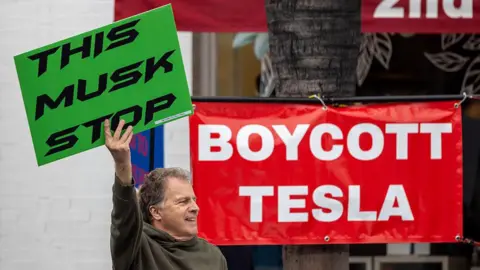
It doesn’t help Musk’s cause that protesters continue to organise anti-Tesla rallies, months after his controversial turn as US President Donald Trump’s government efficiency tsar crashed and burned in May.
“It’s hard for me to imagine that Elon Musk, in the very near term, shakes off the damage that he’s done to this brand,” said Mr Kotchen.
Others though would say Musk’s extraordinary track record of entrepreneurship would make it unwise to bet against him, even when the sum being staked is as dizzyingly high as $1tn.
“It’s hard to deny that Elon Musk’s larger-than-life personality has helped drive more interest and awareness for his organisation than almost any other corporate leader in the modern era,” said Edmunds’ head of insights Jessica Caldwell.
“He’s become a more polarizing figure over time, but there’s still a belief in his ability to deliver on bold, unconventional ideas,” she added.
The trillion dollar question now is – do Tesla shareholders agree?

Growth in the UK’s services sector rebounded last month with business activity picking up, but firms face a “short-lived” recovery amid surging costs and lower demand linked to war in the Middle East, a new survey has shown.
Experts cautioned that the outlook for firms may be weaker after a rush of activity in April.
The S&P Global UK services PMI survey showed a reading of 52.7 in April, up from 50.5 the previous month.
Any reading above 50.0 means the sector is growing while any reading below signals it is contracting.
Activity across the industry, which spans businesses from hospitality and leisure to healthcare and transport, has been increasing for almost a year.
But while the latest reading marked an improvement from March – when the US-Israel’s conflict with Iran escalated – it signals a slower rate of growth than at the start of the year.
Businesses taking part in the survey, which is watched closely by economists, cited worries about intensifying pressures on inflation, global supply shortages and elevated borrowing costs as factors holding back business and consumer demand in April.
Some firms said export sales were lower due to disruptions to business travel and weaker demand in the Middle East.
Nevertheless, others pointed out resilient global demand for technology services while backlogs of work also decreased.
But the survey revealed that cost pressures ramped up for businesses in the service industry last month.
Costs for companies rose at the fastest pace since November 2022, with firms widely attributing the increased bills to fuel costs and higher prices for raw materials including metals and plastics, which have been driven up by soaring energy prices since the start of the war.
Many firms also cited pressure from higher wages, following the increase to the national minimum wage at the start of April.
Tim Moore, economics director at S&P Global Market Intelligence, said April’s “modest recovery” for the industry could “easily prove short-lived as new business intakes remained subdued in comparison to the start of 2026”.
Mr Moore said: “Survey respondents widely noted that the Middle East conflict and subsequent global supply chain disruptions had weighed heavily on business and consumer confidence.”
Matt Swannell, chief economist for the Item Club, agreed that there were “already some signs that this jump will be short-lived as businesses reported little improvement in new work amidst weak domestic and foreign demand”.
“We think that the outlook for private sector activity is gloomier,” he went on.
“A sharp rise in inflation will cause households’ real incomes to fall and spending growth to slow.
“Supply chain disruption, rising costs and lingering geopolitical uncertainty will cause some businesses to put their investment plans on hold.”
Mr Swannell added that the survey suggests the Bank of England will prefer to keep interest rates held steady for the rest of the year, but that there was the potential for a hike in the summer.
Thomas Pugh, chief economist at RSM UK, said firms showed “resilience” last month, adding: “However, the rebound is partly fuelled by a rush of activity before price rises and supply shortages start to bite.”
He said future interest rate hikes were “more likely” as a result, but that “everything depends on how energy prices move going forward”.
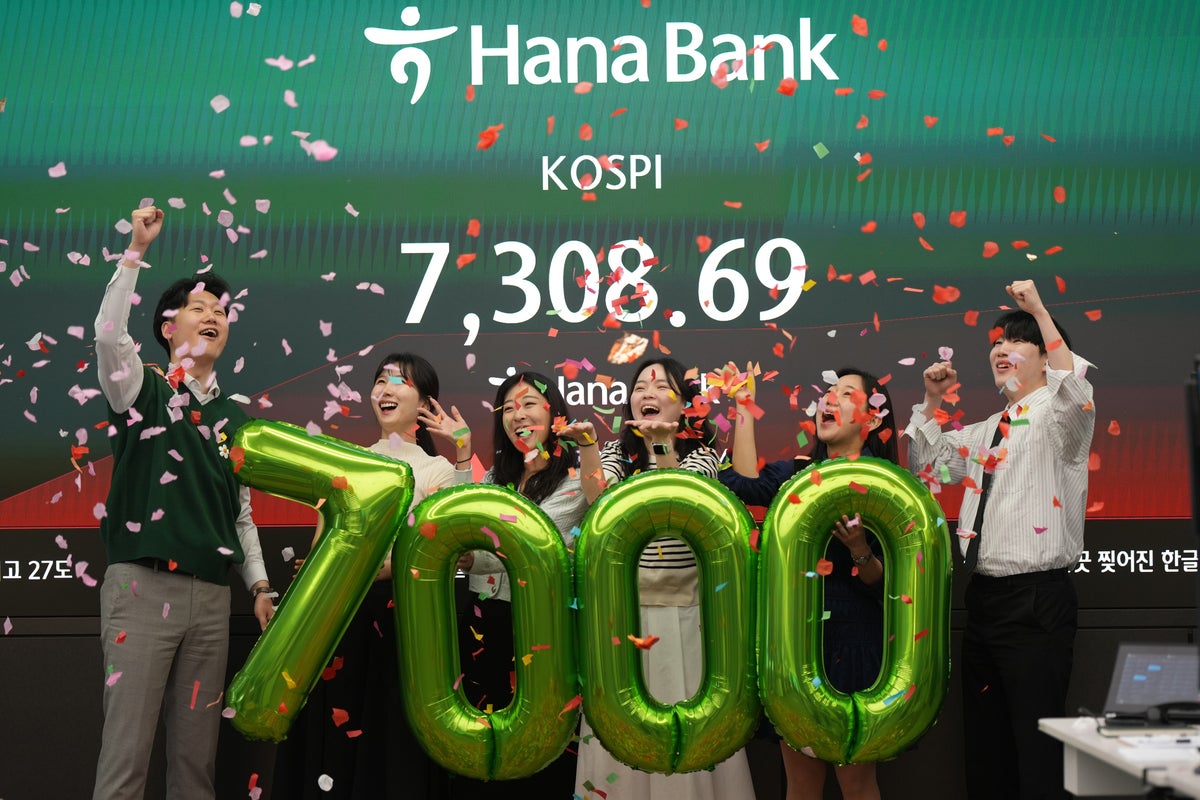
Oil prices fell and Asian stock markets surged to record highs on Wednesday after Donald Trump said negotiations with Iran were making “great progress” toward a final agreement and announced a brief pause in US operations escorting ships through the Strait of Hormuz.
Brent crude tumbled 1.2 per cent to $108.51 a barrel, still well above its roughly $70 price before the war began, but lower than the highs of recent weeks.
Wall Street had already set records on Tuesday, with the S&P 500 rising 0.8 per cent to a new all-time high and the Nasdaq gaining 1 per cent, as oil pulled back sharply after briefly crossing $115 on Monday.
Strong corporate earnings underpinned the Wall Street rally. DuPont surged 8.4 per cent after the chemical giant reported better-than-expected first-quarter profits and raised its full-year forecasts, even as it acknowledged some impact from logistics disruptions in the Middle East.
Pinterest jumped 6.9 per cent after its number of active monthly users rose 11 per cent to 631 million, beating Wall Street’s sales and profit targets. AB InBev climbed 8.7 per cent after topping profit forecasts on growth for its Corona, Stella Artois and Michelob Ultra brands. “Cheers to beer,” chief executive Michel Doukeris said.
Palantir fell 6.9 per cent despite beating expectations, as its stock continued to struggle on worries about increased competition. American Electric Power rose 1.8 per cent and Cummins added 2.8 per cent after both reported stronger-than-expected results.
In Europe, markets were mixed. The CAC 40 rose 1.1 per cent in Paris while the FTSE 100 fell 1.4 per cent in London. Hong Kong’s Hang Seng fell 0.8 per cent. Many Asian markets were closed for holidays.
The momentum carried into Asia on Wednesday, where MSCI‘s broadest index of Asia-Pacific shares outside Japan jumped 2.3 per cent to a fresh all-time high. South Korea’s Kospi surged 5.1 per cent, clearing the 7,000 mark for the first time, as Samsung Electronics jumped 12 per cent and crossed a $1 trillion market valuation, overtaking Berkshire Hathaway.
The AI trade drove much of the enthusiasm. Advanced Micro Devices jumped 16.5 per cent in extended trading after forecasting second-quarter revenue above Wall Street expectations on strong demand from cloud computing companies accelerating spending on AI infrastructure.
“Due to the capital expenditure we are seeing from hyperscalers in the US, the earnings growth trajectory for sectors such as semiconductors, tech hardware, industrials and materials in Asia exceeds anything I have seen in a long time,” Rushil Khanna, head of equity investments for Asia at Ostrum, an affiliate of Natixis Investment Managers, told Reuters. “This capex is leading to material value creation in Asia as the provider of the picks and shovels to the AI ecosystem.”
The diplomatic backdrop of US-Iran talks also helped the markets. Mr Trump said he would briefly pause US operations escorting ships through the strait, which has been effectively closed since Iran blockaded it in late February, triggering a global energy shock. US defence secretary Pete Hegseth confirmed the ceasefire remained in place despite the US and Iran exchanging fire the previous day.
“Markets embraced a sense of calm and stability overnight, with the risk of escalation in the Middle East conflict viewed as having diminished,” analysts from Westpac wrote in a note.
Despite the optimism, analysts cautioned that significant uncertainties remained this week.
“A fragile ceasefire, a novel blockade, Friday’s NFP and diminishing odds of a US-Iran peace deal are all converging this week,” said Lukman Otunuga, head of market research at trading broker FXTM.
“Gold may find itself on the losing end of conflict-induced inflation fears, even as uncertainty grips markets.”
Gold rose 1.2 per cent to $4,609.59. The dollar index slipped 0.1 per cent, snapping a three-day winning streak, with the euro rising to $1.1724 and sterling to $1.3577.
The Australian dollar climbed 0.6 per cent to its highest since June 2022, buoyed by improved risk appetite and underpinned by a third consecutive interest rate rise from the Reserve Bank of Australia, which cited the Middle East conflict’s impact on fuel and commodity prices. The ten-year US Treasury yield held flat at 4.424 per cent.

Josh D’Amaro, chairman of Disney Experiences, speaks during the grand opening ceremony of Shanghai Disney Resort’s Zootopia-themed land on December 19, 2023 in Shanghai, China.
Vcg | Visual China Group | Getty Images
Disney will release its fiscal second-quarter results before the bell Wednesday. It will mark the first earnings call led by Josh D’Amaro since the former parks executive took over as CEO in March.
Under the new CEO, who replaced Bob Iger after his two turns at the helm totaling roughly 20 years, Disney has already been through a round of layoffs and has faced mounting political pressure surrounding its late night TV host Jimmy Kimmel.
“This earnings call marks Disney’s first real gut‑check under D’Amaro’s leadership, and a test of how his theme‑parks roots translate, or don’t, into the rest of the business,” said Mike Proulx, research director at Forrester. “Streaming is still the main event, but the market is consolidating. A potential combination of Paramount+ and HBO Max would reset the competitive calculus for Disney+.”
Streaming and TV results have gobbled up much of the focus for media investors across the board as the industry faces significant upheaval and consolidation.
Here’s how Disney is expected to perform in its fiscal second quarter, according to LSEG:
- Earnings per share: $1.49 expected
- Revenue: $24.78 billion expected
Last quarter Disney stopped reporting some details for the entertainment segment — which is comprised of its traditional TV, streaming and theatrical releases — including the breakdown of revenue and operating income for each segment. The company has also stopped reporting quarterly streaming subscriber numbers.
The consumer shift from pay TV bundles to streaming has weighed on media companies for years, with both distribution and advertising profits continuously decreasing. Still, traditional TV remains a cash cow, and investors have been keen to see how and when streaming can make up for the declines.
Updates on the state of Disney’s theme parks, which are part of its experiences unit and the profit driver of the company, will also be of particular interest on Wednesday.
In February, Disney provided second-quarter guidance that called for “modest” growth in operating income for the experiences division due to international visitation headwinds at domestic parks. That forecast was issued before the U.S. and Israel launched attacks on Iran roughly two months ago, causing a surge in oil prices.
This story is developing. Please check back for updates.

UK services industry faces ‘short-lived’ rebound as costs rise sharply

Moody’s raises Vietnam’s outlook to ‘positive’ from ‘stable’

Motorbikes, buses, rickshaws to use designated lanes on Karachi’s Sharea Faisal or face fines

A Brain Implant for Depression Is About to Be Tested in Humans

Pro wrestling star Steph De Lander reveals how colleague’s advice helped lead her to title triumph at ACW

‘I had £20,000 stolen and had to fight a 13-month fraud reporting rule to get it back’

-
 Tech1 week ago
A Brain Implant for Depression Is About to Be Tested in Humans
-
 Sports1 week ago
Pro wrestling star Steph De Lander reveals how colleague’s advice helped lead her to title triumph at ACW
-
Business1 week ago
‘I had £20,000 stolen and had to fight a 13-month fraud reporting rule to get it back’
-

 Entertainment1 week ago
Norway joins Type 26 Frigate Programme to boost NATO naval power
-

 Entertainment1 week ago
Melania Trump says ABC should ‘take a stand’ on late-night host Kimmel
-

 Tech1 week ago
Are tech leaders risking a cyber resourcing crisis? | Computer Weekly
-
 Business6 days ago
PSX plunges over 4,800 points | The Express Tribune
-
 Business1 week ago
Starmer says ‘tide could be turning’ on shoplifting epidemic